Introduction
WHOIS data redacted by registrars and registries presents fundamental challenges for engineers developing domain management, security, and compliance systems. Unlike fixed-format protocol responses, redaction policies vary widely across top-level domains (TLDs) and regulatory regimes such as the GDPR, obscuring essential ownership details including registrant name, email, and phone number. This uneven redaction complicates automated parsing, domain verification, threat intelligence, and abuse mitigation workflows that depend on reliable WHOIS metadata for accuracy and trustworthiness.
The inherent trade-off between transparency and privacy results in the masking or proxying of many personal fields, while operational metadata—registration timestamps, registrar identifiers, and DNS delegation information—remain largely public for essential governance. Understanding precisely which WHOIS fields are redacted, and distinguishing regulatory-mandated redaction from privacy service proxying, is crucial for designing domain intelligence systems that operate decisively without false negatives or information leakage. This article analyzes the technical mechanisms and regulatory drivers behind WHOIS data redaction, explores variability across registrars, registries, and TLDs, and presents practical engineering approaches to glean actionable data despite pervasive privacy constraints.
Understanding WHOIS Data Redaction
What WHOIS Data Is Typically Redacted and What Remains Public
WHOIS was originally conceived as a straightforward directory listing domain registration data but has evolved under pressure from privacy legislation, security needs, and operational requirements. For software engineers and domain professionals, comprehending which WHOIS fields are redacted and which survive in public records is central to integrating domain management tools, automating compliance checks, and performing security analyses with high fidelity.
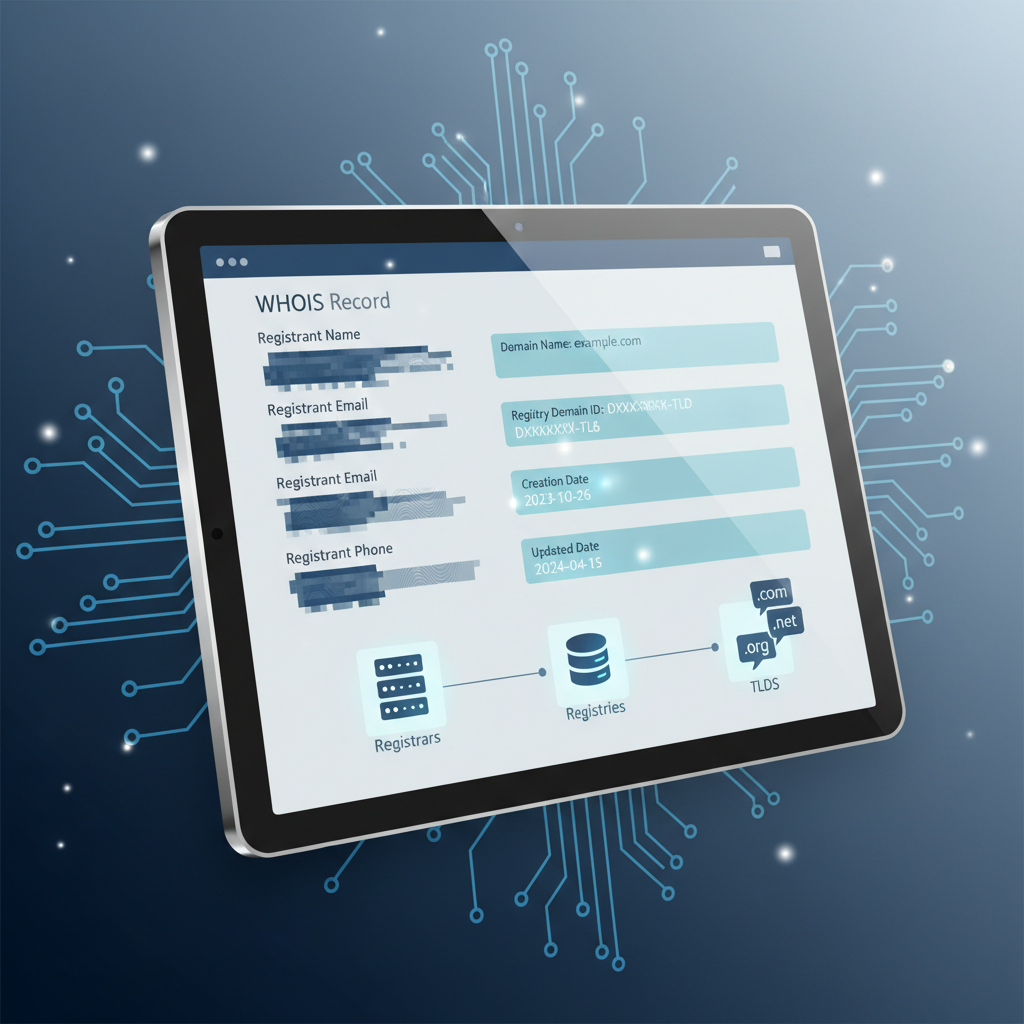
At its core, WHOIS records combine personally identifiable information (PII) tied to the registrant with operational metadata required for network governance and domain lifecycle transparency. WHOIS data redaction refers to selectively masking or removing PII fields in public WHOIS responses, while preserving technical and operational data necessary for service continuity.
Redacted Fields: Registrant PII and Contact Information
The fields most commonly redacted correspond to personal data that identifies registrants directly or indirectly. These usually include:
- Registrant’s Full Name: Reveals ownership identity, whether individual or organization.
- Postal Address: Physical contact location including street, city, state/province, postal code, and country.
- Telephone Number: Direct voice contact numbers exposing personal or business reachability.
- Email Address: A prime privacy vector because it enables unsolicited spam and phishing attacks.
Redaction is driven primarily by regulatory compliance (e.g., GDPR), which mandates minimization of publicly exposed personal data. Technical implementations vary: registries or registrars invoke redaction by either blanking those fields in WHOIS responses or substituting anonymized proxy contact details provided by privacy services.
For example, an email may be replaced with a persistent proxy address like [email protected] that forwards communications while shielding the actual registrant’s identity. This masking commonly occurs within the WHOIS server software operated by the registrar or registry at query response time. Some registries embed these redaction mechanisms within their RDAP servers, dynamically applying nuanced policies based on request origin or authenticated user privileges. IETF RFC 7483 provides an in-depth specification of RDAP’s enhancements over traditional WHOIS, including privacy-aware access.
Publicly Visible Fields: Operational and Delegation Metadata
Despite extensive redaction of PII, key operational metadata remain publicly accessible to serve domain governance, security monitoring, and troubleshooting requirements. Typical visible data includes:
- Domain Creation, Expiration, and Last Update Timestamps: Critical for lifecycle management and renewal auditing.
- Registrar Name and IANA ID: Identifies the registrar responsible for domain registration, essential for accountability, dispute resolution, and interfacing.
- Name Servers: Reveals DNS delegation endpoints enabling actual domain name resolution and DNS troubleshooting.
- Domain Status Codes: RFC-defined flags indicating domain states (e.g.,
clientTransferProhibited,pendingDelete), conveying domain lifecycle or registrar-imposed locks helpful in automated monitoring. - DNSSEC Status: Shows if Domain Name System Security Extensions are enabled, a measure of DNS integrity and trustworthiness.
- Registrar Abuse Contact Information: Enables reporting of abusive registrations such as phishing or malware hosting.
Retaining these fields balances transparency with privacy, ensuring that critical operational data are available to registries, registrars, users, and security operators without compromising personal registrant information. ICANN’s Domain Status Codes documentation is a key resource for understanding domain lifecycle flags.
Variation Across Registrars and Registries
The extent and method of WHOIS redaction differ substantially by registrar, registry, and TLD policies. Some gTLD registries enforce strong GDPR-compliant redactions, masking nearly all registrant PII, whereas ccTLD registries implement jurisdiction-specific policies with diverse redaction regimes.
For example, Verisign’s .com registry applies redaction following ICANN’s temporary GDPR specification, routinely masking registrant contacts for EU residents and sometimes globally. By contrast, ccTLDs like .uk or .ca may allow more granular exposure of registrant data depending on local laws and registry contracts.
Registrars also influence visibility through domain privacy services: a domain with a paid domain WHOIS privacy subscription often displays proxy contact details instead of real registrant information, while domains relying solely on mandated redactions may show redacted placeholders or empty values.
This distinction matters significantly for tooling. Redaction selectively removes PII but preserves lifecycle and delegation metadata, allowing partial but limited audits, security analysis, or asset tracking. Conversely, domain privacy WHOIS services fully proxy registrant data, complicating ownership validation and abuse response workflows due to the absence of direct owner contact info.
Typical WHOIS Query Response Flow with Redaction
To illustrate:
- A client issues a WHOIS query for a domain.
- The WHOIS server inspects TLD policies and registrant privacy subscription status.
- Personal data fields (name, email, phone, postal address) are masked or replaced by proxy data accordingly.
- Operational metadata (registration dates, status codes, name servers) are returned transparently.
- The client receives and processes a WHOIS response exposing technical metadata but obfuscated or proxied registrant contacts.
This process balances data privacy against operational transparency, preserving essential domain context needed for domain lifecycle engineering and network management while protecting personal privacy.
Common Reasons for WHOIS Data Redaction
Privacy and Security Regulations Driving Redaction
The most transformative factor in WHOIS redaction has been the emergence of comprehensive privacy laws, foremost the European Union’s GDPR. GDPR places strict limits on processing personal data, requiring explicit consent for public disclosure.
Registrars and registries handling domains registered by EU residents or operating under EU jurisdiction must therefore redact PII from WHOIS records, effectively turning WHOIS from a fully open directory into a redacted, limited-access service.
Technically, registrars embed data suppression mechanisms in their WHOIS and RDAP servers, dynamically masking registrant fields upon lookup. Registries must enforce redaction rules according to contractual obligations with ICANN and relevant local laws.
Additional data protection statutes like California’s CCPA and Brazil’s LGPD mandate similar privacy requirements, creating a global patchwork requiring domain operators to adjust redaction scope dynamically based on registrant location, registrant consent, and TLD policy.
Operational Trade-Offs: Transparency Versus Privacy
Balancing domain ownership transparency with registrant privacy is a nuanced engineering and regulatory challenge. Historically, WHOIS data served critical business and security purposes: abuse mitigation, trademark enforcement, domain transfer verification, and DNS issue resolution.
- Abuse Handling: Proxy or anonymized contacts hinder timely responses to phishing, malware hosting, or spam complaints.
- Trademark and Legal Enforcement: Diminished access to registrant information complicates domain dispute resolutions.
- Domain Transfers and Ownership Validation: WHOIS-based authentication is impaired, necessitating alternative identity verification methods.
In response, many registrars deploy domain privacy WHOIS services that replace personal data with proxy contacts, maintaining contactability while hiding true ownership. This model improves privacy but demands robust abuse handling workflows and enhanced registrar cooperation.
Some registries further implement tiered WHOIS/RDAP access, providing granular data to authenticated parties such as law enforcement or intellectual property representatives—effectively a controlled-access model balancing privacy with operational necessity.
Jurisdiction and Registry-Specific Implementation Variance
Not all registries apply WHOIS redaction identically. European ccTLDs often default to aggressive redaction or full privacy-by-design approaches. Other ccTLDs with more permissive data regimes allow broader public access to registrant data.
For example, .de aggressively redacts personal data, exposing minimal registrant information. Conversely, .us has traditionally published fuller registrant data unless privacy is specifically requested.
These variances require domain managers, security engineers, and compliance teams to customize toolchains to each TLD’s privacy landscape, applying adaptive parsing rules, proxy detection, or alternate data sourcing to maintain accurate ownership and risk insights.
Supplementing Redaction with WHOIS Privacy Services
WHOIS privacy services complement mandated redaction by offering layered privacy through full proxy substitutions. Rather than blanking fields, these services:
- Substitute registrant contact fields with proxy email, phone, and mailing addresses.
- Forward inbound messages, acting as gatekeepers to the true registrant.
- Offer seamless privacy with functional contact points but at the cost of complicating abuse and ownership verification.
From an engineering perspective, these proxy layers add indirection requiring integration with privacy service APIs, expanded abuse escalation paths, or alternative ownership corroboration methods.
Real-World Implications and Adaptive Tooling Needs
For domain infrastructure operators, security analysts, and compliance engineers, the reality of WHOIS data redacted environments mandates adaptive data acquisition and processing strategies:
- Query systems must gracefully handle missing or proxyed registrant data without breaking workflows.
- Tools enrich redacted WHOIS with RDAP structured data, WHOIS history, and registry zone files for completeness.
- Automated abuse detection pipelines require fallback sources—DNS analytics, registrar transparency reports, or third-party repositories—to supplement incomplete WHOIS data.
- Domain management platforms must incorporate privacy-aware parsing, error handling, and verification routines attuned to evolving privacy regimes.
Alternative access mechanisms like RDAP offer more granular, tiered data retrieval, permitting authorized users deeper visibility. WHOIS history archives—storing prior public snapshots—further mitigate current redaction opacity by revealing pre-redaction registrant states.
By mastering the interplay of redaction mechanics and regulatory motives, engineers can architect resilient, privacy-compliant systems that navigate opaque WHOIS landscapes without undermining security or operational visibility.
Variability of WHOIS Data Redaction Across Registrars, Registries, and TLDs
Expanding from fundamental definitions, the next domain involves dissecting how variability in WHOIS data redaction manifests across registrars, registries, and domain extensions—critical to building adaptive, scalable systems for domain intelligence that operate reliably despite non-uniform data landscapes.
Redaction Differences by Registrar and Registry Policies
WHOIS redaction outcomes diverge notably due to variation in registrar and registry policy interpretations, regulatory compliance approaches, and technical enforcement mechanisms.
Policy Implementation Variance at Registrar LevelRegistrars serve as the critical interface between registrants and domain infrastructure, and their privacy enforcement strategies significantly influence WHOIS redaction granularity.
Some registrars adopt a stringent privacy posture, blanking all PII fields under GDPR mandates, including name, email, address, and phone. Others implement selective masking, preserving certain non-sensitive fields like country codes or phone numbers to aid communications or verification.
These disparities arise from different readings of GDPR, CCPA, or emerging privacy laws, as well as varying contract terms between registrars and registries. For example, Namecheap’s domain privacy service offers layered opt-in controls allowing granular privacy settings, whereas GoDaddy’s WHOIS privacy commonly replaces all registrant data with proxies, maximizing anonymity but complicating abuse workflows.
Registrar Privacy Options and Service ModelsPrivacy services may be opt-in or default purchased features depending on registrar business models. Full proxy redaction entails operational overhead: forwarding email, abuse reporting, compliance tracking, and customer support. Partial redaction offers simpler implementation but risks inadvertent PII exposure or confusing users.
Operational risk mitigation and customer trust demand balancing privacy guarantees with responsiveness and abuse mitigation efficiency. Domains even within a single TLD can manifest radically different WHOIS visibility based on registrar privacy implementations.
Registry-Level ConstraintsRegistries define baseline WHOIS publication policies via ICANN agreements or national law. Generic registries for gTLDs mandate GDPR-aligned redactions but delegate enforcement granularity to registrars. ccTLD registries like .de or .fr impose strict full redaction of contact details at the registry level.
Registry WHOIS or RDAP servers tightly enforce these mandates in their live queries. Registries with lax policies or operating under looser privacy regimes leave redaction decisions primarily to registrars, exemplified by .io or .me registries, which often publish full registrant data openly.
This layered enforcement produces unpredictable data fidelity across domains. Automated tools must implement registrar- or registry-specific logic to detect and extract registrant or technical contact data accurately. Failing to do so risks false negatives in abuse detection or domain dispute case workflows.
Some third-party services address this disparity through aggregation, historical data stitching, or registrar API integration; however, instantaneous WHOIS queries remain inconsistently informative globally.
Domain Privacy Protection Worthiness and Operational ConsiderationsPaid privacy services’ effectiveness depends on registrar infrastructure robustness. Providers like GoDaddy or Namecheap deliver full redaction with forwarding services but incur complex operational demands. Less capable registrars may partially redact, diminishing privacy impact and increasing risk exposure.
Effective privacy provisioning must balance legal compliance, customer confidentiality, service overhead, and abuse response capabilities, demonstrating the technical and operational complexity in delivering transparent yet private domain registration data.
This nuanced registrar-to-registry variation frames the subsequent discussion of how these differences proliferate across TLD categories under distinct regulatory and operational regimes.
WHOIS Data Redaction Variations Across Different TLDs
Transitioning from registrar-registry policy heterogeneity, an examination of TLD-specific redaction patterns reveals how jurisdictional laws, ICANN governance, and registry mandates shape the WHOIS data access landscape.
TLD-Specific Redaction PracticesGeneric TLDs (gTLDs) such as .com, .org, and .net conform predominantly to ICANN’s Temporary Specification on GDPR enforcement, mandating comprehensive redaction of PII for EU registrants and sometimes all registrants based on jurisdiction. Global registries like Verisign or PIR generally delegate redaction mechanics to registrars within these guidelines.
Country-code TLDs (ccTLDs) enforce more localized policies. The .de registry mandates full registrant PII redaction by default, exposing only technical contacts. The .uk registry publishes fuller registrant data unless explicitly protected, while .jp or .au maintain hybrid approaches reflecting national privacy laws.
GDPR imposed landmark privacy norms compelling registrars and registries servicing EU registrants to reduce public WHOIS PII exposure drastically. This led ICANN to suspend public availability of some contact fields, pushing privacy service adoption.
In contrast, TLDs in regions absent comprehensive privacy laws—many African or Asian ccTLDs—often continue publishing extensive registrant data publicly, although this is evolving in some jurisdictions.
Examples of Contrasting TLD BehaviorFrance’s .fr registry enforces automatic PII redaction, revealing only generic contacts in public WHOIS. Meanwhile, the .us registry historically publishes registrant information openly unless privacy service opt-in is activated.
Some registries apply geolocation- or IP-address-based conditional redaction, restricting data returned depending on request source’s jurisdiction privacy expectations, further complicating uniform domain data access globally.
Technical and Operational ImplicationsFor domain intelligence engineers, TLD-dependent redaction demands parsers and normalization layers tailored to each registry’s format and masking approach, accommodating missing, proxy, or obfuscated fields gracefully. Security threat analysis must consider increased uncertainty in ownership attribution where registrant PII is masked or withheld.
Operations teams rely heavily on supplemental data—WHOIS history, passive DNS, certificate transparency logs—to close gaps left by redaction. Proprietary aggregated WHOIS APIs sometimes deliver curated data with lower redaction, but cost and compliance concerns persist.
Domain WHOIS Privacy Service InteractionsPrivate registration services introduced by registrars add a second redaction dimension by fully proxying all ownership data beyond registry mandates. These services mask ownership behind proxy contacts, ensuring privacy but complicating direct access.
This layered redaction results in complex privacy ecosystems composed of registry-directed masking plus optional proxy substitution, varying by TLD and registrar capabilities. Not all TLDs permit privacy proxies; some forbid them, forcing reliance solely on mandated redaction.
Together, the multi-tier registrar-registry-TLD redaction ecosystem demands domain intelligence workflows be modular, adaptive, and cognizant of layered privacy filters to maintain accurate, compliant, and effective domain data operations.
For a detailed protocol-level technical foundation, see IETF RFC 7482 on Registration Data Access Protocol (RDAP), which outlines modern WHOIS data querying standards with built-in privacy and tiered access support.
WHOIS Privacy Services Versus True Data Redaction
Mechanics of WHOIS Privacy Services
Building upon the landscape of redaction variability, it is essential to clarify the functional and technical distinctions between WHOIS privacy services and regulatory WHOIS data redaction, which represent fundamentally different privacy approaches in domain data management.
WHOIS privacy services operate by substituting the registrant’s genuine personal or organizational data (name, address, telephone, email) with proxy or generic contact details maintained by the privacy service provider. Registrars update WHOIS records dynamically or periodically with these substitutes so that queries return anonymized details. The privacy provider acts as an intermediary, forwarding communications and abuse reports to the rightful owner, thereby preserving a contact mechanism while obscuring ownership identity.
In contrast, mandated WHOIS data redaction—principally driven by GDPR and similar laws—requires suppressing or masking PII fields entirely in WHOIS and RDAP responses, not substituting data but omitting or blanking out personal identifiers. This redaction is usually implemented within the registry or registrar WHOIS server software or RDAP endpoints, applying policy-based filtering dynamically. For example, registrant name, telephone, email, and address may be replaced with static placeholders like “REDACTED FOR PRIVACY” or removed outright.
This difference has profound technical implications downstream. Privacy services provide consistent, syntactically valid contact fields that automated parsers can consume, though they do not expose true owner data and require proxy detection mechanisms. In contrast, data redaction results in missing or nullified fields that challenge automated validation and ownership verification processes, often requiring alternate inference methods or fallback data sources.
Privacy service implementations vary by registrar and TLD. Namecheap’s service replaces registrant data consistently with proxies, enabling seamless anonymity with minimal parser disruption. GoDaddy’s privacy services employ tiered proxying and forwarding that may or may not align perfectly with registry-level redaction, producing complex data layering.
Some registries independently enforce registry-level redaction separate from registrar privacy services, potentially creating “proxy-on-proxy” scenarios where multiple forwarding layers obscure true ownership, considerably complicating attribution and abuse workflows.
For security teams, malware researchers, and domain operations, distinguishing privacy-enabled proxy contacts from mandated redaction is critical since privacy services maintain abuse and communication channels, while redacted-only records often do not. Addressing these distinctions in domain data models and verification pipelines is essential to maintain operational accuracy and effective abuse management.
Advantages and Limitations of WHOIS Privacy Services
Examining the trade-offs provides a clearer picture of how privacy services complement or diverge from mandated redaction:
- Privacy services enhance registrant anonymity by substituting real personal data with actively managed proxy contacts that remain reachable. This affords registrants a contact buffer that facilitates legitimate communication, reduces spam risk, and supports a degree of interactive transparency because proxy contacts can forward queries to owners.
- However, these services obscure verifiable domain ownership, complicating due diligence, intellectual property enforcement, and domain transfer validation by dissociating the domain from the true registrant in public data. The proxy contacts may be automated, nonresponsive, or outsourced, reducing reliability of abuse contacts and increasing incident response complexity.
- Conversely, mandated WHOIS data redaction removes fields entirely, prioritizing privacy and legal compliance but eliminating even proxy contact points in some cases. While this approach protects personal data rigorously, it strains operational processes dependent on WHOIS queries for ownership verification, incident response, or legal discovery. Supplemental disclosure typically requires registry or legal process involvement, reducing transparency.
In high-risk scenarios such as cybersecurity consulting, whistleblowing, or sensitive infrastructure registrations, privacy services allow registrants to adjust privacy settings or proxy endpoints, offering flexibility and selective concealment beyond statutory minimums. Redaction mandates tend to be automated, permanent, and non-negotiable, ensuring baseline privacy but no customization.
Operationally, privacy effectiveness hinges on registrar and registry cooperation, service-level capabilities, and geographic scope. Unlike redaction policies that operate indiscriminately, privacy services are often optional, configurable, and may not be available for all TLDs or registrars. Some ccTLDs prohibit privacy proxies entirely, relying solely on mandatory data redaction, which affects overall privacy posture.
System architects integrating WHOIS data must support the dual realities of proxy substitution and mandated redaction, adopting tiered data validation models and establishing fallback channels such as abuse reporting APIs or registry escalation pathways. Domain lifecycle management similarly requires handling privacy toggling, proxy forwarding configurations, and compliance auditing for shifting privacy requirements.
Understanding these differences is foundational for building domain data pipelines that respect privacy, ensure compliance, and maintain operational continuity in domain security, ownership verification, and infrastructure management contexts.
Techniques to Access Useful WHOIS Data Despite Redaction
Given the increasing norm of WHOIS data redaction driven by global privacy laws and diverse registrar practices, engineers building domain intelligence, cybersecurity, or compliance tooling must adopt sophisticated strategies for obtaining actionable ownership and registration information from incomplete, obscured, or proxied datasets.
Leveraging WHOIS History and Archival Data
A pivotal approach to overcoming contemporary WHOIS redaction involves exploiting historical WHOIS records. Before GDPR and similar privacy statutes were widely applied, WHOIS responses were far richer in registrant details. Many archival services and third-party providers preserve these historical snapshots, enabling retrospective recovery of registrant identities now masked or replaced.
Central repositories like DomainTools Historical WHOIS, SecurityTrails, and various ICANN archival platforms offer indexed, time-series WHOIS data. Querying these enables engineers to correlate past registrant information with current domain states, effectively bypassing present-day redaction. This is particularly useful for domains with long registration histories or infrequent ownership changes, providing a temporal fingerprint.
Effective use of historical data requires sophisticated correlation methods linking stable metadata elements—domain creation and update timestamps, registrar identifiers, and DNS server information—across current and archival records. These anchors allow probabilistic reconstruction of domain ownership trajectories even when key PII fields are currently redacted. ICANN’s Whois Accuracy Program Specification details the technical underpinnings and accuracy considerations relevant here.
Limitations remain, including the potential retroactive obfuscation or redaction of historical WHOIS snapshots, incomplete archival coverage, and staleness issues when ownership transfers occur post-archival. Systems must embed heuristics to assess data freshness and flag suspect stale information.
In practice, incident responders, fraud analysts, and brand enforcement teams integrate WHOIS history to enrich investigation fidelity, attribute malicious infrastructure, and map DNS ecosystems, offsetting real-time data opacity from redacted or privacy-protected WHOIS. This strategy demands integrating WHOIS archives within domain intelligence architectures to sustain depth and accuracy.
Automated Parsing and Verification Workarounds
Although WHOIS redaction reduces data richness, responses are not uniform; they entail significant variability according to registrar, registry mandates, and TLD-specific policies. Building scalable, accurate domain intelligence requires robust parsers and verification systems engineered to absorb noise, proxy substitutions, missing fields, and format deviations without generating misleading ownership assignments or false alarm rates.
Parsing logic must identify and handle registrar- or privacy service-induced pattern changes, such as missing emails or proxy email placeholders ([email protected]). Parsers benefit from heuristic modules trained to detect canonical proxy signatures—email suffix patterns, anonymity banners, placeholder strings—to tag data as proxy and avoid incorrect trust assumptions.
Context-aware parsing is essential. Parsing expectations should adapt dynamically based on the TLD or registrar involved, as WHOIS response formats and field availability differ even across major gTLDs (.com vs. .net) or newer TLDs. Modular parsers enabling toggled field interpretation increase resilience and reduce false negatives from rigid schema assumptions.
Complementing heuristics, extraction of stable, non-redacted metadata such as registration dates, registrar names, and nameserver records enables partial verification or behavioral anomaly detection. Correlating this metadata with DNS records or TLS certificate transparency logs enriches domain profiling beyond WHOIS. For example, certificate transparency data can reveal subdomain ownership and indirect registrant ties, aiding attribution despite privacy masking (Cloudflare blog on certificate transparency).
Cross-validating parsed WHOIS data with external data sources and passive DNS ensures higher confidence in ownership attribution or threat detection. Fuzzy matching or probabilistic algorithms operating on combined metadata fields allow inferring ownership continuity or changes despite partial data visibility.
Automated systems benefit from human-in-the-loop triage workflows where ambiguous or discordant WHOIS results trigger manual review, balancing scale with accuracy in high-stakes environments.
Domain privacy proxies and layered privacy services complicate parsing by adding chaining layers and cross-registrar indirection. Detection of proxy hierarchy and distinguishing policy-enforced redaction from proxy substitution is fundamental to prevent misinterpretation of WHOIS data during verification workflows.
Where registrars deploy consistent privacy proxies (e.g., Namecheap, GoDaddy), integration with their APIs or abuse portals can improve contactability and abuse response fidelity. This methodological approach contrasts with partial or inconsistent TLD policies, which yield fragmented and less predictable WHOIS data conditions.
In sum, resilient WHOIS parsing in redacted ecosystems requires modular design, layered inference combining WHOIS plus ancillary telemetry, proxy signature detection, and fallback human review, ensuring operational robustness amid evolving privacy constraints.
Together, leveraging historical archives and engineering sophisticated parsing and verification pipelines constitutes an effective technical framework to recover and utilize useful domain registration data despite widespread, heterogeneous WHOIS redaction.
Key Takeaways
- WHOIS data redaction embodies a complex balance between maintaining domain ownership transparency and enforcing privacy compliance under regulations like GDPR. Engineers developing domain management, security, or compliance systems must deeply understand which WHOIS fields are obscured and how redaction varies across registrars, registries, and TLDs to implement accurate parsing, threat detection, and domain verification.
- WHOIS protocols do not standardize redaction; instead, it is policy-enforced at registrar or registry layers. Consequently, WHOIS query results vary significantly depending on domain TLD and registrar privacy implementations, challenging consistent automated data extraction.
- Regulatory mandates including GDPR enforce redaction of personal identifying fields such as registrant name, email, phone, and postal address, reducing direct visibility into domain ownership to protect personal privacy and prevent misuse.
- Public WHOIS data typically retains operational metadata—domain status codes, lifecycle timestamps, registrar details, and DNS delegation info—that support validation, troubleshooting, and dispute resolution without exposing PII.
- WHOIS privacy services replace registrant data with proxy contact information rather than blanking fields, preserving contactability but obscuring definitive ownership details; this creates trade-offs between anonymity and operational transparency affecting abuse tracking and ownership verification.
- Variation across registrars and TLDs in redaction scope and implementation introduces substantial complexity in normalizing WHOIS data; systems must incorporate registrar and registry-specific APIs, policies, and parsing heuristics to avoid false or missing ownership signals.
- Historical WHOIS archives and third-party databases serve as critical auxiliary resources for revealing obscured registrant details by providing temporal context, enhancing forensic investigations, albeit with API access cost and data freshness considerations.
- Redaction significantly impacts security tooling that relies on WHOIS metadata for reputation scoring and threat intelligence; effective risk assessment requires correlating WHOIS data with additional contextual sources and developing privacy-compliant inference models.
- Recognizing the distinction between private registration (proxying contact data) and mandated redaction (data omission) is key to accurate domain data modeling, ownership validation, and abuse investigation system design.
This layered understanding equips engineers with the foundational insight to architect domain management and security tools resilient to the inherent opacity of modern WHOIS data landscapes. Subsequent practical system designs must accommodate these nuances to maintain compliance, enforce domain governance, and enable actionable domain intelligence.
Conclusion
Navigating the evolving WHOIS data redaction ecosystem entails grappling with a complex overlay of regulatory mandates, registrar and registry policy variation, and technical implementations that collectively shape the domain privacy-transparency spectrum. For engineers and domain governance professionals, discriminating between regulatory-mandated data suppression and proxy-based privacy service substitution is essential to architecting resilient, privacy-compliant systems that operate correctly under partial or obscured ownership information.
The pronounced variability across TLDs, registrars, and registries compels tooling that adapts dynamically—merging real-time WHOIS and RDAP queries with historical archives, DNS telemetry, and supplemental metadata sources to maintain operational visibility and security assurance. As privacy regulations worldwide continue to evolve in stringency and reach, architecting modular, extensible domain ownership verification and abuse management frameworks that integrate multi-source verification and tiered access will become critical.
Ultimately, the enterprise-wide challenge lies in balancing competing demands: rigorous privacy compliance, robust security attribution, and operational transparency within an increasingly opaque WHOIS data environment. How teams design for observability, testability, and correctness at scale amidst shifting privacy constraints will define the future efficacy of domain data-dependent security, compliance, and governance infrastructures.