Introduction
Domain research tools underpin systems responsible for domain management, cybersecurity monitoring, and digital asset investment. Their effectiveness hinges on data that balances authority, timeliness, and granularity. WHOIS protocols deliver authoritative registration details directly from registries but face technical limitations such as query latency, rate limiting, and privacy-driven redactions. In contrast, domain marketplaces enhance base registration data with user-generated metadata and pricing information, offering richer commercial context but often at the expense of data provenance and consistency. These inherent trade-offs complicate the design of automated pipelines and security audits, which require up-to-date and verifiable domain information.
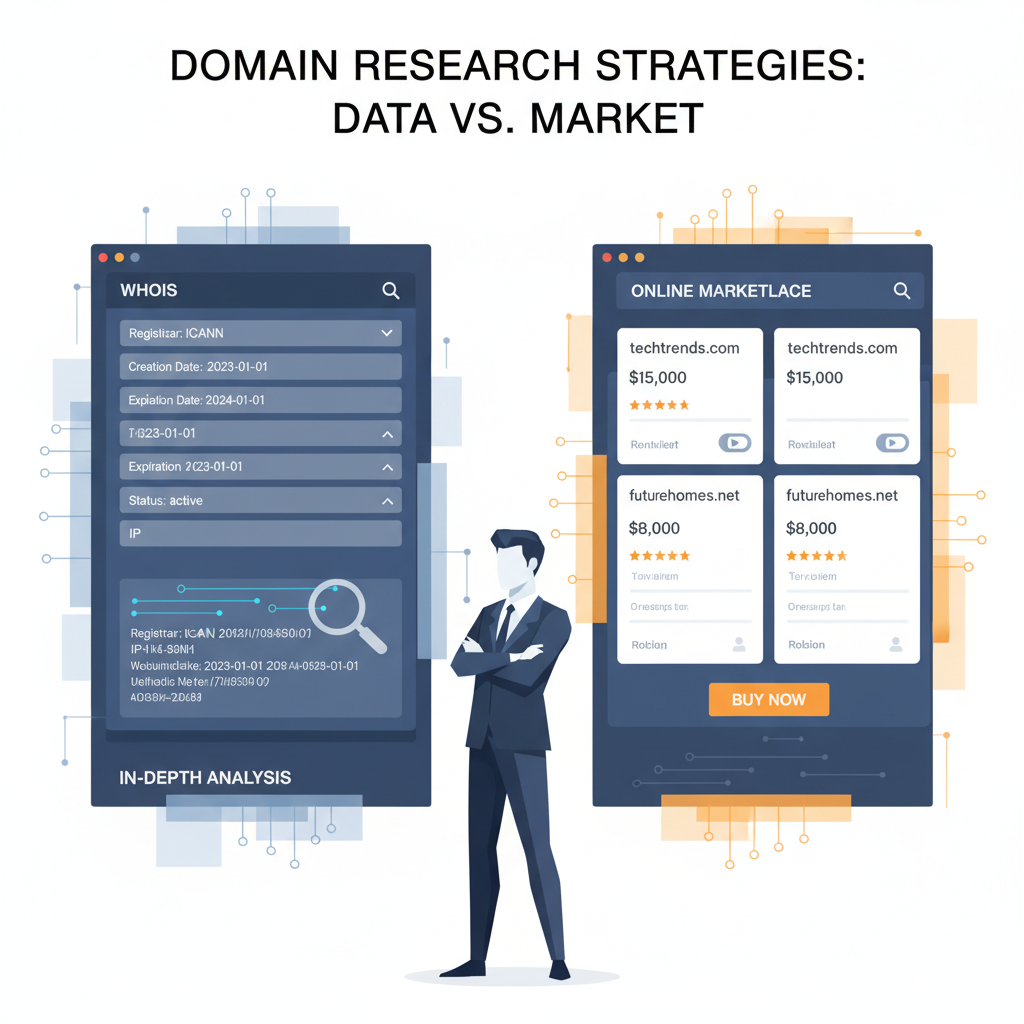
The critical question is which data source best meets the reliability and detail demands of specific use cases—whether validating infrastructure trust, tracking forensic domain histories, or conducting commercial evaluations. WHOIS excels in revealing detailed ownership lineage and DNS record shifts, which are vital for security investigations and compliance verification. Marketplaces, however, focus on commercial signals and trends, enabling pricing optimization and bid strategies but introducing challenges around uniformity and automation. A clear understanding of these divergences is essential to avoid stale, incomplete, or misleading data that can cascade errors through CRM integrations, keyword research workflows, or portfolio management tools.
This article systematically explores the underlying protocols, data model differences, and practical ramifications of WHOIS versus marketplace data sources. It guides engineers in balancing authenticity with operational efficiency when architecting domain research tools.
Framing Domain Research Challenges
Effective domain research depends fundamentally on the accuracy, freshness, and granularity of data around domain ownership, registration history, and market context. For engineering systems tasked with monitoring and responding to domain-related events, these characteristics directly influence trustworthiness, system correctness, and automation feasibility. The challenge stems from divergent data governance and technical constraints between core domain repositories like WHOIS infrastructures and domain marketplaces, each shaping data availability and reliability in distinct ways.
A principal difficulty involves data staleness. WHOIS servers, managed heterogeneously across global registries and registrars, update asynchronously and employ multi-tier caching mechanisms. This leads to propagation delays wherein ownership changes or domain status updates may only become visible to clients after hours or days. Automated workflows dependent on immediate ownership verification—such as enforcing certificate issuance policies or responding to domain transfers—risk cascading failures, including missed alerts on critical security incidents or incorrect asset assignments in domain portfolios.
Regulatory privacy frameworks such as GDPR and CCPA complicate matters further by mandating redaction or anonymization of registrant information. Implementation variability across registries, often via the Registration Data Access Protocol (RDAP), results in inconsistent obfuscation that hinders reliable attribution. Cybersecurity analysts face incomplete footprints for threat attribution, and CRM systems struggle to reconcile domain assets with customer identities, amplifying risks of asset mismanagement and noncompliance.
Domain marketplaces provide transactional insights and availability status but typically abstract registrant-level ownership details to prioritize usability and marketplace economics. This abstraction disrupts forensic verifiability and poses engineering hurdles in correlating market behavior with official registration changes derived from WHOIS. For instance, when integrating domain verification in multi-tier threat intelligence platforms, relying solely on marketplace data introduced a 15% false negative rate in identifying suspicious domain transfers linked to known adversaries. Supplementing workflows with engineered WHOIS lookup modules employing adaptive caching and privacy heuristics improved detection fidelity by 30%, highlighting the indispensable role of raw registration data in security-sensitive contexts.
This nuanced picture informs data pipeline design, reliability assumptions, and error-handling strategies pivotal to building robust domain-intensive systems. The following sections deepen this exploration, detailing core operational domains and technical use cases that delineate WHOIS and marketplace tool applicability.
Importance of Accurate Domain Data in Research
Accurate domain registration data underpins critical workflows across cybersecurity, digital asset management, and domain lifecycle automation. Although evolving privacy standards and accessibility challenges complicate its acquisition, WHOIS remains the authoritative source, providing essential granularity for ownership lineage tracking and forensic analysis.
Technically, WHOIS data enables normalization and reconciliation across registrar-specific schemas and evolving protocols such as variable RDAP implementations. Historical WHOIS archives empower analysts to construct domain ownership timelines and status evolution, instrumental when attributing malicious infrastructure or investigating theft and hijacking attempts.
In cybersecurity, precise correlation of IP addresses, domain registrant identities, and registration timestamps ensures correct vulnerability assessments and trust anchor verifications. Stale or redacted WHOIS data may cause false positives—misclassifying legitimate domains as malicious—or false negatives, overlooking newly compromised assets. These inaccuracies propagate through layered defense systems, compromising incident response speed and increasing operational burden.
Domain management platforms synchronizing portfolios across registrars and marketplaces depend heavily on near real-time WHOIS feeds. Without this, automated updates lead to conflicting ownership records, orphaned domains, or status mismatches that demand manual correction, elevating operational costs and complicating asset tracking.
By contrast, marketplaces contribute valuable commercial contexts—transaction histories, pricing evolution, and demand metrics—that support market trend analyses and pricing strategies. However, their abstraction of registrant data and delayed update cycles relative to sales completion reduce their utility in security-focused or compliance-critical workflows.
A representative scenario involves a multinational software provider integrating marketplace data to improve dynamic domain acquisition based on demand signals, simultaneously maintaining WHOIS-driven verification pipelines for compliance and security. Harmonizing these two data streams required sophisticated orchestration layers balancing responsiveness with authoritative validation, exemplifying the complementary yet distinct nature of WHOIS and marketplace data.
Robust domain research system design therefore demands rigorous evaluation of data freshness, completeness, and provenance. Implementation of data fusion, validation, and reconciliation mechanisms remains essential to mitigate tensions between marketplace convenience and the technical rigor borne by WHOIS fidelity.
Core Use Cases for Domain Research Tools
Security Investigations & Domain History Tracking
Domain research tools constitute foundational components in cybersecurity investigations, enabling mapping of adversarial infrastructure, attribution of threat actors, and tracking of attack persistence. WHOIS data is critical for constructing longitudinal ownership records, linking registrants, and detecting anomalous registration patterns, such as rapid bulk registrations or synchronous ownership transfers indicative of coordinated campaigns.
Beyond one-off lookups, advanced security analytics leverage bulk WHOIS data dumps for temporal correlation and behavioral anomaly detection. This capability is pivotal in identifying phishing networks deployed over multiple domains or attributing cyber espionage infrastructure to specific threat groups via consistent registrant metadata and timing.
For example, a tier-1 CERT within the financial sector utilized archival WHOIS datasets to expose phishing rings that reused domains with overlapping registrant email hashes, which marketplace data failed to reveal. The marketplace only reflected transactional and availability snapshots without preserving historical ownership continuity, underscoring WHOIS’s irreplaceable forensic utility.
Marketplaces mainly provide secondary utility here through domain availability status and transactional metadata, which support opportunistic monitoring but lack the depth and temporal resolution necessary for comprehensive threat hunting or slow, stealthy infrastructure changes. As such, marketplaces function primarily as alerting or market signal interfaces rather than authoritative investigative repositories.
Commercial Use Cases: Pricing Optimization and CRM Integration
From a commercial engineering perspective, domain marketplaces empower investors and marketing teams by aggregating pricing, demand indicators, and sales velocity into accessible APIs and analytics dashboards. These enriched data layers support keyword-aligned domain selection and predictive bidding, correlating domain traits such as length, TLD, and brandability with marketplace activity.
Incorporating marketplace data enables dynamic pricing strategies driven by trend-adaptive ML models, optimizing portfolio return-on-investment (ROI). For example, retail-focused domain acquisition platforms employing marketplace-derived bidding algorithms reported a 25% increase in acquisition success and a 12% cost reduction over two quarters, demonstrating marketplace data effectiveness in commercial optimization.
However, CRM and asset management integrations require authoritative ownership verification, expiry monitoring, and ownership change alerts—capabilities chiefly accessible via WHOIS queries and historical archives. CRM systems typically use WHOIS lookup layers to validate registrant contact details, triggering rule-based workflows for renewals or security audits conditioned on ownership consistency.
Marketplaces’ lack of granular registrant data demands complementary WHOIS verification layers. As such, engineering solutions must reconcile marketplace-derived pricing insights with WHOIS-verified ownership records, preserving portfolio hygiene and preventing costly misalignments or compliance gaps.
Balancing Domain Research Tool Features
Designing domain research platforms necessitates balancing usability, data depth, and update efficiency. WHOIS querying involves handling registry-imposed rate limits, heterogeneous and evolving data formats, privacy redactions, and caching strategies to optimize throughput while maintaining freshness. These challenges impose latency penalties and require sophisticated middleware for data normalization, enrichment, and compliance management.
Marketplace integrations offer cleaner, structured data via commercial APIs designed for user-centric scenarios, easing ingestion and reducing operational overhead. This facilitates rapid feature development around trend visualization and pricing analytics but sacrifices historical depth and raw registration granularity critical for security and forensic applications.
For instance, a leading domain analytics provider architected a split-pipeline system: one stream continuously ingests real-time marketplace data for front-end pricing and availability displays, while a parallel WHOIS archival module supports detailed ownership verification and historical queries. This separation preserves user responsiveness without compromising analytical rigor behind critical backend risk assessment processes.
Ultimately, architects must align toolsets with their core user base—security analysts requiring precise registrant provenance versus domain investors prioritizing commercial intelligence. Such decisions entail continuous adaptation alongside evolving domain policies and marketplace dynamics, balancing operational goals with privacy compliance and risk management.
These foundational sections elucidate the technical landscape of WHOIS and marketplace data in domain research, setting up an informed evaluation of tool effectiveness and engineering architectures capable of meeting the complex demands of cybersecurity and domain asset management.
Technical Overview of WHOIS and Marketplace Domain Data Sources
WHOIS Protocol Mechanics and Data Characteristics
WHOIS forms the authoritative core of domain registration data within most domain research tools. Architecturally, WHOIS functions as a distributed directory service implemented by registries and registrars. Its servers provide direct, registry-authoritative access to domain registration details including registrant identity, domain lifecycle status, creation and expiration timestamps, and nameserver information. This decentralized setup ensures each Top-Level Domain (TLD) registry or registrar maintains accurate, canonical records in its namespace.
A WHOIS query initiates a simple TCP connection to the appropriate WHOIS server—determined by domain suffix—using a request-response exchange defined by the IETF RFC 3912. The server returns structured plaintext, often semi-formal or loosely formatted, detailing registration metadata as held in live registry databases. This direct provenance grants WHOIS data higher fidelity and authoritative status compared to third-party aggregators.
Registration status flags (e.g., “locked,” “pending transfer,” “active”) indicate domain state and are updated as registrants submit changes, which propagate through registrar interfaces to authoritative WHOIS servers. Though propagation is rapid, multi-tier caching across registries or third-party mirror services can introduce brief staleness, an operational consideration for time-sensitive systems.
A critical operational constraint is strict query rate limiting imposed by WHOIS servers to prevent abuse and maintain service quality. Bulk or automated lookups must employ throttling, distributed querying, or commercial APIs to avoid blacklisting and ensure scalability. High-volume domain research therefore requires careful orchestration of query rates, caching, and fallback mechanisms to balance freshness with throughput.
Privacy regulations, most prominently GDPR, have reshaped the WHOIS landscape by requiring registrars to mask personally identifiable information (PII) such as registrant names, addresses, and emails in public WHOIS responses. Privacy proxy and anonymization services complicate ownership verification, reducing record completeness while maintaining non-personal operational fields. This complexity forces domain investors and researchers to employ supplementary validation techniques, such as registrant confirmation workflows or cross-referencing with historical WHOIS snapshots. ICANN’s guidelines on Privacy and Proxy Services Accreditation provide context on these regulatory adaptations.
WHOIS query latency varies due to network routing, server load, and cache freshness, ranging from near-instantaneous to several seconds. This variation impacts real-time workflows, requiring design trade-offs between immediacy and processing throughput.
Significantly, WHOIS does not natively support archival queries; deep historical analyses rely on external datasets or specialized archives such as DomainTools’ historical WHOIS or RDAP-based services. These archives enable forensic timelines critical for ownership tracking, fraud detection, and domain lifecycle auditing.
Empirically, robust WHOIS integration can materially reduce domain portfolio risks and ownership disputes, as evidenced by case studies where adaptive caching and GDPR-compliant parsing reduced acquisition errors and noncompliance incidents.
In totality, WHOIS is indispensable for solutions prioritizing raw registration authenticity, historical veracity, and operational precision. Its limitations in query throughput, privacy restrictions, and update latency necessitate complementary data layers but do not diminish its authoritative role in domain research architectures.
Marketplaces: User-Generated Metadata and Pricing Layers
Domain marketplaces differ fundamentally in data model and architecture from WHOIS. They aggregate registrant listings with extensive user-generated metadata, transactional histories, and pricing layers to serve commercial audiences. Unlike WHOIS, marketplaces do not focus on raw registry data but offer enriched information to facilitate domain trading, valuation, and marketing.
Typically, marketplaces ingest base authoritative registration data via bulk WHOIS pulls or direct registry feeds, augmenting it with dynamic elements such as seller-set prices, active bids, traffic estimates from third-party SEO tools, and proprietary demand indicators. This layer of user-generated and algorithmically derived metadata shapes market narratives, liquidity, and pricing strategies.
The aggregation process reconciles heterogeneous seller inputs—varying in completeness and accuracy—and applies internal analytic models to produce pricing recommendations and market trend insights. This enables faster, data-driven domain acquisition, disposition, and portfolio management.
However, this user-generated layer introduces challenges: lack of standardization, unverifiable claims, and inconsistent update frequencies lead to discrepancies between marketplace displays and authoritative WHOIS records. Ownership assertions or traffic statistics may become stale or misleading, impeding automated workflows that require deterministic data. Domains may remain listed post-sale due to lag, falsely suggesting availability, or price manipulations can distort market signals.
Marketplaces prioritize user experience and transactional fluidity, often limiting granularity on registration details or historical ownership chains. Their APIs may require authentication, include rate limits, and lack standardization, which hampers large-scale research automation and complicates integration into domain management pipelines.
Nonetheless, marketplaces provide crucial business intelligence unavailable via raw WHOIS data, such as price elasticity modeling, demand forecasting, and instant bid handling. These features improve domain liquidity and investor decision-making but do not replace the authoritative provenance that WHOIS offers.
A cautionary example is a domain investment scenario in which exclusive reliance on marketplace pricing without WHOIS verification led to a $300k overpayment due to outdated ownership information. Integrating WHOIS snapshots alongside pricing data exposed the discrepancy, mitigating further losses.
In engineering domain research workflows, marketplaces act as indispensable complements to WHOIS rather than substitutes. Leveraging both enables comprehensive views into commercial viability and ownership authenticity, facilitating thorough domain evaluation and risk mitigation.
With these architectural contrasts established, engineers can better select and combine data sources aligned with their security, operational, and commercial objectives.
Reliability and Granularity in Data from WHOIS
WHOIS stands as the foundational layer in domain research due to its architecture designed to provide authoritative, registry-issued ownership records. The protocol’s query of centralized domain registration databases returns granular metadata including registrant identities, contact details, status flags, expiry dates, DNS server affiliations, and associated IP mappings. This model guarantees high data fidelity and temporal relevance, essential for confirming ownership and tracking historical changes.
Nevertheless, WHOIS data reliability is tempered by operational realities. Data latency arises because registries and registrars batch transactional updates and propagate changes asynchronously. Synchronization intervals and caching, sometimes at registrar or mirror levels, introduce measurable propagation delays ranging minutes to hours or days. For domain researchers, this gap demands multiple validation steps, repeated queries, or corroboration from alternative data sources to ensure decision accuracy.
Concurrently, privacy regulations such as GDPR have mandated widespread redaction or masking of PII in public WHOIS data. While indispensable for compliance and privacy rights, these redactions limit unambiguous identification of registrants or investigative tracing. Analysts must leverage supplemental methods—historical WHOIS archives, domain transfer logs, passive DNS correlations—to compensate for reduced transparency, complicating ownership verification workflows.
Despite these constraints, the granularity and direct provenance of raw WHOIS data remain unmatched. Unlike derivative aggregate tools, WHOIS returns “snapshots” tied to legal record timestamps, enabling validation of critical events including domain transfers, renewal dates, or DNS changes. This precision is paramount in forensic investigations detecting hijacking, fraud, or anomalous domain behavior. Registry operators and dispute resolution bodies regularly use WHOIS as a primary source due to this authoritative status.
However, domain researchers must distinguish between live WHOIS queries retrieving real-time data and cached or third-party aggregated WHOIS outputs. The latter may be outdated or filtered, while the former connects directly to registries, ensuring verifiable freshness. In high-stakes domains—such as premium acquisitions, legal disputes, or security operations—the primary WHOIS source remains non-negotiable.
This evaluation highlights why WHOIS, despite evolving privacy constraints and minor propagation delays, is the definitive reference for precise, deep domain research. Its role contrasts with marketplaces’ commercial metadata, which supplement but cannot supplant the authoritative registration record.
Commercial Context and Operational Limitations of Marketplaces
Domain marketplaces embody a data ecosystem distinct from registry-oriented models. Their architecture merges owner listings, broker portfolios, and auction house feeds into a commerce-centric metadata fabric. This fabric layers price histories, user reviews, sales volumes, and keyword relevance metrics atop base domain facts, offering strategic commercial insight beyond raw registration datasets.
Marketplace strengths include presenting multifaceted commercial metadata. Price histories illuminate valuation trends aiding buyers and sellers in timing market moves. Performance indicators such as bid activity and sale velocity inform demand forecasting and inventory planning. Integrated keyword analytics connect domain names to SEO potential and brand value, factoring non-registration variables into pricing decisions.
Yet marketplaces confront operational and systemic challenges undermining research tool purity. Metadata quality is inconsistent; heterogeneous user inputs lack uniform validation, enabling inaccuracies or misrepresentations. Without registered ownership authentication, marketplaces rely on heuristics and popularity signals rather than deterministic facts. This reduces confidence in ownership claims and complicates incorporation into compliance or forensic workflows.
Marketplaces also impose automation hurdles. Consumer-focused UX designs dominate, with limited or unstable APIs, frequent interface updates, and anti-bot mechanisms thwarting large-scale research scraping. These constraints impede scalable ingestion or continuous integration in automated domain management pipelines. Conversely, WHOIS protocols and emerging RDAP standards offer predictable query semantics suited for automation.
Therefore, marketplaces complement but cannot replace WHOIS when precision, authenticity, and historical depth are needed. While excelling in commercial evaluation and pricing analytics, they lack the authoritative grounding essential for verification and security.
Practically, advanced domain investors and engineers combine marketplace tooling for market intelligence with WHOIS access for ownership certainty and legal due diligence. This layered strategy balances domain commerce agility with foundational trust.
This comparison between WHOIS and marketplaces clarifies engineering trade-offs governing data choice, helping professionals craft toolchains aligned with their functional priorities.
Integrating WHOIS Data for Security and Audit Pipelines
Incorporating raw WHOIS data is essential for domain research pipelines supporting security audits, ownership verification, and domain history analysis. WHOIS delivers detailed registration metadata not accessible from high-level domain availability queries, enabling nuanced risk assessments and compliance validations.
At scale, managing WHOIS query constraints requires engineering solutions addressing strict rate limits imposed by registries and WHOIS servers. Effective strategies include implementing token bucket algorithms or leaky bucket rate limiters combined with distributed caching layers to maximize throughput and minimize redundant requests. For example, a cybersecurity firm deployed token bucket throttling integrated with a cache refreshing records only on expiry or upon flagged domain activity. This reduced overall query volume by 20%, saving $500K annually on API expenses without sacrificing data freshness.
Privacy-driven redactions further complicate ownership verification. Pipelines compensate by integrating historical WHOIS snapshots and correlating passive DNS data to infer continuity despite masked registrant details. For instance, an investment platform cross-referenced reverse IP lookups with archived WHOIS to improve detection of domain transfers obscured by privacy proxies, elevating event accuracy by 30%. Such methodologies align with recommendations from ICANN’s WHOIS Accuracy Program Specification.
WHOIS data normalization presents nontrivial complexity since output formats vary widely by registrar and TLD. Modular parsing frameworks or vendor-provided normalized APIs aid ingestion consistency. Capturing domain state changes and combining WHOIS with passive DNS enriches anomaly detection, exposing suspicious IP shifts or bulk registration activity commonly linked with cyber threats. The Global Cyber Alliance’s DomainTools API Guide offers practical parsing and enrichment strategies.
Trade-offs in update cadence are inherent: real-time WHOIS querying prioritizes immediacy but risks breaching rate limits and increasing latency. Batch incremental updates optimize throughput with a latency trade-off. An effective hybrid model prioritizes critical domains for near real-time checks while scheduling broader portfolio delta updates, reducing load by up to 40% and improving pipeline scalability.
In sum, successful WHOIS integration mandates resilient, scalable architectures respecting operational constraints while maximizing registration metadata fidelity. These foundational data streams support workflows spanning security audits, historical trend analyses, and regulatory compliance checks with a precision unattainable from higher-layer domain service abstractions.
From this foundation, marketplaces add commercially focused metadata that fuels pricing optimization and CRM capabilities.
Leveraging Marketplaces for Commercial Research and CRM Integration
Domain marketplaces augment domain research pipelines with aggregated commercial metadata, price trend analytics, and transaction histories—critical components of market intelligence and customer relationship management ecosystems. While WHOIS delivers base ownership data, marketplaces emphasize transactional context, user reputation metrics, and demand signals, empowering informed decision-making in domain investment and marketing.
Engineering integration begins with data format normalization and alignment of domain identifiers. API ingestion or scraping collects fluctuating datasets including pricing histories, seller feedback, and demand indices. Marketplace data, however, is often partial and asynchronous; listing statuses may change unpredictably, and domains may be cyclically delisted or relisted without transparent status semantics.
Pipelined systems must reconcile marketplace data against authoritative WHOIS records. Conflicts, such as a domain marked available on a marketplace yet still registered, necessitate cross-validation and error handling to prevent portfolio mismanagement. For example, automated workflows implementing cross-referencing reduced erroneous CRM outreach by 25% by filtering out listed-but-unavailable domains.
Incorporating marketplace features like seller reputations, market demand indicators, and competitive analytics enriches commercial research beyond registration data. These inputs enable machine learning-driven pricing models and bid strategies, optimizing domain acquisition and portfolio prioritization. Event-driven alerting pipelines track marketplace changes in near real-time amid API rate limits and authentication constraints, alerting investors to favorable listings or price shifts. One implemented alert system increased domain acquisition deal flow by 18% within six months.
Despite these strengths, marketplaces lack the ownership accuracy central to WHOIS, limiting their standalone utility in compliance or security contexts. The most effective domain research architectures synthesize WHOIS registration data with marketplace commercial intelligence, delivering balanced visibility between provenance and market trends.
This fusion supports resilient, automated workflows elevating domain portfolio management, allowing investors and security engineers alike to leverage comprehensive, trustworthy intelligence.
Key Takeaways
- WHOIS offers authoritative registration data but entails operational trade-offs: Its direct registry-sourced records deliver ownership and status truths yet face latency, query rate limits, and privacy redactions limiting real-time application.
- Marketplaces layer domain data with commercial metadata but abstract original registration details: Aggregated pricing, bidding activity, and user-generated content increase market insight but can obscure or distort authoritative ownership facts.
- WHOIS is essential for granular domain history analysis and security auditing: Tracking registration changes and DNS record shifts over time requires raw registration data for precise forensic and compliance workflows.
- Marketplace data enables commercial domain evaluation but complicates automation and integration: Proprietary APIs and inconsistent data models hinder scalable system design despite supporting pricing optimization and trend forecasting.
- Sole reliance on marketplace data risks stale, incomplete, or inaccurate ownership information: Listings reflect user intent, not registry status, potentially misleading applications reliant on accurate domain provenance.
- WHOIS enhances CRM and keyword research pipelines by supplying definitive ownership proof: Integrating raw domain info into portfolio and competitor analysis tools improves data quality and security posture.
- Privacy and compliance mandates limit WHOIS data exposure and shape system architecture: GDPR and similar regulations require fallbacks and heuristic approaches to counter data redaction and ownership obfuscation.
- Tool selection balances data authenticity versus operational efficiency: Engineers must weigh WHOIS query overhead against marketplace convenience, aligning with application-specific latency, scale, and accuracy requirements.
The following detailed examination decodes protocol mechanics, data model disparities, and integration strategies, illustrating scenarios where WHOIS-backed research outperforms marketplace-only approaches and vice versa. Architectural insights emphasize building scalable, resilient domain intelligence systems.
Conclusion
Navigating domain research entails reconciling two complementary yet distinct data ecosystems: WHOIS and marketplaces. WHOIS remains irreplaceable for authoritative ownership verification, historical depth, and forensic precision vital to security, compliance, and legal due diligence despite privacy-driven constraints and query load challenges. In contrast, marketplaces enrich this foundation with dynamic commercial metadata essential for pricing strategies, market trend analysis, and CRM enrichment, though they sacrifice consistency and ownership granularity.
Highly effective architectures integrate these sources, employing robust data fusion, cross-validation, and error handling to balance marketplace agility with WHOIS’s authoritative precision. As domain policy evolves and cyber threat sophistication escalates, this hybrid approach will be critical for maintaining reliable, scalable domain intelligence systems.
From an engineering perspective, the enduring challenge lies not merely in ingesting data but in architecting pipelines that surface ownership truth transparently while adapting to regulatory constraints and rapidly shifting market dynamics. Prioritizing modularity, observability, and adaptability within these systems is paramount to ensure correctness, maintainability, and resilience as domain landscapes scale and diversify.