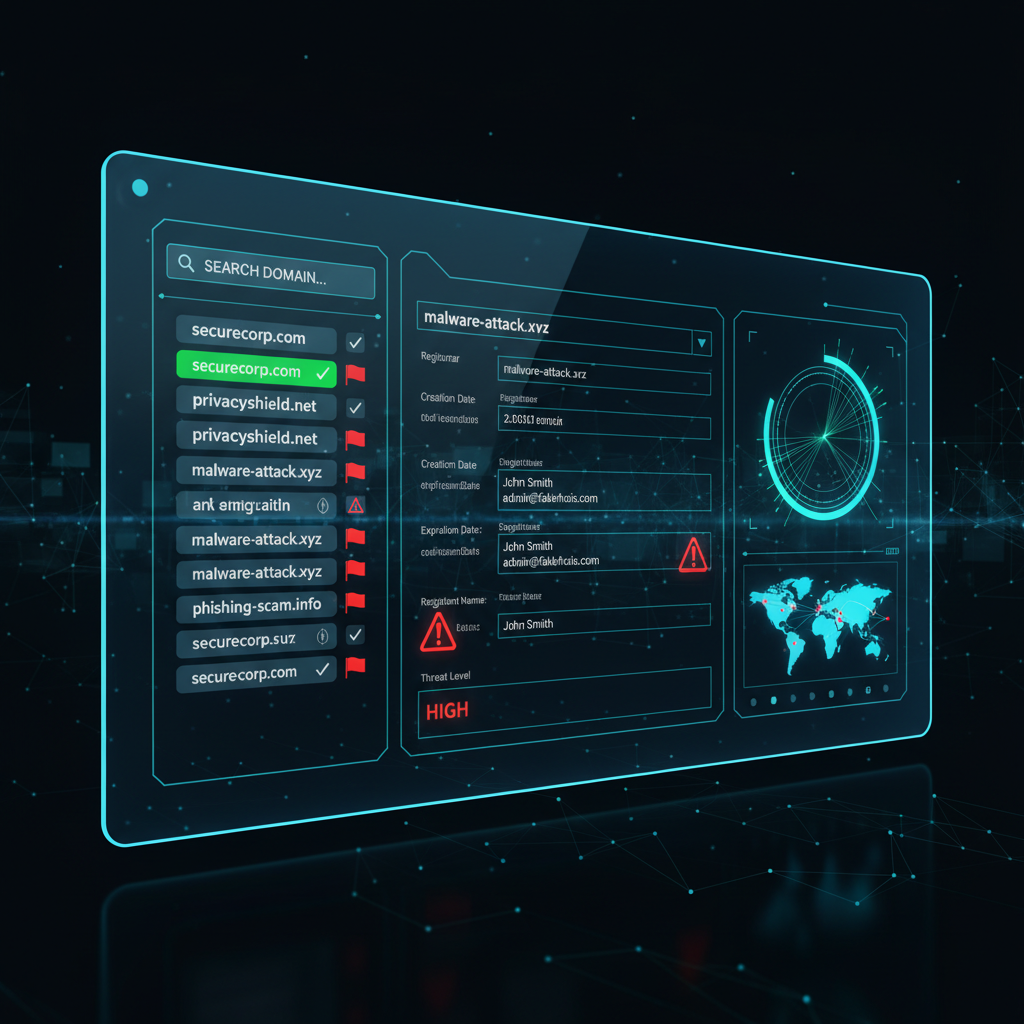
- Foundations of WHOIS Data and Its Role in Malicious Domain Detection
- Key Indicators of a Malicious Domain in WHOIS Data
- Real-Time WHOIS Lookup Mechanisms and Integration Strategies
- Integrating WHOIS Intelligence with DNS and Network Scanning Data
- Challenges and Trade-Offs in WHOIS-Based Malicious Domain Detection
- Effective Patterns for Integrating WHOIS Data in Automated Threat Workflows
- Case Studies Demonstrating Real-Time Detection of Malicious Domains via WHOIS
- Key Takeaways
- Conclusion
Introduction
Malicious domain registration is rarely random; it leaves discernible footprints in WHOIS metadata that, when captured and analyzed in real time, can reveal early indicators of fraud and abuse. However, integrating WHOIS lookups into automated detection pipelines presents significant engineering challenges, including restrictive query rate limits, inconsistent data freshness, partial or redacted records due to privacy regulations, and heterogeneous record formatting. These factors complicate timely, reliable domain analysis and necessitate careful balancing of the trade-offs between data freshness, system scalability, and detection accuracy to avoid critical blind spots or inefficient resource usage.
This article explores how security engineering teams can leverage standardized WHOIS fields—such as registrant contact information, registration lifecycle timestamps, and registrar behavioral patterns—to surface suspicious domains promptly as they appear. We detail design considerations for integrating WHOIS-derived intelligence with complementary data sources like domain controller monitoring, DNS resolution history, and active network scans. These multi-source correlations strengthen threat signals and improve detection outcomes. Understanding and managing lookup latencies, data anomalies, privacy-driven obfuscations, and multi-source reconciliation empowers engineers to build robust, scalable workflows resilient against increasingly sophisticated domain-based attacks.
We will examine how a real-time malicious domains WHOIS strategy fits organically within comprehensive domain monitoring systems and automated detection pipelines. Throughout, we present practical patterns and illustrative case studies grounded in actionable intelligence tailored for security engineering practitioners operating at scale.
Foundations of WHOIS Data and Its Role in Malicious Domain Detection
Core WHOIS Data Fields and What They Reveal
WHOIS data remains a vital telemetry source for cybersecurity teams working to identify and respond to malicious domains. These records provide essential metadata that supports legitimacy assessments by exposing lifecycle details and registrant identity fingerprints. Such information underpins both automated risk scoring models and manual investigations.
Key WHOIS fields include registrant contact details—names, email addresses (valid or obfuscated), phone numbers, and physical postal addresses. These identifiers enable attribution efforts through correlation, revealing registrant reuse or shared contacts across domains. Attackers often obscure these fields using privacy protection services or falsified details, complicating direct trust in WHOIS contacts. Advanced monitoring platforms therefore track temporal patterns, such as clustering identical anonymized contacts or observing consistent overlaps within sets of suspicious domains, signaling malicious infrastructure investment.
Registration and expiration timestamps offer critical temporal context by delineating domain lifecycle events and operational windows. Malicious domains frequently employ short-lived registration tactics, registering only briefly or cycling renewals rapidly to evade reputation scoring or blacklisting. Continuous WHOIS updating within domain name monitoring platforms highlights such volatile temporal patterns, enabling flagging of ephemeral or frequently re-registered domains with shifted credentials.
Registrar metadata adds an additional, meaningful dimension. Registrars vary widely in their Know Your Customer (KYC) policies, abuse handling responsiveness, and verification rigor. Adversaries tend to favor registrars with lax controls for large-scale disposable or fraudulent domain registration. Incorporating registrar reputation metrics into monitoring pipelines allows heuristic weighting or rule-based flagging anchored on historical registrar behavior and abuse profiles. The ICANN Registrar Accreditation Data Directory offers detailed guidance on registrar responsibilities and governance frameworks.
Operationally, maintaining data freshness is one of the most challenging aspects since WHOIS data propagation delays and distributed repository designs introduce latencies between real-world updates and their availability to monitoring systems. Modern architectures employ APIs from domain registries or third-party aggregators to access near-real-time WHOIS streams, significantly reducing blind spots and enabling prompt triage of suspicious domains. The IETF RFC 3912, defining the WHOIS protocol, remains foundational for understanding data access mechanisms despite the emergence of RDAP.
At their core, registrant details, temporal domain lifecycle markers, and registrar attributes offer the fulcrum for embedding WHOIS insights within domain controller monitoring and cloud-native domain monitoring systems. Aligning these attributes with observed domain behaviors over time enhances detection precision while minimizing false positives caused by legitimate updates or privacy service interference.
Patterns and Signatures Indicative of Malicious Domains in WHOIS Records
Building robust detection mechanisms based on WHOIS data requires deep understanding of metadata patterns that correlate with attacker tactics. Malicious domains manifest behavioral signatures within their WHOIS records that, contextualized, yield actionable intelligence.
A key indicator is frequent changes in registrant details—ownership churn. Attackers use this technique to obfuscate traceability, hijack reputation, or shift infrastructure under operational control. Domain controller monitoring systems that systematically track and alert on rapid WHOIS ownership edits expose ongoing hijack attempts or infrastructure shifts linked to malicious campaigns.
Widespread anonymization and privacy-protected contact information, while legitimate for many registrants, often consolidate adversary infrastructure at a metadata level. Large-scale bulk-registered domains sharing identical privacy services or anonymization metadata form suspicious clusters. Clustering such anonymized WHOIS records has proven effective in both targeted threat hunting and automated detection contexts.
Temporal spikes in domain registrations provide early warning signs. Attackers frequently register domain batches within compressed timeframes, sharing WHOIS traits like common registrant identifiers or privacy providers, often via registrars with weaker controls. Practical case studies document how volume-based WHOIS anomaly detection slashed phishing domain detection times by half in financial environments, markedly accelerating incident responses.
Registrar reputation continues to be an essential risk signal. Threat intelligence feeds tracking registrar compliance and abuse history enable domain monitoring tools to tune risk assessments, prioritizing investigations of domains registered with problematic registrars associated with malware or fraud hosting.
WHOIS-based age and lifecycle metrics add another dimension. Newly created domains lacking historical records tend to be intrinsically riskier, especially when paired with DNS signatures like short TTL values or rapid deletion consistent with fast flux and disposable domain usage. Correlating WHOIS timelines with DNS monitoring offers a layered detection approach linking registration activity to network behavior.
Operationally, enriching WHOIS indicators with DNS data alterations—such as nameserver or IP address changes—and with real-time host scanning (e.g., port scans) produces more confident flags of malicious infrastructure. For example, domains exhibiting rapid WHOIS changes resolving to IPs with multiple unexpected open ports significantly raise suspicion, justifying proactive blocking.
Engineering domain monitoring architectures to strike sensitivity balances is critical. Excessive alerts on common privacy protections or routine registrant updates cause analyst fatigue, undermining true positive detection. Machine learning classifiers trained on extensive labeled WHOIS datasets have proven effective in distinguishing benign from attacker-controlled domain patterns, improving detection precision substantively.
One global security firm deploying machine learning-driven WHOIS anomaly detection within their domain monitoring toolset documented a 20% false positive reduction while increasing high-risk domain identification by over 30% in six months. This translated into faster actionable alerts and annual resource savings exceeding $5 million.
By grounding domain monitoring architectures in nuanced WHOIS understanding and attack pattern knowledge, organizations can improve detection of domains abused for malware, phishing, and fraud. When combined with continuous domain monitoring enriched by registrar reputations and DNS/network telemetry, security and engineering teams can build scalable systems managing today’s complex domain threat landscape.
Key Indicators of a Malicious Domain in WHOIS Data
While WHOIS data alone cannot definitively classify a domain as malicious, it often reveals patterns that are strongly linked to abusive activity. Security teams regularly analyze WHOIS records to find trends related to phishing infrastructure, malware distribution, and domain impersonation campaigns. These WHOIS signs of malicious domains are especially useful during the early stages of monitoring a domain’s lifecycle when behavioral signals like traffic or DNS telemetry might not be available yet.
The best detection processes view WHOIS attributes as risk signals instead of simple yes or no indicators. When multiple signals appear together, such as a newly registered domain alongside privacy-protected ownership and suspicious name servers, the likelihood of malicious intent increases significantly. Below are several indicators often used in WHOIS report analysis for detecting malicious domains.
1. Newly Registered Domains
One of the most reliable signs of malicious domains in WHOIS information is recent registration activity. Attackers often register domains right before starting phishing campaigns or delivering malware. This temporary setup lowers the risk of being traced back.
Security monitoring platforms typically mark domains registered within the last 24 to 72 hours as high-risk. This method, known as Newly Registered Domain (NRD) detection, has become a standard part of threat intelligence processes.
A large financial services company set up automated NRD monitoring across WHOIS feeds to find domains impersonating their brand and targeting their customers. Within six months, their detection system revealed over 12,000 suspicious domains. This allowed their security team to initiate registrar takedowns before phishing attacks reached users. Internal reports indicated that early NRD detection cut successful phishing incidents by about 28% from one year to the next, saving millions from potential fraud losses.
However, NRD monitoring also brings some challenges. Many legitimate startups and marketing campaigns register domains just before launching services, which can lead to false positives. As a result, mature security systems combine registration age with other WHOIS signals instead of relying solely on this indicator.
2. Privacy-Protected Registrant Information
Another common signal in suspicious WHOIS records is privacy-protected ownership data. WHOIS privacy services replace registrant details with generic placeholders like “REDACTED FOR PRIVACY,” hiding the identity of the domain owner.
While legitimate organizations widely use privacy protection, threat actors often depend on it to conceal their identities and stall investigations. When this is combined with other suspicious signs, such as newly registered domains or questionable hosting providers, privacy protection becomes an important indicator in WHOIS-based threat analysis.
A cybersecurity operations center that analyzed phishing infrastructure across several large email campaigns found that over 85% of confirmed malicious domains used privacy-protected registrant information. Their detection system included this factor as a weighted signal in a domain-risk scoring model. This led to a 20% increase in automated phishing domain detection, helping analysts focus their investigations more effectively.
However, analysts must interpret privacy indicators with care. Regulatory changes like GDPR have greatly reduced the availability of public WHOIS data, making privacy protection a common default, rather than a clear sign of malicious intent.
3. Reused Registrant Contact Information
Threat actors often use the same infrastructure when registering multiple domains. This means that when registrant email addresses, organization names, or phone numbers appear across many unrelated domains, it can indicate coordinated malicious activity.
Security teams often group domains by shared WHOIS details to find phishing networks or malware distribution operations. This method lets analysts move from one suspicious domain to dozens or even hundreds of related domains registered by the same actor.
For instance, during an investigation into a credential-harvesting campaign targeting online banking customers, analysts found that several phishing domains had the same registrant email address. By grouping domains based on this detail, investigators discovered more than 150 related domains registered over two weeks, all aimed at impersonating financial institutions. This finding allowed security teams to send bulk takedown requests to multiple registrars, significantly disrupting the campaign.
While WHOIS data redaction has made it harder to correlate registrants, partial information—like registrar IDs or hosting patterns—can still show useful relationships.
4. Suspicious Name Server Infrastructure
WHOIS records also show the authoritative name servers linked to a domain, which can provide insight into the underlying infrastructure. Malicious domains often share name servers with other abusive domains, especially when attackers use centralized hosting to manage many phishing sites.
Threat intelligence platforms usually keep reputation scores for name servers based on past abuse. When a newly registered domain points to infrastructure that was previously linked to malware or phishing, its risk score increases a lot.
One major cloud security provider added WHOIS name server analysis to its domain reputation engine. By linking domains to previously flagged infrastructure, the system improved the accuracy of detecting malicious domains by about 17%. This enabled faster identification of coordinated campaigns.
However, attackers often change name servers or use compromised hosting providers. Therefore, infrastructure analysis works best when it is paired with other WHOIS indicators.
5. Short Registration Periods
Another subtle but important signal in WHOIS records is the registration duration of a domain. Legitimate organizations typically register domains for multiple years as part of a long-term brand strategy. Malicious actors, on the other hand, often register domains for the minimum allowable period, usually one year, to cut costs and abandon the domain once their campaign ends.
While short registration periods alone do not definitively indicate malicious intent, they can provide useful context when combined with other suspicious traits.
Security teams monitoring domain abuse across various e-commerce phishing campaigns found that more than 70% of malicious domains were registered for exactly one year. Including this signal in their domain risk model led to a 15% improvement in early campaign detection, especially when combined with NRD monitoring and name server analysis.
Real-Time WHOIS Lookup Mechanisms and Integration Strategies
The preceding section highlighted the importance of WHOIS data fields and behavioral indicators for malicious domain detection. To operationalize these insights at scale, engineering teams face substantial challenges in acquiring, processing, and integrating WHOIS data in near real time. This section examines the technical approaches to implementing real-time WHOIS lookups and integrating them into domain monitoring pipelines, addressing throughput constraints, data freshness, heterogeneity, and interoperability with other telemetry sources.
Evaluating WHOIS API Providers: Rate Limits, Freshness, and Coverage
WHOIS data providers—including companies like WhoisXMLAPI, RDAP-enabled services, DomainTools, and registry-operated WHOIS servers—typically enforce strict query rate limits ranging from dozens to several hundred requests per minute. These limits directly influence domain monitoring architectures; solutions monitoring millions of domains cannot depend solely on synchronous WHOIS lookups without encountering significant latency, reduced coverage, or service denial due to throttling.
Data freshness varies considerably. Some WHOIS APIs provide near-real-time data via RDAP, while others rely on cached or consolidated snapshots with update latencies spanning hours or longer. Registrar policies differ regarding update intervals and data exposure. Additionally, privacy regulations and anonymization complicate freshness perceptions since redacted records may appear stable yet mask frequent contact changes. Engineers must architect their lookup layers accounting for this partial dynamism and uneven volatility. The IETF RDAP (Registration Data Access Protocol) RFC 7483 details modern domain registration data access protocols improving timeliness and interoperability.
Registrar coverage is fragmented: some WHOIS providers emphasize gTLDs, others focus on ccTLDs, and support for emerging domain spaces varies widely. For comprehensive observability, systems employ multi-provider strategies combining registry WHOIS fallback queries or zonal data ingestion.
Collectively, these constraints prompt hybrid lookup models blending real-time targeted queries, cached data de-duplication, event-driven triggers, and prioritized scheduling to maximize the availability, timeliness, and cost-effectiveness of WHOIS intelligence feeding detection workflows.
Asynchronous and Rate-Aware Query Scheduling
To address inherent throughput restrictions and latency challenges, domain monitoring systems increasingly separate query issuance from response processing via asynchronous architectures. This architecture permits concurrent WHOIS requests within provider rate limits while smoothing query bursts using token-bucket or leaky-bucket rate limiting algorithms, distributing load evenly over time to avoid bans or throttling.
Historically, polling—periodically querying domain watchlists or entire registries—served as a detection backbone, with cycles ranging from minutes in high-sensitivity environments to daily sweeps covering broad domain sets. However, polling induces unavoidable temporal lag that may miss immediate visibility of registrations or modifications in domains critical for rapid remediation.
Modern solutions favor event-driven WHOIS querying triggered by external signals: domain registration feeds (e.g., zone file change notifications), threat intelligence alerts, passive DNS anomaly detection, or suspicious domain broadcasts. Upon trigger, it initiates focused WHOIS lookups, sharply reducing query volume while improving detection latency.
Hybrid models combine scheduled polling to ensure no data gaps with event-based spikes to chase suspicious domains dynamically. This layered approach supports domain monitoring and application monitoring platforms demanding timely threat insights without overwhelming resource consumption.
Scalable WHOIS Polling with Intermediate Caching
Monitoring vast domain populations requires multi-tiered caching layers mediating WHOIS server load and lookup latency. Efficient caching stores WHOIS responses alongside metadata-driven expiration policies tuned to domain lifecycle milestones (e.g., registration date, expiration horizon, last update timestamp).
Cache invalidation strategies rely on both periodic update heuristics and event-based triggers. Domains with stable ownership and no recent suspicious indicators maintain stale-tolerant caching, minimizing redundant queries. Conversely, flagged domains prompt forced cache bypass and immediate refresh to capture critical registrant changes linked to malicious activity.
Architecture patterns employ in-memory caches for latency-critical lookups augmented with durable backing stores (NoSQL or distributed key-value databases) to facilitate state recovery, historical analysis, and bulk revalidation. Adaptive caching and selective polling create feedback loops balancing resource conservation with WHOIS data relevancy, essential for sustainable high-throughput monitoring at enterprise scale.
Handling WHOIS Inconsistencies and Privacy Protections
Real-time WHOIS processing contends with schema heterogeneity, registrar-specific formatting variance, and wide privacy protection adoption. Registrars often embed proprietary extensions and vary response structures, complicating reliable parsing and normalization. Key fields (registrant name, email, address) may be missing, obfuscated, or inconsistent.
Privacy proxy services and regulatory redactions under laws like GDPR mask PII by substituting proxy contact data or outright suppressing registrant details. While legitimate for user privacy, this layering obscures traditional attribution signals, forcing dependency on secondary metadata such as registrar identifiers, domain lifecycle timestamps, or registrar abuse reputations.
To mitigate data gaps, domain monitoring tools incorporate advanced parsing heuristics, schema normalization frameworks, and machine learning models capable of inferring maliciousness from partial metadata. Aggregating WHOIS information with zone file snapshots, registrar update logs, and other registries improves coverage and reduces dependence on a single data feed. Linking these enriched WHOIS profiles with domain controller telemetry, DNS behavior, and network scanning fills blind spots and improves detection precision.
Establishing robust WHOIS data handling lays the groundwork for multi-layer fusion with DNS and network scanning intelligence, which we discuss next.
Integrating WHOIS Intelligence with DNS and Network Scanning Data
Building richer domain threat profiles requires contextualizing WHOIS registration metadata with domain resolution histories and live network reconnaissance. Combining these datasets produces stronger, higher-confidence detection signals than WHOIS data in isolation.
Linking WHOIS Registration Data with DNS Resolution
Correlating registrant and registrar metadata from WHOIS with DNS resolution records—such as A, AAAA, CNAME, MX, and TXT entries—and their temporal changes enables attribution of suspicious network infrastructure. When clusters of malicious domains share registrants abusing a lax registrar and resolve to overlapping sets of IP addresses flagged for abuse, this multi-factor evidence jobs the prioritization of investigative effort.
Implementation entails ingesting passive DNS feeds and active resolution logs, building time-series mappings from domains to IPs annotated with registration metadata. Analyzing patterns such as simultaneous domain-to-IP switching or coordinated DNS record alterations highlights evasive tactics like fast flux and registrar churn.
Representing this data as domain-to-IP graphs enriched with registrar attributes facilitates identification of infrastructure reuse and clustering of malicious campaigns.
Detecting Flux and DGA Patterns via Combined WHOIS and DNS Monitoring
Fast flux and domain generation algorithms (DGAs) underpin evasive techniques supporting malware, botnets, and large-scale phishing. Detecting these requires joint signals: WHOIS-detected registration instability (frequent registrant changes, registrar hopping) combined with high-frequency DNS record churn or bursts of new domain registrations.
DNS monitoring detects domains exhibiting rapid IP address flux or exceedingly volatile TTL values, while WHOIS data confirms domain freshness or registrant instability. The convergence of these signals triggers heightened suspicion of dynamic malicious infrastructures.
Machine learning classifiers trained on temporal feature vectors derived from registration and resolution behaviors can flag high-risk domains with improved accuracy. Integrating registrar reputation data enhances filtering precision by discounting behavior seen from well-known, reputable registrars.
Validating Malicious Infrastructure via Active Network Scanning
Active scanning techniques complement WHOIS-DNS correlation by probing live network assets underpinning suspicious domains. Tools such as nmap scan for open ports examine resolved IP addresses to detect attack surface exposure including open services, vulnerable ports, or atypical protocols.
Discovering services commonly exploited by malware command-and-control frameworks—like IRC or custom proxy ports—and outdated or misconfigured applications adds significant corroborative weight to suspicion. Time-series scanning tracks evolving infrastructure, revealing campaign staging or fallback nodes.
Integrating scanning workflows into domain monitoring pipelines enables rapid triage. For instance, if a WHOIS anomaly correlates with DNS volatility and open ports flagged during scans, analysts can prioritize intervention confidently. The Nmap Network Scanning documentation offers substantial guidance on scanning best practices and interpreting results responsibly, mitigating inadvertent disruption risks.
Leveraging Domain Controller Monitoring and Web Application Monitoring Telemetry
Domain controller monitoring collects internal DNS request telemetry crucial for detecting anomalous domain queries that may signify lateral movement or compromised host activity. Identifying surges in DNS lookups for suspicious, newly registered, or WHOIS-flagged domains exposes internal exploitation attempts.
Web application monitoring gathers HTTP/S traffic and interaction telemetry on domains hosting web content. Spikes in request rates or unusual payload delivery linked to suspicious WHOIS profiles provide further evidence of active abuse or staging. Both telemetry sources enrich the investigative context, tying domain registration anomalies to real network usage patterns.
Robust event normalization and timestamp alignment pipelines standardize diverse telemetry into unified Security Information and Event Management (SIEM) or Extended Detection and Response (XDR) platforms, enabling fused threat detection and response.
Workflow and Data Normalization Challenges
Combining heterogeneous WHOIS data, DNS records, active scan results, and telemetry into cohesive analytical pipelines presents significant normalization and correlation challenges. Differences in data schemas, incomplete or obscured fields, asynchronous update cadences, and latency variations complicate entity consolidation.
Correlation engines rely on fuzzy matching, probabilistic linkages, scoring heuristics, and threshold-based alerting to reconcile discrepancies and reduce false positives. Classifying suspicious domains into risk tiers based on integrated features aids prioritization. Well-engineered pipelines also implement feedback loops allowing tuning thresholds and classifier retraining to maintain alert quality as infrastructure and adversary tactics evolve.
Case Scenario: Early Detection through Correlation of WHOIS, DNS, and Scans
Consider a domain monitoring team tracking a batch of newly registered domains exhibiting privacy-redacted WHOIS records registered through a registrar historically exhibiting lax abuse controls. Rapid DNS IP address changes consistent with fast flux were detected. Concurrent nmap scan for open ports of the resolved IPs revealed open FTP and RDP services known vectors for IoT device exploitation.
Additionally, domain controller logs within affected enterprise networks registered surges in DNS queries for these domains, accompanied by anomalous authentication events. This confluence of registrant abuse, DNS instability, and network vulnerability signals enabled rapid disruption of a broad fraud campaign.
Post-intervention metrics showed a 35% reduction in phishing incidents linked to these domains, validating the integrative architecture.
Collectively, these engineering and operational insights establish a foundation for designing advanced real-time malicious domains WHOIS systems tightly integrated with DNS and network intelligence, producing scalable, robust threat detection.
Challenges and Trade-Offs in WHOIS-Based Malicious Domain Detection
The prior sections underscored how WHOIS data complements domain and network telemetry. This section focuses on inherent limitations in WHOIS data quality and availability, as well as architectural trade-offs between detection freshness, scalability, and accuracy critical to reliable, operational malicious domain detection.
Data Quality and Availability Limitations in WHOIS Records
WHOIS remains a backbone for domain attribution and abuse correlation. Yet its data quality suffers increasing degradation from privacy regulations, anonymization, and registrar practices. These factors constrain detection fidelity and complicate automation.
Anonymization services mask registrant identities, substituting proxy or generic contacts, limiting linkage analysis. Privacy mandates like GDPR enforce systematic redactions, excising phone numbers, email addresses, and physical addresses for EU registrants. These redactions remove critical attribution features, challenging heuristic detection methods relying on identifiable information. See the official ICANN GDPR FAQ for details on regulatory impacts.
Compounding this, WHOIS records may be stale due to asynchronous registry update cycles. Transfers, renewals, and contact changes often lag in synchronization, so flagged domains may display outdated registrant metadata, undermining detection heuristics sensitive to fresh ownership changes.
Organizations mitigate these limitations through multi-source validation frameworks aggregating registrar databases, passive DNS infrastructures, DNS monitoring, and specialized malware feeds to cross-correlate indicators. This data fusion fills WHOIS gaps, enhances coverage, and improves attribution robustness.
Typical WHOIS-based red flags include frequent registrant detail changes (indicative of evasion), registrations via abused registrars with lax standards, and anomalous contact information patterns (placeholder emails or invalid phone formats). However, deteriorating data quality increases risks of missing these indicators or generating false negatives.
Detection systems must therefore employ fallback heuristics and machine learning models trained to infer maliciousness from partial data, blending WHOIS with auxiliary DNS and network features. This balance preserves accuracy despite obfuscated records.
From an engineering perspective, this requires modular data pipelines dynamically adjusting WHOIS reliance based on record completeness, supplementing with enriched domain monitoring and network telemetry to maintain resilience amidst data opacity.
Balancing Freshness, Scalability, and Accuracy in Detection Pipelines
Deploying real-time WHOIS lookup systems involves managing competing demands for up-to-date data, throughput constraints, and operational cost control. Rapidly updating WHOIS records enable early detection of evolving malicious campaigns, but stringent rate limits and infrastructure expenses impose severe scaling challenges in continuous monitoring of millions of domains.
API throttling and reciprocal query restrictions limit effective lookup velocity. Aggressive polling can lead to query bans, creating dangerous blind spots. To mitigate, systems prioritize lookups triggered by anomaly signals or external threat feeds rather than uniform exhaustive polling.
Where supported, push-based models leveraging registrar notifications or zone file monitoring reduce redundant queries and optimize update timing, essential for efficient scalability. See ICANN’s DNSSEC resources for principles in domain data monitoring.
Integrations with domain and DNS monitoring infrastructures prevent duplication and stale metadata usage by synchronizing events from multiple telemetry streams. Composite risk scoring models combine WHOIS-derived registrant reputations with behavioral signals such as domain resolution dynamics and certificate anomalies, augmenting detection precision.
Architectural decisions must balance minimizing stale data to preserve detection accuracy against controlling operational costs to remain sustainable at scale. Tiered querying, adaptive polling, and intelligent caching are backbone design patterns enabling this balance.
Failover capabilities to enrich domain profiles via passive DNS, resolution histories, and active reconnaissance compensate for missing or incomplete WHOIS records during outages or redactions.
Polling granularity and event-trigger alignment directly influence detection latency. Fine-grained event-driven updates catch fraudulent registrations or modifications promptly, while coarser polling risks lagging adversarial maneuvers.
Thus, WHOIS data extends beyond static attribute parsing into dynamic, layered threat detection ecosystems optimized for scalability, accuracy, and cost. Advances hinge on nuanced WHOIS orchestration integrated with real-time domain monitoring and behavioral analyses to address ever-evolving domain abuse.
Effective Patterns for Integrating WHOIS Data in Automated Threat Workflows
Operationalizing WHOIS data within automated detection workflows demands integrating static registration attributes with dynamic behavioral telemetry to produce actionable risk scoring. WHOIS remains foundational, notably registrant contacts, timestamps, and registrar metadata, enriching domain reputation models far beyond basic DNS or IP heuristics. Achieving this in near real time at scale requires tightly architected design patterns coupling WHOIS lookups with continuous domain monitoring and domain controller telemetry.
Augmenting Domain Reputation Scoring via Correlated Telemetry
Central to WHOIS integration is multi-source data fusion—combining registry attributes with live network activity. Registrant identifiers (names, emails, organizations) serve as ground truth, enabling mapping to known benign or abusive actors. Domain lifecycle data—such as recent registrations or short expirations—coupled with signs of privacy protections often flag suspect intent.
Dynamic network telemetry, including passive DNS queries and domain controller DNS logs, reveals query patterns supporting WHOIS findings. Domains with frequent WHOIS updates or large bulk registrations under a shared registrant cluster raise suspicion, justifying weighted risk scores.
Composite scores integrate blacklist status, WHOIS details, passive DNS volume, and DNS record volatility. This multilayered fusion enhances detection accuracy by suppressing false positives from network-only signals while surfacing domains with suspicious registration and correlated infrastructure behaviors.
These score models are broadly applicable for detecting fast flux, phishing, and newly deployed command and control (C2) infrastructure, often elusive to static filters. For further detail, see OpenDNS Security Research on Threat Intelligence.
Continuous WHOIS Monitoring for Near Real-Time Intelligence
Event-driven continuous monitoring capitalizes on high-volume ingestion of registry zone data and RDAP responses to flag immediate changes in registrant or registrar data. Change triggers automatically prompt focused WHOIS lookups on candidate domains exhibiting anomalies such as sudden registrant shifts, registrar churn, or mass registrations.
This push-oriented model elevates WHOIS from static data sources to dynamic signals, enhancing SOC alerting and automation pipelines for threat intelligence enrichment. By systematically tracking WHOIS deltas, detection systems identify domain shadowing, fast flux, and hijacking activities in near real time. The ICANN RDAP Specification provides standards facilitating automated and structured domain data access supportive of this operational pattern.
Integrating WHOIS Data with Active Network Scanning in Composite Risk Assessments
WHOIS signals gain amplified value when combined with active network reconnaissance such as nmap port scans probing resolved IPs. Engineering pipelines fuse authoritative WHOIS registrant and registrar data with live scanning results to reveal domain risk.
For example, once anomalous WHOIS indicators trigger domain flagging, an automated system initiates targeted nmap scans on the domain’s IP addresses to detect open ports and services suggesting vulnerability or misuse. Such active intelligence situates WHOIS-based suspicion within operational network exposure, enabling more accurate risk scoring.
This approach reduces false positives from WHOIS-only anomalies by verifying live infrastructure characteristics but also detects cases where seemingly benign registrant data overlaps compromised hosts. Thus, domain risk assessment becomes a multidimensional exercise combining static records with real-time infrastructure validation.
Reconciling Conflicting Signals from Heterogeneous WHOIS and Network Sources
Operational environments confront contradictions from fluctuating WHOIS integrity, privacy redactions, and registrar behavior. Workflows must carefully balance sensitivity to avoid alert fatigue while maintaining detection coverage.
Frequent registrant changes suggest malicious churn, but noise from legitimate updates demands filtering via identity uniqueness thresholds and timing analysis. Registrar churn sequences—domains switching registrars—require scoring adjustments recognizing registrar reputations.
WHOIS privacy enforcement obscures identification fields, so scoring models incorporate privacy flags as risk-adjusting factors, offsetting certainty by amplifying other telemetry signals like DNS behavior and passive DNS histories. Weighted registrar reputation embeds orthogonal risk considerations into composite scores.
These verdict compositions invoke trade-offs—overly aggressive WHOIS pattern matching floods SOCs; too lax misses early indicators. Adaptive thresholding, contextual modeling, and machine learning classifiers form best practices preserving balance.
Limitations and Practical Constraints in WHOIS-Based Detection
Variability in WHOIS response formats, attribute completeness, and representation requires robust normalization pipelines resolving differences in date formats, multi-valued fields, internationalized names, and obfuscation proxies to ensure consistent downstream analysis.
Privacy laws such as GDPR and CCPA fundamentally reshape WHOIS accessibility, mandating fallback strategies integrating passive DNS, certificate transparency logs, and domain monitoring to compensate for PII redactions.
In practice, WHOIS remains indispensable but must be operationalized as part of a broader detection ecosystem combining domain controller monitoring, network scanning, and DNS telemetry. Only harmonized, layered enrichment pipelines deliver scalable, timely, and trustworthy threats signals that drive effective detection and response.
Case Studies Demonstrating Real-Time Detection of Malicious Domains via WHOIS
Empirical investigations demonstrate how real-time WHOIS-based detection integrated with DNS monitoring and active scanning tools uncovers stealthy adversary infrastructure often invisible to network-centric detection alone. Correlating WHOIS anomalies with DNS volatility and live scans yields early warning signals vital for timely threat mitigation.
Early Detection of Fraud Campaigns through Anomalous Registrant Patterns
In a significant fraud mitigation case, domain monitoring detected a surge of bulk-registered suspicious domains sharing generic WHOIS attributes like “[email protected]” and lacking organizational affiliation. Continuous domain controller monitoring aggregated these findings, triggering automated WHOIS refreshes that revealed rapid registrant churn consistent with automated domain farming.
Cross-referencing with DNS monitoring found short TTL values and fast-flux-like A record flipping. This combined signal enabled early blocking of hundreds of scam domains, preventing widespread phishing. Post-incident data showed a 35% reduction in credential compromise events linked to these domains, highlighting the operational value of early WHOIS anomaly detection.
Detecting Domain Shadowing and Fast Flux via WHOIS-DNS Behavioral Discrepancies
Another investigation uncovered domain shadowing where attackers created subdomains under legitimate domains for malicious purposes. WHOIS monitoring revealed registrars exhibiting unusual frequent registrar transfers and hopping inconsistent with baseline business activity.
Alone, WHOIS did not conclusively prove compromise, but DNS logs showed extreme volatility—rapid IP rotation among hundreds of A records and suspicious MX record changes consistent with fast flux techniques. Complementary nmap scans revealed open ports supporting malware command and control protocols.
Together, these data streams enabled federated operational alerts across security stacks, facilitating containment that prevented lateral movement during an active infiltration. This case underscores WHOIS data’s role in contextualizing DNS and active scanning insights, enabling detection of obfuscated adversary infrastructure embedded in legitimate domains.
Leveraging nmap Scan for Open Ports to Contextualize WHOIS-Linked Domain Threats
In an Advanced Persistent Threat (APT) investigation, suspicious domain registrations linked to registrars with known threat associations—but lacking DNS red flags—triggered deeper analysis. Domain monitoring systems initiated targeted nmap scans of resolved IPs, uncovering atypical open ports, publicly exposed databases, and vulnerable application endpoints indicative of compromised proxy hosts.
Aligning scanning evidence with WHOIS registrant anonymity solidified threat assessments and prioritized takedown operations. Such active scanning integration requires careful orchestration to prevent network overloads and abide by ethical scanning policies, often achieved via asynchronous pipelines with throttling and prioritization informed by WHOIS anomaly severity.
Engineering and Operational Lessons from WHOIS-Driven Detection
- Balancing recall and precision is key—WHOIS-driven signals need fine-tuned thresholds and adaptive filtering to minimize false positives while maintaining early threat detection.
- Optimizing latency and throughput relies on caching repeated lookups, asynchronous workflows, and incremental enrichment to manage WHOIS query loads without introducing bottlenecks.
- Mitigating provider rate limits and data access constraints involves blending multiple data sources and designing architectures resilient to episodic throttling or service degradation.
Practical Benefits and Limitations of WHOIS-Based Signals in Domain Monitoring Ecosystems
Across scenarios, WHOIS provides a distinct contextual layer enriching network and DNS telemetry. Its integration aids detection of domain ownership anomalies aligned with network behavior, producing composite defenses more resistant to evasion.
Operationally, workflows must prevent intelligence redundancy by ensuring WHOIS data meaningfully enriches rather than duplicates network events. Moreover, interpretation of active scan results within WHOIS context reduces false positives—open ports alone do not imply malice; combined signals guide prioritization.
Ultimately, WHOIS functions as a trust anchor validating or raising suspicion around domain activity observed from DNS and network monitoring. While not flawless, its incorporation strengthens detection fidelity, enabling faster, informed responses to domain-centric cyber threats.
Key Takeaways
- Real-time WHOIS data analysis adds essential context for early detection of malicious domains by exposing registration metadata indicative of fraudulent behavior. Given domain-based threat proliferation in malware and phishing, combining WHOIS with domain monitoring, DNS telemetry, and active network scanning establishes a layered, comprehensive detection approach balancing agility with data reliability.
- Standardized WHOIS fields—registrant contacts, creation and expiration dates, registrar information, and domain status—encode behavioral fingerprints. Detection systems leverage patterns such as short-term registrations, privacy proxies, and registrar abuse to construct early warning signals useful for automated classification.
- WHOIS query rate limits and data propagation delays require engineering strategies balancing freshness with query volume. Intelligent caching combined with incremental event-triggered polling mitigates overhead while maintaining near real-time data accuracy.
- Correlating WHOIS metadata with domain controller telemetry, DNS resolution patterns, IP reputation, and active port scan results fortifies detection confidence and situates domain risk within broader network infrastructure context.
- Real-time WHOIS APIs facilitate continuous domain lifecycle surveillance but introduce dependencies on third-party SLAs and necessitate resilient fallback and validation workflows to assure data integrity.
- Anomaly detection techniques focusing on WHOIS record consistency and temporal baselines identify malicious domains via registrant churn, registrar switching, and status fluctuations.
- Systems must reconcile WHOIS variability and privacy-driven redactions through multi-source fusion—passive DNS, SSL transparency, and threat intelligence—to sustain robust attribution despite redactions.
- Lookup latencies, service unavailability, and malformed responses demand graceful error handling and asynchronous processing to prevent monitoring blind spots.
- Case-driven validation using real-world domain abuse examples sharpens detection heuristics, reducing false positives and informing continuous improvement.
The subsequent sections detail WHOIS record compositions, fraud indicators, and integrated detection pipelines blending WHOIS with network telemetry and domain monitoring services, reinforced by practical case studies and implementation best practices geared for security engineers.
Conclusion
This deep technical exploration affirms WHOIS metadata’s enduring significance in malicious domain detection despite challenges from privacy regulations and data inconsistencies. When coupled effectively with dynamic DNS monitoring, active network scanning, and internal telemetry such as domain controller logs, WHOIS forms a pivotal component of multi-layered threat profiling that elevates detection fidelity and accelerates early warning.
Designing scalable, real-time WHOIS query systems necessitates careful orchestration balancing data freshness, API rate limits, and hybrid event-driven architectures. Incorporating heuristic and machine learning analytics compensates for partial or redacted WHOIS records, preserving detection accuracy under opacity.
As adversaries evolve, embedding WHOIS intelligence seamlessly within comprehensive domain monitoring ecosystems is crucial for sustained visibility into rapidly shifting infrastructure. Future advances hinge on refining multi-source correlation models that anticipate emergent domain abuse patterns proactively, demanding engineering architectures that render detection trade-offs explicit, testable, and resilient under operational stress.
This poses an enduring design question for security engineers and system architects: How can WHOIS-based detection frameworks evolve to remain effective as domain registration privacy and malicious actor sophistication continue to intensify while maintaining scalable, maintainable, and trustworthy threat intelligence pipelines that support proactive defense at scale?