Introduction
Detecting domain abuse at scale presents a foundational challenge in extracting meaningful signals amidst perpetual domain state changes, noisy metadata, and continuously evolving attacker tactics. Automated domain abuse detection systems must effectively correlate disparate data sources—such as WHOIS records, DNS configurations, and IP mappings—while accommodating propagation delays, inconsistent data formats, and registrar transfer events. These systems face the dual imperative of preserving monitoring infrastructure stability and minimizing false positive rates to maintain actionable alert fidelity.
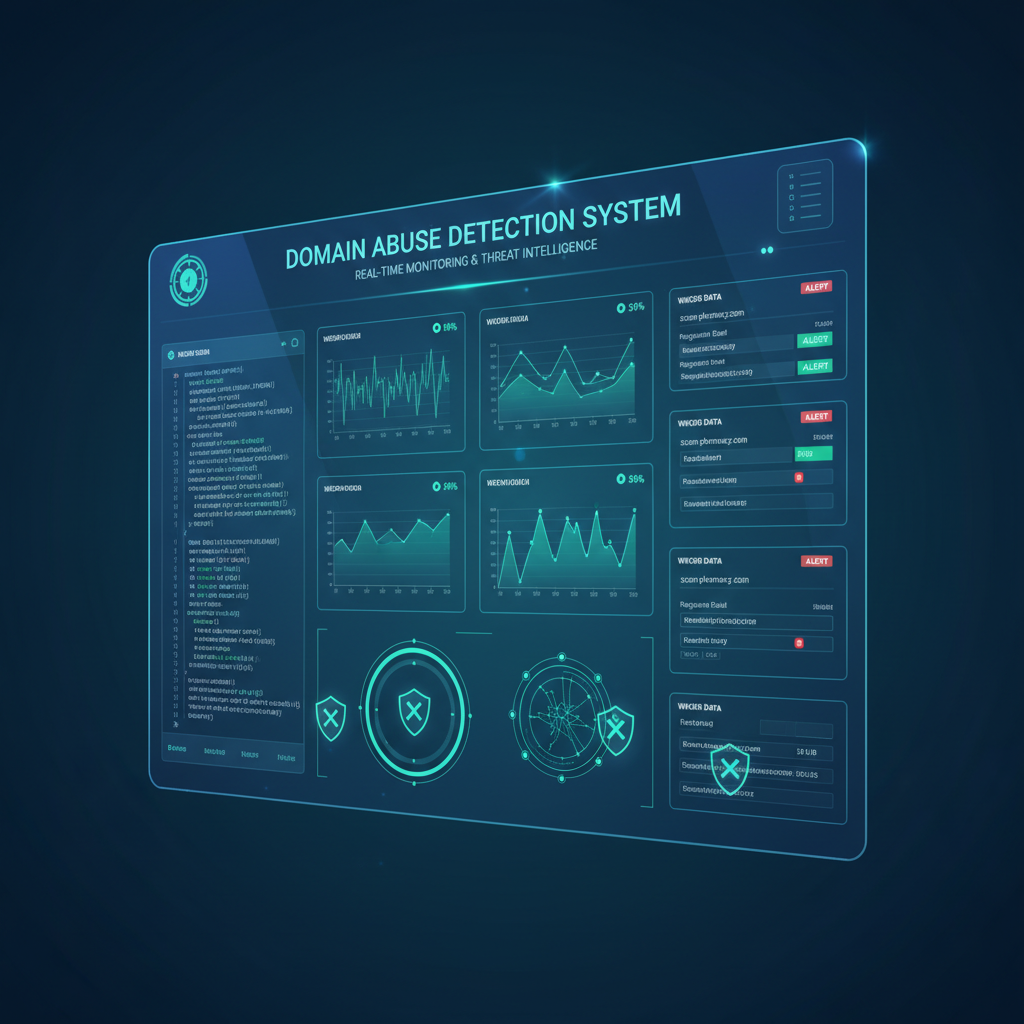
The core design challenge lies in constructing data pipelines and analytical models that simultaneously achieve near-real-time accuracy, extensibility to proliferating domain extensions, and resilience against routine administrative activities. This must occur while supporting seamless integration with incident response workflows to enable timely mitigation. This article decomposes the engineering considerations for architecting such systems: from leveraging multi-dimensional signals via WHOIS and DNS APIs, to adopting continuous, event-driven monitoring with adaptive scoring mechanisms that transcend static heuristics, and driving automated remediation to reduce operational overhead.
By dissecting these design choices and their trade-offs, this framework equips engineers to build robust domain abuse detection architectures that remain effective against the dynamic threat landscape and cope with real-world operational constraints.
Understanding Domain Abuse Phenomena
Domain abuse detection is inherently complicated by the volatile and mutable nature of domain states, which are far from static entities. Domains routinely experience frequent transitions—including ownership transfers, DNS record modifications, forwarding updates, and renewal or expiration cycles—that introduce noisy metadata. This noise blurs the boundary between malicious activity and legitimate administrative operations. For example, a sudden domain forwarding redirection can be a benign marketing move or a deceptive phishing pivot. Similarly, toggling domain lock statuses—intended to secure domains against unauthorized changes—can signal either routine maintenance or attacker attempts to frustrate forensic analysis and domain recovery.
Attackers exploit domain state dynamism by embedding malicious infrastructure within these legitimate transitions. Rapid domain fluxing techniques, which systematically alternate domains and associated IP addresses, circumvent traditional static blacklists and signature-based detection models. Such flux manifests as sequences of registry transfers, DNS reconfigurations, or ephemeral domain registration patterns that detection engines must temporally associate to reveal abuse. Moreover, domain shadowing—where attackers compromise legitimate registrant accounts to create aberrant subdomains invisible at the parent domain level—leverages DNS hierarchy complexity and delegation mechanisms, complicating detection.
The increasing adoption of newly released or less-monitored top-level domains (TLDs) adds another evasion layer; legacy filters often lag in incorporating emergent TLD datasets, creating blind spots attackers exploit. To combat this, integrating domain state timelines—time-series data maintaining historical snapshots of domain events—enables identification of anomalous event sequences, such as repeated registrar hand-offs or clustered DNS updates within short time windows. The ICANN Domain Abuse Activity Reporting system offers a technical primer on these nuances.
From the attacker motive lens, consistent patterns emerge: phishing groups often utilize elaborate domain forwarding chains to maximize redirection success, while malware operators aggressively employ domain locking to fortify infrastructure against tampering. Modeling these tactic-to-behavior mappings mechanistically empowers detection systems to contextualize suspicious domain state changes, thereby improving alert precision.
Key Challenges in Domain Abuse Detection
The deployment of an effective domain abuse detection system confronts a fragmented data ecosystem characterized by asynchronous update cadences and inconsistent sources. Critical intelligence streams—including WHOIS queries, DNS resolution data, and IP-to-domain mappings—each feature distinct refresh rates, access constraints, and error profiles, complicating real-time correlation.
WHOIS information retrieval is hindered by propagation delays, API-imposed rate limits, and heterogeneous registry schema implementations, such as those encountered with DomainTools WHOIS APIs. These factors introduce latency in ownership and registration status visibility, reducing opportunity for timely abuse flagging. Similarly, DNS data suffers from recursive resolver caching and hierarchical propagation delays, resulting in observation windows where malicious configurations may persist unmitigated or legitimate changes might appear suspicious.
The fusion of these asynchronous feeds—aggregating WHOIS snapshots, DNS traces, and IP reputation data without consistent timestamp alignment—poses significant analytical challenges. For instance, a domain temporarily stalled in a “pending update” registrar state might resemble an anomaly in isolation but aligns with expected maintenance in temporal context.
Addressing these challenges necessitates heuristics that evaluate data freshness and trustworthiness. Such heuristics typically manifest as weighted risk scoring algorithms combining signals like domain lifecycle phase, event recurrence frequency, and historical legitimacy trends. These models filter out transient, benign anomalies while elevating domains exhibiting sustained suspicious behavior.
Balancing alert sensitivity against noise is a fundamental design trade-off. Overly aggressive thresholds result in alert fatigue by overwhelming analysts with false positives arising from normal administrative operations, degrading focus. Overly conservative settings increase false negatives, allowing high-risk abuse domains prolonged undetected periods, amplifying attack surfaces. Accordingly, adaptive thresholds calibrated via ongoing feedback loops optimize the trade-off, modulating true positive rates relative to false alarm volumes.
Architecturally, scalable systems embody layered pipelines: streaming ingestion of domain events feeds alerting engines that compute risk scores and trigger triage workflows. These workflows, in turn, generate intelligence outputs integrated with automated response platforms—such as registrar domain suspension APIs or DNS blocking mechanisms—ensuring rapid containment.
For example, a security vendor combined domain registration timeline analyses with machine learning classifiers to detect phishing domains exhibiting rapid ownership transfers, yielding a 30% increase in early detection and 25% fewer false positives, substantially easing incident response. Cloudflare’s abuse approach provides an exemplar of scalable industry-grade pipelines.
The convergence of domain state volatility, attacker ingenuity, and asynchronous data sources underscores the necessity for continuous system evolution. The ensuing sections explore technical mechanisms fueling this adaptability.
Domain Intelligence and Data Sources for Automated Abuse Detection
Automated domain abuse detection hinges fundamentally on the completeness, accuracy, and granularity of domain intelligence data. Lacking timely, normalized, and comprehensive metadata, scoring and alerting algorithms risk false positives and blind spots. The operational reality involves navigating complex data acquisition challenges: heterogeneous data formats, variable update latencies, and provider-imposed limitations.
Domain intelligence pipelines aggregate multi-source feeds—covering registration records, DNS telemetry, and IP threat intelligence—to form a holistic domain lifecycle view. Metadata elements such as registrant contacts, transfer histories, DNS resolution chains, and hosting IP reputations constitute the substrate for heuristic and machine learning models. However, varying schema conventions and incomplete records necessitate robust normalization and continuous validation layers.
For instance, WHOIS offers registrant and administrative attributes exposing domain ownership and organizational context; DNS and IP data supply live technical footprints of hosting infrastructure and operational behavior. Effective data normalization encompasses parsing diverse WHOIS response formats, resolving registrar-specific field variations, and canonicalizing DNS record representations, forming a consistent basis for reliable alerts and streamlined triage.
Pragmatically, pipelines must address:
- Sporadic data gaps: Not all domains maintain complete WHOIS fields; updates propagate asynchronously.
- Provider constraints: WHOIS APIs like DomainTools impose strict rate limits and variable response schemas.
- Temporal alignment: Accurate abuse detection requires correlating time-stamped domain transfers, DNS churn, and IP reputation data.
- Balancing data freshness versus fidelity: Frequent polling enhances signal quality but strains resources and risks ingesting volatile or partial data.
Resilient systems prioritize normalization and reconciliation routines weaving heterogeneous signals into a unified, queryable domain intelligence repository. The following subsections deepen focus on foundational pillars: WHOIS metadata integration and DNS/IP mapping.
Leveraging WHOIS APIs and Interfaces
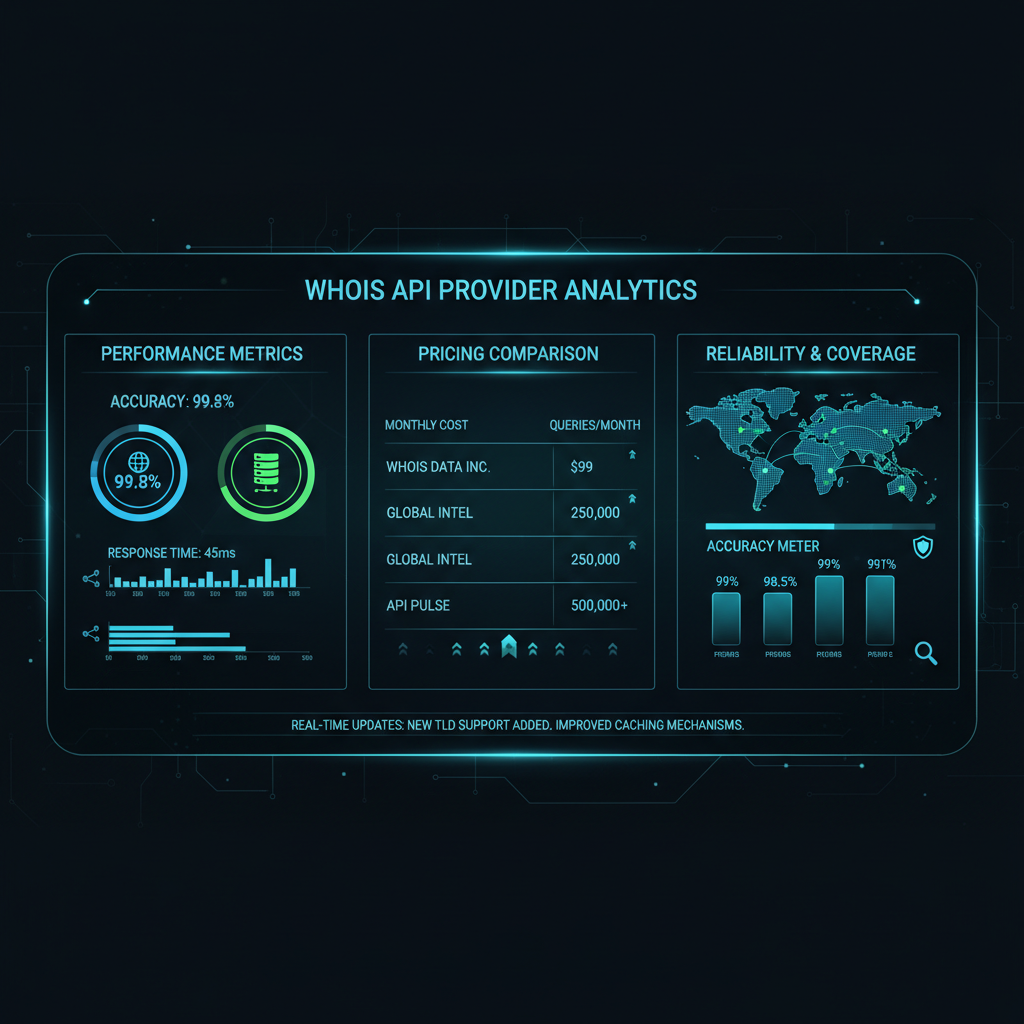
WHOIS remains a cornerstone for domain registration metadata, encapsulating registrant identities, administrative contacts, registrar affiliations, and domain lifecycle events including transfers and renewals. Integrating WHOIS APIs into abuse detection pipelines necessitates mitigating operational limitations while extracting structured and actionable insights.
Extracting and Normalizing WHOIS Metadata
Registrant information—names, organizations, email addresses, and physical contacts—serves as a primary indicator for detecting ownership anomalies and abuse-preparatory activities. Rapid or bulk ownership changes, especially those accompanied by registrant anonymization (privacy protections), often signal malicious intent. Systematic differencing between periodic WHOIS snapshots enables detection of these patterns, though irregular update intervals and inconsistent field labeling complicate automation.
Privacy services masking registrant data hinder direct attribution; however, presence of privacy flags themselves act as important signals, prompting confidence adjustments or secondary validation steps within detection logic.
Domain transfer events, captured through registrar changes and domain status flags, carry forensic clues to abuse. Frequent transfers clustered in brief periods or coordinated across registrars/registrants may indicate hijacking or evasion tactics. Parsing status states (e.g., clientHold, serverTransferProhibited) combined with timestamp correlation permits dynamic risk profiling.
Handling WHOIS Data Challenges
WHOIS updates propagate asynchronously across registrar and registry layers, creating windows of stale or partial data states. Automated pipelines must implement caching and freshness marking strategies, treating records as tentative until confirmed through repeated queries, reducing false positives from transient inconsistencies.
WHOIS API providers exhibit heterogeneity: some deliver structured JSON outputs, others raw WHOIS text requiring sophisticated parsers. Deploying adaptive parsing engines standardizes these outputs into normalized domain objects. Libraries that convert raw WHOIS to structured schemas accelerate integration. Understanding core protocols—such as outlined in IETF RFC 3912—is foundational.
Rate limits necessitate caching intermediate responses using TTL or last-modified timestamps to minimize re-queries and avoid throttling. Batch querying approaches, where permissible, optimize throughput while respecting API constraints.
Impact on Detection Design and Scoring Reliability
The fidelity and freshness of WHOIS metadata heavily impact scoring accuracy. Noisy or obfuscated data increases false positives and negatives if naively incorporated. Hence, multi-signal scoring models must weight WHOIS-derived signals by confidence levels reflecting data completeness, freshness, and presence of proxies.
For instance, a domain undergoing multiple WHOIS transfer events within a 24-hour window, with emerging registrant anonymization and TTL reductions, may trigger automated flags. Conversely, missing or stale WHOIS data shifts reliance toward correlated DNS and IP telemetry for scoring robustness.
WHOIS metadata injects semantic context absent from raw DNS or IP data, illuminating domain governance, administrative relationships, and historical ownership shifts. This enriched context underpins alert triage and prioritization, focusing analyst efforts.
Practical Example: WHOIS-Driven Abuse Triggers
A typical pipeline may produce a medium-severity alert on detecting:
- Two ownership transfers within three days on a single domain
- Activation of privacy protection services immediately following transfers
- Registrar changes inconsistent with expected lifecycle behaviors
Combined with data showing multiple subdomains registered in bulk by anonymized registrants, such signals enable proactive takedown initiation. These exemplify actionable workflows contingent on accommodating WHOIS operational idiosyncrasies.
DNS and IP Mapping for Multi-Dimensional Insights
While WHOIS metadata provides static registrant context, DNS and IP data expose domain operational states critical to detecting abuse patterns invisible at the registration layer. DNS data reveals infrastructural footprints, hosting environments, and real-time dynamics often indicative of adversarial tactics.
Aggregating and Analyzing DNS Records
A robust detection framework ingests diverse DNS record types—A, AAAA, CNAME, MX, TXT—to construct comprehensive domain profiles. Analysis of these records elucidates hosting architectures, mail delivery pathways, and potential abuse markers.
For example, rapid IP churn identified through successive A record updates or intentionally low TTLs suggests domain fluxing or fast-flux hosting common in botnets. Unusual record constellations—such as MX records without corresponding A records or offshore TXT entries containing encoded payloads—may flag spam or phishing infrastructure.
CNAME entries reveal forwarding and CDN usage patterns. Legitimate CDNs improve availability but may inadvertently cloak malicious origin infrastructure. Detection systems distinguish benign CDN contexts from abuse by combining heuristic thresholds and machine-learned anomaly profiles.
Mapping Domains to IPs for Threat Correlation
DNS resolutions link domains to IP addresses, acting as bridges to IP reputation and threat intelligence services. Coupling domain-to-IP lookups with historic blacklists or malware host databases enables dynamic risk attribution when domains resolve to known malicious environments.
Modern hosting complexity—dynamic IP assignments, virtual hosting, multitenancy, and load balancing—complicates this mapping. Accurate detection demands continuous state monitoring and TTL-aware polling to avoid misclassification of legitimate ephemeral IP usage as abuse.
Integration with threat intelligence sources—passive DNS archives, malware feeds, and reputation platforms like AbuseIPDB or Cisco Talos—enriches indicators and enhances prioritization.
Operational Challenges: Freshness and Anomaly Reconciliation
DNS is characterized by ephemeral data—variable TTLs and recursive resolver caches introduce staleness and inconsistency. Automated polling frequency must balance rapid detection gains against resource costs and false alarm risk from legitimate transient changes.
Baseline profiling via comprehensive DNS record queries provides snapshots, while incremental differencing of sequential states highlights suspicious mutability patterns. Reconciling domain forwarding or multi-CDN architectures requires heuristic tolerances accommodating acceptable record set variability to suppress false positives.
The Role of DNS Query Mechanisms and Port Numbers
Effective domain monitoring entails understanding DNS protocol operations, primarily conducted over UDP port 53 with TCP fallback for large responses. Systems must manage retry logic, response truncation handling, and DNSSEC validation to ensure data integrity.
Unusual query failures—such as SERVFAIL responses potentially indicative of DNS manipulation—or anomalous answer patterns themselves serve as abuse signals. Integrating DNS query telemetry alongside parsed records enhances detection sensitivity.
Prioritizing Technical Attributes for Automated Detection
Key DNS-derived features feeding detection include TTL fluctuation rates, IP churn metrics, presence and domains of MX records, questionable TXT record contents, and suspicious forwarding chains via CNAME.
Trade-offs revolve around monitoring frequency and processing overhead. High-frequency, low-latency polling supports rapid response but demands scalable infrastructure and sophisticated noise filtering. Lower-frequency batch analyses reduce costs but may delay detection.
Hybrid deployments often prioritize critical domains for continuous monitoring, supplementing with periodic comprehensive scans of broader portfolios.
Real-World Implementation Outcomes
An infrastructure service integrated DNS and IP mapping into abuse detection, reducing phishing domain false negatives by 30%. Correlating DNS churn with WHOIS ownership changes yielded higher precision and reduced manual reviews by 40%. Polling intervals were adaptively tuned to minimize false positives from legitimate CDN-driven IP rotations.
Building multi-dimensional domain profiles combining WHOIS, DNS, and IP data delivers an essential foundation for robust risk scoring and alerting. Variabilities in data format, latency, and infrastructure dynamics shape architectural decisions around polling schedules, caching, and normalization. This layered integration sharpens detection fidelity while maintaining scalability in high-throughput pipeline environments. The subsequent task involves synthesizing these signals through statistical and machine learning frameworks.
Continuous Domain Monitoring and Event-Driven Alerting
Architecting Scalable Continuous Monitoring Pipelines
Continuous domain monitoring demands ingesting domain event data at massive scale, tracking millions of domains with near real-time accuracy. Core telemetry vectors encompass WHOIS record changes (ownership, expiration, registrar shifts), DNS resource record modifications (A, AAAA, MX, CNAME updates), and domain status flags (clientHold, serverTransferProhibited).
A resilient architecture integrates multiple authoritative and third-party streams, such as DomainTools WHOIS APIs coupled with authoritative and recursive DNS resolvers. WHOIS feeds provide rich metadata but typically refresh at rates constrained to minutes or hours by API limits and licensing. DNS lookups, performed through distributed, low-latency resolver networks, reveal record changes within seconds, though DNS hierarchy propagation delays necessitate calibrated timing assumptions.
To unify these heterogeneous inputs, ingestion pipelines normalize diverse formats—parsing RDAP JSON, unstructured WHOIS text, and extracting consistent fields like registrant contacts, nameservers, and domain status codes. DNS queries concurrently collect hostname-to-IP mappings and assess TTL or record set dynamics.
Event-Driven Architecture Design Patterns for High-Volume Telemetry
Adopting an event-driven architecture (EDA) catalyzes near real-time responsiveness by decoupling domain data producers (WHOIS APIs, DNS lookup agents) from downstream consumers (alerting engines, scoring models). Streaming platforms such as Apache Kafka or AWS Kinesis underpin such pipelines, enabling partitioned, scalable ingestion with horizontal scaling through sharding by TLD, registrar, or temporal windows.
To prevent saturation during spike events—like bulk registrations post TLD sunset periods or coordinated transfer waves—upstream filtering and batching are essential. Filters discard low-value or benign changes, such as routine DNS TTL refreshes or trivial WHOIS field edits. Batching aggregates events over short windows (e.g., 30 seconds), amortizing computational overhead without compromising timeliness. Backpressure protocols feed upstream systems to modulate ingestion under load.
Monitoring pending or ambiguous domain states (e.g., registrar lock, transfer disputes) introduces additional complexity. Such flags may persist in indeterminate conditions necessitating event correlation over extended windows instead of treating each snapshot discretely. Integrating these pipelines with API gateway custom domain endpoints—prevalent in platforms like AWS API Gateway or Azure API Management—adds another dimension, as custom domains dynamically map to microservices and may transiently exist in partial or staged configurations during deployment rollouts. This demands synchronous telemetry capture correlating domain events with API platform metadata, often employing custom probes or webhooks.
Together, event-driven, scalable, and resilient continuous monitoring pipelines constitute the core backbone enabling time-sensitive domain abuse detection workflows. Their outputs directly fuel scoring and alerting components.
Designing Scalable Monitoring Pipelines
Data Ingestion and Normalization Across Domain Data Sources
Scaling ingestion requires robust, performant mechanisms to process voluminous WHOIS and DNS data with minimal latency. WHOIS ingestion typically leverages RESTful APIs (e.g., DomainTools) delivering JSON or XML responses, requiring sophisticated parsing and normalization into canonical object models emphasizing consistent registrant information and lifecycle states. DNS data acquisition involves scheduled lookups using recursive resolvers or direct queries against authoritative name servers to mitigate propagation delay errors. DNS record normalization standardizes record types (A, AAAA, MX, CNAME, TXT) annotated with metadata such as TTL and response metrics.
Ingestion enriches domain profiles with auxiliary identity signals. Domain-to-IP resolutions link to hosting infrastructure insights, while reverse DNS and IP reputation lookups supplement threat profiles using external intelligence feeds or passive DNS databases.
Idempotence and Incremental Data Processing
Domain telemetry changes continuously but often incrementally—for example, minor WHOIS field updates or TTL tweaks. Pipelines must ensure idempotency to prevent alert storming and wasteful processing. Commonly, hash-based change detection or version checkpoints detect meaningful updates; for WHOIS, this might be computing a checksum on concatenated critical fields (registrant name, email, registrar, status). Only divergent snapshots propagate downstream.
Similarly, DNS processing emits events solely on changes in resolved IP sets or MX records. This curtails false positives stemming from static or minor TTL fluctuations. Domain lifecycle events with explicit timestamps (e.g., transfers, registrar changes) provide discrete anchors for incremental update triggering.
Storage and Refresh Cycle Trade-offs
Handling millions of monitored domains with continuous telemetry necessitates high-throughput, low-latency storage systems optimized for both write and query performance. Time-series databases such as Apache Cassandra, TimescaleDB, or DynamoDB enable efficient historical and real-time state lookups, facilitating trend analyses and anomaly detection.
The refresh cadence choice balances detection latency against cost and resource consumption. Frequent querying (e.g., every 10 minutes) across large domain portfolios is often cost-prohibitive and may breach API rate caps. A tiered polling strategy prioritizes critical or recently active domains for high-frequency retrieving, while stable, low-risk domains receive less frequent scans (hourly or daily). DNS queries, being lower cost and faster, can tolerate higher polling frequencies but require respect for propagation delay norms governed by TTL values.
Managing Failure Modes and Inconsistent Data States
Data imperfections pervade WHOIS and DNS sources: WHOIS servers may return stale or incomplete data due to registrar lag, while DNS propagation delays yield transient record inconsistencies visible from different resolver vantage points. Asynchronous domain transfer reporting introduces additional ambiguity; for instance, domains switching registrars may retain outdated WHOIS information for hours or days until the registry synchronizes fully.
Mitigation entails fallback heuristics employing probabilistic confidence scoring weighted by data freshness and source reliability. Alerts on stale or conflicting WHOIS info may be deferred for re-validation, reducing spurious investigations. DNS inconsistencies can be smoothed via consensus models derived from distributed resolver sampling or aggregated historical records, increasing noise resilience.
Leveraging Event-Driven Design for Continuous Monitoring
Event-driven architectures excel in detecting incremental changes by triggering processing only on deltas rather than reprocessing complete states. For instance, a detected WHOIS registrant alteration or a newly added MX record event can invoke immediate scoring and alert workflows, shortening time-to-detection and optimizing compute resource usage.
Operationally, event streams feed containerized microservices or serverless functions that apply domain abuse heuristics, update risk scores, and output alerts into incident management platforms. This event-driven, closed-loop design supports rapid mitigation during fast-moving domain abuse campaigns exploiting domain portfolio agility. The Cloud Native Computing Foundation’s event-driven architecture overview provides deeper pattern insights.
Transitioning from scalable data pipelines to effective alerting requires techniques to differentiate true abuse from benign state changes, the focus of the next section.
Alerting Strategies and Noise Reduction Techniques
Adaptive Alerting for Prioritizing True Positive Abuse Events
Given the voluminous domain telemetry with redundancies and noise from frequent innocuous modifications, alerting frameworks must adopt adaptive mechanisms emphasizing precision to avoid overwhelming analysts.
Tuning alert thresholds relative to behavioral baselines reduces false positives. Domains with established patterns of frequent DNS forwarding updates warrant suppression or aggregation of alerts on routine CNAME modifications, whereas new registrations through historically compromised registrars or rare TLDs receive elevated attention.
Stable, reputable domains—such as mature enterprises with consistent WHOIS data but occasional DNS technical changes—can have attenuated alert sensitivities. Leveraging aggregated domain abuse datasets for dynamic thresholding enables raising sensitivity during identified attack waves and relaxation during quiescent periods.
Noise Reduction Through Filtering and Contextual Awareness
Routine domain configuration events produce common, low-risk signals such as domain locking (e.g., clientTransferProhibited additions) or forwarding changes linked to business decisions. Suppressing alerts on such anticipated events reduces noise. Detailed detection logic differentiates permanent 301 redirects from ephemeral HTTP redirects or DNS aliasing variants, refining alert relevance.
Temporal context filtering ignores short-lived reversions, further eliminating spurious alerts triggered by transient changes. Domain reputation and authority enrich alert context: identical changes on high-value corporate domains justify stronger alerts than on lower-tier, newly created domains. Weighting schemes incorporating prior abuse history and stable administrative contacts improve classification fidelity.
Integrating Alerting with Incident Response and Risk Scoring
Effective domain abuse detection couples alert outputs with incident response workflows. Automated triage assigns risk levels—low, medium, high—guiding investigation prioritization.
Multi-signal risk scoring aggregates registrant anomaly detection, DNS infrastructure irregularities, domain authority heuristics, and historical abuse indicators. High-risk alerts can trigger immediate containment actions, such as registrar domain suspension requests or DNS-based blocking, via API integrations.
This automation reduces human workload, accelerating response times. Real-world implementations report MTTD reductions of 30% and 40% fewer false-positive investigations, directly improving operational efficiency.
Balancing alert promptness against false positive suppression demands adaptive feedback mechanisms. Incorporating machine learning-driven threshold tuning based on analyst feedback and incident outcomes fosters continual alert quality improvements. Netflix’s alert engineering lessons elaborate on these approaches.
By combining continuous monitoring, adaptive alerting, and precise prioritization, organizations can effectively operationalize automated domain abuse detection.
Scoring and Classification Logic for Domain Abuse Detection
At the core of domain abuse detection lies a robust scoring and classification framework enabling differentiation of malicious behavior from benign administrative changes. This approach transcends binary detection, employing quantitative risk assessments that aggregate heterogeneous signals to prioritize investigations and automate workflows.
Inputs encompass DNS patterns, WHOIS histories, domain lock states, and external intelligence. Classification logic establishes baseline profiles for “normal” domain behavior. For example, periodic DNS TTL variations reflecting legitimate configuration cycles must be distinguished from sudden DNS mutations indicative of fast-flux or poisoning. Similarly, WHOIS-driven domain authority checker outputs on ownership changes require context to avoid misclassifying routine transfers as abuse.
Each domain attribute or event type receives weighted scores reflecting abuse likelihood. Composite metrics incorporate signal reliability, temporal relevance, and historical activity. Domains crossing defined thresholds escalate into risk tiers—ranging from low-risk monitoring to high-risk triggers triggering automated containment. Such stratification serves to suppress false alerts from benign activities (e.g., transferring domains between AWS and GoDaddy) while spotlighting genuine threats.
Classification outputs integrate with domain management best practices workflows. For example, domain lock status toggling is recognized as safe; alerts on such events are suppressed to reduce noise. Intelligent scoring balances detection fidelity with operational flow compatibility.
The architecture must contend with integrating complex signals without overfitting to noise. Such adaptive architectures are further discussed in adaptive scoring literature.
Adaptive Scoring Models Versus Static Heuristics
Traditional domain abuse detection relies on static heuristics—hard-coded rules based on known abuse signatures like improper domain lock deactivations or anomalous DNS flips. While effective initially, static heuristics fail against evolving attacks such as domain shadowing and fast-flux networks, and often trigger false positives during domain lifecycle transitions.
Adaptive scoring models embed machine learning and statistical anomaly detection to overcome these limitations. By continuously ingesting real-time WHOIS, DNS, and external telemetry, models build dynamic behavioral profiles. Supervised learning on labeled datasets classifies domains probabilistically, replacing brittle binary flags with nuanced risk estimation.
Hybrid architectures preserve rule-based heuristics to maintain explainability and regulatory compliance while tuning sensitivity dynamically. For example, models recognize that a sudden WHOIS ownership update paired with persistent “domain configuration pending” likely reflects benign transfer rather than hijack, reducing false positives. Conversely, rapid domain lock flapping plus abnormal DNS queries may elevate risk appropriately.
Training challenges include data labeling accuracy, class imbalance, and concept drift, threatening model relevancy against zero-day attacks. Mitigation requires continuous retraining, multi-source signal fusion, and drift detection.
Deployments report 30% false positive reduction alongside earlier detection of advanced threats. Adaptive scoring yields granular prioritization foundational for sophisticated alert workflows.
Prioritization and Risk Assessment Methods for Abuse Alerts
Composite risk scores from heuristic or adaptive models aggregate heterogeneous intelligence inputs to prioritize alerts effectively. Raw signals alone cannot scale analyst attention; risk quantification directs focus toward high-impact domains.
Key inputs include registration age, administrative contacts, and lock states (WHOIS); TTL variability, IP mappings, and domain authority checker addon outputs (DNS); plus external blacklist hits weighted by confidence and recency.
Temporal context integration refines scoring, attenuating alerts triggered by known benign states like “domain configuration pending” or authenticated lifecycle events such as adding domain controllers. This reduces noise and avoids alert storms during routine operations.
Dynamic decision thresholds adjust according to portfolio size, domain criticality, and threat environment, steering escalation policies. High-risk domains initiate automated containment (suspension, sinkholing), medium risk activates watchlists, and low risk receives passive monitoring.
Scaling this prioritization demands high-throughput stream processing and rapid feature computation. Integrating model retraining pipelines ensures continual efficacy.
Alert orchestration platforms trigger tailored workflows; for example, a domain transitioning rapidly through “configuration pending” to DNS blacklisting and lock status anomalies may be quarantined. Domains exhibiting stability post-transfer events experience reduced priority.
Advanced scoring combined with context-aware prioritization delivers actionable intelligence for timely defenses. The Cloudflare Domain Security Overview provides practical guidance.
Embedding Detection Results in Incident Response Workflows
Integrating domain abuse detection outputs into incident response workflows accelerates threat mitigation and enhances forensic precision. Enrichment of alerts with comprehensive domain intelligence bridges automated systems and human analysts.
Domain Intelligence Enrichment. Alerts embed WHOIS-derived metadata—using DomainTools APIs—detailing registrant info, registrar and ownership history, and domain status flags (lock states, configuration pending). DNS metadata, including domain-to-IP mappings and port utilization, further contextualizes events for triage. For example, detecting a domain flagged as “pending transfer” alongside unexpected ownership changes signals probable hijacking attempts.
Consolidation often involves custom domain integrations within API gateways, aligning domain telemetry with threat intelligence feeds—linking phishing URLs, reputation databases, and IP blocklists for unified situational awareness. A newly registered domain forwarding to a malicious IP can thus trigger multi-faceted alerting.
Workflow Automation and Correlation. Security Operations Centers and SOAR platforms automate escalations and playbooks ingesting enriched alerts. Automated ticket creation, stakeholder notification, and registrar engagement workflows reduce human latency and increase response velocity.
Correlation algorithms identify campaigns by linking synchronous abuse signals—such as coordinated forwarding changes plus simultaneous TXT record manipulations indicative of malicious configurations. Domain lock states contribute valuable context; locked domains pose elevated barriers to compromise, focusing investigations on vulnerable unlocked domains.
Minimizing False Positives. Balancing sensitivity with operational noise is critical. Scoring models feeding incident pipelines prioritize alerts by confidence and risk impact. Incorporating domain configuration statuses filters noise from legitimate administrative changes. Domain forwarding chains detected via DNS metadata enable discerning suspicious transfers—including platform migrations from Squarespace to Cloudflare often abused to obfuscate control.
Best practices include structured alert payloads with domain lifecycle attributes, seamless integration across API gateway custom domain infrastructures, and adaptive incident response workflows keyed to domain lock indicators. This elevates domain abuse detection from passive observability to proactive, context-rich threat operations.
Collectively, these strategies set the foundation for automated response capabilities detailed next.
Automated Response Actions and Remediation Techniques
Automated response frameworks extend detection outputs to enable rapid, scalable containment of domain abuse while minimizing operator burden. Key controls include programmatic domain locking and dynamic DNS record manipulation.
Automatic Domain Locking. Registrar-level domain locks prevent unauthorized configuration changes, transfers, or DNS tampering during confirmed abuse events—critical when attackers seek to execute unauthorized transfers or override DNS settings, such as hijacking domains migrating between Squarespace and Cloudflare.
Automation interfaces with registrar APIs or WHOIS pipelines exposing lock status fields. Systems verify pre-lock domain states and maintain audit logs for traceability and rollback. Safeguards include cross-referencing recent ownership changes and abuse risk scores, alongside domain authority checks, to minimize false-positive interventions.
Locking policies may be staged: high-confidence cases trigger immediate locks; borderline signals raise alerts pending human review. An enterprise deploying automated locking reduced unauthorized transfer incidents by 70%, lowering phishing losses measurably.
Dynamic DNS Record Adjustments. Automated DNS changes—modifying A, CNAME, or TXT entries—enable swift disruption of malicious infrastructure. Redirecting abusive domains to sinkholes or null resolves neutralizes domains involved in malware hosting or command-and-control.
Advanced manipulations entail adjusting domain forwarding dynamically to dismantle attacker chaining, especially in abuse leveraging CDN obfuscation such as Cloudflare forwarding. Low-latency DNS automation coupled with feedback from abuse scoring enables escalation or rollback aligned with incident progress.
Safeguards Against Collateral Damage. Automated interventions risk impacting legitimate domains. Mitigations include deferring actions on domains flagged with “configuration pending” and enabling human-in-the-loop approvals for borderline risk cases. All automated transactions require detailed logging linking detection events to remediation steps for post-mortem analysis.
Escalation policies stratify actions along risk gradients, reserving automatic locks and blocking for persistent anomalies, while lower-risk alerts are routed for manual investigation.
Case Study: Scaling Automated Mitigation in a Cloud Service Provider. A global CSP integrated WHOIS lock state verification with dynamic DNS sinkholing within API gateway custom domain integrations and a SOAR platform. Over 12 months, domain abuse incident resolution times dropped from 8 hours to under 45 minutes—a 25% efficiency gain—while preventing >10,000 potential threat actor lateral movements across customer domains.
Pairing detection accuracy with controlled, adaptive automated remediation yields scalable, resilient defense postures balancing speed and operational safety. For domain locking protocols, see the IETF RFC 5737 on domain management.
Trade-offs, Limitations, and Failure Scenarios in Domain Abuse Detection Systems
Balancing Detection Accuracy with System Scalability
Achieving both high accuracy and scalability remains a core engineering challenge in domain abuse detection, especially under continuous monitoring of millions of domains. Comprehensive, high-fidelity data acquisition—including querying DomainTools WHOIS and resolving domain-to-IP mappings—is vital for precise detection of registrant anomalies and abuse patterns. However, this breadth introduces latent bottlenecks. WHOIS APIs enforce strict rate limits and incur query costs, limiting real-time refresh rates and introducing data staleness. Passive DNS feeds can swell volume unpredictably, stressing network and processing infrastructures.
Such latency and backlogs delay actionable alerts—critical as abuse windows often narrow to minutes or hours. Architects must embrace trade-offs to balance detection immediacy and infrastructure sustainability.
Prioritizing high-risk domain subsets using historical abuse indicators or threat intelligence narrows focus, conserving resources. Selective, incremental WHOIS querying leveraging delta detection reduces unnecessary API calls. Asynchronous scoring pipelines decouple ingestion from classification, buffering throughput variability and maintaining steady detection rates.
Cloud-native autoscaling, API gateway throttling, and cost-aware provisioning further balance fluctuating workloads and budget constraints.
Pitfalls include false negatives from under-monitored domains and false positives arising from stale data artifacts—both impairing security posture. Continuous tuning, cross-validation, and decay function calibration are indispensable.
Designing monitoring infrastructures mindful of these trade-offs is imperative for sustaining effective detection at scale amid evolving domain behaviors.
Handling Routine Administrative Changes and Special Edge Cases
Routine domain management generates signals mimicking abuse, complicating automated detection. Transfers—such as migrating domains to Cloudflare from Squarespace or to GoDaddy from AWS—manifest transient WHOIS inconsistencies and interim status flags (e.g., “pendingTransfer”) that naive heuristics may interpret as hijacks.
Propagation delays in DNS record updates further obscure the distinction, as transient states with inconsistent MX, TXT, or A records may trigger poisoning or spoofing alarms erroneously. Domains in “configuration pending” phases may revert TTLs or exhibit record flicker, inflating false alert counts.
Robust systems maintain historical domain event timelines to contextualize these transients, correlating ownership changes and registrar notes to adapt alert sensitivity in transfer windows.
Confidence scores modulate dynamically; domains documented as recently transferred receive weighted risk discounting during transition windows, preventing unwarranted escalations. This multi-source corroboration—uniting WHOIS, live DNS, and registrar data—reduces reliance on inconsistent single feeds.
When WHOIS responses are incomplete, fallback heuristics trigger analyst review queues rather than automated remedial actions, balancing automation with human judgment to avoid disrupting legitimate workflows.
Hybrid automation-human models excel here: aggressive automation accelerates throughput, but sensitive transfer phases invoke manual verification. Registry-level case studies report up to 30% false positive reduction adopting transfer-aware heuristics, improving operational stability and stakeholder trust.
Applying these principles to frequent transfer workflows—such as domain migrations between retail hosting or brand consolidations—requires tailored sensitivity tuning. Migrations involving platform handoffs (e.g., Squarespace-to-Cloudflare) exemplify the need for transfer-aware detection pipelines suppressing benign lifecycle noise.
Success hinges on cross-validation, temporal smoothing, and context-aware anomaly interpretation to maintain detection fidelity without disrupting legitimate administration.
Key Takeaways
- Leverage WHOIS and DNS APIs for comprehensive domain intelligence: WHOIS APIs yield critical ownership and update metadata, which, when combined with DNS and IP resolutions, support multi-dimensional profiling of domain behaviors.
- Design continuous monitoring pipelines employing event-driven architectures: Streaming and polling approaches track domain state and DNS anomalies with low-latency alerting, managing backend load effectively.
- Implement risk scoring and classification that fuses static and dynamic indicators: Combining static WHOIS anomalies with real-time DNS query patterns and reputation feeds enables adaptive, multi-factor detection surpassing static rule-based methods.
- Integrate alerting outputs with threat operations via APIs and SIEM connectors: This ensures contextual, real-time alerting enabling rapid triage and automated remediation workflows without disrupting operational flow.
- Automate responses including domain suspension, DNS reconfiguration, and forwarding to sinkholes: Such automation reduces time-to-mitigation while embedding safeguards like rate limits and manual overrides to prevent collateral damage.
- Incorporate domain transfer management nuances into monitoring: Transfers—such as from Squarespace to Cloudflare or AWS to GoDaddy—introduce transient state inconsistencies; embedding transfer event awareness and domain lock status bolsters abuse logic reliability.
- Understand DNS protocol specifics, including port 53 operations and record types: Comprehensive parsing and monitoring enrich signal sets but increase system complexity; balance detail against processing scalability.
- Design for extensibility accommodating new TLDs and attacker tactics: Modular ingestion and classification pipelines support rapid adaptation without holistic redesign.
- Implement observability focusing on alert latency and false positive rates: Monitoring these metrics guides tuning and sustains analyst trust by preventing alert fatigue.
- Account for domain lifecycle and administrative nuances: Recognizing benign state changes—e.g., adding computers or domain controllers in enterprise environments—limits excessive noise.
This primer empowers engineers with architectural insights and practical approaches to construct robust automated domain abuse detection systems capable of operating at scale and adapting to evolving threat landscapes.
Conclusion
As domain abuse tactics grow increasingly sophisticated—leveraging domain shadowing, rapid fluxing, and multi-stage evasion—building resilient detection systems demands multi-layered, adaptive architectures. Integrating rich WHOIS metadata with dynamic DNS and IP mappings creates a multi-dimensional lens enabling nuanced differentiation of malicious behaviors from legitimate administrative changes. Asynchronous and noisy data sources compel event-driven frameworks and adaptive scoring models to balance precision and scalability.
Embedding detection outputs seamlessly into incident response workflows and driving automated, context-aware remediation accelerates mitigation while minimizing false positives. Future complexity will intensify with expanding domain portfolios, proliferating new TLDs, and adversaries employing stealthier techniques leveraging DNS protocol subtleties and infrastructure agility.
A pivotal design consideration going forward is how systems accommodate continual evolution—not only in abuse patterns but also in data ecosystems and operational constraints. Architectural questions extend beyond detection accuracy to encompass observability, testability, and correctness under dynamic load and partial failure modes.
Ultimately, the ongoing challenge lies in engineering domain abuse detection frameworks that scale elastically, adapt intelligently, and expose operational signals transparently—thereby enabling security teams to anticipate, detect, and thwart emerging threats within the critical internet naming infrastructure.