Introduction
AI agent engineering in 2026 confronts a multifaceted challenge: constructing distributed, multi-agent systems that maintain reliability and responsiveness amid heterogeneous environments, resource constraints, and complex coordination demands. Traditional modularity is no longer sufficient when agents must simultaneously balance autonomy with global coherence, manage persistent and evolving state, orchestrate asynchronous workflows, and integrate external tools seamlessly—all while preserving observability and fault tolerance essential for real-world, production-grade deployments.
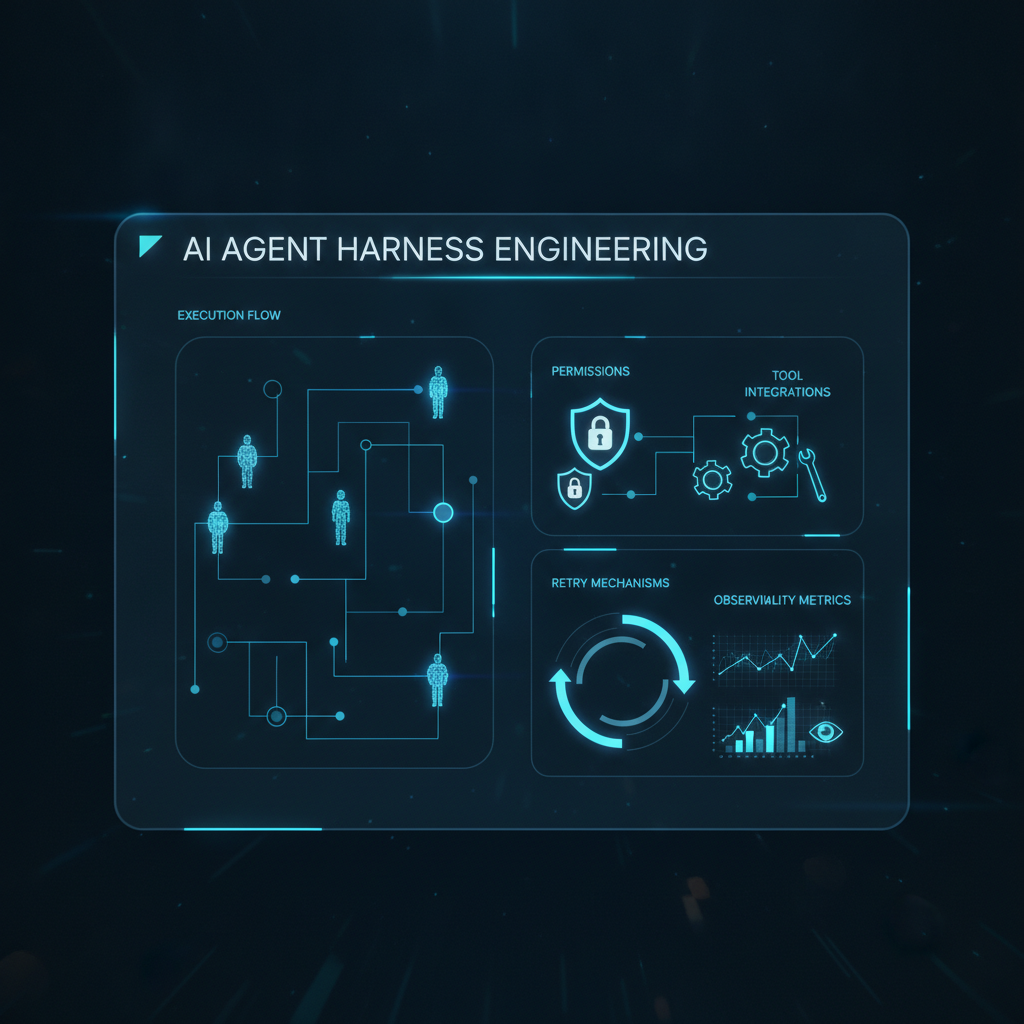
This article systematically examines the architectural trade-offs and orchestration patterns shaping modern AI agent frameworks. We dissect layered designs that isolate perception, reasoning, and actuation; memory architectures coupled with adaptive planning loops; and composable APIs engineered to control side effects in production environments. Emphasizing practical engineering decisions—such as managing latency-consistency trade-offs, architecting hierarchical coordination, and embedding human-in-the-loop controls—this treatment offers a grounded understanding vital for building scalable, maintainable AI automation platforms beyond proof-of-concept prototypes.
We now explore how these foundational principles coalesce to address increasingly demanding AI automation challenges, illustrated through detailed examples and case studies revealing the tangible costs and benefits of various design choices in today’s multi-agent ecosystems.
Fundamental Challenges in AI Agent Engineering
Complexities in Multi-Agent Coordination
Building multi-agent systems where AI agents operate as coordinated digital team members instead of isolated units presents profound engineering challenges. The central tension arises between maintaining agent autonomy—where each agent independently manages its local decision-making and goals—and ensuring global coherence aligned with system-wide objectives. This tension fundamentally shapes multi-agent system architecture, influencing communication protocols, synchronization mechanisms, conflict resolution strategies, and orchestration design.
A primary complexity lies in crafting communication protocols tailored for heterogeneous agents possessing diverse roles, capabilities, and authority hierarchies. Effective coordination extends beyond simplistic message passing to protocols that enable semantically rich exchanges, such as intention sharing, plan negotiation, and consensus on shared knowledge. Agent Communication Languages (ACL), rooted in speech act theory (e.g., FIPA-ACL), offer structured message semantics but entail overhead and rigid constraints often ill-suited to dynamic operational conditions like distributed monitoring or multi-robot systems. Scaled environments must manage communication saturation risks, employing layered protocols featuring contextual filtering, prioritization, adaptive compression, and role-based message routing—e.g., leader agents handling strategic directives while worker agents communicate execution status.
Synchronization and conflict resolution pose further intricate challenges. Multi-agent systems typically employ planning loops where agents cyclically propose actions, observe state changes, and revise plans. However, partial observability—arising from sensor limitations or asynchronous messaging—prevents agents from maintaining a holistic system state. Addressing this requires asynchronous algorithms, event-driven triggers, incremental plan refinement, and probabilistic consensus mechanisms rather than strict lock-step executions. Conflict resolution ranges from centralized arbitration—ensuring consistency but limited by scalability and single failure points—to decentralized negotiation, which fosters emergent collaboration at the cost of increased complexity, potential livelocks, or latency spikes. For instance, distributed trading platforms rely on centralized matching engines for order consistency, whereas decentralized drone swarms implement bio-inspired collision avoidance tolerating temporary inconsistencies to maintain agility.
Multi-agent orchestration explicitly encodes these trade-offs. Centralized planners facilitate global optimization, priority enforcement, and simplified state management, favoring use in critical infrastructure with limited agent counts (e.g., power grid control). Yet, their lack of fault tolerance and scalability necessitates augmentation through local fallback controllers and hierarchical planning. Conversely, decentralized emergent coordination, realized via consensus protocols (Paxos, Raft), market-based task allocation, or stigmergy-inspired methods, scales naturally, tolerates partial failures, and enables dynamic adaptation—but demands sophisticated agent logic to avoid deadlocks or starvation. Hybrid arrangements, such as Amazon Robotics’ fleet orchestrating, combine centralized traffic control with distributed task execution to balance latency and robustness. For comprehensive details on consensus mechanisms, the Paxos and Raft protocols documentation remains authoritative.
State management frameworks form another critical dimension. Handling asynchronous updates and partial observability typically involves shared ontologies or distributed ledgers achieving eventual consistency. This approach demands synchronization heuristics, conflict detection, rollback strategies, and careful versioning to reconcile divergent agent views. Autonomous vehicle platoons demonstrate the necessity for adaptive state alignment techniques to prevent dangerous desynchronization. Deadlocks from circular wait conditions during resource allocation are mitigated via timeouts, priority escalation, and rollback embedded in coordination protocols.
Misconceptions around coordination abound. A pervasive fallacy holds that naive message passing—for instance, relaying unstructured sensor data or status—suffices for coordination. In reality, uncontrolled communication fosters bottlenecks, inconsistent states, and brittle systems. Neglecting agent heterogeneity—differences in compute resources, communication reliability, or command authority—exacerbates coordination failures; less capable agents can become overwhelmed, and dominant agents risk creating bottlenecks or single points of failure.
In summary, multi-agent system architecture and AI agent orchestration require tightly integrated designs balancing autonomy and collective behavior. Communication protocols must support expressivity and scalability, synchronization must embrace asynchrony and partial observability, and orchestration layers explicitly negotiate centralization for fault tolerance and scalability. Mastery of these complexities is essential to avoid cascading failures, inconsistent states, or deadlocks in demanding production domains encompassing logistics, autonomous mobility, and financial systems. These foundational coordination principles directly inform subsequent challenges in deploying AI agents under constrained and unreliable infrastructure.
Resource Constraints and Reliability in Distributed Agents
Transitioning from coordination, operational realities impose additional engineering constraints: AI agents deployed in distributed, resource-constrained environments must meet stringent reliability standards while managing heterogeneous computational, network, and power envelopes.
Resource limitations span compute capacity (CPU, GPU, memory), network latency, bandwidth, and throughput ceilings, critically impacting agent responsiveness and system agility. For instance, edge AI agents in IoT deployments or autonomous drones run on limited hardware, constrained by energy and form factor, making local inference and lightweight processing paramount. Techniques such as model compression, pruning, and quantization optimize performance, offloading heavier inference or learning tasks to cloud services. However, offloading introduces latency and jitter, complicating closed-loop control and rapid decision-making, prompting hybrid architectures with predictive local models and caching of global states. An automotive example involves splitting perception and planning pipelines between onboard units and edge servers to meet 50 ms control loop requirements for vehicle-to-infrastructure communication.
Architectural trade-offs center on balancing local low-latency responsiveness with global state freshness. Local agents excel in responsiveness but risk stale global context, potentially causing unsafe or suboptimal decisions. Cloud orchestration sustains global optimization at the expense of latency and single points of failure. Common mitigation patterns include approximate state synchronization, periodic snapshots with delta updates, and hierarchical planning layers segregating local tactical decisions from global strategic coordination. System scalability hinges on these architectures, necessitating careful consideration during design.
Fault tolerance is integral and multi-dimensional. Checkpointing and state replication enable crash recovery and rapid failover. For example, autonomous factory floor agents checkpoint state aligned with control milestones, reducing disruption during failures. Consensus protocols (Paxos, Raft) enforce consistency among replicas, maintaining shared state coherence despite unreliable networks. Graceful degradation is essential: agents detect failures via health-check heartbeats and dynamically assume responsibilities or adjust global plans to maintain availability. Distributed sensor networks reassign coverage proactively to address node failures.
Consistency models have evolved beyond strict linearizability, which incurs high latency and availability trade-offs. Many systems adopt eventual or causal consistency, augmented by Conflict-free Replicated Data Types (CRDTs) to maintain consistent shared states without lock-step coordination. Balancing consistency, availability, and partition tolerance (CAP theorem) remains nuanced, with systems imposing stronger guarantees at actuator interactions while relaxing consistency in informational layers, e.g., retail recommendation engines employing asynchronous state propagation with reconciliation.
Production incidents affirm these concerns. In industrial robotics, network partitions led to conflicting actuator commands from stale states, causing equipment damage; resolution involved version vectors and leader election enabling safe consistency during partitions. Cloud throttling delayed responses in multi-agent traffic routing, inducing reroutes and failures; solutions deployed adaptive load shedding, enhanced monitoring, and edge-side cached planning fallbacks.
Operations roles are critical for sustaining reliability. Engineers deploy monitoring dashboards aggregating agent health metrics, anomaly detection models powered by meta-learning, and automated rollback capabilities integrated with continuous delivery pipelines. Automation also dynamically adapts agent resource consumption responding to network and computational load fluctuations, enhancing robustness. For comprehensive tooling strategies, see Google Cloud’s best practices on multi-agent telemetry.
In summary, resource constraints and reliability imperatives fundamentally shape AI agent architectures and operations. Balancing computational limitations, latency, fault tolerance, and consistency demands a holistic mindset that aligns agent autonomy with systemic resilience and scaling. These insights inform multi-agent coordination frameworks’ design, enabling maintainable and robust systems at scale that function reliably in diverse operational conditions.
Architectural Patterns for Modern AI Agent Frameworks
Building on foundational challenges of coordination and reliability, the architectural patterns underpinning modern AI agent frameworks embody modularity, scalability, and robustness. These structured patterns partition complexity, enabling maintainable and extensible agent ecosystems delivering production-grade reliability across heterogeneous domains.
Modern AI agent frameworks converge on decoupling key responsibilities—perception, reasoning, and actuation—within autonomous agents, facilitating independent development, testing, and optimization. This modularization is critical as agents scale from isolated implementations to coordinated collectives, where coupling introduces disproportionate complexity. Layered designs, event-driven pipelines, and service-oriented components structure agents for graceful integration with heterogeneous sensors, external tools, and platform services, while providing well-defined extension points. These frameworks mature into comprehensive AI agent building platforms emphasizing component reuse, parallel development workflows, and real-time agility.
Examples include Meta’s Merlin and emerging OpenAI agent-centric SDKs, offering modular plugins that isolate perception, reasoning, and actuation, interconnected by clear APIs. Such platforms simplify iterative design, support runtime scaling across distributed cloud and edge environments, and empower complex projects like robotics fleets or digital assistants operating in hybrid infrastructures. Modular architecture enhances robustness by isolating failure domains—perception or actuation modules can be hot-swapped or degraded independently, sustaining availability SLAs expected in commercial deployments.
From this architectural foundation, we next examine the most influential architectural pattern: layered designs that separate perception, reasoning, and actuation.
Layered Designs Separating Perception, Reasoning, and Actuation
Layered architectures remain the definitive blueprint for contemporary AI agent systems, partitioning functionality into three distinct layers: perception, reasoning, and actuation. This explicit separation provides clear interface contracts and modular boundaries facilitating independent evolution, debugging, and optimization of each component.
Perception involves ingesting and processing sensor inputs—spanning vision, audio, text, and complex telemetry fusion. It abstracts raw, noisy data streams into symbolic or vectorized representations suitable for downstream consumption. For example, perception modules may combine multimodal transformers for natural language processing with convolutional neural networks for computer vision, unifying disparate sensory modalities into semantic embeddings.
Reasoning encompasses core decision-making constructs: planning, inference, learning, and policy execution. It interprets perception outputs in the context of internal models, goals, and memory, generating actionable directives. Reasoning components range from symbolic logic engines to reinforcement learning modules and probabilistic planners, outputting commands or strategic objectives.
Actuation converts reasoning outcomes into commands controlling effectors—robotic limbs, software APIs, or UI actions—translating intent into concrete interaction with the environment.
This layered decomposition conveys critical engineering benefits:
- Clear Interface Boundaries: Modular components expose minimal, explicit contracts, enabling concurrent development by specialized teams. For instance, perception improvements (e.g., novel vision architectures) can be integrated independently of reasoning logic, accelerating innovation cycles.
- Maintainability and Fault Isolation: Isolated layers simplify fault detection and containment, reducing cascading failures. Multi-agent systems can share reasoning policies while adapting perception and actuation modules tuned to heterogeneous hardware, facilitating heterogeneous fleet management.
- Scalability Across Diverse Agents: Advancing sensor modalities or actuator technologies impacts only relevant layers, minimizing systemwide ripple effects. For example, retrofitting new LIDAR sensors affects perception modules exclusively without requiring reengineering of fleet-wide planning algorithms.
Strict layered decomposition trades off increased latency due to extra processing stages, serialization, and buffering. Latency-sensitive scenarios (autonomous driving, high-frequency trading) often adopt hybrid architectures merging perception and reasoning layers to reduce overhead while preserving modularity at a system level. Misconceptions that layering uniformly reduces overhead disregard these nuanced trade-offs between maintainability, responsiveness, and upgradeability.
Modern AI agent building platforms complement layering with visual composition tools, enabling drag-and-drop assembly of perception pipelines, reasoning graphs, and actuation sequences deployable on heterogeneous environments. This compositionality forms the backbone of scalable, robust AI ecosystems. For comprehensive design guidance, see Martin Fowler’s layered architecture article.
Having established modular layered architectures, the next critical design dimension is memory management and planning support enabling agents to reason adaptively over time.
Memory Architectures and Planning Loops in Agent Systems
Memory architectures serve as the cognitive substrate enabling AI agents to transcend reactive behavior toward context-aware, adaptive decision-making. The interplay between persistent and ephemeral memory defines how agents accumulate knowledge, adapt to changes, and collaborate in multi-agent settings.
Persistent memory retains long-term knowledge: learned policies, world models, and historical interactions. Architecturally, it often resides in distributed databases, knowledge graphs, or vector stores optimized for semantic retrieval. Agents may maintain user profiles, environmental maps, or task histories to support long-term learning and cross-session continuity.
Ephemeral memory holds transient, working data—immediate observations, intermediate inference results, and active plan fragments—optimized for fast, low-latency access within planning loops. This enables rapid decision cycles uninhibited by expensive data retrieval.
Managing both memory types demands hierarchical storage, caching, and partitioning strategies balancing retrieval latency versus capacity. For example, a drone fleet might cache recent sensor telemetry in-memory for immediate use while asynchronously persisting environment state updates to long-term stores.
Distributed multi-agent scenarios introduce synchronicity and concurrency challenges. Shared world states necessitate synchronization primitives or consensus protocols preventing staleness or conflicts. Conflict-free Replicated Data Types (CRDTs) provide eventual consistency with minimal coordination overhead. Lack of such controls risks divergent plans and action conflicts, undermining system coherence.
Central to agent reasoning are iterative planning loops—closed feedback cycles where agents generate, score, and refine candidate plans continuously. These loops integrate perception data and memory inputs to dynamically adjust goals and trajectories:
- Plan Generation: Compose high-level strategies or action sequences based on current states and objectives.
- Plan Evaluation: Score feasibility, risk, and cost using embedded models and heuristics.
- Execution and Monitoring: Carry out partial plans while observing environmental feedback.
- Feedback Integration: Update plans informed by perception and ephemeral memory to tackle uncertainty, obstacles, or failures.
Such iterative loops excel in dynamic domains—autonomous vehicles navigating variable traffic or industrial agents adjusting production lines. Leveraging structured memory prevents redundant failures, fosters learning, and enhances resilience.
Examples like Tesla Autopilot’s real-time replanning or warehouse AI teams managing inventory illustrate these principles. Systems applying hierarchical caching have documented up to 30% reductions in planning latency, directly impacting safety and responsiveness.
Developers benefit from graphical AI agent diagrams visualizing memory flows and planning pipelines, clarifying component interactions and expediting debugging for complex, production-grade agents. For detailed discussion, see the OpenAI Microscope analysis of agent architectures.
With established modular layering and adaptive memory frameworks, effective external interaction remains a critical factor, which leads us to composable APIs and side-effect control in practical deployments.
Composable APIs and Side Effect Control in Production Systems
As AI agents increasingly operate within heterogeneous software ecosystems, composing external tool invocations safely and reliably is paramount. Composable APIs provide a foundational pattern, enabling agents to orchestrate diverse capabilities—databases, schedulers, sensor frameworks—while controlling side effects and guarding system integrity under production workloads.
Designing these APIs requires adhering to minimal, expressive interfaces, exposing narrowly scoped operations with explicit input-output contracts. Such design minimizes accidental mutable state exposure, aids reasoning about operation costs, and enforces runtime policies governing service usage.
Crucially, side effect control governs interactions that alter external system states—such as updating databases, actuating machinery, or modifying service configurations. Unrestricted side effects risk cascading failure, data corruption, or inconsistent system states. Established engineering solutions in AI agent integration include:
- Transactional Execution: Wrapping tool invocations in atomic transactions that commit or rollback changes ensures system consistency even under failure scenarios.
- Sandboxing and Isolation: Running external tools in containers or restricted sandboxes limits resource access and mitigates spill-over risks, essential for invoking third-party or less-trusted services.
- Idempotency Enforcement: Designing API operations to be repeatable without unintended cumulative effects prevents duplication or state drift during retries or event replays.
Dynamic orchestration examples illustrate this: a healthcare scheduling agent might query knowledge bases, book appointment slots, and update patient records atomically. If any step fails, rollback or compensation occurs to maintain consistency.
Production pitfalls are well-documented: race conditions from concurrent API calls, resource contention among multiple agents vying for limited tools, and error cascade amplification require mitigation. Mature AI agent tooling integrates runtime monitoring and circuit breaker patterns to detect anomalies, throttle usage, and isolate compromised components dynamically.
Platforms offering comprehensive AI agent tool ecosystems deliver middleware abstracting such difficulties, ensuring predictable agent behavior despite diverse operational contingencies.
In aggregate, composable APIs with rigorous side effect management are pillars of large-scale, robust AI agent ecosystems, enabling teams of specialized agents to operate cohesively and safely.
Transitioning from tooling integration, human judgment remains irreplaceable in many contexts, prompting the incorporation of human-in-the-loop mechanisms to guard reliability and safety.
Human-in-the-Loop Mechanisms for Reliability and Safety
Despite advancements toward automation, critical junctures within AI agent workflows demand human oversight to manage ambiguity, ethical considerations, and safety-critical decisions. Integrating human-in-the-loop (HITL) architectures is essential to ensure reliability, accountability, and ethical compliance—anchoring AI agency in practical operational contexts.
Supervisory Control and Decision Gateways
Supervisory control integrates humans as gatekeepers wielding authority to approve, modify, or veto AI agent decisions prior to execution. Architecturally realized as decision gateways, these intercept actions with elevated risk—high-value financial transactions, autonomous overrides, or content publishing—pausing automatic execution until explicit human validation.
Gateways typically leverage AI agent uncertainty estimates or rule-based thresholds. Workflows exceeding confidence or risk boundaries route into human review queues, striking a balance between automation velocity and risk mitigation.
Escalation Triggers from Anomaly and Uncertainty Detection
Automated escalation frameworks underlie proactive HITL engagement. Agents continuously monitor outputs with anomaly detection models and out-of-distribution classifiers. Suspicious or unexpected inputs—e.g., model drift or inputs outside training distribution—trigger immediate human intervention.
Uncertainty quantification methods, including Bayesian inference or Monte Carlo dropout, empower agents to flag ambiguous decisions effectively. Automation engineers calibrate alerting thresholds to minimize false positives while ensuring safety coverage.
Interactive Feedback and Agent Retraining
HITL systems also serve as feedback loops, capturing expert corrections and commentary during human interventions. Interfaces allow domain experts to annotate, correct, or contextualize outputs, feeding continuous improvement cycles through retraining or incremental model updates. This process enhances calibration, reduces error rates, and bolsters adaptability.
Such retraining often occurs asynchronously to avoid inference latency impacts, embedding human expertise into evolving agent behavior.
Balancing Latency and Throughput
A pivotal engineering trade-off arises between automation throughput and latency introduced by human validation. To maximize efficiency without compromising safety, AI agent developers orchestrate prioritization and batching within review queues, ensuring urgent cases receive expedited attention without operator overload.
Effective HITL user experience design is critical—presenting concise, relevant information reduces cognitive load and mitigates operator fatigue, thereby lowering human error rates.
HITL Infrastructure and Auditing
Robust HITL pipelines embed human review interfaces tightly within agent orchestration layers. Dashboards convey visibility into pending tasks, historical decisions, and audit trails vital for compliance and forensic analysis. Role-based access controls enforce secure permissions, while tamper-evident logging safeguards data integrity.
Such infrastructure enables seamless transitions between autonomous and manual control modes, including fail-safe human takeovers during system anomalies or outages.
Skills and Responsibilities of Automation Engineers and AI Agent Developers
Implementing effective HITL safeguarding demands multifaceted expertise encompassing system architecture, UX design, operational workflows, security frameworks, and human factors engineering—complementing core AI and software development capabilities. Collaboration with domain experts, compliance officers, and end users shapes interventions aligned with organizational risk profiles.
Increasingly, AI agent developer roles emphasize HITL integration to balance automated efficiency with ethical responsibility, blending human judgment and machine precision.
Through these architectural and operational approaches, AI agents transcend automation, embedding nuanced human judgment essential for dependable and ethically sound deployment in complex operational environments.
Real-World Case Studies and Production System Insights
Case Study: Scaling Hierarchical Multi-Agent Frameworks
Large-scale hierarchical multi-agent systems (MAS) underpin diverse critical applications from autonomous logistics networks to adaptive smart environments. These architectures deploy layered control hierarchies where decentralized agent clusters execute localized tasks under supervisory overseers, enabling scalability beyond flat agent ensembles.
A primary engineering bottleneck arises from exponential growth in coordination overhead as agent populations increase. Each inter-agent interaction—state exchanges, command updates, goal negotiations—adds network latency and computational load. Production environments alleviate this via agent clustering: semantically or geographically related agents aggregate under local coordinators, reducing communication fan-out and consolidating control flows.
Complementary delegated control layers distribute decision responsibilities, with higher-level agents issuing strategic directives instead of micromanaging constituent states, optimizing CPU cycles and load balancing.
Latency-sensitive deployments—robotic fleets, financial trading systems—favor event-driven coordination, eschewing polling and broadcast in favor of event triggers over publish-subscribe protocols with guaranteed delivery semantics. Integration of lightweight message queues (e.g., Apache Pulsar, custom binary protocols optimized for AI pipelines) reduces asynchronous overhead and maximizes responsiveness. These align with best practices in event-driven architecture design.
State consistency presents ongoing challenges in scaled hierarchies. Systems employ eventual consistency augmented by conflict resolution intrinsic to agent frameworks. CRDTs and operational transformation techniques synchronize local agent states without heavy consensus protocols, preserving responsiveness. Checkpointing, snapshot isolation, and continual liveness verification empower supervisory agents to reroute tasks dynamically upon failure, sustaining fault tolerance.
Balancing centralized orchestration and decentralized coordination depends on operational context. Centralized orchestration simplifies global visibility and debugging but risks bottlenecks and single points of failure. Decentralized coordination scales and adapts but demands sophisticated coherence protocols. Hybrid models embedded in modern platforms incorporate agent registries, heartbeats, and policy-based scheduling, dynamically modulating centralization per load and fault conditions.
From a resource standpoint, agent complexity magnifies CPU and memory costs non-linearly. Mitigations include granular life-cycle management for unloading idle agents and resource-aware scheduling distributing workloads. Network layers leverage fabric optimizations, backpressure-aware protocols, compression, and zero-copy serialization—vital for high-throughput low-latency communication within AI agent pipelines.
Overall, scaling hierarchical MAS necessitates holistic engineering integrating architecture, communication, state, and resource management to enhance scalability, fault tolerance, and responsiveness—imperative for production AI agent developer roles.
Case Study: Memory and Planning Loop Implementations
Sophisticated memory architectures combined with adaptive planning loops constitute the cognitive core of advanced AI agents operating in dynamic, uncertain domains. Unlike stateless models, production AI agents require robust subsystems supporting structured knowledge retention and context-aware behavior over extended lifecycles.
Memory is architected along three axes: episodic memory (recording event sequences), semantic memory (encoding generalized facts and models), and working memory (holding transient decision-critical state). This layered model enables agents to recall specific histories, generalize patterns, and maintain immediate context critical for effective planning.
Implementations blend in-memory databases and durable storage, optimized for low-latency access ideal for iterative planning loops. These loops emphasize incremental replanning, balancing computational expense of global plan generation with the need for responsiveness. High-level global plans serve as strategic frameworks refined by local planners incrementally, improving efficiency.
Robust failure recovery leverages episodic memory indices to roll back invalidated plans to prior successful states, minimizing catastrophic outcomes. Integrated heuristic learning components identify failure patterns proactively, adapting planning strategies in closed feedback loops to enhance resilience.
Memory capacity and retrieval latency pose key trade-offs. Extensive episodic stores boost adaptability but increase lookup costs. Pruning policies employ relevance decay algorithms or reinforcement signals to contain growth. Indexing uses vector similarity search augmented by symbolic annotations, accelerating context-sensitive recall while managing overhead.
Integration requires serialized data formats, distributed consistency protocols, and synchronization semantics consistent with planning processes. Agents prioritize memory operations carefully to avoid stale or conflicting information, particularly in asynchronous event-driven settings.
This architecture forms the cognitive backbone of capable AI agents, transforming raw memory stores into actionable, adaptive cognition suited for production.
Operational Lessons in Tool Integration and Observability
Effective deployment of AI agent systems hinges on integrating diverse AI tools—NLP modules, knowledge graphs, feedback controllers—into coherent, observable pipelines. Complexity and heterogeneity introduce challenges spanning interoperability, observability, and incident diagnosis.
Operational experience highlights observability gaps as critical barriers to swift issue resolution. Teams implement layered monitoring incorporating health checks, synthetic transactions, and runtime profiling. Metrics span CPU, memory, API latency, queue depths, and custom agent-specific KPIs like task success rates and plan iteration counts.
Architectural safeguards include circuit breakers detecting anomalous tool behavior and triggering fallback procedures, preserving partial service in degraded modes despite upstream faults. Such patterns are vital when agent automation pipelines invoke third-party or SLA-bound external services.
Centralized observability platforms unify logs, traces, and metrics using AI-specific schemas. Correlating asynchronous message flows with event logs reveals bottlenecks or deadlocks in multi-agent interactions. Distributed tracing frameworks localize latency spikes to specific inter-agent or API call paths. These techniques resonate with modern observability engineering best practices.
Debugging frameworks with real-time session replay, coupling trace data with memory snapshots and plan states, improve forensic capabilities, addressing elusive behavioral anomalies.
Common failure modes include protocol mismatches, runtime dependency conflicts, and unintended side effects from agent composition. Mitigation entails rigorous schema versioning, containerized isolation, immutable infrastructure, and exhaustive integration tests simulating failure scenarios within continuous deployment pipelines.
Collectively, these operational strategies ensure tool integration and observability mature beyond experimentation toward sustainable production readiness, poised for advances in automated anomaly detection and self-healing.
Key Takeaways
- AI agent engineering in 2026 demands architecting modular, scalable, multi-agent systems integrating sophisticated coordination, memory management, planning, and robust tool integration, tailored to operate reliably under heterogeneous environments and resource constraints.
- Employ agentic engineering models facilitating explicit, hierarchical multi-agent coordination, balancing autonomy with global coherence to prevent communication bottlenecks and conflicts.
- Adopt layered agent architectures separating perception, reasoning, memory, and actuation to enable independent optimization, maintainability, and flexible scaling.
- Combine persistent, structured memory with iterative planning loops for adaptive, context-aware cognition, mitigating planning overheads and memory bloat through hierarchical caching and pruning.
- Utilize asynchronous orchestration patterns decoupling scheduling and execution to enhance throughput, fault tolerance, and horizontal scaling.
- Abstract external tool integration behind composable APIs with well-defined interfaces, robust monitoring, transactional safeguards, and side effect control to preserve system integrity.
- Incorporate human-in-the-loop mechanisms balancing automated throughput with safety and ethical oversight through supervisory controls, escalation triggers, and continuous feedback loops.
- Prioritize comprehensive observability leveraging fine-grained telemetry, distributed tracing, and anomaly detection to navigate emergent multi-agent complexity and diagnose systemic issues.
- Account for latency-consistency trade-offs explicitly—balancing strong consistency for critical workflows against eventual consistency for scalable, high-throughput state sharing.
- Design agent frameworks for modular extension, accommodating deployment heterogeneity in hardware, networking, and integration targets to future-proof systems.
- Evaluate AI agent building platforms rigorously on abstraction support, ecosystem maturity, tools, and language features to avoid costly technical debt as systems grow.
Conclusion
AI agent engineering today reconciles the demands of modular architectures, memory-rich cognition, and robust orchestration patterns essential for scaling real-world multi-agent systems. The enduring tension lies in balancing individual agent autonomy with tightly integrated distributed coordination, navigating the intrinsic latency-consistency trade-offs while scaling hierarchical control.
Composable APIs and human-in-the-loop frameworks extend automation with controlled external interaction and embedded ethical governance, ensuring robustness and accountability under real operational uncertainties.
As agent ecosystems grow in scale, complexity, and heterogeneity, engineering challenges evolve beyond isolated technical silos toward holistic designs integrating communication protocols, state management, resource constraints, and failure resilience. The defining question for future AI agent engineering is whether system designers can render these intricate trade-offs both observable and manageable under operational pressure—transforming architectural decisions from conceptual to testable guarantees shaping autonomous capabilities sustainably.