Introduction
The threat landscape surrounding brand protection domains has evolved from static, occasionally monitored assets into a fast-moving battleground exploited by automated adversaries. Spoofed registrations, lookalike domains, unauthorized transfers, and stealthy DNS hijacks frequently bypass manual audit cycles, leaving engineering teams at risk of silent failures where domain ownership and configurations change unnoticed. Factors such as GDPR-inspired WHOIS privacy masking and increasingly heterogeneous DNS services compound visibility challenges.
Consequently, effective domain brand protection demands continuous, automated monitoring architectures powered by WHOIS and domain monitoring APIs that transcend simple one-off lookups. The technical challenge lies in architecting resilient workflows that correlate metadata across registrars and DNS providers, gracefully handle API rate limits and inconsistent data, detect subtle lexical similarities indicative of attack, and execute enforcement actions like domain locks or transfers with minimal operational disruption.
This article presents practical strategies for integrating automated WHOIS queries and domain monitoring APIs at enterprise scale. We unpack key design trade-offs, explore common failure modes, and elucidate automation patterns crucial for maintaining near real-time visibility across large, multi-provider domain portfolios. These systems empower engineering teams to detect and mitigate brand impersonation risks proactively before they escalate into customer-facing incidents or legal disputes.
Understanding Brand Protection Domains and Common Threats
Nature of Brand Abuse in Domain Ecosystems
Brand protection domains serve as a vital frontline defense in preserving digital asset integrity against adversaries targeting weaknesses in domain name management infrastructure. At the core of many brand abuse campaigns are techniques leveraging structural vulnerabilities in domain registration and DNS resolution processes to undermine brand identity, erode user trust, and capture or redirect traffic illicitly.
A prevalent adversarial vector is the mass, automated registration of lookalike domains, crafted to evade simplistic detection while impersonating legitimate brands. Attackers employ homoglyph substitutions, where visually similar characters replace canonical letters (e.g., Latin ‘o’ swapped with Cyrillic ‘о’), typosquatting through prevalent misspellings (e.g., “ggoogle.com”), and exploitation of punycode domains encoding Unicode characters to masquerade as trusted sites on improperly configured browsers. These deceptive registrations proliferate across multiple Top-Level Domains (TLDs)—from popular gTLDs like .com, .net, .info to country-code TLDs (ccTLDs)—maximizing attack surface and user reach.
From a technical perspective, adversaries automate domain registrations through registrar APIs or third-party automation tooling, enabling rapid bulk creation of malicious domains. Traditional string-based matching fails to detect these variants efficiently, necessitating sophisticated semantic and fuzzy matching algorithms augmented by DNS and web content analysis to identify phishing infrastructure or counterfeit brand proxies. Consequent abuse often includes deploying phishing landing pages, malware distribution channels, or search engine poisoning to siphon traffic and harvest sensitive user credentials.
Beyond static registrations, unauthorized domain transfers and stealthy ownership changes pose insidious risks. Attackers exploit weak registrar controls, spearphishing attacks on administrative accounts, or vulnerabilities in two-factor authentication to transfer domains surreptitiously away from rightful owners. Alternatively, adversaries manipulate nameserver records via compromised management consoles or APIs, redirecting DNS resolution to attacker-controlled infrastructure while preserving apparent legitimate domain ownership. These attacks subvert traditional domain lock protections that typically guard against transfers but not DNS or registrant modifications.
Operationally, these tactics can lead to complete loss of control over critical brand protection domains without immediate detection. Consequences include revenue loss, eroded customer trust, and impaired legal standing if domain-based trademarks appear abandoned or compromised. The layered, decentralized nature of domain infrastructure further complicates enforcement: registrars, registries, DNS providers, and content delivery networks operate within differing trust frameworks, each with unique protocols, APIs, and logging capabilities.
Understanding this ecosystem requires unpacking domain lifecycle management fundamentals—registration, renewal, transfer, and DNS record configuration—and the semantics of DNS resolution translating hostnames to IP addresses. Malicious actors manipulate this semantic chain by injecting spoofed DNS records, redirect chains, or proxy services to camouflage hosting origins. Common evasion techniques include DNS TXT record misconfigurations, CNAME chaining to attacker infrastructure, and fast-flux DNS patterns to evade detection. For comprehensive understanding, Cloudflare’s DNS Concepts and Components guide offers foundational insights into DNS mechanisms and security implications.
Defensive trade-offs surface starkly between manual audits and automated detection. Manual approaches, despite their conceptual thoroughness, introduce latency, inflexibility, and scale limitations—particularly as lookalike registrations multiply exponentially. Ownership changes and DNS hijacking events often slip through gaps between periodic reviews. Absence of continuous machine assimilation leads to prolonged attacker persistence, enabling brand exploitation to flourish undetected.
Collectively, these domain abuse tactics degrade consumer confidence as fraudulent or compromised domains impersonate legitimate services. Incident response teams struggle with cross-jurisdictional enforcement complexities inherent in the distributed domain ecosystem. Trademark holders confront ambiguity when domains appear abandoned or untraceable. This landscape underscores the need for progressive brand protection that extends beyond manual intervention toward automated, comprehensive monitoring powered by WHOIS intelligence, multi-source DNS telemetry, and risk analytics.
Limitations of Manual Monitoring and Audits
An understanding of manual monitoring limitations motivates the transition into automated WHOIS and domain monitoring API strategies. Manual monitoring and periodic domain portfolio audits have long been foundational to brand protection efforts. However, modern domain ecosystem dynamics—rapid adversarial tactics, multi-TLD registrations, and privacy-driven data masking—expose critical shortfalls in these traditional approaches.
A central challenge is detecting silent domain status changes—unauthorized transfers, DNS hijacks, or forwarding adjustments—that occur without triggering alerts during scheduled manual reviews. Tools like GoDaddy’s bulk domain transfer capabilities facilitate swift intra-account or inter-registrar domain migration at scale. These mass operations can easily evade detection absent continuous tracking of registrar lock statuses, transfer logs, and WHOIS records.
Likewise, domain forwarding configurations introduce complexity. Brand owners may intentionally forward legacy or campaign-specific domains to primary sites, but attackers can hijack or override these forwarding rules post-transfer to redirect traffic to malicious endpoints. Since forwarding configurations often reside outside registrar control—implemented at DNS servers or web application layers—manual audits relying solely on registrar interfaces lack visibility into these critical redirection channels.
The imposition of privacy regulations such as GDPR further complicates visibility into ownership changes. WHOIS registrant fields, historically pivotal for ownership verification, now frequently undergo masking or proxy substitution. This obfuscation diminishes the reliability of manual ownership change detection and increases the false-negative rate in automated correlation workflows. Without trustworthy registrant data, linking suspicious DNS behaviors to ownership manipulations becomes tenuous, weakening enforcement readiness and alert prioritization.
The increasing adoption of cloud-based DNS providers—including Cloudflare, Amazon Route 53, and Google Cloud DNS—introduces dynamic control plane APIs allowing rapid DNS record updates, forwarding setup, and proxying. Brand protection systems that cannot integrate these heterogeneous APIs into consolidated monitoring pipelines miss critical configuration changes. Domain lock mechanisms, while effective against unauthorized transfers in many cases, rarely provide real-time alerts for DNS record changes or ownership data proxies, leaving blind spots.
Compounding detection complexity is the prevalence of proxy networks and domain redirection chains. Domains resolving through Cloudflare redirect infrastructure or similar services homogenize IP footprints among thousands of customers, obfuscating hosting origins. This undermines detection methods relying strictly on IP or netblock analysis when trying to identify fast-flux networks or phishing infrastructure.
At enterprise scale, these challenges impose operational burdens. Large portfolios with thousands of domains cannot effectively support human-in-the-loop checking for WHOIS or DNS state daily. Even scripted WHOIS lookups confront registrar-specific rate limits and privacy-induced masking. Registrar APIs, if available, often lack standardization and comprehensive event notifications.
The imperative emerges for continuous, automated WHOIS and domain monitoring API integration—combining ownership change event streams, DNS record diffs, and lexical similarity detection across TLDs. Effective platforms aggregate:
- Real-time WHOIS event streams enhanced by historical data to detect anomalies under masking.
- Multi-layered DNS telemetry from authoritative, recursive, and passive sources providing a unified view of DNS record changes and redirect patterns.
- Fuzzy string matching engines enriching detection of phishing or spoof domains mimicking brand protection domains.
- API-integrated control planes triggering alerts or policy enforcements on critical domain configuration changes or bulk transfer attempts.
This holistic approach elevates brand protection beyond reactive measures into a proactive, scalable defense strategy. The complexity and need for such integrated monitoring are underscored in community resources like the CNCF DNS Privacy and Security Landscape, highlighting the ecosystem’s emergent tooling.
Recognizing manual approaches’ limitations sets a clear rationale for adopting robust WHOIS and domain monitoring API architectures described next.
Mechanics of WHOIS and Domain Monitoring APIs in Brand Protection Domains
Having established challenges undermining manual monitoring, we now explore the technical underpinnings enabling automated brand protection: WHOIS and domain monitoring APIs. These interfaces serve as foundational telemetry systems, providing ingestion, normalization, and longitudinal analysis of domain registration metadata and DNS configurations across heterogeneous TLDs, encompassing both legacy gTLDs and emergent namespace extensions.
At their core, WHOIS APIs query authoritative registrars and registries for detailed domain registration metadata: owner contacts, registration creation, update, expiration dates, registrar affiliations, status flags, and other lifecycle indicators. Domain monitoring APIs extend this state by enabling temporal change detection—monitoring status updates, registrar lock flags, DNS record changes, and contact information modifications over time. Collectively, these APIs abstract away the diversity in registrar implementations and WHOIS server protocols, exposing normalized data feeds usable by security platforms and monitoring systems.
Embedding these APIs into portfolio management workflows permits automated detection of suspicious or unauthorized events. For instance, identifying a newly registered domain with high lexical similarity to a protected trademark, correlating hostname resolution anomalies in DNS, and triggering alerting or automated takedown procedures. Such early detection proves invaluable against ephemeral phishing campaigns or rapid domain hijacks.
Crucially, these APIs facilitate cross-TLD, cross-registrar surveillance. As attackers increasingly exploit varied legacy and new gTLDs (.online, .xyz) or ccTLDs with diverse WHOIS policies, maintaining unified oversight becomes feasible only through API-driven normalization layers. For a comprehensive perspective on WHOIS evolution and the role of RDAP in standardization, the IETF’s RDAP specification provides authoritative guidance.
Integration within SIEMs, SOAR platforms, and bespoke brand protection tools transforms fragmented WHOIS queries from manual lookups into data-driven, event-driven operations. This transition compresses detection-to-response windows and scales enforcement efficacy.
Technically, these APIs demand sophisticated supporting infrastructure: adaptive query schedulers respecting varying registrar rate limits and query volumes, parsers handling divergent response formats and schema versions, and change detection engines that discern meaningful modifications from noise.
This foundational knowledge opens the door to a deeper look at WHOIS data utilization in extracting domain ownership intelligence essential for enforcing brand protection at scale.
Leveraging WHOIS Data for Domain Ownership and Registration Insights
Within brand protection domains, WHOIS data extraction and interpretation supply critical metadata revealing ownership footprints, domain lifecycle milestones, and registrar-specific attributes. Modern WHOIS API integrations operate in an increasingly privacy-restricted environment where regulations like GDPR mandate redactions or proxy masking of sensitive registrant fields such as email addresses and phone numbers. This evolving reality necessitates WHOIS APIs offering more than raw record dumps: advanced solutions incorporate historical record archives and entity resolution heuristics to reconstruct partial ownership visibility.
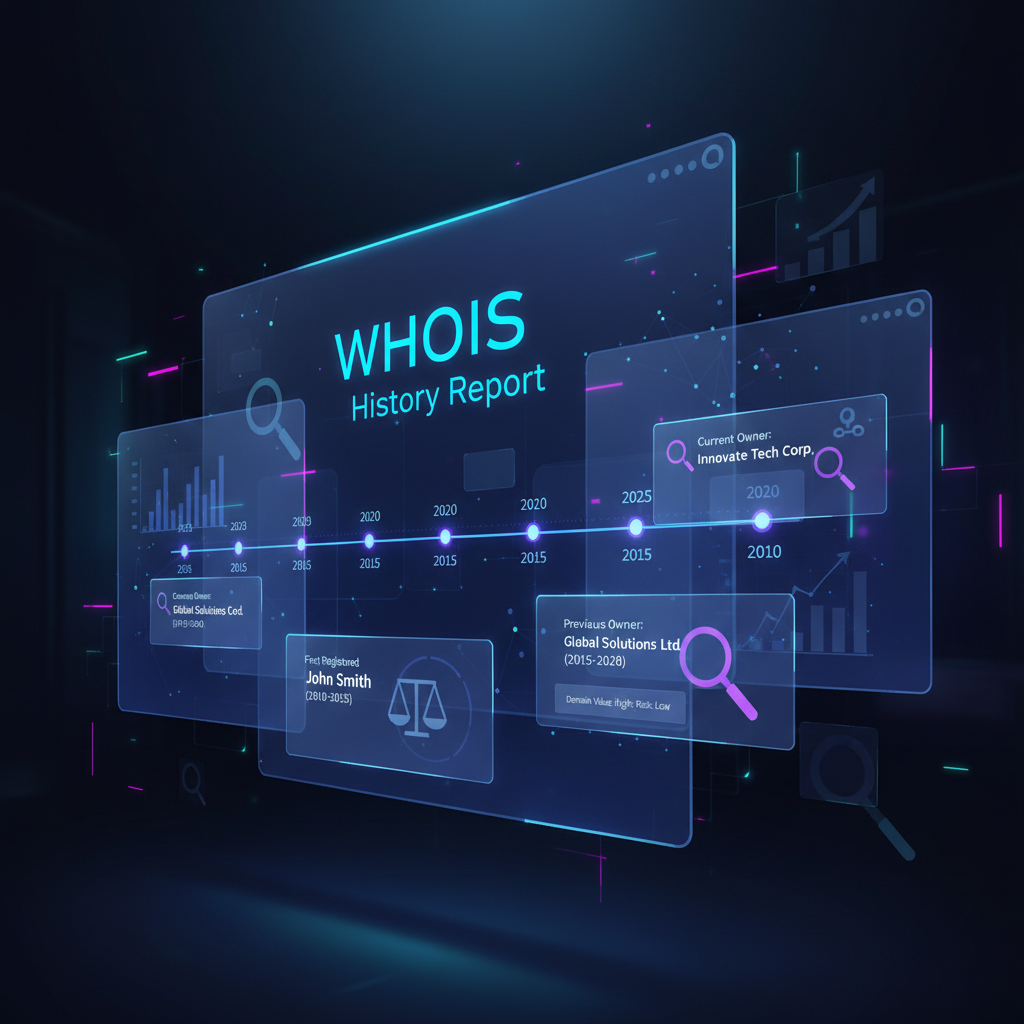
Enhanced WHOIS services augment current queries with archived snapshots capturing longitudinal registration data—tracking creation, renewal, expiration, and transfer timestamps. Coupled with third-party enriched datasets (e.g., DomainTools WHOIS), these include heuristic analyses clustering registrants into entities, probabilistic associations linking masked contacts, and detection of shell company registrations prevalent in abuse campaigns. Such layered approaches help illuminate ownership continuity obscured by privacy masking.
Key data assets obtained include precise domain lifecycle timelines and registrar history, enabling anomaly detection: rapid bulk registrations of lookalike domains within narrow timeframes, frequent ownership transfers without apparent cause, or unusually short-lived domains often signal phishing or brandjacking infrastructure rollouts.
Implementing this intelligence remains complex. WHOIS schemas vary widely among registrars and TLD operators—some conforming to RDAP standards, others using legacy WHOIS protocols with non-standardized field arrangements and date formats. API consumers must design parsers tolerant of missing or malformed data, rate limiting from domain registries, and asynchronous response delays. Adaptive query scheduling, combined with caching and fallback strategies such as RDAP direct queries or passive DNS cross-checks, is critical for maintaining freshness without overwhelming systems.
DNS controller information—such as authoritative name servers and DNS port (standardly port 53)—functions as a subtle yet strong validation axis. Correlating WHOIS ownership details against authoritative DNS records (NS entries) reveals indications of fraudulent transfers or DNS hijack attempts. For example, discrepancies between registrant contact data and hosting provider DNS configurations may warrant investigative escalation.
Operationally, WHOIS-derived insights feed automated alerting and enforcement pipelines. Anomalous domains detected via lifecycle analysis or ownership clustering trigger notifications or automated remediation actions like registrar lock enforcement or transfer blockades. Integrations within enterprise security platforms establish continuous real-time feedback loops, minimizing detection-to-mitigation latency—critical in countering fast-moving brand abuse campaigns.
Understanding how WHOIS data is accessed and interpreted sets the stage for supplementing static ownership snapshots with dynamic observability enabled by domain monitoring APIs.
Domain Monitoring APIs Beyond Simple Lookups
Moving beyond static ownership snapshots, domain monitoring APIs provide continuous, automated observability over domain state transitions—including DNS record mutations, registrar lock status changes, and domain lifecycle updates. Unlike standalone WHOIS queries focused on registration metadata, domain monitoring aggregates telemetry from multiple sources: DNS resolution state, registrar status endpoints, security-indicative flags, and sometimes passive DNS data.
At their foundation, these APIs implement persistent polling or event-driven subscriptions to track DNS resource records—A, AAAA, CNAME, MX, TXT—and WHOIS attributes such as domain status, registrant contact alterations, and registrar-administered locks. This construction yields a granular, temporal visibility imperative for brand protection—detecting DNS hijacks (unexpected NS changes), malicious redirect setups (e.g., HTTP redirects observable via Cloudflare API), and unauthorized lock status toggling that could prelude domain transfers or takedown circumvention.
Building these monitoring pipelines encounters engineering trade-offs. API rate limits, for example those enforced by Cloudflare or WHOIS data providers, restrict polling cadence and volume, mandating intelligent scheduling algorithms and priority queuing. Systems must gracefully handle partial or inconsistent responses arising from DNS timeouts or registrar data gaps to avoid false positives. Employing stateful anomaly detection models and heuristic scoring frameworks balances sensitivity against alert fatigue.
DNS-centric monitoring complements WHOIS visibility. Cloudflare’s global DNS resolver infrastructure and transparent DNS server listings expose domain status endpoints revealing real-time DNS record sets and HTTP redirect targets. These signals allow early identification of domain abuse patterns: an abrupt redirect change may indicate phishing deployment, while authoritative DNS server alterations suggest potential hijacking.
Operationalizing this monitoring at scale requires cost and latency optimization: caching layers to reduce redundant queries, differential change detection to prioritize substantive modifications, and heuristic alert filters ensuring manageable analyst workloads. This guards against prohibitive API costs and data noise while maintaining near real-time state awareness.
Common misconceptions warrant clarification. Not every lookalike domain is malicious—some represent legitimate brand extensions or partner properties—and WHOIS data alone often falls short due to privacy masking or registrar constraints. Domain lock status, a registrar mechanism preventing unauthorized transfers, represents a critical protective control surfaced via monitoring APIs. Its effectiveness depends on accurate representation by each provider, and enforcement is contingent on registrar backend capabilities.
Enterprises typically combine WHOIS metadata with real-time DNS monitoring feeds—often integrating Cloudflare DNS API data with enriched third-party WHOIS datasets—to power detection engines and orchestration workflows. For example, a large consumer-facing platform integrated WHOIS data from DomainTools alongside Cloudflare DNS monitoring APIs, detecting over 300 suspicious lookalike domains within 48 hours post-launch. Early takedown actions prevented phishing impact on 95% of these domains, improving incident response speeds by 20% and saving millions in brand damage.
In sum, domain monitoring APIs constitute the operational spine of modern brand protection—enabling seamless surveillance of complex domain portfolios, timely anomaly detection, and automated mitigation orchestration essential against escalating digital threats.
Design Patterns for Correlating Registration Metadata and Lexical Detection
Effective detection in brand protection hinges on amalgamating lexical similarity algorithms with comprehensive registration metadata analysis. Lookalike domains typically employ subtle obfuscations beyond trivial edits, necessitating nuanced algorithmic treatment.
Basic fuzzy string matching techniques such as Levenshtein distance or Jaro-Winkler similarity score domain name pairs quantifying their edit distance. However, attacker sophistication mandates heuristics to detect homoglyph substitutions (e.g., digit ‘0’ for letter ‘o’), Unicode normalization to consolidate visually indistinguishable forms, and phonetic similarity indexing to handle ambiguous homophones. Combining these improves resolution of near-miss typosquatting, IDN spoofing, and syntactic rearrangements employed in phishing attempts.
Lexical filtering yields candidate suspicious domains, yet registration metadata provides crucial context to ascertain legitimacy or malice. Parsing WHOIS records to extract registrant names, email domains, and organization affiliations facilitates clustering domains sharing ownership or operational control. DNS resolution patterns further enrich context: mapping domains to IP addresses, ASNs (Autonomous System Numbers), or hosting providers reveals hosting anomalies signatures indicative of abuse (e.g., fast-flux IP churn, use of bulletproof hosting).
Constructing a unified domain profile that interrelates lexical scores, WHOIS metadata, DNS resolution, and historical lifecycle events permits multidimensional correlation. For example, detecting multiple lookalike registrations resolving within a single IP subnet or sharing proxy registrant emails strengthens confidence in flagging coordinated spoofing campaigns.
Temporal dimension analytics supplement these patterns. Monitoring registration timestamps, modification events, and bulk creation bursts help identify characteristic attacker behaviors. Fortune 500 companies employing this integrated approach report 30% reductions in false positive alerts and 25% acceleration in incident triage.
This design pattern—merging lexical heuristics with enriched metadata correlation—lays the foundation required before scaling detection systems harnessing external APIs and telemetry feeds.
Handling API Inconsistencies and Rate Limits in Scalable Monitoring
Scaling domain protection monitoring to portfolios encompassing thousands of domains requires continuous WHOIS and DNS API queries, which surface challenges of API reliability, rate limiting, and data quality inconsistencies.
APIs may intermittently return HTTP 429 Too Many Requests responses or incomplete records, jeopardizing detection timeliness and accuracy. Mitigating these issues involves principled design:
- Exponential Backoff and Retry: On receiving rate-limit errors, progressively increasing delay intervals redistribute query loads and reduce overload risk on external services.
- Priority Scheduling and Stateful Queues: Organizing domain queries by risk or urgency prevents critical lookups from being blocked behind lower priority requests, ensuring timely visibility on high-value assets.
- Circuit Breakers: Temporarily suspending calls to failing or throttled endpoints allows the system to stabilize without cascading failures or excessive retries.
- Schema Validation and Anomaly Detection: Automated validation flags missing or malformed fields, triggering selective re-queries or escalation to manual review to maintain fidelity.
- Fallback Queries: Employing complementary protocols like RDAP or direct DNS interrogations compensates for incomplete WHOIS data or delayed propagation.
- Geographically Distributed Query Clusters: Multi-region API clients reduce latency and help circumvent localized rate limits or regional blocking.
- Caching Strategies: Multi-tier caches storing stable data reduce redundant API calls and improve response time, balancing freshness against efficiency.
Handling heterogeneous registrar-specific schema and TLD variations requires adaptable parsers capable of dynamically adjusting to vendor idiosyncrasies and evolving protocols. Comprehensive logging and real-time alerting on API anomalies enable proactive maintenance and incident mitigation.
A global financial institution implementing these patterns reduced API failure-induced blind spots by 40%, ensuring uninterrupted, high-fidelity surveillance across a diverse multinational TLD set.
These architectural strategies form the backbone of resilient domain brand protection monitoring systems, achieving detection accuracy at scale while respecting API provider constraints and operational cost ceilings.
Transitioning from reliable monitoring, the natural next step involves integrating these signals with automated enforcement workflows that neutralize threats rapidly yet cautiously to prevent operational disruptions.
Integrating Automated Enforcement Actions Without Disruption
Detection alone is insufficient; operational automation of enforcement transforms insight into timely mitigation, closing the loop on brand protection. However, automation must balance decisiveness with stability to avoid negative customer impact.
Registrar APIs and domain management platforms enable programmatic domain locking, a primary defense that freezes domain settings including transfer permissions and DNS record edits, impeding hijacking. Automated locking requires confident detection thresholds—scoring models that holistically weigh lexical similarity, metadata linkage, temporal patterns, and external threat intelligence reduce false positives. Large trademark portfolios report over 35% reduction in hijacking incidents when deploying calibrated locks, preserving user trust through cautious application.
Automated domain forwarding functions—such as via Cloudflare API redirect configurations—actively redirect malicious domains to warning pages or take down fronts. These rapid mitigations disrupt phishing or counterfeit sales channels, complementing legal actions. Integration of forwarding triggers with monitoring platforms ensures seamless deployment and service continuity.
Domain transfer automation—including transferring domains en masse to trusted registrars (e.g., Amazon Route 53, Cloudflare) or between providers (e.g., Squarespace to Cloudflare)—requires orchestrated multi-step interactions: verifying readiness, confirming lock status, acquiring authorization codes, and updating DNS to maintain resolution continuity. Employing state machines managing these interactions ensures zero or minimal downtime during enforcement, critical for domains serving customer-facing or internal services. For related best practices see the Amazon Route 53 Developer Guide.
Maintaining DNS availability during enforcement necessitates conservative TTL settings and staged propagation to avoid cache inconsistencies. Modular rule engines encapsulating enforcement policies facilitate easy tuning, auditability, and compliance. These engines incorporate feedback loops from analyst input and scoring refinements, enabling continuous policy evolution.
A global retailer deploying automated locking and forwarding tightly integrated with monitoring observed a 40% reduction in mitigation latency and operational overhead savings exceeding $4 million annually. This synergy between detection and action underscores automation’s pivotal role, enhancing resilience while minimizing collateral disruptions.
For architecting resilient API interactions underpinning enforcement, industry resources like the Microsoft Azure Circuit Breaker pattern provide robust design guidance.
Collectively, these enforcement automation patterns round out a defensive architecture maximizing brand protection efficacy from early detection to rapid, operationally prudent remediation.
Operational Considerations and Failure Modes in Brand Protection Domains
Despite sophisticated tooling, brand protection domains operate within real-world constraints where monitoring gaps, propagation delays, and incomplete data pose persistent challenges. Understanding these failure modes is essential for designing robust systems.
Common Failure Scenarios and Monitoring Gaps
A fundamental vulnerability arises from DNS propagation latency. When domains update DNS records—nameserver changes, A/AAAA updates, or forwarding configurations—distributed resolver caches may require minutes to days to flush stale data. This latency creates a window enabling silent transfer failures: unauthorized domain transfers or DNS hijacks undetected as monitoring systems continue observing outdated DNS states.
WHOIS data completeness also suffers from registrar-dependent refresh intervals (often 24–72 hours) and privacy masking. For example, WHOIS snapshots ingested via DomainTools or similar services may present stale or partial records due to caching or rate limits. Proxy registration services further obscure ownership attribution, complicating automated detection of critical lifecycle events like ownership changes or cancellations.
An overlooked failure vector is domain forwarding and redirect monitoring. Legitimate forwarding configurations, if unaudited in correlation with DNS and WHOIS data, can mask redirection to phishing or malicious sites post-compromise. Without active integration of DNS and HTTP redirect monitoring (e.g., via Cloudflare’s DNS servers list or HTTP redirect API endpoints), attacks exploiting forwarding remain hidden.
Exclusive reliance on WHOIS snapshots misses multi-dimensional telemetry. Combining registrar data with authoritative DNS signals and domain name server port probing substantially enhances accuracy. Failing to fuse these signal layers weakens threat intelligence and slows enforcement.
In practice, these monitoring gaps translate to delayed alerts and missed takedowns. Malicious actors exploit this window for domain squatting, lookalike phishing establishment, or malware delivery, inflicting brand damage and customer harm. Documented cases include global brands suffering fraudulent traffic siphoning due to delayed WHOIS data refresh or unmonitored forwarding changes.
These realities enforce a mandate: brand protection requires multi-source data fusion, continuous iterative verification, and adaptive corrective mechanisms rather than simplistic API snapshot polling.
Ensuring Real-time Visibility at Scale Across Domain Portfolios
Effective protection of expansive domain portfolios demands architectural and operational patterns enabling dependable, scalable, near-real-time monitoring. Multiregistrar, multi-TLD environments—including large CSC-managed corporate portfolios—necessitate consolidation of heterogeneous telemetry and automated intelligence pipelines capable of handling data volumes, API rate limits, and alert prioritization complexity.
Portfolio Aggregation and Scalable Alerting
Central to this is unified domain metadata aggregation. Enterprises deploying multiple registrars (e.g., GoDaddy for bulk domain holdings alongside CSC corporate services) must ingest and normalize diverse API feeds and event streams. Streaming pipelines consolidating WHOIS change events, DNS status updates, bulk transfer logs, and forwarding anomalies eliminate monitoring silos, ensuring end-to-end domain visibility.
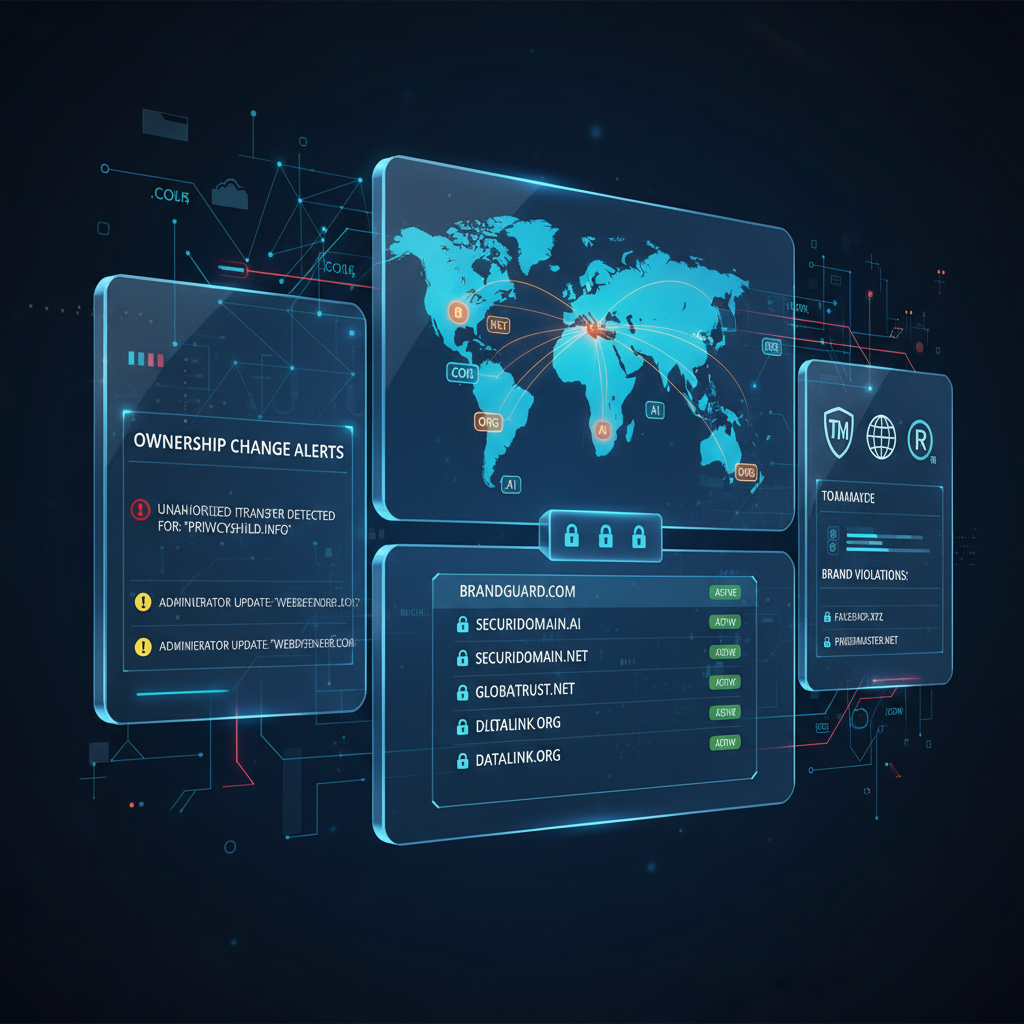
Correlating this data yields powerful analytic capabilities: detecting scenarios such as simultaneous new lookalike domain registrations combined with ownership changes and suspicious forwarding rule activations. Scalable alerting frameworks integrate anomaly scoring, suppression of noise from expected legitimate changes, and prioritization of verified threats, preventing analyst overload.
Multi-factor verification workflows enhance alert trustworthiness by automatically cross-validating WHOIS changes with authoritative DNS server lists (e.g., Cloudflare DNS servers list) and resolving domain name system port number behaviors. This contextual fusion recalibrates alert severity, reducing false positives and focusing human review where necessary.
Polling cadence design balances data freshness, operational cost, and API limits. Adaptive models prioritize higher-risk domains for frequent checks while cycling lower-risk assets less often. This tuning minimizes exposure windows without excessive overhead.
At scale, automation-assisted enforcement workflows play a crucial role. CSC’s enterprise APIs, for example, support bulk domain monitoring, transfer approvals, and registrar lock manipulations, simplifying management of thousands of domains. Integrating such capabilities into centralized monitoring infrastructure enables timely response and policy enforcement with minimal manual intervention.
Real-world deployments combining GoDaddy bulk transfer APIs, Cloudflare DNS monitoring, and CSC integrations have demonstrated 35% faster detection of unauthorized domain changes within the first 24 hours post-event, greatly improving incident response effectiveness.
Delivering real-time visibility requires harmonized data fusion from registrars and DNS providers, sophisticated correlation algorithms, automated differential alerting, and dynamic polling strategies. This comprehensive architecture empowers engineering teams to secure domain portfolios resiliently against evolving threats.
Key Takeaways
- Effective brand protection in the digital domain space necessitates real-time, automated monitoring of domain registrations and ownership changes. This enables early detection and mitigation of risks such as spoofing, typosquatting, and lookalike domain abuse that exploit brand trust. Engineering teams leverage WHOIS and domain monitoring APIs to systematically track the global domain namespace, correlating registration metadata with brand asset portfolios while navigating challenges from GDPR-masked data, diverse registrar behaviors, and complex DNS landscapes.
- Integrate WHOIS API queries for authoritative ownership metadata: WHOIS data offers critical domain registration details—creation and expiration timestamps, ownership contacts, and registrar information—that underpin detection of unauthorized domain registrations. Given GDPR-related redactions and proxy masking, robust systems require fallback heuristics and entity linking strategies to infer ownership continuity or changes.
- Implement continuous domain monitoring with change detection: Periodic polling via APIs or webhook-driven event subscriptions enable tracking of domain status, registrar locks, and contact changes. This reduces monitoring blind spots inherent in manual processes but requires balancing API rate limits, data consistency, and processing overhead in scalable pipelines.
- Detect lookalike domains using lexical similarity algorithms: Combining WHOIS metadata with domain name similarity scoring (e.g., Levenshtein distance, homoglyph detection, Unicode normalization) improves identification of spoof and phishing domains. Enhanced heuristics reduce false positives from legitimate variations and brand subsidiaries.
- Design domain portfolio management workflows that enforce policy at scale: Automated actions triggered by WHOIS or DNS changes—such as initiating domain transfers to trusted registrars (e.g., Route 53, Cloudflare), applying registrar locks, or adjusting nameservers—improve response times. These workflows must weigh operational costs, registrar constraints, and potential service disruptions to maintain stability.
- Leverage DNS data for contextual threat analysis: Correlating domain-to-IP mappings, monitoring DNS server changes, and tracking redirections (e.g., via Cloudflare API endpoint listings and HTTP redirects) provide rich telemetry to infer malicious use or unauthorized infrastructure shifts beyond static WHOIS data.
- Handle API reliability and data consistency trade-offs: WHOIS and DNS APIs vary in data freshness and may experience transient failures or rate limiting. Systems require robust error handling, adaptive caching strategies, and alternate data sources (e.g., RDAP, passive DNS) to maintain comprehensive monitoring integrity.
- Account for privacy regulations impacting WHOIS completeness: GDPR and similar privacy laws cause widespread masking of registrant information, complicating direct traceability. Combining WHOIS with complementary telemetry such as passive DNS, web content fingerprinting, and threat intelligence feeds improves detection coverage.
- Incorporate automation for domain enforcement actions with operational safeguards: APIs enabling domain transfers, nameserver changes, and forwarding facilitate rapid mitigation of threats. Strict access controls, audit logging, and staged change management are essential to avoid unintended disruptions or abuse of automation privileges.
Understanding these technical dimensions enables engineering teams to build resilient, scalable brand protection systems that transparently safeguard trademark integrity and reduce exposure to domain-based abuse. The following sections explore detailed implementation strategies, architectural patterns, and practical code integration examples for WHOIS and domain monitoring APIs.
Conclusion
Brand protection domains confront an increasingly hostile digital environment where adversaries exploit domain registration systems and DNS infrastructure weaknesses via lookalike registrations, stealthy transfers, and DNS manipulations. Traditional manual monitoring proves insufficient to match the speed and automation of these attacks, underscoring the centrality of integrated WHOIS and domain monitoring API solutions delivering scalable, real-time observability.
Core to this protection is fusing lexical similarity detection with enriched registration metadata, overcoming API reliability challenges through resilient designs, and orchestrating carefully curated automation workflows that minimize operational disruption. Large, multi-registrar portfolios demand consolidated analytics capable of adapting polling cadence and alert prioritization dynamically while ensuring comprehensive telemetry ingestion.
Looking forward, the domain ecosystem’s growth—driven by emergent TLDs, increasingly sophisticated attackers, and evolving privacy regulations—will amplify complexity and require brand protection systems to advance toward more predictive, AI-augmented detection and enforcement. The architectural challenge lies not merely in accumulating richer datasets but in constructing transparent, testable, and maintainable monitoring and response frameworks that maintain correctness under operational scale and pressure.
The enduring question for engineering leaders is whether their domain protection architecture surfaces and reconciles these complexities proactively, enabling timely, confident decisions before brand abuse escalates into irreparable harm.