Introduction
WHOIS data often serves as the initial forensic metadata layer investigators leverage when dissecting the domain-level infrastructure of phishing, ransomware, and fraud campaigns. However, the landscape is complicated by disparate registrar policies, privacy protections such as domain guard services, and a lack of uniform WHOIS response formatting. These factors impede automated data collection and raise concerns about data completeness and veracity, making WHOIS investigations a nuanced balancing act between raw registration data and complementary domain security frameworks such as DNSSEC and domain trust analyses.
Understanding how WHOIS fits into the broader domain name system security context and how privacy regulations constrain data exposure is crucial for reconstructing the lifecycle of malicious domains and attributing cybercrime activities reliably. This article explores systematic techniques for querying and analyzing WHOIS data, illustrates how investigators exploit timestamps and registrant metadata to build rich threat profiles, and showcases real-world cases where WHOIS remained indispensable despite evolving domain security technologies.
By progressively layering WHOIS with domain security intelligence, forensic workflows can scale to meet increasingly sophisticated adversary tactics while respecting operational, legal, and technical constraints faced by security engineers and investigators.
Foundations of WHOIS Data in Cybercrime Investigations
WHOIS data forms a foundational metadata source within domain-centric cybercrime investigations. Each WHOIS record provides a snapshot of the domain’s registration attributes—including registrant identity, administrative and technical contacts, domain lifecycle timestamps (creation, update, expiration), plus registrar and registry information—which collectively anchor investigative timelines and attribution efforts.
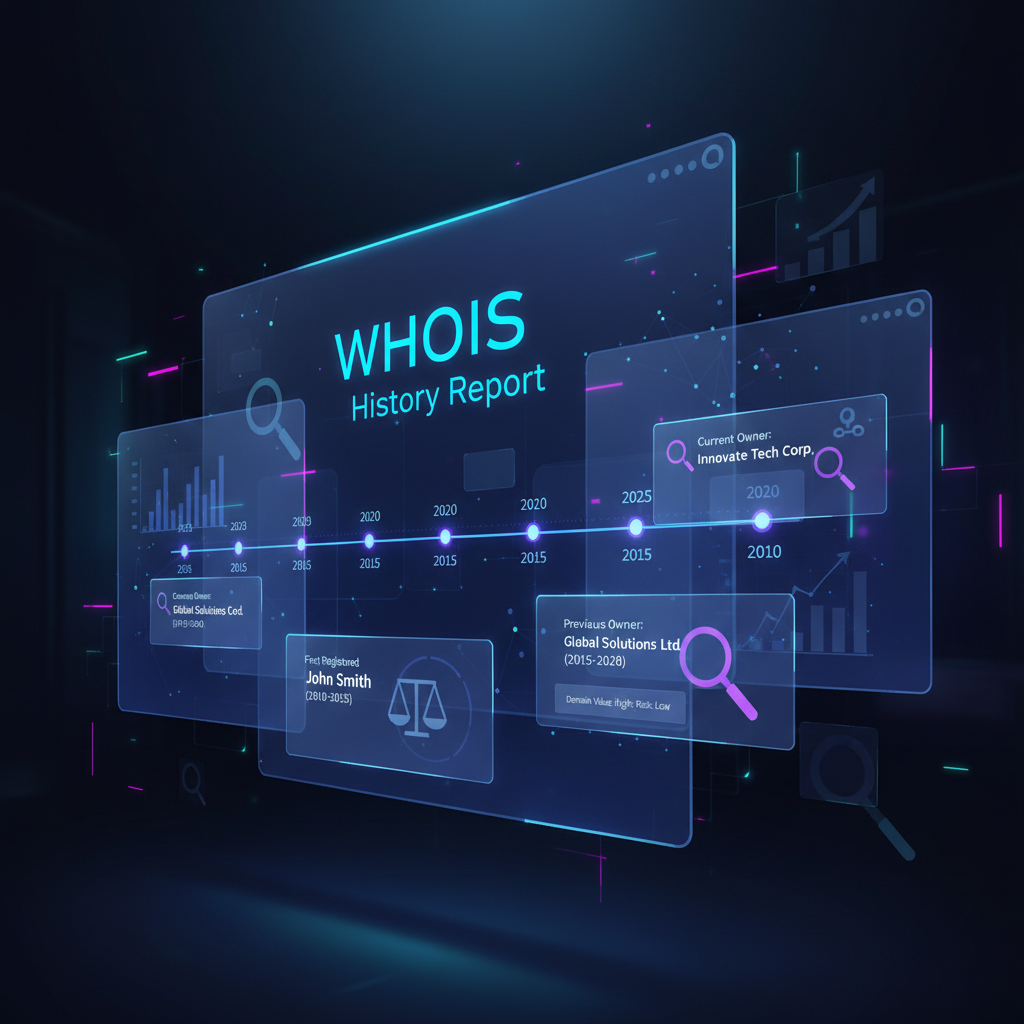
A critical capability is the analysis of historical WHOIS records capturing ownership changes over time. Temporal WHOIS archives enable investigators to detect infrastructure reuse or domain pivoting strategies employed by threat actors. This historical perspective allows construction of detailed domain ownership graphs and relational networks, revealing patterns not evident from single snapshots. Such graph-based methodologies uncover trust relationships and operational consistencies across distributed domain portfolios, augmenting direct attribution studies.
Contemporary investigations contend with domain security mechanisms and privacy enhancements that complicate whois analysis. Increasingly prevalent WHOIS privacy services (“domain guard”) redact or proxy registrant details, constraining direct visibility into true ownership. Nonetheless, WHOIS remains invaluable as a forensic entry point—it reveals indirect indicators such as registrar reputations, authoritative name server assignments, and domain publishing behaviors. When combined with DNSSEC metadata verifying signed DNS records, investigators can assess domain integrity and detect manipulation suggestive of malicious activities. The DNSSEC specification and best practices offer authoritative grounding on this security layer.
Understanding the strengths and limitations of WHOIS data is vital. Privacy-related redactions, common under GDPR in many TLDs, introduce attribution uncertainty. This mandates corroboration with complementary telemetry like passive DNS records, malware sandbox results, and threat intelligence feeds to build holistic attack profiles. Additionally, the timeliness of WHOIS updates directly affects data reliability, encouraging investigators to leverage archival tools and timestamp validations to contextualize lifecycle events credibly.
When integrated with domain trust relationships and domain security infrastructures, WHOIS becomes part of a layered analysis framework revealing attacker operations. For instance, synchronizing timelines of domain registrations and status changes can expose coordinated campaign fingerprints, while failures in DNSSEC validation may flag phishing or domain compromise. By constructing investigative pipelines that fuse WHOIS, DNSSEC status, proxy services, and registrar reputation data, law enforcement bolsters its capability to triage complex cybercrime networks such as ransomware distribution and large-scale phishing.
This multi-faceted utility positions WHOIS as a dynamic forensic asset, far beyond a simple registry lookup tool—instrumental in unraveling sophisticated domain abuse ecosystems. The next section delves into the critical information fields within WHOIS records that empower these investigations, along with practical limitations posed by privacy-aware Internet governance.
Key Information Provided by WHOIS Records
WHOIS records consolidate structured metadata pivotal for attribution and forensic linkage in cybercrime investigations. The principal fields of interest include:
Registrant Identity and Contact Information: This set includes the registrant’s name, organization, physical address, email, and phone number, typically mirrored across administrative and technical contact roles. However, prevalence of privacy protection services often obscures these fields by proxying or replacement, necessitating investigative caution. Law enforcement must corroborate contact information against external intelligence to filter out privacy-enabled obfuscations.
Domain Lifecycle Timestamps: Creation, update, and expiration timestamps serve as temporal anchors to align with attack timelines or observed threat actor activity. For example, spikes in domain registrations followed by rapid expirations generally indicate disposable infrastructure for spam or phishing, whereas domains with sustained registration histories could represent stable operational assets.
Registrar and Registry Details: These fields provide critical context regarding jurisdictional authority and registrar cooperation potential. Analyses include registrar abuse history, helping prioritize investigations and support community-driven blacklisting.
Name Server Records and DNSSEC Status: WHOIS often indicates authoritative name servers, directly linking domains to their DNS infrastructure. These records help verify domain authenticity and operational posture. DNSSEC presence and validation state are particularly salient; properly configured DNSSEC indicates domain record integrity, whereas its absence or inconsistencies may reflect tampering or lax security.
Operational limitations primarily arise from data redactions and privacy hygiene enforced by domain guard services, which mask registrant fields to reduce spam and abuse risks but hamper direct attribution. Indirect clues remain accessible via registrar profiles, DNSSEC implementation, and domain publishing patterns.
WHOIS querying techniques have evolved in response to GDPR and similar privacy regulations. Modern tools combine partial WHOIS datasets with passive DNS histories, threat intelligence feeds, and historic WHOIS archives to mitigate data gaps. These historic archives, often commercial or research-operated, allow ownership timeline reconstructions critical to linking infrastructure despite current redactions. Resources such as the ICANN WHOIS accuracy program elucidate these challenges.
In practice, WHOIS reliability is continually balanced against corroborative telemetry. Analysts carefully flag stale or fabricated WHOIS entries, a frequent adversary tactic. For example, phishing domains with anonymized registrant data are cross-validated with hosting IP clusters, SSL certificate transparency logs, and malware signatures before attribution.
Ultimately, WHOIS data is one vital tile in a broader investigative mosaic. Integrated with domain security protocols like DNSSEC and vigilant observation of privacy services, it continues to surface indispensable metadata that underpins cybercrime attribution.
Techniques for Querying and Analyzing WHOIS Data
Practical Methods for Querying WHOIS Data
WHOIS data extraction at scale is a core task for law enforcement and security analysts working against cybercrime, but technical and operational hurdles complicate this process.
At the protocol level, WHOIS queries are performed against registrar-operated WHOIS servers using either the legacy WHOIS protocol or the more structured Registration Data Access Protocol (RDAP). Legacy WHOIS, operating over TCP port 43, accepts textual queries and returns free-form text responses with no standardized syntax, making reliable parsing difficult. Moreover, it enforces strict rate limits to prevent abuse.
RDAP, by contrast, is a modern RESTful HTTP API delivering machine-readable JSON responses, supporting internationalized domain names, standardized contact fields, and improved error handling. While RDAP adoption is growing, many registrars—especially in less-regulated locales—still rely solely on legacy WHOIS, limiting uniform access. The IETF RDAP standards formalize this protocol, highlighting its strengths for automation.
Investigators use automated tooling to overcome manual query bottlenecks. Common utilities include command-line WHOIS clients, RDAP libraries, and commercial or open-source forensic suites like DomainTools and ArcSec Domain, which aggregate historical and current WHOIS data from multiple sources, including authorized archives. ArcSec Domain is noteworthy for scalable domain ownership verification and integrated multi-source query aggregation.
One persistent challenge is data inconsistency and registrar-specific implementations. WHOIS output formats vary widely, with proprietary structures, multilingual entries, and obfuscation introduced by privacy regulations such as GDPR and CCPA. Parsing pipelines must dynamically adapt, employing heuristic patterns, regular expressions, and schema normalization to extract key data points reliably. Cross-validation against known field identifiers (e.g., Registrar WHOIS Server, Registrant Email, lifecycle timestamps) assists in maintaining fidelity.
Registrar rate limits and anti-abuse policies designed to protect WHOIS servers impose query caps, CAPTCHAs, and throttling, impeding bulk data retrieval. To mitigate, investigators distribute queries across multiple IP addresses, schedule staggered request intervals, and implement local caching of known domains to reduce repeat queries. Caching preserves WHOIS snapshots at investigation milestones, preventing data loss due to dynamic changes and ensuring consistent analysis context. However, this infrastructure demands continuous tuning to avoid detection and blocking by registrars.
Privacy protections intensify complexity. Post-GDPR, a substantial fraction of registrant data is redacted or replaced with proxy contacts, limiting direct attribution. Hence, investigators augment WHOIS data with third-party historic datasets and commercial WHOIS archives. Established archives such as DomainTools’ historic WHOIS or private cybersecurity firms’ repositories enable reconstruction of domain ownership timelines essential for tracing hostile infrastructures.
Privacy proxy detection is another analytical vector: grouping domains that share the same proxy services can reveal coordinated clusters linked to single threat actors. This approach leverages both current and historical WHOIS datasets to identify operator patterns despite obfuscation.
In sum, law enforcement’s WHOIS querying capability depends on resilient, scalable tooling able to parse heterogeneous outputs, navigate querying constraints, and integrate external datasets. These capabilities form the backbone for subsequent metadata analysis.
Analyzing Metadata for Threat Attribution
WHOIS data, beyond simple owner identification, provides a rich signal set for attributing cybercrime and exposing malicious infrastructure.
A core technique involves pattern detection within registrant metadata across domain populations. Analysts search for recurring registrant names, emails, phone numbers, postal addresses, or administrative contacts exhibiting consistent or subtly varied strings. This fingerprinting identifies clusters of domains likely controlled by the same actor, facilitating recognition of phishing networks, malware command-and-control points, and scam hubs. For example, repeated use of a specific email prefix or consistent hosting provider across domains often aligns with known cybercrime groups.
Temporal WHOIS metadata analysis further refines attribution. Examining domain creation, modification, and expiration timestamps reveals lifecycle behaviors: rapid rotation or ownership changes suggest evasive tactics or hijacking, while stable registration histories indicate controlled assets. In backend services with high scalability needs, such domain lifecycle analyses help discern transient attack infrastructure versus persistent backend resources.
Integrating WHOIS with domain trust relationships adds nuanced intelligence. DNSSEC deployment and domain lock status provide extra signals about domain legitimacy and security posture. Investigators examine domain trust configurations to differentiate normal transfers and renewals from suspicious reassignments timed with attack campaigns. Complex distributed denial-of-service (DDoS) backends or data pipeline domains leveraging DNSSEC lineage can be identified and differentiated from attacker-disrupted domains.
Historical WHOIS records are invaluable here: continuous ownership tracking exposes cross-domain linkages obscured in isolated snapshots. Domains cited in recent campaigns may have prior registration aliases or shifted across privacy proxies, revealing persistent threat actor activity through longitudinal analysis.
However, WHOIS data is vulnerable to falsification. Attackers use proxy registrations, fabricated contacts, and domain protection services to mask ownership footprints. This mandates cross-correlation with diverse data sources including passive DNS feeds, SSL certificate transparency logs, IP infrastructure mappings, and dynamic malware telemetry. Only by converging datasets can investigations sustain high-confidence attribution capable of withstanding legal scrutiny.
For illustration, consider ransomware investigations where command-and-control domains with anonymized WHOIS contacts share registrar lock status changes and co-hosting IP clusters. Coupled with historical WHOIS linkages and domain trust models, investigators unearth linked infrastructures operated by the same adversary group, supporting targeted takedown efforts.
Analytic tooling supporting WHOIS metadata leverages dynamic parsing, normalization, temporal correlation, and trust relationship modeling. These pipelines evolve continuously to counter adversarial privacy abuses and registrar policy changes, enabling law enforcement to transform raw WHOIS data into high-value attribution artifacts.
- Balancing automation with human analyst intervention to mitigate deceptive registration data
- Merging domain trust relationships with historical WHOIS to calibrate confidence scores on ownership claims
- Fusing multi-source intelligence to bypass privacy masking and proxy usage
- Adapting metadata extraction frameworks to internationalization challenges, registrar evolution, and expanding privacy regulations
Mastering these challenges empowers investigation teams to derive nuanced attribution, converting scattered metadata into cohesive domain trust graphs reflecting attacker infrastructures.
Together, robust querying and analytic techniques turn WHOIS data into a critical lever for disrupting cybercriminal ecosystems, despite its intrinsic operational complexities.
Limitations and Challenges in WHOIS-Based Cybercrime Investigations
Impact of Privacy Protections and Policy Variations
Recent regulatory changes, notably GDPR, alongside registrar-driven privacy services such as domain guard, have profoundly altered the operational utility of WHOIS data in cybercrime investigations. Privacy frameworks enforce deliberate data obfuscations that blanket registrant identities, contact information, and sometimes timestamps, severely constraining law enforcement’s ability to attribute domain ownership directly.
Masked WHOIS records generate investigative blind spots, impeding simple ownership tracing and complicating longitudinal timeline analyses that are crucial for attributing sophisticated campaigns. Access to historical WHOIS data remains uneven, with some registries restricting archival records or imposing jurisdiction-based access controls. This fragmentation challenges continuity in investigations and requires strategic use of multiple data sources.
In addition to privacy obfuscations, WHOIS data suffers from lack of format standardization. Proprietary registrar schemas, nonstandard field naming, and inclusion of auxiliary metadata complicate automated parsing and cross-source normalization. Local regulatory compliance further diversifies data presentation, eroding the consistency needed for confident forensic chains. Investigators therefore prioritize corroborative intelligence and employ multiple querying methods.
These limitations translate into real operational delays in investigations of phishing and ransomware, where obscured or incomplete WHOIS data hampers identification and extends attribution timeframes. Law enforcement frequently compensates with multiple API integrations, third-party historic archives, and domain reputation databases, though these carry dependencies on access agreements and trust in external data integrity.
Technical and Operational Obstacles
WHOIS data acquisition is further complicated by registrar-imposed rate limiting and anti-abuse controls. To defend against scanning and denial-of-service risks, WHOIS servers enforce per-IP query caps, introduce CAPTCHA-like challenges, and implement dynamic throttling. These protections constrain large-scale WHOIS data aggregation critical to tracking sprawling malicious infrastructures that may operate thousands of domains.
To scale effectively, law enforcement designs distributed querying architectures that partition requests across proxy IP pools while maintaining temporal query staggering and local caching of WHOIS responses. This approach reduces bottlenecks and minimizes trigger points for registrar blacklisting. However, it demands continuous operational overhead, engineering iteration, and close monitoring as registrar policies evolve.
Complicating workflows is the rise of modern DNS-related security measures such as domain name system security extensions DNSSEC and emergent standards like domain sec x. While DNSSEC primarily ensures DNS data authenticity and integrity rather than affecting WHOIS data directly, its widespread adoption by attackers adds layers of operational security, complicating attribution. Threat actors may deploy DNSSEC-signed domains coupled with intricate trust hierarchies to avoid detection and frustrate takedown efforts.
When working with domains under umbrella providers such as ArcSec or registrars like Verisign, strong security policies and rapid dispute resolution mechanisms shield databases and obscure registrant connectivity behind hardened controls. Multi-modal detective techniques combining WHOIS data with detailed DNS configurations, passive DNS logs, SSL certificate transparency, and threat intelligence platforms such as DomainGlass become essential to pierce this veil.
Temporal inconsistencies in WHOIS data pose another challenge. Registrations and ownership transfers may lag in reflecting real-world changes, exploited by adversaries deploying rapid domain skimming, disposable domains, or transient infrastructures to distance themselves from attacks. Continuous monitoring with historic WHOIS aggregation tools is necessary to normalize update latency and align domain lifecycle patterns, ensuring accurate forensic timelines. For technical overview, see the Whois History research.
In combination, privacy protections, rate limitations, and advanced domain security frameworks mandate multi-source correlation in investigations, underscoring why WHOIS can rarely be a sole source for domain attribution in contemporary cybercrime enforcement. Integrated analysis with DNSSEC validation, domain reputation, and passive DNS signals provides the operational foundation needed for timely, accurate investigations.
This complex interplay of data redaction, querying constraints, and sophisticated domain architectures shapes a challenging but evolving frontier requiring adaptive investigative strategies. The following section explores mitigation tactics and illustrative case studies where WHOIS combined with domain security intelligence yielded actionable cybercrime disruption.
Case Studies: WHOIS Evidence in Real-World Cybercrime Investigations
In operational law enforcement contexts, WHOIS investigations extend well beyond rudimentary domain lookups. Sophisticated exploitation of WHOIS attributes enables reconstruction of detailed cyber domain ownership histories, validation of attribution hypotheses, and correlation of threat campaigns. These cases demonstrate the power of layering WHOIS data with DNS securitization and metadata analytics to expose deep adversary infrastructure.
In one multi-national phishing investigation, authorities compiled WHOIS datasets emphasizing registrant and administrative contact fields alongside domain lifecycle timestamps. Combining this with passive DNS data and versioned WHOIS archives, they detected ownership transfers engineered to fragment attribution trails. This multi-temporal analysis surfaced a cluster of domains under a singular operator despite widespread use of privacy proxy services.
Investigators further integrated domain control data, consolidating WHOIS registrant linkages with DNS authoritative name server queries. Cross-referencing zone file snapshots and SSL certificate transparency logs validated domain issuance timelines and detected forged WHOIS entries.
Comparative analysis of registrant emails, phone contacts, and organizations revealed reused or slightly varied identifiers, unmasks a broad infrastructural network spanning multiple campaigns. Graph analytics constructed from this data mapped overlapping domain trust dependencies and points of control—a critical intelligence layer for operational takedowns.
Another case involved takedown of a credential harvesting network heavily cloaked behind domain guard services and privacy protections. Through legal access to registrar-level data combined with forensic WHOIS temporal inconsistencies, investigators unmasked real registrants beneath anonymized proxies. This multi-layered WHOIS evidence combined with technical domain infrastructure insights formed a cornerstone for disrupting lucrative fraud operations.
Similar techniques apply to ransomware and malware distribution networks, where attribution depends on correlating dispersed domain assets and tracing control points invisible in isolated datasets.
Phishing and Fraud Campaigns Traced via WHOIS Data
Phishing and fraud investigations leverage WHOIS data in forensic lifecycle reconstructions of malicious domains. Analysts collect and correlate WHOIS timestamps, registrant metadata, and domain registration events to cluster large numbers of fraudulent domains.
This process entails aggregating WHOIS snapshots across diverse registrars and regional Internet registries, aligning domain registration and expiration patterns with DNS logs and SSL certificate issuance. For example, matching WHOIS creation dates to certificate transparency logs verifies timeline accuracy and detects attempts to mask domain age.
Key investigative challenges arise from privacy protections masking registrant identities. Analysts exploit indirect heuristics, such as clusters of privacy proxy services frequently linked to specific registrant contact patterns or similarities in registrar abuse contacts. These observables, combined with threat intelligence feeds and historical anomaly detection, enable inference of domain ownership linkages.
Domain controllers and trust relationships further enrich phishing infrastructure mapping. Shared authoritative name servers, DNS hosting providers, or registrant organizations reflect control consolidations. Tracking these trust relationships exposes command frameworks and identifies resilient infrastructure in attacker ecosystems.
A representative example involves a coordinated phishing ring utilizing fast-flux domains registered under overlapping registrant phone numbers, email prefixes, and fortified by domain guard protections. Correlating WHOIS timelines with DNS change logs and SSL certificate life cycles confirmed a unified infrastructure, revealing evasive persistence tactics including staggered domain activations and cross-registrar domain transfers.
Automated clustering algorithms group domains with common registrant traits such as language patterns, reused metadata fields, or proxy registrations linked via abuse reports. By shifting focus from purely domain behaviors to registrant-signature-driven surveillance, investigators achieve scalable, intelligence-driven domain blacklisting.
Operational experience shows that even extensive privacy barriers do not negate the relevance of WHOIS timeline and trust relationship analysis in revealing cybercriminal infrastructure, directly supporting enforcement takedowns and prosecution strategies.
These effective approaches frame subsequent applications of WHOIS analysis to ransomware and malware ecosystems.
Ransomware and Malware Distribution Networks Identified Through WHOIS
WHOIS data is instrumental in dissecting complex ransomware and malware domain infrastructures by enabling cross-referencing of dispersed assets and registrant metadata.
A principal method constructs domain trust graphs where registrant metadata—such as shared addresses, emails, or phone numbers—links disparate domains serving as command-and-control, payload hosting, or affiliate nodes. Detecting these clusters across diverse TLDs and registrar jurisdictions exposes cybercriminal ecosystems’ breadth and persistence.
This approach is enhanced by layering domain security framework data. For example, DNSSEC validation reveals where domain records mismatch WHOIS ownership, suggesting hijack or spoofing attempts. Additional tools like domain glass monitoring and Verisign domain reputation scoring contextualize WHOIS insights for higher attribution precision.
Investigative pipelines begin with WHOIS ownership histories generating temporal registration graphs, feeding into DNS enumerations identifying authoritative name servers, MX records for spear-phishing, and evolving DNS configurations supporting malware delivery. Patterns such as large-scale domain registration bursts with obfuscated contacts or lexical variants trigger deeper analyses with malware telemetry correlation.
Challenges arise from false WHOIS data input by adversaries. Investigators employ heuristics cross-checking domain expiration co-occurrences, registrar-resident identity resolution, and domain trust setups to build consistent ownership graphs. Interestingly, domain guard and similar services can paradoxically aid investigations by preserving stable registrar metadata that, while masking registrants, indirectly links protected domain portfolios.
An illustrative ransomware case involved a prolific threat group registering hundreds of domains over years, mainly masked by WHOIS privacy. By correlating persistent phone numbers across registrations, validating creation timestamps against SSL issuance and DNS changes, investigators built a robust attribution chain linking primary ransomware delivery and secondary fallback infrastructure—all from WHOIS metadata clustering.
These insights demonstrate that WHOIS data, fused with DNS telemetry, SSL logs, and malware network activity, is vital for comprehensive domain ownership verification and attack infrastructure mapping. For software engineers and security architects developing detection systems, integrating WHOIS historical analysis and domain trust graphing materially enhances attribution effectiveness against ransomware and malware campaigns.
Mastering advanced WHOIS investigative methodologies enables meaningful disruption of resilient cybercriminal domains despite growing privacy and security countermeasures.
Key Takeaways
WHOIS data provides essential metadata about domain ownership, registration, and operational status that law enforcement harnesses to trace cybercrime involving phishing, ransomware, and fraud. Grasping how WHOIS integrates with Domain Name System (DNS) infrastructure and domain security mechanisms underpins effective attribution and investigation processes amid challenges from data inaccuracies, privacy regulations, and adversary evasion strategies.
- WHOIS metadata complements DNSSEC and domain trust frameworks: WHOIS reveals registrant and administrative contacts, which, when correlated with DNS Security Extensions (DNSSEC) and domain trust relationships, form a multi-dimensional profile of the cyber domain environment enabling deeper context for investigative attribution.
- Automated WHOIS queries require sophisticated rate limiting and robust parsing: Investigators must design querying pipelines that respect registrar-imposed rate limits and handle heterogeneous, evolving WHOIS response formats to maintain scalable and reliable data collection.
- Data reliability varies widely due to privacy protections and registrar policies: WHOIS accuracy often diminishes when privacy services (e.g., domain guard) obfuscate details and jurisdictions enforce data privacy laws, requiring triangulation with auxiliary telemetry for attribution confidence.
- WHOIS domain lifecycle timestamps enable reconstruction of malicious infrastructure timelines: Registration, updates, and expiry dates are critical temporal anchors to analyze domain usage windows and correlate domain activities with cybercrime incidents across complex infrastructures.
- Integration of WHOIS with domain trust models enhances threat intelligence pipelines: Combining WHOIS metadata with domain trust relationships, DNSSEC validation, and registrar reputation scoring empowers pattern detection across related threat infrastructures.
- Case studies validate the ongoing relevance of WHOIS despite modern domain security: Even as DNSSEC and domain protection mechanisms reduce spoofing, WHOIS remains foundational for early-stage suspect identification and layered investigation orchestration in complex domain abuse ecosystems.
The following sections detail practical querying strategies, metadata analysis techniques, and real-world investigations where WHOIS enabled impactful cybercrime disruption alongside domain security insights.
Conclusion
WHOIS data remains a cornerstone forensic resource for cybercrime investigations, furnishing critical visibility into domain ownership attributes, lifecycle events, and infrastructure relationships essential for accurate attribution. Although increasing privacy protections, data redaction, rate limiting, and domain security enhancements like DNSSEC and privacy services pose significant challenges, systematically combining current and historical WHOIS data with complementary intelligence sources empowers investigators to unravel sophisticated adversary operations.
Integrating WHOIS metadata with multi-modal data—passive DNS, SSL certificate transparency, reputation scoring, and threat intelligence—enables construction of detailed domain trust graphs that expose coordinated cybercriminal networks underpinning phishing, ransomware, and malware campaigns. However, this growing complexity demands ongoing innovation in automated parsing, adaptive metadata extraction, multi-source correlation, and trust modeling techniques to maintain investigative efficacy.
From a system design perspective, the evolution of domain registration ecosystems compels engineers and security practitioners to architect attribution frameworks that are resilient to data incompleteness, privacy-driven redactions, and adversarial obfuscation. The critical design question emerges: how can investigative tooling expose sufficient domain ownership signals while respecting privacy constraints and scale dynamically amid increasingly fragmented and secured Internet architectures? Addressing this will define the next frontier in domain-centric cybercrime attribution and disruption.