Introduction
Phishing attacks critically rely on the rapid creation and disposal of malicious domains that vanish before defensive systems can detect them. Traditional signature-based defenses struggle against these fleeting threats, as alerts often trigger only after a domain’s operational window has closed or ownership has shifted. This creates a narrow detection horizon where early signals extracted from domain registration data become essential in preemptive defense.
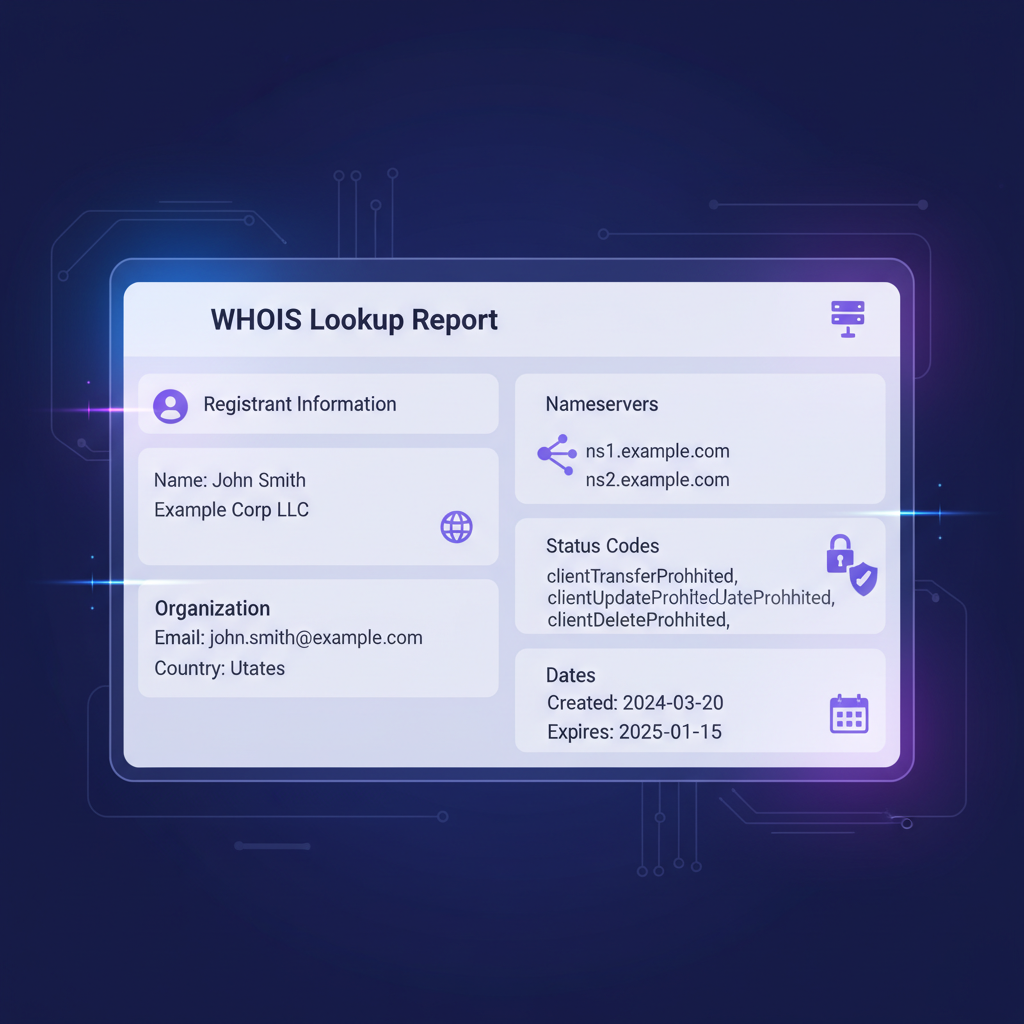
WHOIS phishing detection leverages domain registration metadata—such as creation timestamps, registrar identities, and registrant patterns—to proactively identify suspicious domains. The intrinsic challenge lies in crafting detection systems that balance in-depth metadata analysis with practical constraints, including limitations on WHOIS query rates, privacy-driven data obfuscation, and dynamic domain management tactics employed by adversaries. Understanding how WHOIS attributes directly correlate with phishing infrastructure nuances enables engineers to architect automated detection and mitigation systems that reduce response times and improve the precision of blacklist updates.
This article systematically examines the pivotal WHOIS data points and heuristic strategies most relevant to phishing detection. We dissect implementation trade-offs, explore augmentations with domain expiry and DNS record monitoring, and articulate integration pathways toward scalable, granular defenses that operate effectively in real-world security environments.
Challenges in Detecting Phishing Domains
Detecting phishing domains early and accurately is challenging because attackers craft their infrastructure to exploit structural and operational weaknesses in traditional detection systems. The centerpiece of their strategy is the use of short-lived, rapidly cycling domains coupled with registrant information manipulation and domain name obfuscation. These tactics complicate multiple core detection dimensions.
First, phishing domains often appear and expire within hours or days, shrinking the detection window. Detection pipelines dependent on historical behavioral aggregation either produce late alerts or miss these domains entirely. The ephemeral lifespan undermines signature-based systems and demands real-time or near-real-time processing of fresh registration data, which introduces strict latency and data freshness requirements.
Second, adversaries muddle attribution by dispersing domain registrations across diverse registrars and employing multiple registrant aliases. This distribution frustrates heuristics reliant on consistency or attribution clustering. The problem is compounded when registrars have differing data quality or enforce varying identity verification rigour, causing noise and gaps in WHOIS data. Attackers often leverage registrar churn, moving domains across registrars to evade flagging and takedown efforts.
Third, phishing domains frequently masquerade as legitimate or brand-associated domains through typosquatting, homoglyphs, or benign-sounding lexical patterns, further complicating automated differentiation. They also adopt defensive evasions such as domain parking, fast-flux style DNS configurations, and registrar hopping. This necessitates detection mechanisms capable of probing beyond superficial domain strings—incorporating temporal registration data, ownership linkage, registrar reputations, and behavioral DNS analytics—to reliably surface phishing infrastructure. Techniques such as homoglyph detection and fuzzy string similarity models enhance the discrimination of obfuscated domain names, folding lexical threat intelligence into WHOIS attribute analyses.
Together, these adversarial strategies mandate threat intelligence frameworks that continually ingest, normalize, and analyze WHOIS metadata alongside complementary contextual signals. This combination allows security teams to craft early identification models, enabling preemptive responses before phishing domains realize their intended user impact.
Phishing Domain Lifespan and Detection Timing
The transient lifespan of phishing domains—often mere hours or days—is fundamental to understanding both attacker intent and defensive response imperatives. This fleeting operational window compresses detection timelines, demanding that systems prioritize rapid WHOIS data ingestion and interpretation at scale.
WHOIS registration timestamps offer a critical early detection lever. By performing immediate domain registration lookups, defenders can classify and flag domains created within high-risk windows, especially if registration details match known threat actor patterns or suspicious metadata profiles. This temporal proximity to domain creation allows detection approaches to pivot from retrospective to proactive, facilitating preemptive blocking before extensive phishing campaigns unfold.
However, attackers deploy tactical evasions that complicate early detection. Bulk domain churn—where attackers register many domains in rapid succession—overwhelms analysts and systems with volume and noise. Dormant domain parking further obscures activity; domains may remain unresponsive or redirect silently to avoid immediate detection signals tracked by URL scanning or DNS behavior. Effective pipelines must therefore correlate WHOIS timestamps with complementary indicators like DNS activity bursts and passive traffic observation.
In production systems, integrating WHOIS registration data temporally requires scalable, automated lookup pipelines capable of near-real-time querying, throttling management, and immediate scoring based on composite threat intelligence. Scoring considers registrant consistency, registrar risk profiles, and privacy proxy presence. Platforms such as DomainTools Iris exemplify these integrated threat intelligence solutions, facilitating automated WHOIS-driven detection.
Discriminating malicious new registrations from legitimate startup or brand expansion domains remains a persistent challenge, underscoring the need for multi-dimensional analysis. For instance, legitimate domains generally exhibit consistent registrant identities, stable hosting infrastructure, and validated SSL certificates, whereas phishing domains show anomalies or volatile infrastructure. Combining WHOIS data with DNS metadata, SSL transparency logs, and traffic behavior enables contextual differentiation that improves detection precision.
Real-world deployments leveraging WHOIS phishing detection report significant early blocking improvements—reducing user exposure to phishing within the critical first 48 hours by up to 30%. These outcomes validate registration timestamp analysis as an indispensable early warning indicator but highlight the operational necessity of contextual, multi-signal corroboration to avoid excessive false positives.
Limitations of Traditional Phishing Defenses
Traditional anti-phishing defenses largely hinge on signature-based detection and static domain blacklists. While foundational, these methods manifest intrinsic weaknesses when confronting the agile, ephemeral nature of modern phishing operations.
Domain blacklist reliance is inherently reactive: updates occur only after domains demonstrate malicious activity or are reported. This detection latency creates exploitable windows where attackers register fresh domains, conduct brief phishing campaigns, and then abandon domains before blacklists propagate effectively. Consequently, static blacklists provide incomplete situational awareness against rapid domain churn.
Further limitations arise from domain lifecycle maneuvering. Phishing actors exploit short domain registration periods and rapid registrar or account transfers to obfuscate ownership. Frequent registrar changes disrupt attempts to map domain ownership longitudinally, as WHOIS records shift correspondingly. Blacklists rarely reflect these dynamic transitions in ownership or registrar identity in near real-time, allowing malicious domains to evade detection temporarily.
WHOIS records capture ownership and registrar data over time, revealing such transient behaviors. However, traditional detection tools often fail to track these frequent transitions or to correlate them with suspicious domain usage patterns. This creates gaps that adversaries exploit by selecting registrars with lenient registration policies or inadequate abuse response procedures. Incorporating registrar reputation scoring, gleaned from historical phishing domain registration correlation, enables flagging of registrars that facilitate abuse, supplementing direct domain blacklisting.
Complementary tools, such as domain expiry checkers and lifecycle monitors, extend coverage by tracking expiration patterns, transfer events, and privacy proxy usage—providing additional signals of domain legitimacy or abuse. Yet, scaling automation around these metrics requires robust correlation engines to avoid false positives stemming from legitimate domain churn or varying business practices.
Ultimately, effective WHOIS phishing detection transcends static blacklist dependency. By embedding behavioral pattern recognition derived from live WHOIS data—such as registrant reuse, registrar switching, and anomalous registration timing—systems gain predictive detection capabilities. This shift strengthens defense postures by anticipating attacker tactics rooted in domain infrastructure dynamics rather than relying solely on reactive blacklisting. For further reading on modern threat detection evolution, the OWASP Phishing Guide provides an authoritative overview.
This sets the groundwork for a deeper exploration of how granular WHOIS attributes can be systematically harnessed to outpace traditional endpoint defenses.
Core WHOIS Data Attributes Relevant to Phishing Detection
Registration Dates and Temporal Indicators
At the core of WHOIS metadata analysis lies the domain registration timestamp, primarily the creation date. This attribute is widely acknowledged for its utility in phishing detection, as attackers typically rely on newly registered domains to exploit window-of-opportunity vulnerabilities before blacklists update. Detection workflows prioritize domains with recent creation timestamps, leveraging temporal recency as a high-risk indicator.
Nonetheless, binary thresholds on registration age risk high false positive rates, since many legitimate domains are newly created daily. High-fidelity systems contextualize domain age within comprehensive attribute sets, combining temporal signals with registrant and registrar assessments and DNS activity. For instance, clusters of domains registered simultaneously exhibiting registrant instability or suspicious registrar usage compound suspicion beyond mere recency.
Domain expiry dates constitute a complementary temporal factor essential for delineating attacker intentions. Attackers often register domains with intentionally short lifespans—sometimes a few days or weeks—or synchronize renewals strategically to evade takedown. Automated domain expiry monitoring enables detection pipelines to identify unusual expiration cycles, frequent renewals, or expirations preceding suspicious campaign phases.
Implementing expiry monitoring faces challenges stemming from inconsistent WHOIS output formats across registries, varying field representations, and privacy protection obfuscations masking expiry dates. Query budget constraints further complicate real-time expiry monitoring at scale. Despite these hurdles, temporal features extracted from creation and expiry timestamps remain foundational signals in early-stage phishing detection systems, enriching static heuristics with dynamic lifecycle insights. The technical overview on WHOIS-based phishing defense delves deeper into operationalizing these temporal cues.
Registration Timestamp Anomalies in Detection Pipelines
Phishing detection algorithms extend basic temporal analysis by identifying anomalies within WHOIS timestamp distributions. These anomalies may surface as concentrated bursts of bulk registrations within narrow timeframes, repetitive registrations by the same registrant across related domain names, or staggered renewals indicating operational phasing by adversaries.
Anomaly detection layers employ time-series clustering and outlier detection techniques on WHOIS creation and renewal events, enabling pipelines to distinguish background legitimate registration noise from phishing campaign spikes. By correlating these temporal anomalies with DNS hosting changes and domain trust relationships, platforms achieve multidimensional risk scoring critical for timely incident prioritization.
These advanced timestamp-based heuristics form a foundation upon which registrar and registrant behavioral analysis layers are built, enriching detection accuracy and operational responsiveness.
Registrar and Registrant Patterns Revealing Phishing Infrastructure
Exploitation of Registrar Characteristics
Adversaries exploit registrars with weak identity verification, lax abuse response, or support for rapid bulk registrations. Identifying registrars with historically permissive or vulnerable policies is critical in refining risk scoring for domains. Detection pipelines incorporate curated registrar reputation databases, weighted by phishing domain prevalence histories, to prioritize investigation of domains registered through such registrars.
Registrar churn—rapid domain transfers between registrars—is an evasive tactic utilized to confound ownership tracking and delay takedowns. Detecting such churn requires real-time monitoring of WHOIS changes, supported by registrar API integrations or frequent WHOIS polling to capture transfer events. For example, monitoring phenomena like Cloudflare domain transfers between accounts surfaces infrastructure reconfigurations indicative of ongoing phishing campaigns or laundering attempts. Pipe-lined detection of registrar switching events also serves as a tactical early warning for mitigation teams.
Registrant Metadata Heuristics and Network Detection
Registrant metadata fields—name, organization, email, physical address—offer rich heuristic signals. Phishing infrastructure often reuses templated or anonymized registrant data across domain clusters. Detection systems analyze OSINT and WHOIS-sourced registrant data using clustering and fuzzy matching algorithms to expose such reuse, mapping coordinated phishing networks operating under shared or correlated identities.
Correlating registrant metadata with DNS hosting providers (for example, domains frequently registered via service providers like Hostinger) enhances attribution and confidence scoring. Registrant detail similarity, even amid registrar diversification or creation time variance, reveals underlying operational relationships between domains.
Limitations and Trade-offs in Using Registrant Data
The utility of registrant metadata is increasingly constrained by privacy regulations—GDPR and domain privacy proxy services mask or redact personally identifiable information, reducing visibility and weakening attribution signals. As WHOIS records increasingly present pseudonymous or privacy-protected data, detection systems must rely on indirect features such as registrar reputation, behavioral consistency, and domain trust network inference.
Use of privacy proxies adds complexity. Attackers deploy rotating proxy registrations to obfuscate linkages, requiring detection systems to incorporate domain registration compare tools that contrast historical WHOIS snapshots to detect subtle record changes or irregular update patterns indicative of abuse.
The trade-offs include balancing detection sensitivity with false positives arising from privacy-conscious legitimate registrants and managing the operational complexity of maintaining up-to-date, normalized WHOIS datasets across rapidly changing privacy landscapes. The domain abuse investigation and WHOIS glossary offers a comprehensive resource detailing terminologies and challenges in this domain.
Case Study: Effectiveness Gains from Integrating Registrar and Registrant Patterns
A cybersecurity engineering team operating at scale implemented a composite WHOIS phishing detection module integrating registrar risk reputations, registrant metadata clustering, and real-time domain expiry monitoring. Their system tracked registrar churn patterns, including domains transferred via Cloudflare accounts, correlating these with registrant reuse signals.
The result was a 48-hour lead time improvement in phishing campaign detection compared to prior IP–URL reputation approaches. This early detection translated into a 20% efficiency gain in domain identification workflows and approximately $5 million savings in remediation and incident response costs annually.
This case underscores the power of layered WHOIS attribute analysis in elevating phishing infrastructure visibility and operational responsiveness.
Automated Data Collection and Query Limitations
Automated WHOIS data acquisition is the cornerstone of scalable phishing detection but faces intrinsic constraints imposed by query rate limits and data freshness requirements. Registries and WHOIS servers enforce strict query caps—often tens to hundreds per IP per day—to prevent service abuse and ensure availability. Consequently, detection systems must architect elaborate query scheduling, caching, and prioritization strategies to maintain uninterrupted data flow without incurring throttling or blacklisting.
Local caching of WHOIS responses reduces redundant traffic and improves response times. For example, a globally distributed service implemented hierarchical WHOIS caching paired with adaptive query scheduling, achieving a 30% reduction in WHOIS lookups while sustaining detection fidelity and reducing API access costs.
Prioritization frameworks triage query loads by domain risk level. High-risk candidates—such as newly registered domains or those exhibiting suspicious lexical or DNS signals—receive query priority, whereas low-risk or well-established domains are refreshed less frequently. This triage resulted in a 25% increase in early phishing detection within a constrained query budget.
Scaling further, distributed query infrastructures route WHOIS requests through pools of proxies or geographically dispersed IP addresses to circumvent rate limits. However, this strategy complicates data consistency, as queries originating from multiple vantage points may yield conflicting WHOIS outputs or inconsistent temporal snapshots. Effective pipeline architectures must deploy normalization and reconciliation layers to merge and validate heterogeneous query results into coherent domain intelligence records. The ICANN WHOIS Accuracy Program Specification provides standards to guide such efforts.
Data freshness presents additional complexity. WHOIS records—especially registrant and registrar fields—can change unpredictably due to transfers, renewals, or privacy policy enforcement. Early phishing detection depends on timely data, yet aggressive re-querying strains query budgets and operational costs. Incremental update models address this by employing age-based querying cadences: domains under 30–60 days old are refreshed more frequently, while older, stable domains are queried sparingly.
Event-driven refreshes complement scheduled polling by triggering WHOIS re-queries upon detection of suspicious DNS or passive DNS behavior changes, optimizing resource utilization while preserving data recency.
Longitudinal storage of historical WHOIS snapshots enables change detection and attribution refinement. Tracking registrant or registrar transitions over time exposes stealthy infrastructure evolutions often invisible in isolated records. One enterprise threat intelligence team credited historical WHOIS archiving with unmasking a domain takeover campaign that eluded traditional blacklists, enabling timely remediation before client exposure.
In summary, automated WHOIS data pipelines must delicately balance query load, data freshness, and normalization complexity to sustain accurate and timely phishing detection at scale.
Integration with DNS and Domain Expiry Checks
Augmenting WHOIS metadata with DNS monitoring and domain expiry insights substantially improves phishing domain detection fidelity by providing multi-layer contextual intelligence. DNS characteristics such as short TTLs, rapid or inconsistent record changes, and anomalous MX configurations often signal transient or evasive phishing infrastructure, furnishing additional discriminatory power beyond static WHOIS attributes.
Correlating WHOIS registration and expiration data with observed DNS behavior enables detection of inconsistencies that flag malicious intent. For example, domains registered to one entity yet resolving to IP spaces associated with known threat actors indicate an infrastructure mismatch. Similarly, domains exhibiting frequent DNS record churn—e.g., multiple A record updates within brief intervals—suggest fast-flux hosting strategies employed to frustrate takedowns.
Operators integrating WHOIS and DNS analytics report enhanced detection precision. For instance, a telecom operator achieved a 15% false positive reduction by validating contextual DNS presence against WHOIS-derived registrant and registrar profiles, eliminating benign domains with superficially suspicious WHOIS signals.
Domain expiry monitoring adds critical temporal context, exposing attacker lifecycle strategies. Phishing operators routinely re-register abandoned domains or maintain them just before expiration to circumvent blacklisting. Tracking domain expiry alongside registrant reuse patterns uncovers serial phishing campaigns cycling through domain variants to sustain campaigns despite takedowns.
Further, correlating expiry and ownership transfer events with phishing activity surges provides preemptive indicators of campaign phases. One financial institution identified a phishing spike tied to domains nearing expiration and accordingly implemented registrar-level blocking measures, mitigating over 20% of phishing attempts during the incident window.
Architecting these integrations involves building data pipelines that fuse WHOIS outputs with DNS reconcilers and domain expiry monitoring services into consolidated threat intelligence modules. Such composite models leverage trust metrics derived from repeated WHOIS ownership patterns and domain reputation feeds to enhance decision confidence. For technical deep-dives on DNS misuse and phishing, see the Cloudflare Security Blog on DNS abuse.
This integrated, multi-source correlation framework enables nuanced detection of evolving phishing infrastructure behaviors—such as combined registrar hopping and DNS evasion—improving resilience to single-source blind spots and informing dynamic policy enforcement like domain lock activations or registrar cooperation preemption.
Trade-offs and Challenges in WHOIS-based Detection
WHOIS data provides structured metadata essential for profiling suspicious domains, yet engineering effective phishing detection systems around this resource entails negotiating complex trade-offs arising from data quality, availability, and operational constraints.
WHOIS data is inherently heterogeneous and volatile. Variations in formatting standards, sparse or inaccurate field populations, and inconsistent synchronization across distributed registries complicate automated analysis. While registration dates tend to be reliable, free-text fields like registrant names or organizations suffer from typographical errors, intentional misinformation, or variations in naming conventions, limiting cross-record corroboration. Parsing complexity increases when dealing with internationalized domain names or diverse registry outputs.
Privacy regulations such as GDPR have led to widespread masking or redaction of personally identifiable registrant information. Privacy proxies replace real contact details, significantly eroding direct attribution capabilities critical to heuristic analysis. This regulatory environment forces detection engineers to pivot toward meta-signals, such as registrar reputation or behavioral consistency, to compensate for partial data visibility.
Operational limitations further influence design choices. WHOIS data propagation delay across mirror services and aggregators causes temporal inconsistencies, especially problematic for real-time detection needs. Querying WHOIS servers at scale encounters rate limits, necessitating sophisticated caching, backoff, and scheduling mechanisms, which can reduce immediacy but protect service access.
These constraints compel designers to balance the detection signal value derived from noisy registrant data against operational overhead and risk of false positives. Consequently, hybrid detection models have emerged, blending WHOIS attributes with allied data sources such as DNS resolution patterns, passive DNS data, SSL/TLS certificate transparency logs, and external threat feeds to mitigate gaps introduced by obfuscation or data unavailability. The Cloudflare blog on phishing domain detection provides insights into these multi-data source methodologies.
Understanding these trade-offs guides the construction of layered, adaptable detection architectures rather than overreliance on any single data source, thus preserving accuracy and scalability amid evolving attacker countermeasures.
Privacy Protection and Data Obfuscation
The proliferation of privacy protection services and regulatory data redactions has substantially reshaped the WHOIS phishing detection landscape. GDPR and similar frameworks mandate masking of personal registrant information, leading registries and registrars to substitute data fields with anonymized proxies or privacy shield services.
Consequently, traditional detection approaches—such as clustering domains by registrant email or address—lose granularity and correlation fidelity. The absence of direct identifiers impedes provenance tracking and attribution critical for connecting domains to phishing infrastructure clusters. These privacy shields decouple a domain’s technical trace from its human operator’s identity, creating significant detection friction.
Detection engineering pivots toward leveraging indirect or meta-features. For instance, patterns in registrar-choice, domain lifecycle timing, and privacy proxy provider reputation become valuable proxy signals. Monitoring surges in registrations via emergent registrars or those with historically lax abuse controls highlights potential malicious activity. Similarly, frequent toggling of privacy services or anomalous renewal patterns function as behavioral fingerprints signaling phishing operations.
Sophisticated heuristic inference further attempts to reclaim obscured signals. Such approaches assess the stability, reputation, and abuse history of privacy service providers themselves; repeated associations between phishing domains and specific proxy services enable indirect detection despite data masking. Cross-analysis with external threat intelligence, passive DNS, and certificate transparency logs enriches inference models, introducing orthogonal evidence to mitigate privacy-induced blind spots.
Balancing compliance with privacy regulations against detection efficacy remains a delicate task. Overly aggressive heuristics risk false positives and legal noncompliance, whereas leniency permits phishing infrastructure to operate unchecked. Detection architectures increasingly embed probabilistic inference layers assessing partial or obfuscated WHOIS data’s trustworthiness rather than relying on deterministic attribute presence.
Complementary mechanisms, such as Nextcloud trusted domains principles—emphasizing explicit domain whitelisting and validation—help counteract risks arising from uncertain registrant identity. Domain locking mechanisms, as outlined in ICANN’s domain locking guidelines, further constrict illicit domain transfers or unauthorized ownership changes, raising attacker operational costs even amidst data anonymization.
This evolving privacy context introduces a layer of complexity requiring adaptive detection frameworks that reconcile regulatory imperatives with security transparency.
False Positives and Legitimate Domain Overlap
A critical challenge in WHOIS phishing detection is distinguishing malicious domains from legitimate ones, presenting overlapping attribute patterns. Simplistic heuristics trigger high false positive rates, imposing analyst overhead and risking alert fatigue.
Many legitimate enterprises adopt domain management practices mirroring phishing tactics: bulk registrations to protect intellectual property, rapid registrar changes during corporate restructuring, or frequent ownership transfers linked to mergers and acquisitions. These legitimate events generate WHOIS metadata patterns—multiple ownership changes, short registration durations, registrar switching—that superficially resemble phishing infrastructure.
Reducing false positives mandates embedding domain trust and brand protection intelligence directly into detection logic. Domain trust frameworks dynamically assess domain credibility based on historical stability, verified brand affiliations, and abuse histories, providing context that disambiguates otherwise suspicious WHOIS signatures. For example, stable ownership chains combined with proactive domain lock implementations signify legitimacy despite aggressive lifecycle dynamics.
Integration of domain name brand protection platforms provides complementary filtration. Security teams continuously monitor for infringements on trademarks and brand equity, generating datasets of validated domain acquisitions versus suspicious typosquatting attempts. These data sources, fused with WHOIS metadata, improve differentiation between bona fide registrations and impersonation campaigns.
Striking an optimal balance between detection sensitivity and false alarm rate is necessary to maintain operational effectiveness. Excessive sensitivity inundates SOCs with noise, while overly conservative thresholds permit phishing domains to evade detection.
A practical illustration involves a multinational security team whose WHOIS-based phishing detection initially flagged 15% of legitimate domain portfolio changes as threats. Incorporating brand protection intelligence and domain trust context reduced false positives to under 3%, improving triage throughput by 20% and yielding millions in operational savings annually.
Hence, embedding WHOIS-derived heuristics within broader domain trust and protection ecosystems is essential to achieve scalable, low-noise phishing detection aligned with organizational risk tolerance.
Operational Considerations for Phishing Domain Detection
Operationalizing WHOIS metadata analysis for phishing detection involves nuanced treatment of domain registration and lifecycle attributes as part of holistic infrastructure surveillance. Since attackers provide domain registration data they can manipulate, detection requires identifying inconsistencies and repetitive patterns indicative of abuse.
The registration date remains a cornerstone signal; however, temporal freshness alone insufficiently to discriminate malice. Detection pipelines extend analysis to registrar identity and behavior, spotlighting registrars with weak enforcement histories or tracking registrar switching events signaling evasive maneuvers. Operational environments vary in TLD policies, registrar behaviors, and regional compliance, necessitating adaptable detection rules.
Registrant metadata patterns supplement temporal and registrar signals. Clustering registrant identifiers—name, email, organization—across domains elucidates repeated use of pseudonymous identities or bot-generated contacts. Statistical fuzzy matching helps identify related entities amidst typographic variations or intentional aliasing. Tracking registrant changes over time surfaces potential domain laundering or ownership handoffs designed to circumvent blacklisting.
Beyond static attributes, domain lifecycle events such as impending or recent expiry and renewal patterns provide vital indicators of phishing persistence. Attackers routinely employ rapid renewals or orchestrate expiry-triggered domain cycling. Effective detection systems integrate domain expiry monitoring, flagging non-standard renewal anomalies or mass expirations that suggest operational transitions.
An operational WHOIS phishing detection framework blends automated real-time monitoring with expert oversight. False positives abound when relying on single attributes, due to legitimate enterprises’ complex domain portfolios undergoing frequent legitimate changes. Augmenting WHOIS data with DNS resolution patterns, historical WHOIS snapshots, and external threat intelligence mitigates unreliable signals.
Key operational techniques include registrant clustering, where domains are linked via shared WHOIS attributes and hosting infrastructure, enabling graph-based detection of coordinated phishing campaigns. Enhanced with SSL certificate data and DNS behavior, such networks yield strong indicator confidence for prioritizing mitigation. More on these techniques can be found in Cloudflare’s WHOIS data analysis in threat intelligence.
Challenges remain due to WHOIS formatting inconsistencies, regional policy variations, and privacy proxy proliferation obscuring direct registrant identity. Historic WHOIS archives and passive DNS enrichments provide continuity insights behind privacy shields.
Operational teams must maintain robust data normalization, quality assurance, and comprehensive query scheduling to keep pace with WHOIS freshness demands and rapid domain ecosystem changes.
Response Automation and Blacklist Integration
Actionable WHOIS-derived signals enable automated response workflows that compress detection-to-mitigation latency, critical for curbing phishing campaign effectiveness. Dynamic refinement of domain blacklists informed by WHOIS heuristics transforms passive threat repositories into proactive defense layers.
Indicators precipitating blacklist inclusion include registrant metadata reuse across suspicious domains, registrar switching patterns suggestive of evasive behavior, and rapid expiry-renewal cycles characteristic of phishing churn. Clustering related domains by shared WHOIS attributes allows security teams to block credentialed cohorts en masse, amplifying response efficiency and coverage.
Registrar switching—particularly involving registrars with poor abuse management or domains transferred between Cloudflare accounts at scale—triggers automated risk escalations, and potential temporary domain blocking awaits further investigation. Domains exhibiting rapid expiry cycles backed by WHOIS abuse signals often ultimately merit suspension or registrar notification.
The automation architecture ingesting WHOIS streams may rely on polling, subscription-based feeds, or real-time change notifications. Rule engines and ML models assign composite risk scores, guiding enforced blacklisting or alerting. Blacklists integrate into diverse enforcement points— Secure Email Gateways, Web Proxies, Next-Generation Firewalls—blocking user access early in phishing delivery chains.
Low-latency updates are crucial. Event-driven architectures couple WHOIS change events with automated feed refreshes ensuring emergent phishing domains are blocked swiftly, reducing end-user exposure. One implementation combining WHOIS domain expiry monitoring and automated blacklist integration prevented over 30% of user-targeted phishing within 24 hours post-registration.
However, blind reliance on WHOIS anomaly heuristics risks false positives. Blacklisting solely on domain age or ownership inconsistencies may inadvertently block legitimate domains—especially amid dynamic corporate reorganization or aggressive domain acquisition. To mitigate this, multi-factor reputation scoring synthesizes WHOIS, DNS anomaly detection, certificate transparency data, and phishing activity signals, elevating blacklist precision.
Domain locking status—a WHOIS attribute indicating transfer/mutation protection—factors into automation workflows by signaling domain manipulation feasibility. Domains without locks merit accelerated intervention once accompanying abuse flags arise.
Domain expiry monitoring integrated into response extends proactive capabilities, triggering registrar or enforcement notifications preempting domain relaunches under a new guise.
In sum, WHOIS metadata empowers dynamic, automated refiner blacklists central to contemporary phishing prevention architectures, enabling decisive, scaled countermeasures that curtail attacker dwell time and minimize end-user risk.
Scalability and Maintenance of WHOIS Detection Pipelines
Scaling WHOIS phishing detection to manage surging domain registration volumes and associated WHOIS queries imposes formidable challenges demanding resilient, efficient pipelines with real-time capabilities.
Key factors include registry and WHOIS server query rate limits, heterogeneous WHOIS data formats across diverse TLDs, and stringent data freshness requisite to capture ephemeral domains whose ownership or status can evolve hourly.
Distributed query schedulers orchestrate WHOIS lookups across multiple servers and registries, respecting limits by employing prioritization, exponential backoff, and adaptive retry logic. Prioritization leverages auxiliary signals—DNS anomalies, reputation feeds, malware reports—to focus query resources on high-value domains, balancing coverage breadth against processing depth.
Caching remains indispensable yet introduces staleness risks: outdated WHOIS snapshots might miss critical updates like registrant transfers or domain ownership spoofing events. Incremental refresh policies scoped to risk profiles balance freshness with query economy—high-risk domains are refreshed more aggressively while stable domains are polled sparingly. Historical WHOIS audit logs support anomaly detection by enabling temporal comparisons rather than relying solely on isolated snapshots.
Pipeline health monitoring must track query success metrics, latency, schema changes in registry outputs, and data integrity issues, enabling proactive remediation. Regular retraining of analytic models and heuristic recalibration address evolving adversary tactics such as migration to lesser-monitored registrars, privacy service adoption, or legitimization mimicry via expiration cycle spoofing.
Feedback loops from blacklist accuracy and incident response outcomes refine detection models, reducing false positives without sacrificing sensitivity. Operational feedback carries practical weight: flagged domains with persistently high false positive ratios mandate adjustment of heuristic thresholds or data source weighting.
Insights gleaned inform domain hardening recommendations, encouraging configurations such as domain locks to prevent unauthorized transfers and alerting registrar abuse teams to suspicious registration patterns. By raising operational costs, these controls increase attacker friction, shortening window of opportunity.
A financial services enterprise integrating WHOIS phishing detection with SIEM and automated expiry alerts reported a 48-hour lead time advantage in phishing domain takedowns, a 15% false positive reduction through refined attribute parsing, and a 25% decrease in incident triage costs—demonstrating the tangible enterprise value of mature WHOIS detection pipelines.
Developing scalable, sustainable WHOIS detection architectures demands multidisciplinary expertise—from data engineering and security analytics to registrar collaboration and policy interpretation—ensuring phishing defenses evolve alongside attacker sophistication. Comprehensive guidance on cloud-native pipeline design, like CNCF’s whitepaper offers valuable architectural insights complementing WHOIS detection development.
Key Takeaways
- Analyze domain registration dates rigorously for anomaly detection, as phishing domains frequently cluster around recent creation within short timeframes.
- Correlate registrar histories and registrant metadata to uncover abuse patterns and cluster related infringements, facilitating large-scale phishing operations.
- Monitor domain expiry and transfer activity to detect transient phishing tactics leveraging lifecycle churn or evasive ownership maneuvers.
- Implement WHOIS query automation carefully with caching and prioritization to respect rate limits while maintaining data freshness, essential for high fidelity detection.
- Combine DNS behavioral analytics with WHOIS metadata to enhance trust scoring and contextual validation of suspicious domains.
- Design detection workflows tolerant of privacy protection obfuscation by substituting registrant detail reliance with registrar reputation, domain trust, and inferred metadata signals.
- Dynamically update domain blacklists informed by integrated WHOIS analytics, enabling adaptive, rapid threat intelligence feeding enforcement controls.
Together, these practices enable the construction of comprehensive, scalable phishing detection ecosystems grounded in WHOIS data intelligence, supporting stronger, preemptive cyber defenses.
Conclusion
WHOIS metadata remains a critical vector for phishing domain detection, offering granular insights into registration timing, registrar reputations, and registrant behaviors foundational to early threat identification. Despite privacy-driven obfuscation and attacker countermeasures complicating direct attribution, synthesizing WHOIS data with DNS analytics, domain lifecycle monitoring, and advanced behavioral heuristics materially enhances detection precision and timeliness.
Embedding these multifaceted signals within scalable, automated pipelines enables defenders to maintain low reaction latency and improve blacklist accuracy while minimizing false positives stemming from legitimate domain management dynamics. As adversaries continuously evolve domain registration approaches—leveraging privacy proxies, multi-registrar infrastructures, and sophisticated lifecycle obfuscations—the engineering challenge intensifies. Detection frameworks must adapt dynamically, balancing regulatory compliance with operational transparency, while integrating hybrid models informed by composite domain trust.
Looking forward, the imperative lies in architecting WHOIS detection systems that expose registration ecosystem behaviors at scale with actionable precision—designs that are testable, resilient, and maintainable under real-world throughput, latency, and data quality constraints. The evolving domain threat landscape demands that security teams not only collect WHOIS data but transform it into intelligent, operationally aware components of end-to-end phishing defense architectures.