Introduction
Static WHOIS queries capture domain registration details only at a single point—offering a narrow, transient view insufficient for robust fraud detection and cybersecurity analysis. Engineers relying exclusively on snapshots miss subtle yet critical historical domain changes such as ownership churn, registrar transfers, and contact updates. These changes often contain vital signals of malicious activity, infrastructure reuse, or domain recycling that influence threat attribution and risk scoring. Without this temporal context, reputation systems risk underestimating the persistence of fraudulent campaigns and overlook domains cycled rapidly between actors.
WHOIS history addresses this gap by maintaining a chronological archive of domain registration metadata. Investigative tools leveraging historical data can track domain lifecycle events, reconstruct ownership timelines, and surface hidden patterns of abuse not apparent in current records alone. However, integrating WHOIS history presents unique complexities around data normalization, timestamp consistency, privacy redactions, heterogeneous data schemas, and scalable storage architectures.
Balancing the completeness and freshness of historical data while accommodating privacy constraints and high query throughput is a nuanced engineering challenge. This article unpacks these technical aspects, offering insight into building effective WHOIS history pipelines that deliver authoritative, temporally rich data to fraud detection and cybersecurity systems at scale.
Understanding WHOIS History and Its Importance
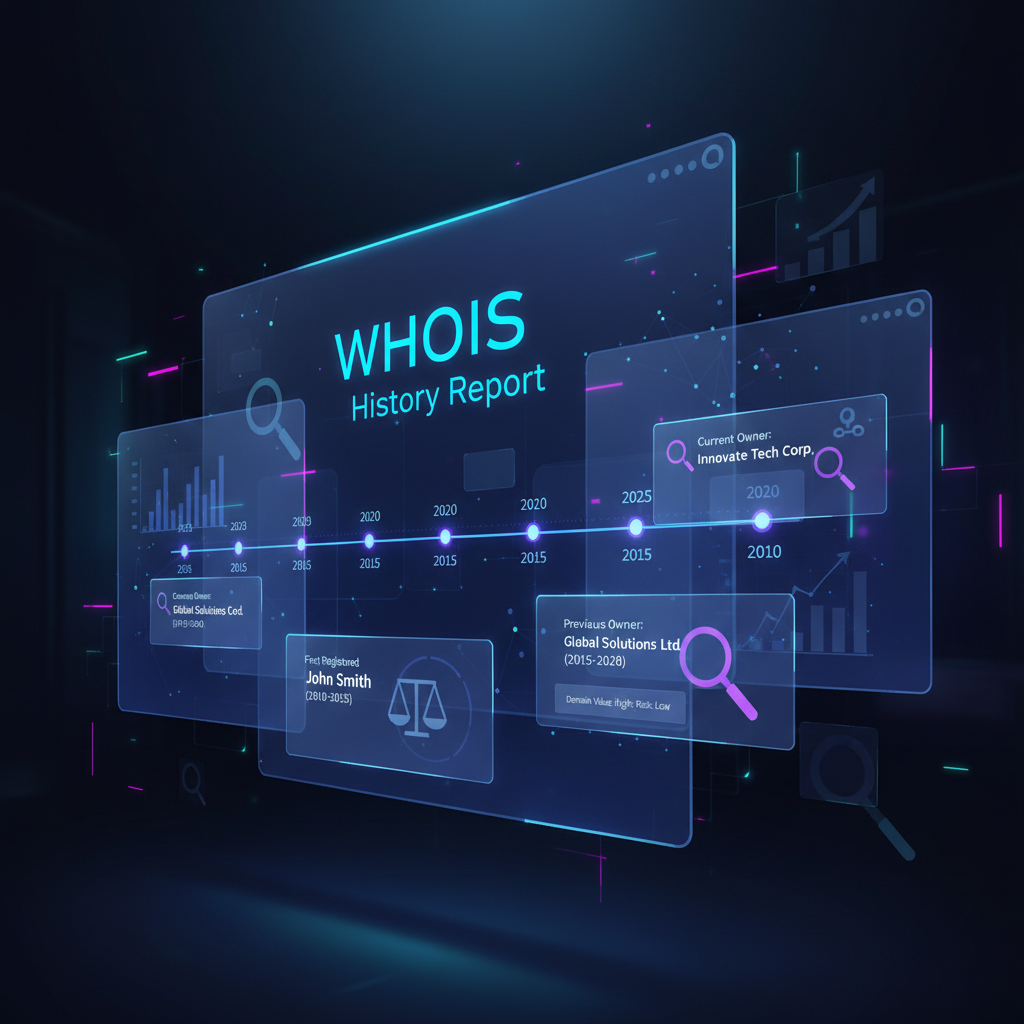
WHOIS history comprises the sequential archive of domain registration metadata collected over time, capturing ownership changes, registrar updates, registration and expiration events, and adjustments to administrative and technical contacts. Unlike static WHOIS queries—limited to current domain state—WHOIS history documents the domain’s lifecycle, providing a timeline essential for forensic reconstruction, fraud investigation, and infrastructure attribution.
For engineers, WHOIS history enables correlation of sequential registration states, revealing patterns such as rapid ownership turnover, domain recycling, and registrar hopping that signal potentially abusive behavior. This comprehensive timeline aids attribution by linking disparate domains through shared registrant identifiers or administrative contacts, enhancing detection of coordinated fraud campaigns.
Maintaining WHOIS history requires systematic collection and long-term archival of snapshots from diverse registries and registrars, involving data normalization and reconciliation to support temporal queries. DomainTools’ research resource DomainTools Whois History Research provides an authoritative technical background on these mechanisms.
Mechanisms Underpinning WHOIS History Systems
- Periodic Polling: Scheduled queries to WHOIS servers at intervals—ranging from minutes to days—capture domain state changes. More frequent polling improves granularity but increases infrastructure load and data volume.
- Registry APIs and Bulk Data Access: Many registries expose APIs or bulk datasets containing historical registration records or event logs, offering authoritative data with higher efficiency and completeness compared to ad hoc polling.
- Third-Party Archival Aggregators: Commercial and open-source providers aggregate WHOIS data by crawling registrars and registries, applying normalization to create comprehensive archives usable for various investigative purposes.
- Passive Data Correlation: WHOIS history is often linked with passive DNS data, SSL certificate transparency logs, and IP address mappings to enrich temporal context and facilitate cross-domain infrastructure analysis.
These mechanisms combined yield rich datasets that enable investigators to longitudinally trace domain ownership and registration events beyond static snapshots. Engineers designing WHOIS history systems must account for heterogeneity in data sources, update frequencies, and privacy constraints.
For interface standards, the ICANN Registration Data Lookup serves as a practical reference for current WHOIS and RDAP protocols used in data retrieval.
Disambiguating WHOIS History from Current WHOIS Queries
A fundamental distinction is that WHOIS history archives represent an ordered series of domain registration snapshots capturing the domain’s evolution over time, whereas current WHOIS queries present only the latest registration state. This temporal dimension is indispensable for understanding domain behavior across ownership transitions.
Current WHOIS results provide no insight into when or how fields—such as registrant contact or registrar—changed, making it impossible to detect tactics like rapid ownership churn or domain recycling. WHOIS history reconstructs the “chain of custody,” enabling forensic analysis of domain provenance, ownership transfer patterns, and lifecycle anomalies indicative of fraud or abuse.
Illustrative Use Cases of WHOIS History in Fraud Investigations
WHOIS history reveals critical patterns otherwise invisible in static data. For example, domain recycling—when previously abandoned domains are re-registered by unrelated entities—can be identified by examining registration lapses and re-registration events. This detection helps discern domains with residual reputation or tainted provenance from genuinely new domains.
Ownership transfers documented in WHOIS history are another investigative asset. By tracking repeated or rapid registrant changes, or uncovering persistent contact points masked by front companies and privacy proxies, analysts can connect domains tied to the same threat actor or infrastructure cluster, even if these signals are obscured in current lookups.
The Investigative Value of WHOIS History
- WHOIS history enables reconstruction of ownership and registration sequences, exposing operational changes and actor transitions over time.
- It uncovers suspicious lifecycle patterns like accelerated domain churn, registrar hopping, and dormant periods punctuated by sudden reuse.
- When integrated with external intelligence such as passive DNS or certificate logs, WHOIS timelines provide multi-dimensional attribution that strengthens threat detection and response efforts.
This temporal insight transforms domain analysis from static snapshots into forensic timelines crucial for combating sophisticated fraud and infrastructure reuse strategies.
Limitations of Static WHOIS Data in Fraud Investigations
Static WHOIS data’s snapshot nature restricts visibility into domain lifecycle dynamics, severely limiting investigative capabilities for fraud detection.
The Problem with Temporal Blindness in Static WHOIS Records
Current WHOIS responses represent domain metadata at the query instant without historical context. This absence of temporal data renders it impossible to discern:
- Domain churn: Rapid ownership or registrar changes intended to thwart attribution and complicate takedown.
- Registrant masking: Frequent updates to contact fields concealing persistent actor identifiers.
- Lifecycle staging: Domain phases such as dormancy, expiration, and reactivation critical to understanding attacker tactics.
Without this contextual granularity, fraud detection loses nuanced signals pivotal for threat intelligence accuracy.
Complications Posed by Domain Recycling and Infrastructural Reuse
Domain recycling—re-registering previously expired or abandoned domains—is a prevalent adversary exploitation technique. Static WHOIS cannot indicate whether a domain is truly new or recirculated infrastructure, causing bias in domain reputation systems.
This obfuscation undermines efforts to map malicious infrastructure persistence and leads to gaps in defensive coverage.
Operational Consequences of Relying Solely on Static WHOIS
Dependence on current-only WHOIS data results in underestimation of ongoing campaigns, delays in threat actor identification, and reduced efficacy of blacklisting and reputation scoring. This fragility can increase mean time to detection and response for security apparatus.
Comparing WHOIS History with Alternative Data Sources
While passive DNS, SSL certificate transparency, and IP reputation systems offer complementary signals, none convey explicit domain ownership transitions integral to exposing domain lifecycle misuse. WHOIS history remains uniquely valuable for domain-centric infrastructure forensic analysis.
The Security Imperative of Tracking Domain Recycling
Maintaining WHOIS historical data empowers security teams to detect infrastructure reuse, track evasive ownership patterns, and build cumulative attribution intelligence essential to preempting persistent fraud operations and informing predictive defenses.
Mechanics of Leveraging WHOIS History for Fraud Detection
Tracking Domain Ownership Changes through Sequential Records
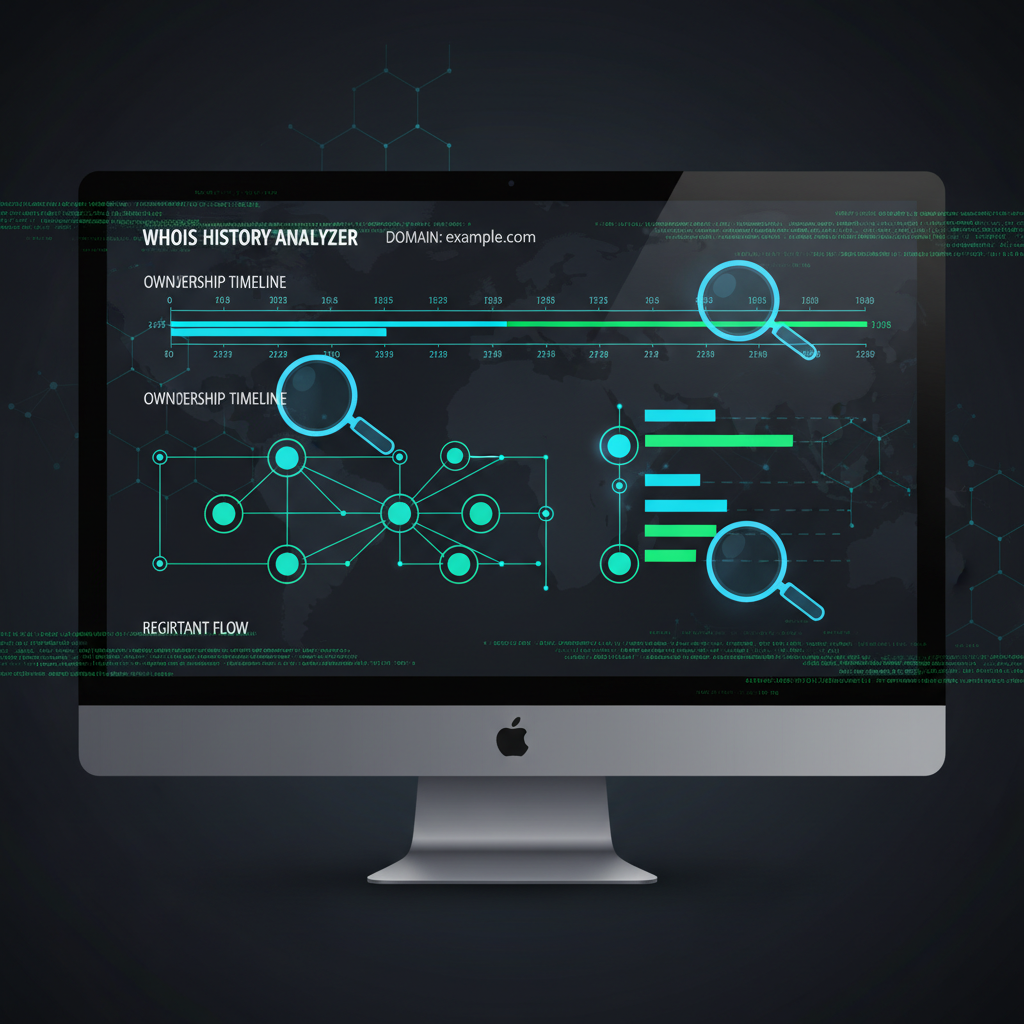
WHOIS history’s core value lies in reconstructing ownership by comparing timestamped snapshots, documenting domain states across creation, renewal, transfer, and expiration events. Normalizing heterogeneous data from RDAP responses, bulk dumps, and third-party feeds is a prerequisite, addressing format disparities and privacy-induced redactions.
Record differencing algorithms identify ownership and registrar shifts, registrant contact changes, and anomalous updates indicative of fraud tactics like rapid handoffs or obfuscation.
This timeline-centric analysis integrates external metadata such as ticket number lookups—linking domain events to legal or forensic actions—and device-related serial number data to associate domain infrastructure with physical assets. These correlations enrich investigative context beyond domain metadata alone.
Operational challenges include managing incomplete data, privacy proxy obfuscations, and update delays. Automated pipelines must incorporate fuzzy matching and anomaly detection to flag suspicious patterns promptly.
Architecturally, scalable WHOIS history integration typically involves RESTful APIs or mass registration bulk lookups, necessitating trade-off evaluations among data completeness, query latency, and processing complexity. Incremental ingest pipelines enable timely updates, while preserving fine-grained historical fidelity.
Detecting Domain Recycling and Infrastructure Reuse
Domain recycling manifests as cyclical registration signatures within WHOIS history—short-lived ownership spans punctuated by rapid re-registration, often by related or identical actors. Extracting these temporal patterns requires aggregating sequential snapshots, mapping registrant overlaps, and identifying clustering behaviors across domains.
Such analytics improve fraud detection by suppressing false positives linked to benign portfolio turnovers and spotlighting persistent malicious infrastructure. Differentiating legitimate transfers from abuse involves multi-modal heuristics incorporating DNS continuity, hosting IP overlaps, SSL certificate reuse, and registrar consistency.
Addressing domain recycling enhances the accuracy and precision of reputation systems, empowering security teams to detect and curtail attacker infrastructure reuse with greater confidence.
Data Normalization and Timestamp Consistency Issues
WHOIS data is inherently heterogeneous, fragmented across registries, registrars, and historical snapshots, complicating unified temporal analyses. Variations in field naming, data structures, and metadata availability demand sophisticated schema normalization to align these disparate records into a canonical model.
Preserving forensic detail while managing dataset complexity requires layered normalization: core high-confidence fields (registrant, registrar, dates) feed primary workflows, while raw or partially structured data is retained for deep investigations.
Timestamp consistency is a significant challenge. WHOIS data suffers from inconsistent timestamp semantics, lack of explicit timezones, and registry-level clock drift. Reconciling event times requires converting all timestamps to a uniform standard (UTC) and accounting for daylight saving and extraction timing versus authoritative update time discrepancies.
Advanced techniques correlate WHOIS timestamps with registry-specific serial numbers and ticket ID lookups as monotonic event anchors, enabling reliable event ordering even among conflicting timestamp records. This approach parallels trust anchor management in distributed systems (e.g., RFC 5011) and device inventory tracking via serial lookups.
Handling partial records and inconsistencies without discarding important anomalies is vital. Maintaining provenance metadata and confidence scoring for each event supports weighted analysis and reduces false hypotheses.
This normalization and timestamp alignment foundation underpin handling increasingly obfuscated WHOIS data under evolving privacy regulations.
Privacy Redactions and Partial Records Management
Evolving global privacy laws such as GDPR and CCPA impose widespread redactions of personally identifiable information in WHOIS records, dramatically reducing available registrant metadata in historical archives. This shift complicates ownership tracking and domain attribution by obscuring critical identifiers like names, emails, and contact details.
To mitigate this, analysts augment redacted WHOIS data with infrastructure fingerprints—IP addresses, hosting providers, registrar metadata—and deploy heuristic and probabilistic matching models. These models analyze registrar patterns, timing correlations, and ancillary data to probabilistically link redacted entries, reconstructing ownership timelines with decreased confidence.
Analogous to “certificate lookup” or “quote checker” systems that maintain trust verification despite incomplete metadata, WHOIS systems rely on redaction-aware pipelines that differentiate missing data from masking, annotate record versions, and balance inference risks to maintain analytic rigor without violating privacy compliance.
Engineering pipelines must navigate this trade-off carefully: overreliance on probabilistic links risks false positives, while excessive pruning reduces investigative utility. Access controls, privacy-by-design principles, and transparent redaction versioning are critical to ethical and compliant operations.
Case studies show firms achieving 70% recovery in investigative insights post-GDPR by combining infrastructure-based correlation with heuristic linking, albeit at increased computational cost and annotation complexity.
Balancing Completeness with Latency and Scalability
Achieving high coverage, freshness, and scalability in WHOIS history ingestion pipelines presents complex engineering trade-offs.
Streaming incremental ingestion prioritizes latency, quickly capturing new domain changes enabling near-real-time fraud alerts. However, partial or out-of-order updates can produce inconsistent states, complicating accurate timeline reconstruction and increasing false positives.
Batch processing—comprehensive reconciliations over longer windows—ensures high data integrity and canonical event ordering but introduces latency incompatible with live security workflows.
Hybrid architectures combine both, layering immediate incremental updates with periodic batch normalizations and deduplication. This design supports timely detection coupled with consistent, historical data fidelity.
Scalable storage architectures must handle high write throughput and efficient querying over billions of records. Time-series databases, append-only event logs, and graph databases provide fitting abstractions but require specialized indexing schemes to preserve query performance at scale.
Analogously to other lookup-heavy domains such as verifying work histories or warrant lookups online, balancing freshness with accuracy under resource constraints demands careful capacity planning and algorithmic tuning.
Data retention policies factor heavily, with tiered archival using cold storage and compression reducing costs but requiring retrieval mechanisms compatible with forensic timeliness.
A real-world example highlights a fraud intelligence platform reducing detection latency by 60% via streaming ingest, while batch reconciliation improved data accuracy by 30%, simultaneously lowering false positive rates and operational costs.
Ultimately, engineering WHOIS history pipelines entails managing nuanced trade-offs between data completeness, timeliness, and infrastructure costs, dictated by business priorities and investigative mission requirements.
Building Sequential Snapshot Processing Pipelines
Effective WHOIS history systems start with versioned ingestion of domain registration snapshots that preserve discrete temporal states of each domain. These snapshots originate from heterogeneous WHOIS sources with significant syntax variation and inconsistent formatting.
Pipeline design emphasizes modular parsers tailored to registrar and TLD-specific WHOIS structures to normalize records into canonical schemas. Implementing robust schema validation and error handling accommodates frequent anomalies and partial data, critical for operational resilience.
Diffing algorithms identify changes between successive snapshots, flagging ownership, registrant, registrar, DNS, and status updates. These diffs feed timestamped events that collectively characterize the domain’s historical trajectory.
To bolster fraud investigation workflows, pipelines incorporate enrichment steps linking domain events with external intelligence like bulk registration alerts, complaint and ticket logs, and device serial number databases. This enriches context and situational awareness.
Operational challenges include handling WHOIS rate limits, latency variability, and high cardinality domain metadata schemas. Caching strategies mitigate redundant queries, while extensible metadata mapping supports evolving data landscapes.
This snapshot-based archival approach strengthens domain forensic analysis by converting heterogeneous, ephemeral registration data into coherent, queryable histories foundational for attribution and detection.
Maintaining Data Privacy Compliance While Maximizing Utility
WHOIS history datasets inherently process PII subject to stringent privacy laws, requiring pipelines to embed privacy-by-design principles.
Anonymization and pseudonymization replace direct identifiers with opaque, consistent tokens, preserving linkage ability without exposing raw personal data. Redaction reconciliation frameworks selectively maintain essential metadata (e.g., creation dates, registrar info) in clear form to sustain investigatory value.
Role-based access control, query filtering, and comprehensive audit logging enforce controlled data access and regulatory accountability. Pipelines must accommodate jurisdictional nuances, dynamically adapting redaction and disclosure policies as laws evolve.
Automated data lifecycle management purges or further anonymizes aged personal data, balancing retention needs with compliance. Transparent versioning distinguishes redacted from missing fields, ensuring analysis pipelines handle uncertainty appropriately.
This approach minimizes regulatory risk while maintaining the analytic precision necessary to detect fraud infrastructure evolution, as demonstrated by industry case studies reporting substantial regulatory incident reductions post-pseudonymization adoption.
Reducing Fraud False Positives via WHOIS History Insights
Precise delineation between legitimate domain re-acquisitions and malicious abuse is key to minimizing fraud false positives, which can otherwise overwhelm security teams and degrade operational efficiency.
WHOIS history provides temporal context illuminating domain recycling patterns and infrastructural continuity. By analyzing registrant stability, registrar consistency, and nameserver configurations across time, investigators can infer benign portfolio transactions versus hostile reuse.
Historical data exposes domains previously flagged abusive that persist across ownership changes, guiding prioritization for investigation without relying on transient reputation signals.
Integrating WHOIS timelines with supplementary signals—IP reputation, SSL certificate reuse, behavioral telemetry—generates multi-factor risk scores that dramatically improve detection precision. Open access to mass registration lookup and historical WHOIS snapshots democratizes such capabilities beyond large enterprises.
This timeline-driven approach shifts fraud detection from speculative snapshots to evidence-based attribution, optimizing alert relevance and security resource allocation.
Key Takeaways
- WHOIS history provides a sequential, timestamped archive of domain registration metadata, capturing changes in ownership, registrar, and contact information over time. For engineers focused on fraud investigations or cybersecurity, integrating WHOIS history enables tracking of domain lifecycle events and surfacing temporal patterns—such as ownership churn and domain recycling—that static WHOIS snapshots cannot reveal. This temporal fidelity is critical to correlating infrastructure reuse and detecting persistent malicious behavior across domain transitions.
- Utilizing sequential WHOIS snapshots as time-series data helps identify rapid ownership transfers and registrar hopping. These patterns often correspond to attempts to obfuscate fraudulent operations and evade detection. Systems that rely solely on instantaneous WHOIS queries miss these signals and must therefore augment with historical data to build a comprehensive intelligence picture.
- Incorporating domain recycling detection reduces false positives in fraud detection workflows. Domains periodically deleted and later re-registered by unrelated entities introduce ambiguity that can inflate alert volumes and misdirect resources. Awareness of recycling events within WHOIS history allows engineers to differentiate persistent malicious infrastructure from legitimate domain portfolio turnover or marketing-driven re-acquisitions.
- Robust WHOIS history integration demands normalization across diverse WHOIS schemas and rigorous timestamp alignment. Variability between registries, registrars, and regional data formats, compounded by partial or inconsistent records, requires engineered pipelines for schema harmonization and temporal reconciliation to maintain high fidelity event timelines essential for reliable fraud analytics.
- APIs and bulk WHOIS history services offer scalability and richer historical coverage than direct WHOIS queries, which are constrained by rate limits and provide only current data. Engineering teams must evaluate trade-offs between latency, data freshness, completeness, and cost when selecting or building these services.
- Correlating WHOIS history with external fraud indicators—such as ticket number lookups, serial number references (e.g., Rheem or Brother devices), or quote checker outputs—enriches contextual analysis. This multi-dimensional fusion aids in uncovering connections between domain ownership shifts and physical asset fraud, augmenting attribution and threat detection.
- Privacy redaction requirements and GDPR-like regulations increasingly impact WHOIS data availability and granularity, complicating longitudinal comparisons. Effective systems implement fallback heuristics, probabilistic matching, and alternative identity resolution strategies to handle partial or obfuscated records without sacrificing analytic rigor.
- Planning for data retention and scalable storage architecture is essential to maintain increasingly voluminous WHOIS history datasets. Efficient indexing, tiered archival strategies, and query optimization reduce processor and storage overhead, preserving performance for real-time fraud detection pipelines as datasets grow.
These key considerations lay a comprehensive framework for understanding and engineering WHOIS history integration in fraud investigation workflows. The following sections explore acquisition methods, data modeling, normalization challenges, privacy implications, and scalable pipeline architectures to harness WHOIS history effectively at enterprise scale.
Conclusion
WHOIS history transcends the limitations of static lookups by encoding dynamic, chronological domain registration states critical for robust fraud and cybersecurity investigations. The temporal dimension exposes domain recycling, ownership churn, and lifecycle anomalies pivotal to uncovering malicious infrastructure otherwise invisible.
Engineering such systems demands sophisticated normalization of heterogeneous, often redacted data, rigorous timestamp reconciliation, and architectures balancing completeness with freshness and scalability. Integrations with external indicators amplify insight, further strengthening attribution and detection precision.
Looking forward, the increasing scale and legal complexity of WHOIS data will challenge engineers to build modular, privacy-aware pipelines that maintain historical fidelity under evolving constraints. As domain-based fraud tactics grow in sophistication and distribution, the architectural question becomes: how will systems scale to ingest, normalize, and analyze petabyte-scale WHOIS archives with minimal latency, ensuring investigator confidence amid growing regulatory and operational complexity?
Mastering WHOIS history at scale is thus integral not just to today’s fraud defense but to future-proofing infrastructure intelligence in a world of continuous domain lifecycle mutation.