Introduction
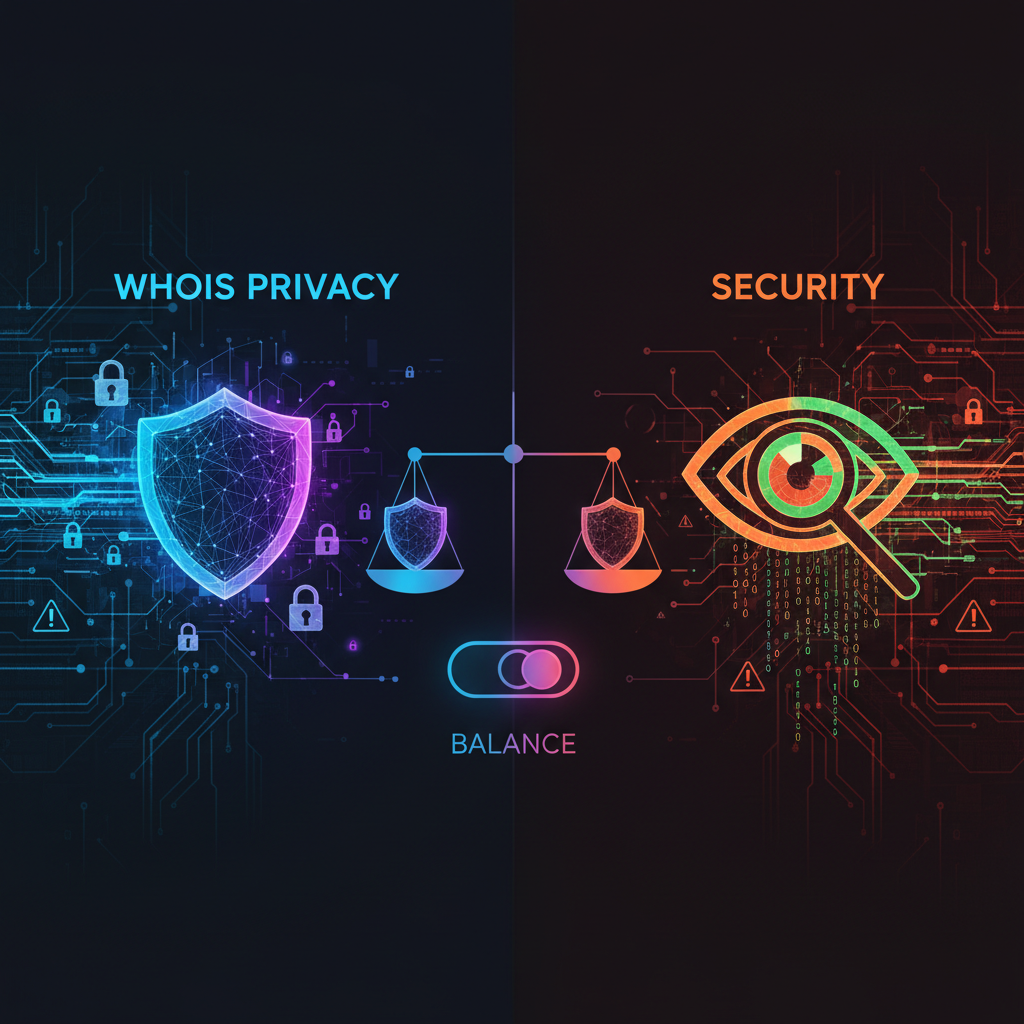
Masking domain registrant details through WHOIS privacy creates a fundamental tension between protecting personal information and preserving domain name system security. While it shields ownership data from public exposure, WHOIS privacy complicates abuse detection, incident response, and trust validation by obscuring the attribution layer integral to many security workflows. This trade-off is far from theoretical—it directly impacts how domain architects, security engineers, and incident responders design resilient, transparent systems that remain operational under threat.
The challenge lies in balancing privacy demands with operational security needs. WHOIS privacy does not prevent domain hijacking or replace cryptographic mechanisms like DNSSEC. However, it alters the effective attack surface and increases complexity in abuse pipelines and law enforcement investigations. These changes impact detection latency, the reliability of automated security tooling, and the efficacy of trust relationships. This article examines the key dimensions of the WHOIS privacy versus security debate, detailing how private domain registration affects data availability, trust models, and response capabilities, as well as what adaptive strategies can maintain robust domain protection while preserving necessary visibility.
Understanding WHOIS Privacy and Its Role in Domain Management
The WHOIS protocol serves as one of the foundational query standards in domain name management, providing a transparent mechanism to retrieve registrant details for any registered domain. At its core, WHOIS exposes data such as the domain holder’s name, postal address, email address, and phone number, directly pulled from registrar records. This openness fosters crucial accountability within the domain name ecosystem; it enables verifying domain ownership, asserting intellectual property claims, and building trust relationships that underpin DNS operations and domain dispute resolution. Registrars and registries depend on accurate WHOIS data to mediate ownership conflicts, enforce policies, and maintain infrastructural integrity across the DNS.
However, the transparency that enforces accountability also presents considerable privacy challenges. To protect sensitive personal or corporate data from public exposure, WHOIS privacy services—commonly labeled as domain name privacy services or private domain registration—have emerged. These services operate as forwarders or proxies. Instead of publishing the registrant’s real contact details, privacy services substitute anonymized or generic contact records managed by the service provider. These proxy contacts maintain bidirectional communication, enabling email forwarding or official correspondence without revealing the actual domain owner. This masking reduces the registrant’s digital footprint, limiting exposure to data scraping, unsolicited contact attempts, or aggregation by malicious actors.
Implementations of WHOIS privacy vary widely among registrars. Some provide partial redaction, where certain fields are obfuscated or truncated, while others fully replace identifying elements with third-party proxies. This variation affects operational workflows—some WHOIS privacy providers allow registrants to update DNS or domain-related data via portals without exposing contact info, while others require registrar intervention, potentially delaying real-time domain management. The design of privacy services influences registrar-side technical support, abuse reporting, and interoperability with incident response processes, as maintaining a valid, reachable point of contact remains imperative for critical interventions.
From a security standpoint, public WHOIS data exposure can broaden the attack surface significantly. Malicious actors leverage harvested contact information to launch social engineering, spear phishing, or spam campaigns targeting domain administrators and organizations. Risk magnifies when contact points include personal phone numbers or emails tied to key administrative roles. Additionally, registrant data open doors for identity theft or targeted harassment, as adversaries utilize WHOIS records to impersonate owners or conduct persistent campaigns. These attack vectors coexist alongside legitimate use cases, including security researchers and law enforcement agencies employing WHOIS data to support investigations and enforcement.
Nevertheless, enabling WHOIS privacy introduces nuanced trade-offs crucial to broader security postures. Privacy measures complicate domain ownership verification during abuse investigations or legal takedowns by obscuring registrant identities, potentially delaying incident response. Importantly, DNS Security Extensions (DNSSEC) bolster DNS integrity through cryptographically signed responses but do not protect WHOIS registrant data. DNSSEC ensures DNS query authenticity and prevents cache poisoning but leaves registrant privacy concerns unaddressed. WHOIS privacy thus operates orthogonally to DNSSEC—privacy hides identity, while DNSSEC protects data integrity. For a detailed understanding of DNSSEC, see the IETF DNSSEC FAQs.
Moreover, WHOIS privacy affects domain trust relationships in complex ways. Stakeholders—including registrars, registries, ISPs, and cybersecurity services—rely on transparent WHOIS data to signal domain legitimacy. Excessive anonymization can disrupt anti-abuse workflows or weaken trust signals, resulting in domains being flagged as suspicious or impeding coordination during security incidents. Balancing the confidentiality benefits of domain privacy with the transparency demands of DNS ecosystem operations remains a challenging engineering and policy problem demanding granular controls and rigorous process discipline.
This interplay between exposure and confidentiality in WHOIS privacy naturally leads into examining how it contrasts with broader domain protection strategies that encompass robust technical controls beyond data masking.
Differences Between WHOIS Privacy and Domain Protection
Having established the core functions and trade-offs of WHOIS privacy, it is critical to differentiate it from domain protection—a broader security discipline focused on preventing unauthorized or malicious domain changes, transfers, or hijacking. These two concepts often get conflated but serve fundamentally distinct purposes within the domain lifecycle.
WHOIS privacy acts as a shield for domain owner identity, limiting what metadata is publicly accessible. In contrast, domain protection introduces procedural and technical controls on domain state transitions, constraining who can modify registration details or transfer ownership at registrar or registry levels. Without effective domain protection, WHOIS privacy alone offers no defense against lateral attacks aiming to seize or alter domain control.
Crucial domain protection mechanisms extend beyond data anonymization. Registrar or registry locks prevent unauthorized edits or transfers. Registrar locks impose non-transferable, non-editable states requiring explicit registrant authorization, often involving multi-factor or out-of-band validation steps. Transfer locks specifically restrict ownership transfers, blocking typical hijacking vectors. Complementing locking controls, authentication enhancements—such as two-factor or multi-factor authentication (2FA/MFA) on registrar accounts—further reduce compromise risk by enforcing strong access control on domain management interfaces.
Parallel to procedural locks and authentication, DNSSEC contributes a vital layer by cryptographically assuring DNS data integrity. It signs DNS resource records digitally, enabling resolvers to verify authenticity and detect tampering. DNSSEC defends against cache poisoning and man-in-the-middle attacks, securing the resolution path regardless of WHOIS privacy. However, DNSSEC’s protective scope excludes registrant data confidentiality—its cryptographic assurances address DNS data, not metadata.
Domain monitoring services provide an additional pillar. These continuously scan for anomalous DNS records changes, domain status updates, or registrar data alterations, triggering alerts on suspicious events. Proactive monitoring complements WHOIS privacy by mitigating attack vectors that data obfuscation alone cannot address—such as brute-force login attempts, credential stuffing, or insider threats.
A common misconception is that enabling WHOIS privacy equates to secured domain ownership. In reality, anonymizing registrant data doesn’t stop a malicious actor with compromised registrar credentials from modifying DNS entries or hijacking a domain. Effective domain protection requires dedicated controls and policy enforcement independent of WHOIS masking.
Operationally, WHOIS privacy introduces friction—with masked contacts delaying ownership verification or owner outreach during abuse and law enforcement investigations. Conversely, full WHOIS transparency can expose registrants to phishing or spam but expedites takedowns and mitigation action. Organizations continuously navigate this trade-off—balancing confidentiality and operational transparency to optimize incident response.
Real-world examples emphasize these dynamics. A cybersecurity firm’s domain was hijacked despite WHOIS privacy; attackers compromised registrar credentials, unlocked domain locks, and transferred ownership, disrupting services until recovery. The privacy concealed contact data but did not prevent unauthorized technical changes. In contrast, another organization suffered persistent spear phishing due to public WHOIS data but mitigated attacks by combining domain privacy with MFA and locking controls, reducing phishing impact while retaining domain security.
These illustrate that WHOIS privacy is necessary but insufficient alone for domain security. Robust protection frameworks must integrate locking features, cryptographic safeguards like DNSSEC, adaptive authentication, and continuous monitoring. Integrating domain privacy with comprehensive protection strategies enables sustainable, resilient defense of digital assets.
Navigating whois privacy versus security necessitates layered defenses acknowledging complementary control scopes—privacy for identity protection; locking, authentication, and DNSSEC for operational integrity and trust.
Security Implications of WHOIS Data Exposure and Privacy
Risks of Public Exposure of WHOIS Data
Publicly accessible WHOIS data underpins domain trust relationships and supports numerous critical security workflows maintaining global DNS ecosystem integrity. Registrant details—emails, organizational affiliations, admin contact names—enable automated systems and analysts to rapidly attribute domain ownership. This attribution is crucial for threat intelligence correlation, incident triage, and trust scoring models foundational to enterprise security operations.
Security orchestration platforms parse WHOIS data to enhance phishing and malicious infrastructure detection. Upon identifying suspicious domains, quick access to meaningful registrant information enables confirmation or rejection of abuse patterns, tracking malicious infrastructure relationships or flagging newly registered domains with incomplete data. Transparency accelerates phishing source identification and enriches “domain glass” models—graphical representations of registration and ownership interdependencies—spotlighting anomalous connections or reputation shifts indicative of abuse. For domain ownership analysis best practices, see ICANN’s WHOIS and Data Protection work.
- Phishing and spearphishing: Public registrant contact details enable adversaries to craft credible pretext emails aimed at domain admins or customers, bypassing defenses through impersonation or contextual knowledge gleaned from WHOIS records.
- Spam and harassment: WHOIS emails become spam fodder, increasing noise and the risk of successful social engineering exploits.
- Domain hijacking and social engineering: Exposed personal and organizational details facilitate impersonation attacks targeting registrar transfer requests or lock removals using legitimate-seeming information, enabling domain takeover.
- Supply chain reconnaissance: In complex infrastructures, registrant data aids attackers in identifying weak trust boundaries across partners and vendors, enabling supply chain compromises.
Despite risks, open WHOIS data supports accountability frameworks. Security operations leverage this data for timely takedown requests, enforcement actions, and reputation scoring. Domain glass and reputation systems dependent on WHOIS data extend protections for enterprise networks, enabling zero-trust architectures that factor domain ownership into access evaluations.
The tension between transparency and privacy is heightened by evolving privacy regulations (e.g., GDPR) restricting public data exposure, forcing registrars and operators to mediate competing policy demands—a focal point for domain security architects.
Security Trade-offs Introduced by WHOIS Privacy
WHOIS privacy services mask registrant contact data with proxy or anonymized fields, shielding individuals’ personal information in compliance with privacy laws such as GDPR while preserving basic domain functionality like contact routing. This obfuscation, however, carries significant security implications.
Impaired Abuse Detection and Incident Response: Automated threat intelligence ecosystems rely on consistent registrant data to identify phishing infrastructures, malware C2 domains, or fraudulent registrations. Masking critical attribution signals through anonymized WHOIS data impairs triage workflows, extending detection timelines and increasing threat exposure windows. Historical incident analyses link WHOIS obfuscation with delayed phishing takedowns and reduced blacklist effectiveness.
Law Enforcement Challenges: Privacy layers introduce procedural overhead and delays. Investigators must route requests through registrars or privacy providers, requiring formal legal process adherence, slowing enforcement actions like seizures or court-ordered takedowns. Jurisdictional privacy law variability compounds inconsistency in data disclosure, complicating cross-border investigations into cybercrime domains.
Technically, DNSSEC and WHOIS privacy operate independently but complementarily. DNSSEC ensures DNS response integrity, defending against manipulation regardless of registrant data exposure. WHOIS privacy protects user identities tangential to DNS resolution security. Integrating these distinct layers yields a comprehensive domain security posture addressing both data integrity and privacy.
With obscured registrant details, domain trust relationships shift toward alternate signals. Security professionals increasingly leverage domain glass visualizations, historical registration data, registrar reputations, TLS certificate transparency logs, and behavior telemetry (query patterns, hosting infrastructure) to supplement trust architectures degraded by WHOIS anonymization.
- Balancing GDPR-compliant privacy with abuse reporting, ensuring proxy contacts remain responsive and escalation paths reveal true registrants under legitimate requests.
- Employing tiered access control via Registration Data Access Protocol (RDAP), enabling selective disclosure to authenticated parties such as law enforcement, reducing public data exposure without eroding operational security.
- Facilitating abuse reporting via transparent proxies, filtering and triaging complaints while preserving registrant anonymity to maintain response pathways.
Ultimately, the WHOIS privacy versus security debate crystallizes as a trade-off: protecting registrants’ identities diminishes immediacy and richness of actionable security data. Maintaining operational security demands layered architectures merging WHOIS privacy with alternative trust signals, DNSSEC, incident response augmentations, and multi-stakeholder cooperation.
Understanding these intertwined dimensions guides domain architects to design resilient systems that respect privacy mandates while sustaining attack surface visibility essential for security.
Balancing WHOIS Privacy and Security: Trade-offs and Operational Challenges
1. Impact of WHOIS Privacy on Abuse Detection and Law Enforcement
WHOIS privacy services, implemented as private registrations, primarily shield personal contact information from public queries. While addressing privacy and spam concerns, they impose operational complexities on cyber abuse investigators, law enforcement, and intellectual property enforcers.
Anonymized registrant data closes the direct communication channel to domain owners, forcing security teams to rely on registrars or privacy providers as intermediaries holding the true registration records. Legal instruments—subpoenas, court orders—are typically required to unmask registrants, introducing procedural latency that compromises timely threat mitigation.
Security tools parsing WHOIS data lose effectiveness with anonymization. Domain glassing and threat intelligence suffer from unreliable ownership mapping, reducing attribution precision for high-volume phishing takedowns or malware campaign disruptions. Law enforcement investigations can devolve into protracted legal processes to obtain registrant info, creating loopholes for malicious operators to exploit persistent anonymity.
Detailed investigations show that during large-scale phishing disruptions, hundreds of legal requests were required to individual privacy providers to unblock domain suspensions, cumulatively delaying mitigation by weeks and enabling threat persistence. Trademark enforcement through UDRP or litigation similarly suffers due to opaque WHOIS data, complicating defendant identification and evidence collection.
The core tension remains reconciling registrant privacy with ecosystem transparency. While privacy shields users from harassment and identity exposure, security success depends on trust and accountability derived from reliable registrant data. Weak attribution degrades domain reputation frameworks, increasing false positives or negatives and undermining security confidence.
Managing this trade-off demands cross-sector cooperation, clearly defined legal frameworks for privacy versus disclosure, and innovative operational models that preserve privacy without unduly stifling security investigations. For foundational standards, see the IETF Registration Data Access Protocol (RDAP) RFC 7483.
2. WHOIS Privacy Does Not Replace Cryptographic Domain Security Mechanisms
Distinguishing WHOIS privacy’s scope from domain protection’s technical controls is critical for comprehensive security. WHOIS privacy masks registrant data but offers no defense against domain hijacking, unauthorized transfers, or DNS manipulation.
Domain protection requires layered controls: registrar locks prevent external edits and transfers without explicit owner approval, employing multi-factor callbacks or out-of-band confirmation. Transfer locks specifically shield domains from unauthorized ownership changes exploited in attack campaigns. These procedural safeguards mitigate social engineering and inter-party fraud.
DNSSEC adds a cryptographic dimension by signing DNS data, enabling resolvers to verify authenticity and prevent cache poisoning or spoofing, ensuring users reach the intended IP addresses. Crucially, DNSSEC’s trust model operates independent of registrant privacy—it secures the resolution path, not the ownership data.
Failure to implement domain locks or DNSSEC while relying only on WHOIS privacy exposes domains to significant risks. Attackers with compromised registrar credentials can alter DNS records or transfer domains even if WHOIS details are anonymized. Conversely, domains with exposed WHOIS but robust locking and DNSSEC remain resilient to many attack vectors.
Operationally, integrating WHOIS privacy with domain protection requires clear customer education regarding limitations. Registrants often assume privacy implies security, leading to complacency if domain locking or DNSSEC is omitted. Registrars and security teams should adopt layered defense strategies combining privacy, procedural domain controls, secure authentication, and cryptographic validation to holistically safeguard domains.
Ultimately, a comprehensive security posture treats WHOIS privacy and domain protection as complementary but separate controls, each addressing distinct layers of risk.
Implementation Strategies for WHOIS Privacy in Registrars and Domain Ecosystem
Registrar Approaches to WHOIS Privacy Services
Registrars implement WHOIS privacy using several foundational models, each with distinct trade-offs impacting security, scalability, and regulatory compliance. These approaches balance protecting registrant confidentiality with enabling operational transparency necessary for abuse mitigation.
Proxy Registration is the most prevalent model. Registrars replace the actual registrant’s contact details in WHOIS with proxy entity information—an intermediary endpoint receiving abuse reports, legal inquiries, and verification requests. Backend systems must authenticate incoming communications, reliably forwarding legitimate messages to registrants securely and promptly. Automated verification, ownership confirmation, and abuse report vetting mitigate misuse. Nevertheless, proxy registrations face failure modes: unreachable proxy contacts delay abuse remediation, and proxy services themselves can be targeted or compromised. Attackers may also exploit proxy services to obscure identities, complicating investigations. Registrars must thus architect proxy infrastructures with redundancy, spam filtering, intrusion detection, and failover capabilities to sustain operational reliability.
Redaction of WHOIS Data involves selective omission or masking of sensitive WHOIS fields (name, postal address, phone, email) at the query layer, often driven by privacy regulations such as GDPR. This dynamic filtering applies contextual access control based on requester identity (public, law enforcement). Unlike proxy registration, redaction keeps original data in registrar databases while restricting public visibility. Overly aggressive redaction impairs abuse detection efficacy; insufficient redaction risks legal compliance breaches. Registrars balance this via role- and context-aware redaction policies coupled with access credentials and query auditing. Implementing scalable redaction demands robust identity management and data access controls.
A hybrid approach is Selective Disclosure, wherein registrars enable controlled, authenticated parties—law enforcement, abuse teams, or trusted third parties—to access unredacted registrant data under strict logging and audit frameworks. This requires integrating registrar databases with identity and access management (IAM) systems, enforcing multi-factor authentication and role-based access. Architectural challenges include preserving compatibility with legacy WHOIS protocols while layering interactive access control and cryptographic audit trails.
Data retention policies further influence WHOIS privacy implementations. Registrars retain underlying registrant data securely and encrypted for years to comply with ICANN mandates and law enforcement cooperation. Public-facing proxy or anonymized data do not replace these records but serve as privacy-preserving facades. Transparency reports detail data disclosure requests, abuse handling, and operational metrics, fostering trust and accountability.
Balancing privacy implementations across global jurisdictions involves reconciling conflicting laws, managing reputational risks, and scaling privacy service operations for millions of domains. Architecting these systems demands intersectional expertise in security engineering, privacy law, operational abuse response, and network infrastructure.
These foundational implementation strategies enable evolving adaptive mechanisms reconciling WHOIS privacy with domain security imperatives, explored next.
Adaptive Strategies to Maintain Visibility and Security
Balancing domain security with WHOIS privacy mandates demands adaptive technical and operational techniques that maintain accountability without exposing registrant PII publicly. Registrars, registries, and security teams deploy cryptographically strong, auditable, and role-aware systems to foster privacy-respecting yet transparent communication channels.
Secure escrow services serve as confidential intermediaries shielding registrant contact information encrypted under rigorous access controls. These escrow frameworks employ layered cryptographic controls—public key infrastructure combined with hardware security modules (HSMs)—ensuring data is inaccessible except during validated incidents or authorized requests. Incident responders or law enforcement authenticate via multi-factor processes and legal validation before escrow operators release decrypted data. This approach prevents wholesale WHOIS data exposure, reduces phishing and data harvesting risks, and aligns with data protection directives. Integration with incident response requires event logging, real-time notifications, and escalation protocols to prevent abuse of the escrow mechanism. Real-world deployments demonstrate improved abuse response times and reduced privacy breaches.
Complementarily, verified communication channels—such as authenticated messaging portals or encrypted email forwarding—facilitate abuse or enforcement correspondence to registrants without exposing identities. Utilizing cryptographic signatures and timestamps ensures message integrity and non-repudiation. Alerting dashboards and automated microservices architectures enable registrars to integrate event-driven notifications with privacy protections.
Implementing layered access controls enhances privacy-accountability balance. Tiered permission models align with roles—registrants, registrars, law enforcement, abuse teams, and vetted third parties—enforced through identity federation, attribute-based access policies, and protocols such as OAuth and SAML. Multi-factor authentication and just-in-time access provision reduce insider threats and unauthorized disclosures. Logging, cryptographic audit trails, and compliance reviews underpin trustworthiness. Legacy protocol constraints in WHOIS and decentralized DNS architectures challenge seamless integration, but adoption of Registration Data Access Protocol (RDAP) and DNSSEC progressively alleviates bottlenecks. For RDAP technical design and benefits, see the IETF RDAP RFC 7480.
Domain trust relationships gain renewed importance as anonymized WHOIS reduces direct ownership verifiability. Trust models incorporate secondary signals—domain glass metadata, DNSSEC validation status, domain age, registrar reputation scores, certificate transparency logs, and anomalous DNS configurations—to assess domain credibility. These signals compensate for obscured registrant data and integrate with abuse detection pipelines, informing proactive intervention thresholds.
Operational blind spots remain inherent; anonymized data can delay abuse source identification, affecting incident response speed. Adaptive measures, including community-sourced threat intelligence sharing and human-in-the-loop reviews, partially mitigate false positives and negatives induced by anonymization artifacts. Escalation matrices and oversight mechanisms ensure wrongful takedowns are minimized.
Anonymized registrant data may inadvertently increase domain hijacking risk due to diminished accountability. Registrars counteract with enhanced transfer verification workflows—registrar locks, transfer codes (AuthInfo), and out-of-band validation calls—increasing transfer friction and thwarting fraudulent changes, though at some cost to legitimate owner convenience.
In sum, WHOIS privacy services anonymize domain owner information to safeguard privacy and comply with regulation but introduce nuanced domain security challenges. Adaptive technical architectures combining cryptographically enforced escrow, verified communication channels, layered access controls, and enriched trust evaluation frameworks are essential to sustain security and transparency. These mechanisms serve registrars, security teams, and regulatory bodies striving to maintain a resilient and trustworthy DNS ecosystem.
Emerging innovations—including blockchain-based identity assertions and zero-knowledge proof protocols—promise to further enhance this privacy-security balance in future domain management paradigms.
Key Takeaways
- WHOIS privacy masks registrant data, generating a fundamental trade-off impacting domain security postures and trust relationships. Engineers must understand how privacy interacts with DNSSEC, abuse detection pipelines, and law enforcement access to build resilient protection strategies evaluating effects on transparency, attack surface, and incident response.
- WHOIS privacy and domain protection serve distinct functions: the former conceals registrant identity, the latter enforces controls preventing unauthorized domain changes, hijacking, or transfers. Both are necessary but complement each other and are not interchangeable.
- Concealing WHOIS data can hinder abuse reporting, attribution, and trust systems, enhancing attackers’ operational anonymity and complicating security workflows.
- Layered domain security must incorporate DNSSEC to provide cryptographic validation of DNS data, a protection orthogonal and essential despite registrant data privacy.
- Balance exposure and privacy considering law enforcement and abuse investigation needs. Removing privacy enhances transparency and incident responsiveness but increases risk of phishing, spam, and harassment.
- Variations in registrar WHOIS privacy implementations impact data consistency and availability, affecting domain glass tools’ accuracy and abuse reporting effectiveness. Systems must adapt with robust parsing and error handling.
- Operational complexity arises from WHOIS privacy—the need for supplementary data sources or heuristic models increases false positive risk and detection overhead.
- Anonymized WHOIS data degrades domain trust frameworks, reducing visible accountability and potentially allowing malicious registrations without enhanced vetting.
- Masking registrant data escalates computational overhead in threat intelligence sharing due to reliance on indirect telemetry, magnifying cost and scaling challenges.
These insights illustrate the necessity of integrating WHOIS privacy into domain security architectures thoughtfully, without compromising operational security, incident response, or compliance requirements.
Conclusion
The interplay between WHOIS privacy and domain security reveals a nuanced trade-off wherein protecting registrant confidentiality must be balanced against preserving operational transparency and trust within the DNS ecosystem. While WHOIS privacy effectively conceals personal data and complies with privacy laws, it complicates abuse detection, incident response timelines, and law enforcement engagement by masking direct registrant access. Crucially, privacy measures alone cannot prevent domain hijacking or unauthorized modifications—robust domain protection requires complementary technical controls, including domain locking, multi-factor user authentication, consistent DNSSEC deployment, and continuous monitoring.
Emerging adaptive strategies—such as cryptographically secured data escrow, selective disclosure frameworks, and enriched domain trust evaluation—offer promising avenues to reconcile these competing imperatives. As the DNS ecosystem grows in scale and complexity, future domain security architecture must evolve to integrate privacy and transparency holistically, accounting for operational realities and threat dynamics. The pressing design question confronting system architects is how to build mechanisms that make privacy versus security trade-offs explicit, auditable, and responsive—ensuring the domain name system remains both private and trustworthy at internet scale in an increasingly hostile digital environment.