Introduction
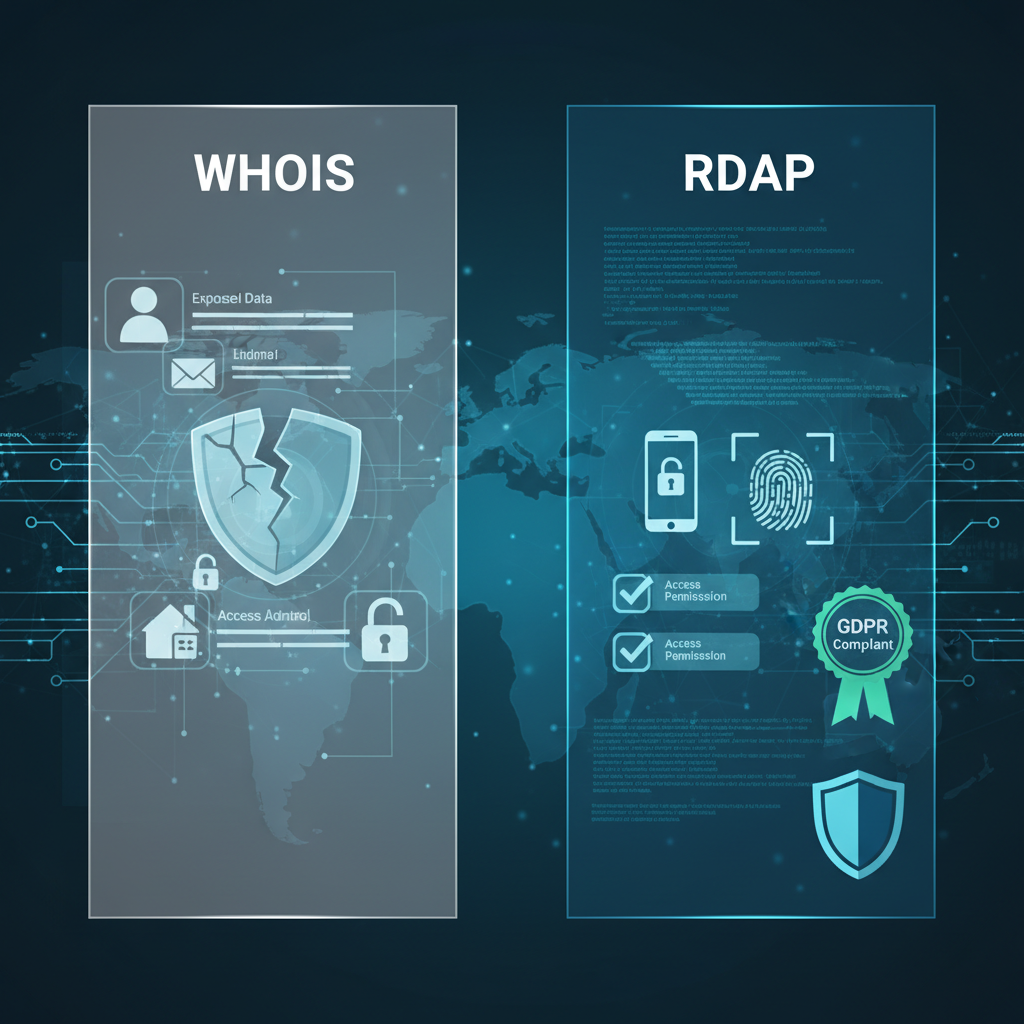
WHOIS’s original plaintext protocol exposes domain registrant data indiscriminately, lacking any built-in authentication or granular access controls. This legacy open-access design creates a critical privacy liability and generates insurmountable compliance challenges under GDPR and comparable data protection regulations. As a result, engineers have been forced to devise patchwork solutions or external workarounds—such as domain privacy services and bulk query throttling—merely to mitigate fundamental shortcomings in WHOIS’s handling of large-scale lookups and domain data confidentiality. In contrast, the Registration Data Access Protocol (RDAP) replaces the archaic WHOIS model with a RESTful, JSON-driven successor that mandates authentication, enforces policy-driven access controls, and provides structured responses, fundamentally reshaping the technical and operational landscape for registrant data retrieval.
Designing domain information services today requires carefully balancing technical complexity, privacy compliance, extensibility, interoperability, and operational scalability. For engineers building or migrating domain lookup systems—whether legacy command-line utilities like whois cmd or next-generation API-driven services—grasping the stark differences between WHOIS and RDAP is essential. These differences manifest most clearly in privacy enforcement, multifaceted access levels, error handling, and data formatting standards. This article unpacks those contrasts in depth, highlighting how RDAP remedies WHOIS’s critical blind spots while introducing nuanced trade-offs and integration challenges that influence real-world deployment architectures.
Framing Privacy and Access Challenges in Domain Lookup Protocols
The domain lookup ecosystem has traditionally juggled the twin goals of transparency and privacy, but ongoing regulatory evolution and rising privacy expectations have exposed the architectural deficiencies inherent to legacy approaches. Historically, protocols like WHOIS prioritized open access, allowing immediate public visibility into registrant and administrative details to aid activities such as dispute resolution, cybersecurity incident response, and law enforcement. While operationally straightforward, this openness exposes personal data without discrimination, enabling relentless harvesting and aggregation that undermines registrants’ privacy and erodes trust in domain governance frameworks.
In this regulatory and threat landscape, domain information infrastructure must evolve toward providing controlled, role-based access that meaningfully balances transparency with privacy preservation. Increasingly stringent frameworks, most notably the GDPR, mandate rigorous personal data protection and restrict unfettered dissemination, requiring domain services to enforce differential access policies. WHOIS, embodying a permissionless plaintext querying model, fundamentally lacks these capabilities, resulting in systemic clashes with modern privacy principles and impeding data minimization obligations. Conversely, RDAP offers a purpose-built, JSON-based protocol with native support for authentication, granular access control, internationalization, and policy enforcement—substantially closing the privacy gap left by WHOIS. ICANN’s transition roadmap and policy updates on RDAP adoption and WHOIS deprecation provide official guidance in this area.
The following sections systematically dissect these protocols with respect to privacy and access governance, beginning with an examination of WHOIS’s intrinsic limitations and their operational consequences, then detailing how the GDPR’s enforcement accentuates these challenges, setting the stage for modern solutions.
Limitations of WHOIS Protocol Regarding Privacy
WHOIS’s design originates from a pre-privacy era, manifesting as an unencrypted plaintext protocol that transfers comprehensive registrant and contact data over unsecured channels without authentication or authorization. Whether invoked through CLI tools such as the UNIX whois cmd, Windows equivalents, or web interfaces, WHOIS servers respond uniformly to every query with full registrant information—names, postal and email addresses, phone numbers—regardless of the requester’s identity or intent.
This indiscriminate data exposure contravenes modern security principles like least privilege, where data disclosure would be limited to the minimal necessary information tailored to the requester’s role or purpose. The absence of access controls invites abuse: automated scraping and bulk harvesting by marketing entities, spammers, and malicious actors are common, enabling phishing attacks, spam campaigns, and social engineering exploits that target exposed registrant details. Furthermore, mass “reverse WHOIS” searches, leveraging the protocol’s openness to enumerate all domains tied to a registrant, amplify privacy risks dramatically.
WHOIS’s architecture lacks standardized mechanisms for partial data redaction or multi-tiered access. To mitigate exposure, registries and registrars deploy voluntary privacy services that proxy or obscure registrant information. However, these overlay protections vary widely, lack uniform enforcement, and frequently result in superficial masking that is inconsistent across different top-level domains (TLDs). Such reactive adaptations fail to provide a systematic, protocol-level privacy model.
Operationally, the lack of authentication and verification mechanisms complicates scenarios requiring legitimate access to sensitive data alongside privacy protection—e.g., investigations by legal or cybersecurity teams performing bulk or reverse lookups must contend with inconsistent data availability, ad hoc redactions, and the complexity of handling openly exposed PII in compliance-restricted environments. The net effect is a protocol that simultaneously jeopardizes privacy and burdens operational workflows across registries, registrars, and their downstream consumers.
The next section reveals how these inherent protocol weaknesses become more acute under the stringent demands of GDPR and analogous regulations.
Privacy and Compliance Challenges Under GDPR
GDPR’s enforcement underscores the fundamental disconnect between WHOIS’s open data model and modern legal requirements for protecting personal data. By imposing strict principles such as data minimization, purpose limitation, and subject rights (access, rectification, erasure), GDPR mandates precise governance of registrant information processing.
WHOIS’s architecture precludes requester authentication or contextual authorization, forcing registries to either indiscriminately disclose data—incurring non-compliance risk—or redact fields en masse, fragmenting data availability. This inflexibility hampers legitimate workflows that depend on registrant data, such as abuse monitoring or law enforcement while failing to conform to GDPR’s requirement of lawful basis for processing and careful dissemination.
The protocol’s inability to authenticate or discriminate requesters also clouds bulk lookup legitimacy. Organizations conducting large-scale harvesting for legitimate purposes now face increased scrutiny, resulting in restrictive policies or burdensome access controls. Privacy protection services—once expedient WHOIS overlays—struggle under regulatory ambiguity regarding proxy legitimacy and data shielding efficacy.
Legacy WHOIS-dependent tools are ill-matched to GDPR realities: command-line clients and utility scripts expect complete, unfiltered outputs, yet encounter redacted or inconsistent data that breaks workflows and complicates compliance. This dissonance forces operators to supplement tooling with complex logic or alternative mechanism to reconcile legal and operational demands.
Consequently, registries, registrars, law enforcement, cybersecurity teams, and data consumers inhabit a regulatory compliance and operational deadlock, balancing transparency for abuse mitigation with privacy protection mandates. WHOIS’s protocol-level deficiencies compel fragmented, often expensive and brittle stopgap solutions.
Given these challenges, the domain industry is actively transitioning toward RDAP, a protocol conceived with privacy, compliance, authentication, and interoperability as first principles. For an accessible summary of these benefits, see OVHcloud’s exposition on WHOIS vs RDAP.
Understanding the outlined privacy and regulatory constraints motivates a closer look into the fundamental protocol architectures shaping these outcomes, beginning with WHOIS’s operational mechanics.
Mechanics and Architecture of WHOIS vs RDAP
At a foundational level, domain registration data retrieval operates atop two starkly different protocol paradigms: the legacy WHOIS and the modern RDAP. Their architectural contrasts have profound implications for privacy enforcement, access control, data formatting, and operational viability.
WHOIS embodies a minimalist, ASCII-based query-response protocol operating over raw TCP (usually port 43). Clients dispatch simple domain or IP queries, and servers respond with unstructured plaintext responses containing registration details. This design prioritizes minimal complexity, operational simplicity, and human readability but lacks support for authentication, data structuring, or flexible policy enforcement. As a result, queries yield near-complete, unrestricted data dumps, exposing registrant information indiscriminately—acceptable decades ago but untenable today.
RDAP, contrarily, embraces a modern, web-centric design based on RESTful HTTP(S) APIs serving structured JSON responses. By adopting HTTP verbs and hierarchical URIs, RDAP integrates seamlessly into standard web tooling and automation frameworks. JSON schemas formalize data encoding, enabling fine-grained disclosure control and simplifying parsing. Critically, RDAP embeds authentication and authorization mechanisms allowing dynamic, role-aware policy enforcement based on client credentials, jurisdictional rules, and usage contexts. The IETF RFC 8622 specification details RDAP’s comprehensive architecture.
This fundamental architectural divergence makes WHOIS ill-suited for privacy-sensitive contexts and regulatory compliance, whereas RDAP’s extensibility and security features accommodate these needs at the cost of increased infrastructure and client complexity.
Before delving into RDAP, it is essential to explore WHOIS’s query mechanics, data representation, and operational properties that underpin its privacy and compliance drawbacks.
WHOIS Protocol: Plaintext Queries and Response Format
WHOIS is a line-oriented, plaintext protocol standardized primarily by RFC 3912. Clients issue simple ASCII queries—such as domain names or IP prefixes—over unencrypted TCP connections commonly on port 43, or via various CLI and web interfaces. The server responds with textual records presenting registrant, administrative, and technical contact information.
A major limitation is WHOIS’s lack of formal syntax or machine-readable metadata; response formats vary across registries and frequently use inconsistent field names and layouts. This unstructured textual output precludes native, automated selective data filtering or redaction. Essentially, the entire available record is “dumped” to every requester regardless of identity or jurisdiction.
The plaintext nature exacerbates security risks; data is transmitted in clear text without encryption, making it susceptible to eavesdropping or interception. The protocol contains no authentication to verify or distinguish queries, leaving registries blind to the requester’s identity or intent.
Operationally, data consumers often resort to third-party commercial platforms (e.g., DomainTools) offering batch lookup, analytics, or historical correlation layered atop WHOIS data. However, since WHOIS servers themselves expose the full data without access restrictions, these augmented services inherit privacy and compliance limitations—the protocol cannot enforce restrictions downstream.
The lack of structured data further complicates compliance: systems must maintain custom parsers capable of adapting to varying data formats across registries, increasing brittleness and maintenance overhead. Automated privacy protection—such as redaction or masking—must occur externally, producing inconsistent outcomes.
Attempts to retrofit privacy controls directly into WHOIS—such as query filtering or response redirection—face hurdles due to the protocol’s stateless, minimalist design. These mechanisms remain experimental or partial, failing to mitigate core privacy vulnerabilities inherently.
Understanding WHOIS’s archaic plaintext structure and open disclosure model clarifies why it became imperative to design a next-generation domain data protocol with native support for privacy, access control, and standardized responses—ushering in RDAP.
RDAP Protocol: RESTful API and JSON Structured Responses
RDAP supersedes WHOIS’s basic request-response with a richer, RESTful API leveraging HTTPS and structured JSON. Clients interact with clearly defined URIs representing domain names, IP allocations, or organizational entities, issuing HTTP GET requests that yield responses conforming to explicit JSON schemas.
This shift enables significant privacy enhancements. Unlike WHOIS’s static dump, RDAP servers dynamically tailor responses based on the authenticated requester’s identity and associated access policies, selectively redacting or omitting fields such as registrant email or phone numbers depending on authorization, jurisdiction, or intended use. This dynamic filtering enforces data minimization and purpose limitation per legal requirements like GDPR, preventing indiscriminate exposure.
Authentication is integral—RDAP supports HTTP Basic Authentication, OAuth 2.0 tokens, API keys, or X.509 certificates, enabling registries to implement flexible, role-based access control (RBAC). Requests from unauthenticated or unauthorized clients receive restricted data, accompanied by precise HTTP status codes (e.g., 401 Unauthorized, 403 Forbidden), signaling access denial. This contrasts sharply with WHOIS’s blunt all-or-nothing disclosures.
RDAP also accommodates internationalized domain names (IDNs), metadata fields such as object status, update timestamps, object relationships, and extensible attributes, supporting comprehensive interoperability and auditability. The ability to encode structured metadata facilitates automation, compliance monitoring, and integration with enterprise security and logging systems.
Operationally, registries adopting RDAP benefit from improved control over data exposure and reduced privacy risks. For example, registries implementing OAuth-based authentication report measurable reductions in unauthorized data scraping incidents and streamlined GDPR compliance processes, yielding operational cost savings on legal risk management and audit overhead.
RDAP requires mature web service infrastructure—encrypted HTTPS connections, rate limiting, logging, and security monitoring—to protect against abuse and ensure reliable service delivery at scale. Web-centric tooling and monitoring tools are readily available, easing operational integration compared to bespoke WHOIS daemons.
Fallback mechanisms ensure RDAP degrades gracefully: when authentication is missing or insufficient, responses minimize data exposure rather than rejecting queries outright, maintaining service continuity without compromising privacy.
The expanding ecosystem of hybrid “whois xyz” services increasingly integrates RDAP back-ends, offering richer, privacy-aware domain lookup experiences beyond traditional WHOIS’s blunt outputs.
Despite these advantages, transitioning from WHOIS to RDAP entails technical effort, reflected in evolving client architectures, authentication management, and new deployment considerations—topics explored further below.
Comparing Privacy Handling and Access Control Mechanisms
WHOIS Privacy Handling and Its Shortcomings
Conceived in the 1980s around openness and straightforward retrieval, WHOIS lacks inherent privacy controls. Every requester receives identical, unfiltered data independent of identity, role, or purpose. This uniform, anonymous access exposes personally identifiable information (PII) like registrant names, postal addresses, phone numbers, and emails by default.
This exposes registrants to privacy risks ranging from unsolicited marketing to phishing and identity theft, directly violating principles like least privilege and purpose limitation vital under GDPR and CCPA. Moreover, WHOIS lacks protocol mechanisms to throttle, filter, or mask data depending on requester context.
Privacy protection today relies on external services—domain privacy or proxy registrations—that mask registrant data by substituting proxy contacts. However, these are non-standard, varying in implementation, and applied outside the protocol itself, leading to inconsistent protection and fragmented privacy guarantees across registries.
Operational challenges stemming from these limitations include susceptibility to large-scale data scraping, uneven privacy enforcement, and complexity in reconciling privacy with legitimate domain research or law enforcement activities. The lack of authentication or rate limiting mechanisms in WHOIS exacerbates these risks.
Attempts to retrofit fine-grained controls into WHOIS falter due to the protocol’s stateless TCP design and lack of metadata support. Enforcement is relegated to external servers or custom filtering layers, lacking universality or auditability. Consequently, the WHOIS privacy model is fundamentally inadequate by current standards, precipitating ongoing compliance and operational burdens.
RDAP Authentication and Policy-Driven Access Control
RDAP was created to supersede WHOIS’s shortcomings with a modern, authenticated, and policy-driven approach. Authentication mechanisms—ranging from HTTP Basic Authentication, OAuth 2.0, to public key certificates—allow servers to identify requesters, enabling role-based access control (RBAC). This restricts data disclosure to appropriate parties, enforcing privacy by design.
Structured JSON outputs enable fine-grained, field-level data redaction based on policy evaluation at query time. Registries can tailor responses dynamically, exposing minimal data for unauthenticated queries while revealing full registrant details only to authorized users such as law enforcement or contracted entities under strict terms. Jurisdictional and purpose-based filtering can also be supported.
RDAP servers maintain audit trails of authenticated queries, crucial for compliance with GDPR and other regulations that require accountability and traceability of personal data access. The protocol’s support for metadata about access policies and client capabilities further enables transparent enforcement.
This model facilitates consistent, enforceable privacy controls within the protocol, reducing reliance on opaque anonymization overlays and curtailing indiscriminate data harvesting. The structured and extensible nature of RDAP responses supports automation and integration with identity and access management (IAM) systems, enhancing operational control.
While RDAP’s complexity increases initial client and server development effort, this investment enables compliance, improves data exposure management, and aligns with evolving privacy regulations globally.
For domain tools builders, integrating RDAP facilitates better privacy compliance, enriches data interactions, and reduces liability exposure. Meanwhile, privacy providers benefit by automating masking tasks natively within the protocol stack, promoting interoperability and regulatory adherence.
The protocol’s design reflects a conscious evolution from WHOIS’s broad openness toward a secure, auditable, and jurisdictionally compliant data access framework.
GDPR Compliance and Regulatory Alignment of RDAP vs WHOIS
WHOIS’s Compliance Deadlock and Legal Challenges
WHOIS’s foundational openness conflicts intrinsically with GDPR principles such as data minimization, lawful basis for processing, purpose limitation, and accountability. Its uniform, unauthenticated dissemination of PII fails to provide necessary controls for restricting or auditing data access.
Practically, WHOIS servers cannot vary responses per requester attributes or enforce access policies. Registries often respond by wholesale redactions or suppression of WHOIS data, impairing legitimate access and fragmenting data availability. This blunt approach also risks undermining transparency and operational trust.
Further, the protocol offers no technical means to facilitate data subject rights like rectification or erasure effectively. The lack of structured data and authentication exacerbates difficulty in verifying and executing such requests.
Bulk lookups and reverse WHOIS harvesting, common for abuse mitigation or research, now face stricter legal constraints, forcing limiting strategies or complex governance measures.
Regulatory bodies—European Data Protection Authorities and ICANN—have recognized these weaknesses, prompting initiatives such as ICANN’s Temporary Specification requiring tiered access and promoting RDAP adoption. Legal scrutiny raises potential liability for registries failing to restrict unlawful data processing, underscoring WHOIS’s untenability under GDPR.
The lack of data provenance, query auditing, and detailed logging also undermines accountability requirements, increasing legal risks. Supplemental privacy overlays do not resolve structural deficiencies and often create regulatory uncertainty.
WHOIS thus entraps the domain ecosystem in a compliance deadlock: the protocol’s open model cannot be reconciled with GDPR, necessitating substantial policy or architectural overhaul.
RDAP’s Design Enabling GDPR Alignment
RDAP offers a future-proof architectural paradigm aligned with GDPR’s mandates. By employing authenticated queries and structured JSON responses, RDAP enables registries to enforce data minimization rigorously, disclosing only the minimal data necessary per requester identity and purpose.
The protocol’s support for robust authentication schemes ensures that data access is restricted to authorized users, enabling tiered privileges compliant with GDPR’s access constraints. Auditability is enhanced via standardized logging of credentials, request timestamps, and data returned.
RDAP’s extensibility and support for internationalization allow compliance mechanisms to factor diverse jurisdictional requirements and linguistic needs, facilitating global regulatory alignment.
By embedding privacy enforcement within the protocol rather than relying on external overlays, RDAP supports consistent, transparent, and auditable data handling. It also simplifies compliance appraisal and supports dynamic enforcement of data subject rights within authenticated query workflows.
Operationally, registries deploying RDAP integrate policy engines and IAM systems to tailor responses in real time, minimizing legal risk and improving operational security.
Major TLDs and governmental registries have adopted RDAP to meet regulatory demands, signaling an industry shift. ICANN’s endorsement and integration of RDAP into standardized access models further validate this direction.
Ultimately, RDAP translates legal data protection principles into enforceable technical architectures, fostering a more resilient and privacy-conscious domain registration ecosystem.
Technical and Complexity Trade-offs in Migrating to RDAP
Architectural Contrast: WHOIS Plaintext vs. RDAP JSON
WHOIS delivers unstructured, textual records over simple TCP, enabling clients with minimal parsing requirements but lacking machine readability or consistency. This simplicity eases initial deployment but significantly impedes automation, data filtering, and integration with modern systems.
RDAP’s structured, schema-driven JSON responses over HTTPS provide rich semantics, enabling precise parsing, filtering, and policy enforcement. This architectural increase introduces client-side complexity requiring robust JSON parsing libraries, schema validation, and error handling. However, the payoffs include improved interoperability, automation, and extensibility essential for scalable domain data services.
Authentication and Authorization Integration
WHOIS’s stateless, open query design fundamentally lacks authentication. RDAP requires clients to obtain and manage authentication tokens or credentials—commonly OAuth2 bearer tokens—introducing stateful interactions with identity providers.
Clients must implement secure storage, token refresh logic, and authenticated HTTPS requests, increasing development complexity. On the server side, policy engines perform dynamic access evaluations per request, controlling data exposure based on requester identity, role, and context, adding processing overhead and operational demands.
Migration Challenges to RDAP
Legacy scripts, command-line tools, and batch lookup pipelines tailored for WHOIS require significant refactoring or replacement to handle HTTP(s), token-based authentication, and JSON workflows. This migration entails integrating standard HTTP clients, OAuth flows, JSON deserialization, and managing asynchronous HTTP semantics.
Bulk lookup and privacy tools must evolve to handle per-request varying data views, complicating data aggregation and analysis compared to WHOIS’s flat dumps. Operational teams need to coordinate authentication credential provisioning and policy awareness.
Balancing Complexity with Enhanced Capabilities
The augmented complexity in client-server interactions introduces installation, operational, and security overheads. However, the resulting gains are substantial: improved privacy compliance, auditability, programmability, and granular control open new capabilities for automation, monitoring, and regulatory adherence.
RDAP’s extensible design supports future advances and evolving privacy demands, justifying upfront complexity in light of long-term sustainability.
Understanding these trade-offs prepares stakeholders for the technical and operational realities of implementing or migrating to RDAP while capitalizing on its modernized capabilities.
Operational Scalability and Interoperability Considerations
Fine-Grained Access Control and Policy Enforcement at Scale
RDAP’s dynamic redaction and authentication demands require tightly integrated IAM systems capable of validating tokens, applying attribute-based access controls (ABAC), and supporting contextual policy decisions at query time. These systems must operate with low latency and high availability to avoid degrading user experience or service reliability under peak loads.
Distributed architecture patterns—deploying policy decision points (PDPs) and enforcement points—may be necessary to ensure scalability and fault tolerance, unlike WHOIS’s lightweight TCP daemons.
As millions of queries occur daily, registries must design scalable authentication middleware, token caches, and query rate limiting to prevent abuse while ensuring legitimate users are unhindered.
Operational Scalability Trade-offs
Adding authentication workflows, audit logging, and fine-grained policy evaluation increases processing overhead compared to WHOIS’s stateless query model. Registries must provision horizontally scalable API gateways, caching layers, and monitoring infrastructure to maintain performance SLAs.
Failure to scale identity backends or policy engines can lead to increased latency or failures, negatively impacting legitimate users and eroding trust.
Comprehensive auditing and logging, required for compliance, must balance storage and analysis costs with operational visibility, necessitating well-designed data retention and archival policies.
Interoperability and Legacy WHOIS Integration Strategies
Many legacy clients remain dependent on open WHOIS interfaces. Registries often adopt dual-stack models operating WHOIS alongside RDAP endpoints, necessitating synchronization of data, privacy policies, and update propagation.
Translating RDAP’s JSON responses back into WHOIS-style textual outputs for legacy compatibility introduces risks of data inconsistencies or inadvertent overexposure. Maintaining consistency between protocols during transition periods requires diligent cache management and policy alignment.
Client education and migration tooling are necessary to clarify usage contexts and promote RDAP adoption.
Internationalization and Extensibility
RDAP’s native support for UTF-8 enables globalization of registrant information, permitting localized representations and compliance with international linguistic standards—critical for truly global domains and privacy regulations.
Clients and middleware must adapt parsing, storage, and rendering to support multibyte, internationalized text, influencing downstream user experience and integration.
RDAP’s extensible JSON schemas permit registry-specific enhancements but require clients to be resilient to unknown fields or extensions to maintain interoperability.
Common Operational Pitfalls and Mitigation
Mixed usage of unauthenticated WHOIS and authenticated RDAP endpoints leads to inconsistent data views and user confusion; clear operational policies and client guidance mitigate this.
Underprovisioning authentication backends produces query bottlenecks; proactive capacity planning and distributed architectures prevent disruptions.
Privacy service providers must evolve from wholesale data masking to protocol-level, per-request authorization models, restructuring their workflows accordingly.
Understanding these operational dynamics ensures stable, compliant RDAP deployments capable of meeting evolving user and regulatory demands.
Key Takeaways
WHOIS’s design for open, unauthenticated registrant data retrieval fundamentally exposes private data and impedes regulatory compliance—forcing patchwork privacy solutions and complicating bulk data usage.
RDAP provides a structurally modern RESTful protocol with JSON responses, built-in authentication, and policy-driven data disclosure that directly addresses WHOIS’s shortcomings.
Engineers must contend with operational complexity increases, including authentication flows, dynamic access control evaluation, and client-side JSON handling—trading simplicity for compliance and security.
Transitioning to RDAP requires updating legacy client tooling and infrastructure but enables richer, privacy-conscious domain services aligned with GDPR and global data protection laws.
RDAP also supports capability discovery, extensible metadata, and structured error reporting, enhancing interoperability, resilience, and observability beyond WHOIS’s static outputs.
While RDAP’s fine-grained privacy controls constrain bulk and reverse WHOIS capabilities, they establish a foundation for responsible, purpose-bound data access, shifting investigative and analytic tooling toward compliant architectures.
Understanding these distinctions equips engineers to craft domain data services that balance transparency, privacy, and scalability in a privacy-first Internet governance environment.
Conclusion
The migration from WHOIS’s legacy plaintext, permissionless protocol to RDAP’s authenticated, API-driven architecture captures a paradigm shift in balancing transparency, privacy, and regulatory compliance in domain registration data management. WHOIS’s inherent inability to distinguish requester identity or purpose fosters uncontrolled data exposure and fragmented compliance efforts, increasingly untenable amid evolving global privacy regimes.
RDAP’s structured, policy-aware, and auditable model embeds privacy considerations as primary design principles, enabling registries and registrars to enforce granular access controls, minimize unnecessary data exposure, and demonstrate accountability. This alignment responds directly to GDPR’s demands and similar regulations, providing the technical foundation for lawful, secure domain data ecosystems.
Yet, this evolution involves significant technical and operational complexity: integration of authentication infrastructures, client tooling evolution, dynamic policy enforcement, and scalability planning all present ongoing challenges. Domains stakeholders must navigate these trade-offs deliberately, balancing usability, privacy, and operational cost.
Looking forward, key architectural questions emerge: how to design RDAP-based systems that remain performant under massive query loads while continually adapting to expanding privacy imperatives and regulatory shifts? How to maintain interoperability across diverse registry policies and international frameworks without sacrificing user experience? And how to ensure auditability and resilience in face of increasing automation, distributed threat landscapes, and decentralizing control?
Answering these questions will shape the next generation of domain data services, reinforcing privacy-conscious digital identity governance while preserving the openness and trust vital to the Internet’s continued growth.