Introduction
Choosing between generic Top-Level Domains (gTLDs) and country code Top-Level Domains (ccTLDs) is not merely a branding or preference decision—it constitutes a foundational design choice that directly influences DNS resolution authority, domain security, registration constraints, and SEO strategies. The distinction between gTLDs and ccTLDs determines how your domain integrates with global Internet infrastructure, compliance with data sovereignty laws, and the complexities of operational workflows including automation and monitoring.
For software engineers and system architects responsible for managing domain portfolios or designing geo-distributed platforms, overlooking these differences leads to intricate failure modes: inconsistent WHOIS/RDAP data, gaps in DNSSEC coverage, or regulatory challenges that disrupt automated provisioning pipelines. This article provides a rigorous technical and operational analysis of gTLD versus ccTLD domains, delivering a framework to guide domain extension selection in systems where resilience, compliance, and observability are paramount.
Fundamentals of gTLD and ccTLD in Domain Name Systems
Definition and Roles of gTLDs and ccTLDs
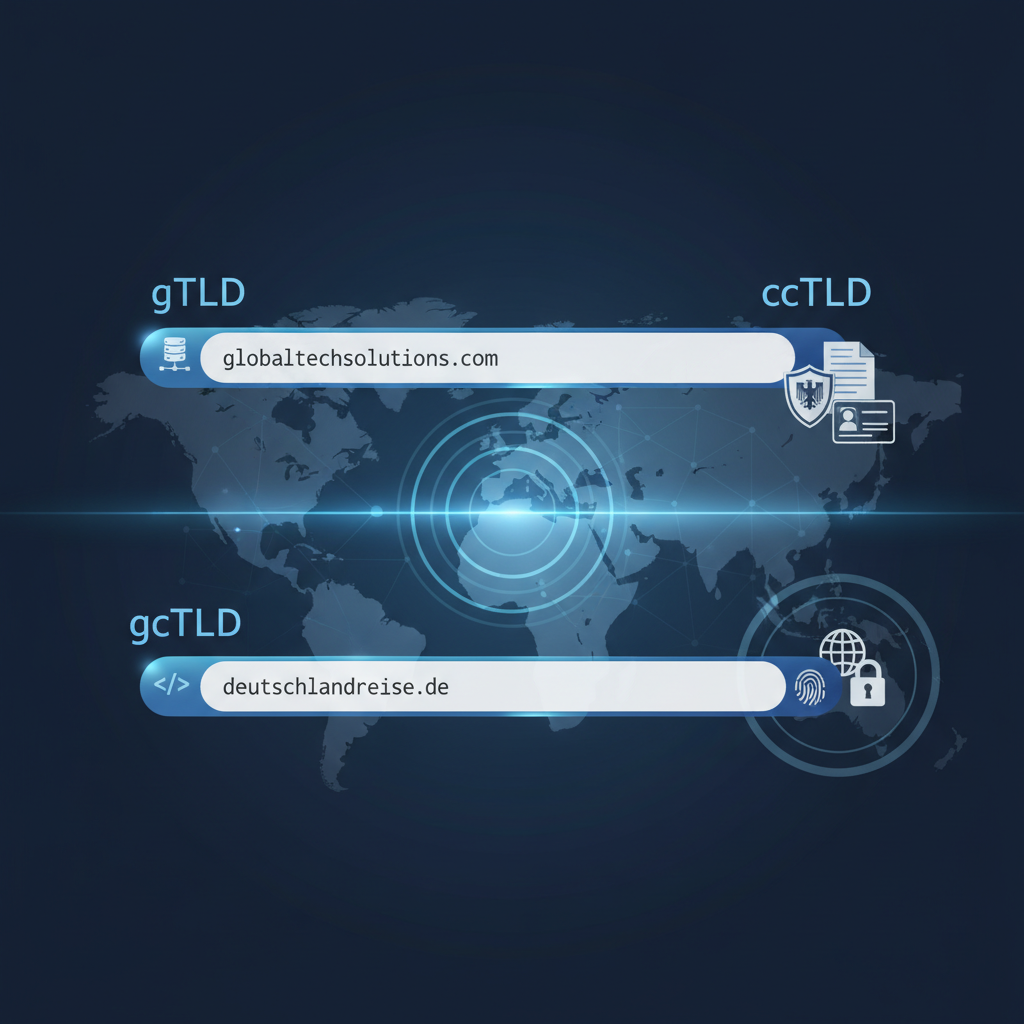
At the apex of the global DNS hierarchy, the namespace bifurcates into generic Top-Level Domains (gTLDs) and country code Top-Level Domains (ccTLDs), each containing distinct technical roles, administrative models, and operational implications imperative for software engineers and system designers.
Generic Top-Level Domains (gTLDs) such as .com, .org, and .net define namespaces that are globally scoped and intentionally non-geographic. By design, gTLDs do not imply ownership or location within any political or territorial boundary, serving as universal namespaces optimized for scalable, brand-neutral domain architectures. This neutrality allows individuals and enterprises to register domains without geographic restrictions, promoting flexible, hierarchical domain management suitable for platforms targeting international user bases. For example, SaaS providers hosting distributed microservices or APIs often leverage gTLDs to maintain a consistent namespace independent of regional regulatory fragmentation.
Conversely, country code Top-Level Domains (ccTLDs) follow the ISO 3166-1 alpha-2 standard, embedding a geographic identifier in the DNS structure—for instance, .uk for the United Kingdom, .jp for Japan. These domains represent national sovereignty digital identifiers operated under the authority and legal regime of the respective country or territory. From an architectural standpoint, ccTLDs function as delegated resources within a constrained administrative and compliance environment that may enforce residency, business presence, or other eligibility requirements affecting registration and ownership transfers.
The distinction extends substantially into registry policies and user workflows. ccTLD registries often impose stringent documentation and eligibility verification to uphold local policy goals—such as .ca requiring Canadian presence or .au restricting based on business incorporation—which introduces manual or hybrid verification steps within automated domain management systems. In contrast, gTLD registration is controlled centrally by ICANN, employing standardized contracts and policies with consistent dispute resolution mechanisms like the Uniform Domain-Name Dispute-Resolution Policy (UDRP). This uniformity simplifies automation but can reduce compliance specificity in certain jurisdictions.
Registry governance frameworks also diverge: gTLDs operate under global ICANN oversight with broadly harmonized policy enforcement, while ccTLDs reflect heterogeneous regulatory frameworks imposed by local governments or delegated entities. This leads to variable enforcement models—some ccTLD registries delegate policy decisions to registrars or regional bodies, whereas others function under direct ministerial authority.
A common misunderstanding is attributing intrinsic SEO advantages to gTLDs or assuming they guarantee universal accessibility. Instead, gTLDs offer a geographically agnostic namespace, lacking explicit regional authority signals leveraged by search engines. ccTLDs, by encoding geographic origin, provide strong local trust and relevance but may limit global discoverability due to perceived regional confinement in search algorithms.
In summary, the conceptual and administrative gulf between generic and country code TLDs entangles operational, regulatory, and strategic considerations extending far beyond simple naming conventions. Awareness of these differences is crucial for engineers architecting Internet-facing systems across jurisdictions. For a detailed reference on top-level domain governance, see ICANN’s documentation on TLDs.
DNS Infrastructure and Authority Differences
Building upon the definitional distinctions, a closer examination of DNS infrastructure and zone authority reveals how governance models create divergent operational and security postures affecting system reliability and domain lifecycle management.
gTLDs function within a highly centralized DNS hierarchy under ICANN’s coordination. Authoritative zone file management contracts with established registries—e.g., Verisign for .com, Public Interest Registry for .org—who maintain automated, scalable zone operations. The ecosystem adheres to uniform policies and protocols such as the Registry Registrar Protocol (RRP), supporting seamless workflows for domain lifecycle events: registration, renewal, transfer, and revocation. This centralization enables consistent DNS resolution performance, standardized support for Domain Name System Security Extensions (DNSSEC), and predictable vulnerability mitigation strategies essential for high-availability services.
In contrast, ccTLD DNS infrastructure control is decentralized, managed by individual national registries or governmental organizations with variable operational maturity and policy approaches. Some ccTLDs are run by independent Internet registries, others under direct state oversight, resulting in heterogeneous implementations of domain management APIs, registration workflows, and security standards. For example, while .se (Sweden) and .nl (Netherlands) have adopted DNSSEC comprehensively, many other ccTLDs lag behind or apply DNSSEC optionally due to resource constraints or legacy infrastructure. This disparity affects DNS resilience and the cryptographic assurance chain, with tangible implications in critical systems requiring trusted endpoint verification.
Domain lifecycle operations under ccTLDs can be more manual or constrained: eligibility checks, manual renewal payments, or additional attestation complicate automation. Incident response protocols also vary; gTLD registries facilitate streamlined abuse reporting and suspension via global standards, whereas ccTLD incident governance may involve longer escalations across diverse legal agencies, increasing latency in abuse remediation.
National regulations further complicate WHOIS and RDAP data handling. While GDPR and analogous privacy laws have homogenized registrant data redaction in gTLDs, ccTLDs maintain a patchwork of data disclosure policies reflecting local statutes—some permit broad registrant transparency, others enforce tighter controls, impacting automated WHOIS querying and privacy proxy services. This inconsistency challenges developers implementing security and compliance monitoring at scale.
- Domain transfer policies: ccTLDs commonly impose residency or local presence restrictions on ownership transfer, unlike the globally permissive gTLD transfer model.
- Renewal workflows: ccTLDs may enforce periodic re-verification of registrants or utilize longer grace and redemption periods that differ from ICANN norms.
- Security protocols: DNSSEC deployment variability introduces elevated risks for ccTLD domains concerning cache poisoning or validation failure.
- Data privacy and WHOIS transparency: differing regulatory overlays impact how registrant data is exposed or redacted, affecting domain provenance verification.
Understanding these DNS infrastructure and governance layers equips engineers with critical context when designing domain portfolios traversing multiple jurisdictions, simplifying security architecture decisions and operational automation.
Together, the definitional and infrastructure contrasts establish a comprehensive baseline for evaluating top-level domain options. The following section advances into the security and technical implications these distinctions incur, linking registry governance and data policy with domain trustworthiness and operational continuity.
Technical and Security Implications in gTLD vs ccTLD
DNSSEC and Security Protocol Variances
DNS Security Extensions (DNSSEC) form a pivotal factor differentiating gTLD and ccTLD environments in terms of domain integrity and resistance to attacks such as cache poisoning or man-in-the-middle spoofing.
gTLD registries, under ICANN’s rigorous policy framework, generally mandate or strongly incentivize universal DNSSEC deployment. Their implementations involve comprehensive zone signing practices, systematic cryptographic key rollovers, and well-documented trust anchor maintenance negotiated with root zone operators. This uniformity establishes a reliable ecosystem of recursive DNS validators globally, reducing the frequency of validation failures and improving the resilience of secure DNS resolutions fundamental to modern infrastructure security.
Conversely, ccTLD operators—often constrained by regulatory priorities, budgetary limitations, or technical capacity—exhibit heterogeneous DNSSEC adoption levels. Industry estimates suggest approximately 60–75% of ccTLDs implement DNSSEC to some extent, yet many deployments are partial or non-mandatory, applying cryptographic signing selectively. This patchwork leads to inconsistent validation chains manifesting as higher validation failures or fallback to insecure DNS queries. In critical distributed systems, such inconsistencies can undermine trust in service endpoints or trigger failover conditions impacting user experience or compliance reporting.
Incomplete or uneven DNSSEC rollout exposes ccTLD domains to cache poisoning risks, where attackers exploit unsigned delegation points or expired signatures to inject false DNS responses. Additionally, ccTLD registries may defer full DNSSEC enforcement to minimize latencies or operational complexity within resource-constrained environments—a trade-off between cryptographic resilience and system performance.
From an operational engineering perspective, gTLD DNSSEC involves automated zone signing tools integrated into Continuous Integration/Continuous Deployment (CI/CD) pipelines, monitored trust anchor updates, and active metrics for cryptographic key validity. Root zone operators propagate trust anchors used by validating resolvers, minimizing configuration drift and outages. Management complexity is largely abstracted by standardized tooling and contractual obligations.
In contrast, ccTLD DNSSEC management can present challenges: manual key rollovers, delayed trust anchor publication, or legacy DNS software stacks impede seamless validation. Such deficiencies complicate incident detection and remediation workflows, requiring domain operators to instrument enhanced monitoring, alerting thresholds for DNSSEC anomalies, and fallback handling for resolvers that disable validation upon encountering trust anchor uncertainties.
While DNSSEC strengthens security, the added cryptographic overhead increases DNS payload sizes and introduces computational costs, which are material for high-traffic, latency-sensitive domains especially in regions with limited bandwidth. Therefore, system architects must balance DNSSEC adoption and operational performance, tailoring deployment strategies per TLD and regional infrastructure constraints. For a detailed analysis, see Cloudflare’s technical overview of DNSSEC impact.
In summary, gTLDs offer a stable and consistent DNSSEC security posture with reliable cryptographic proof chains, enhancing domain authenticity. ccTLD DNSSEC adoption is uneven due to diverse operational and policy factors, presenting resilience gaps domain owners and engineers must assess in security architectures.
WHOIS and RDAP Data Consistency and Compliance
Registration data transparency and consistency represent another critical operational axis where gTLDs and ccTLDs diverge significantly, impacting ownership verification, security automation, and regulatory compliance workflows.
Within the gTLD ecosystem, ICANN enforces a relatively uniform WHOIS framework, progressively augmented by the Registration Data Access Protocol (RDAP) to support scalable, machine-readable access to registrant data. Despite the constraints imposed by global privacy regulations such as the European GDPR, gTLD registries and registrars implement harmonized schemas disclosing registrant, administrative, and technical contact details subject to standardized redaction and privacy protections. This uniformity facilitates integration with automated security monitoring systems, certificate issuance verification, and abuse detection pipelines reliant on domain ownership metadata.
In contrast, ccTLDs are governed by diverse national laws and customary practices, leading to a decentralized and fragmented landscape of WHOIS and RDAP service offerings. Many ccTLD registries restrict access to registration data reflecting local privacy norms, requiring proprietary APIs or limiting query scopes, which hinders automated synchronization. Additionally, data models vary—some ccTLDs expose minimal registrant details, others enforce residency-based query authorization. This inconsistency complicates domain lifecycle automation and security intelligence efforts, particularly for enterprises managing portfolios spanning multiple ccTLDs.
Operationally, ccTLD registration processes often include manual residence verification, government-issued ID submission, or periodic eligibility confirmation that introduce latency and misalign with programmatic WHOIS update cycles common in gTLD environments. Such manual controls elevate operational overhead and complicate real-time ownership tracking critical for distributed denial-of-service (DDoS) mitigation, threat intelligence correlation, or compliance audits.
This fragmentation negatively affects incident response as comprehensive domain metadata correlations underpin the rapid triage and takedown of malicious domains. Security operations centers leveraging WHOIS and RDAP data for reputation assessment experience blind spots in ccTLD contexts, elevating risk exposure to phishing, fraud, or domain hijacking attacks.
The ongoing migration toward RDAP aims to standardize domain registration data queries via JSON schemas supporting layered authorization and extensibility, yet ccTLD adoption remains uneven. Some registries have partial implementations or lag entirely, reflecting regulatory peculiarities and development resource divergences. To understand RDAP standards and uptake, consult the IETF RDAP working group documentation.
Practically, incomplete WHOIS and RDAP coverage necessitates engineering workarounds such as manual validation, custom scraping pipelines, or selective domain portfolio pruning, increasing operational risk and cost. Conversely, consistent gTLD registration data enables domain owners to automate compliance checks, reputational monitoring, and renewal forecasting reliably.
In conclusion, gTLDs furnish domain registrants with relatively uniform, privacy-conscious registration data transparency conducive to automated security and compliance tooling. ccTLDs, reflecting localized policy regimes, present a complex patchwork of data access limitations that require domain infrastructure teams to invest in specialized interoperability and domain visibility strategies.
Understanding these domain registration data disparities is essential before examining the regulatory and ownership nuances that further characterize ccTLDs.
Regulatory and Ownership Constraints in ccTLDs Compared to gTLDs
Registration Restrictions and Policy Variations for ccTLDs
Moving from technical to governance dimensions, ccTLDs exhibit significant registration restrictions that contrast sharply with the relatively open, globally accessible gTLD paradigm.
ccTLD registries are typically operated under national or regional authorities enforcing residency or citizenship criteria as preconditions to domain ownership. For example, the German .de domain requires registrants to demonstrate a physical address or registered entity within Germany, restricting foreign registrations without local presence. Similarly, .us mandates bona fide presence in the United States, including notarized identity verification or organizational presence. These policies reinforce digital sovereignty, ensuring ccTLD usage aligns with national interests, but they introduce additional operational hurdles for cross-border brand ownership, often necessitating legal counsel, local partnerships, or agent-based registrations.
Beyond residency, ccTLDs often implement domain category restrictions tied to specific sectors or functions, such as .gov.uk reserved exclusively for governmental institutions or .edu.au limited to accredited educational bodies. This segmentation imposes strict use case boundaries, promoting regulatory clarity while reducing flexibility in namespace utilization. Further, registries typically require ongoing compliance verification, mandating periodic documentation re-submission or eligibility attestations to uphold registration validity.
Conversely, gTLDs operate under ICANN’s global policy frameworks fostering openness: registrations are accessible worldwide without requiring territorial presence or citizenship. This global accessibility enables streamlined brand protection, multi-national domain strategies, and simplified portfolio management. Uniform registration rules, dispute handling, and transparent WHOIS policies reduce administrative friction and facilitate automation.
These divergent registration policies affect operational and strategic decision-making profoundly. Enterprises seeking to protect intellectual property globally must navigate local ccTLD restrictions potentially requiring entity establishment in each jurisdiction, inflating costs and increasing complexity. For localized services or compliance-driven industries, securing ccTLDs with residency enforcement ensures legal clarity and enhances consumer trust.
For instance, multinational engineering services deploying API gateways or data aggregation platforms regionally may leverage .fr or .de ccTLDs for compliance and local SEO benefits but need to manage the additional operational overhead of local registrant validation. This contrasts with using a .com gTLD globally but investing in geo-targeted content and infrastructure to signal regionality.
In total, ccTLDs exhibit strict residency prerequisites, purpose-driven use constraints, and administrative compliance oversight, juxtaposed against gTLDs’ universal availability. These structural differences constitute critical considerations for domain acquisition strategies and lifecycle management tools.
Impact of Data Sovereignty and Local Regulations
Layered atop registration constraints is the enforcement of data sovereignty and localized regulatory regimes shaping ccTLD operations differently from the more globally governed gTLD model.
Many countries treat their ccTLD namespace as extensions of national digital infrastructure, enforcing data residency mandates that require registrant and associated domain data to reside within territorial boundaries or operate under national legal frameworks. For example, .ca registries must keep registration data on servers physically located in Canada or managed under Canadian jurisdiction. Similarly, .au domains comply with stringent Australian data governance laws. Such data residency requirements influence architecture decisions regarding data storage, replication, and disaster recovery, mandating regional data center integration or legal agreements with third-party service providers.
Privacy and transparency laws further diversify the treatment of registration data. While gTLDs have aligned around ICANN’s uniform framework modified by GDPR-driven redactions balancing privacy with transparency, ccTLD policies often reflect national privacy philosophies and legal traditions variably. Some ccTLDs adopt restrictive WHOIS access policies minimizing publicly exposed personal data; others enforce transparency mandates facilitating public dispute mechanisms and consumer protection. For instance, Indonesia’s .id requires public WHOIS disclosure to support regulatory and consumer trust objectives, contrasting with stricter anonymity preferences in other ccTLDs.
Additionally, legal jurisdiction greatly affects domain dispute resolution and takedown procedures. ccTLDs fall under local courts or administrative authorities, providing faster, more enforceable mechanisms for domestic registrants but complicating enforcement for foreign entities due to conflicting cross-border legal frameworks. Conversely, gTLD disputes typically resolve through global arbitration mechanisms like UDRP, offering uniformity but sometimes slower legal recourse.
These regulatory environments impose material operational impact—domain portfolio managers must design workflows compliant with data sovereignty and local privacy laws, often requiring regionally tailored data management, legal oversight, and incident response capabilities. For multinational backend services or distributed data pipelines, aligning domain registration data residency with server deployments mitigates legal risk and supports compliance audits.
In essence, ccTLDs manifest sovereignty in domain data governance through localized data residency, privacy customs, and jurisdictional enforcement, juxtaposed against gTLDs’ globally coordinated but less jurisdiction-specific policies. Enterprises must integrate these considerations into security and compliance frameworks alongside technical and operational requirements.
Collectively, the distinctive registration restrictions and regulatory landscapes highlight the comprehensive complexity embedding ccTLD domains—a complexity absent in the more standardized gTLD environment—leading naturally to evaluating the implications for domain visibility and search engine relevance.
SEO and Visibility Considerations for gTLD and ccTLD Choices
Geotargeting and Search Engine Relevance
The DNS structural differences between gTLDs and ccTLDs extend directly to SEO and geotargeting strategies, affecting how search engines interpret domain geographic associations and prioritize content in regional search results.
By design, ccTLDs embed explicit country signals within their DNS namespace. Domains like .fr, .de, or .jp inherently indicate country association, simplifying geotargeting as search engines interpret these TLDs as authoritative markers for the respective regions. This leads to enhanced ranking prominence in localized search queries without requiring additional technical configuration. Search engines also correlate IP block allocations, language signals, and content compliance within these national contexts, reinforcing relevance mappings. For example, a large-scale distributed API serving primarily German-speaking users may benefit from a .de ccTLD to align domain identity with regional indexing algorithms and trust models.
In contrast, gTLDs—including legacy domains like .com and evolving custom extensions such as .tech or .cloud—lack inherent geographic tagging. Webmasters and system architects must explicitly signal regional focus via mechanisms like Google Search Console’s geographic targeting tools, hreflang annotations encoding language and regional variants, or dynamic content localization tied to user IP detection and internationalized URL structures. This approach enables global scalability with centralized DNS management but requires more complex SEO engineering, content management pipeline segmentation, and deployment strategies to optimize for multiple regional markets simultaneously.
The role of DNSSEC in SEO is more indirect; while it does not influence rankings directly, its presence enhances domain trustworthiness by preventing DNS manipulation attacks, indirectly supporting user experience and compliance that search engines may correlate with quality signals.
Operationally, companies managing distributed microservices or CDNs must align DNS and CDN edge configuration with TLD geotargeting strategies. For ccTLDs, geographic locality is implicit, enabling simpler cache routing and content delivery placement decisions. For gTLDs, geo-aware DNS or CDN routing mechanisms must be paired with explicit geotargeting metadata to maintain search relevance and user experience consistency.
In practice, a multinational SaaS provider using .de and .fr ccTLDs observed measurable uplifts in organic search traffic driven by automatic regional SEO trust signals. However, sustaining multiple ccTLDs increased registration, renewal, and legal compliance overhead. This experience informed a shift toward hybrid architectures incorporating gTLDs with geo-subdirectory strategies for combined scale and regional targeting efficiency.
Understanding these DNS and registry mechanisms guides architects in balancing domain operational complexity, local search visibility, and technical overhead.
Misconceptions and Real SEO Impacts of TLD Selection
A widely held misconception is that ccTLDs automatically outperform gTLDs within their regions or that gTLDs inherently dominate global search visibility. In reality, TLD selection is only one among many intertwined SEO factors influencing page ranking.
Critical drivers like content relevance to the user’s query, backlink quality, site architecture—including crawlability and indexing efficiency—and domain authority significantly outweigh the geographic signal encoded in TLDs. Well-optimized .com sites with robust local content and backlinks often outperform poorly maintained ccTLDs, evidencing that domain extension alone does not guarantee ranking advantages.
Moreover, emerging gTLD extensions receive equal treatment to legacy TLDs by search engines when combined with strong SEO foundations. This dynamic underscores the importance of comprehensive SEO strategy beyond merely choosing TLDs.
However, domain ownership policies across ccTLDs and gTLDs can indirectly impact SEO trustworthiness. Residency and eligibility requirements in ccTLDs create a registrant pool anchored in local entities, potentially reducing spam and abuse-related penalties, thereby improving perceived domain trust. In contrast, gTLDs allow broad global registrations, which—while fostering openness—may increase risk from spammy actors, influencing search engine heuristic trust models.
Transparency in domain ownership data via WHOIS/RDAP also informs search engines and regulatory entities assessing domain legitimacy and compliance—a facet stronger and more standardized in gTLDs than in most ccTLDs.
This interplay complicates simplistic SEO narratives and highlights the need for domain planners to incorporate ownership clarity and regulatory conformity alongside content and technical optimization.
Technical Recommendations for Domain Owners
- Business Domains and Operational Contexts: Use ccTLDs when localized presence, regulatory compliance, and direct country association yield tangible benefits, especially for region-focused platforms, microservices endpoints, or infrastructure restricted by data residency laws. For global SaaS platforms, APIs, or federated services, gTLDs paired with detailed geo-tagging and localized content offer scalability and operational consistency.
- Registry and Ownership Constraints: Thoroughly evaluate ccTLD eligibility rules, residency verification processes, and renewal policies against operational automation capabilities. Prefer gTLDs for streamlined registration and transferability unless local constraints or trust benefits justify additional complexity.
- SEO Strategy Alignment: Prioritize comprehensive content localization, site architecture optimization, and backlink development over exclusive dependence on TLD geography. Complement gTLDs with webmaster tools’ geotargeting signals; leverage ccTLDs where automatic geo-indication simplifies SEO execution.
- Security and Transparency: Implement DNSSEC uniformly to fortify domain integrity and mitigate spoofing risks. Ensure WHOIS or RDAP data transparency aligns with corporate compliance needs, facilitating domain ownership verification and abuse detection.
Integrating these considerations positions domain owners to design robust, compliant, and scalable domain portfolio architectures that transcend simplistic extension debates, balancing operational costs, regulatory risks, and user trust.
Having explored the interplay of policy, technical, and SEO factors shaping domain extension choice, the discourse advances naturally to how these practical decisions influence lifecycle management, compliance, and operational resilience.
Decision Factors for Global vs Local Business Models
The technical, regulatory, and operational differences between gTLDs and ccTLDs align closely with a domain owner’s underlying business model, informing choice of namespace for global uniformity versus local specificity.
Uniform Namespace and Centralized Governance of gTLDs
gTLD domains exist under a centralized namespace administered by ICANN, enforcing consistent policies around registration, renewal, dispute resolution, and security protocols like DNSSEC. This uniform governance enables predictable operational workflows critical for engineering automation: renewal grace periods and redemption windows follow fixed intervals; domain lifecycle state machines remain consistent; registrar API behaviors conform to stable specifications facilitating reliable provisioning and monitoring.
This architecture benefits multinational platforms—backend services scaling across regions, global API endpoints, and multi-tenant software systems—by offering transparent, scalable DNS management under brand-neutral TLDs such as .com or .tech. The lack of inherent regional binding supports uniform namespace allocation, permitting seamless deployment of infrastructure with consistent certificate management, DNSSEC key rollover procedures, and centralized compliance monitoring.
Furthermore, the gTLD ecosystem encourages adoption of modern automation frameworks—such as extensible RDAP queries coupled with reliable WHOIS data—simplifying domain ownership reconciling across large portfolios. This streamlining reduces operational risk and supports tightly integrated security tooling.
Delegated Authority and Local Constraints in ccTLDs
ccTLDs impose a contrasting operational regime under delegated national control, with registries or government bodies enforcing residency criteria, registration policies, and local legal compliance. Variation in renewal intervals, transfer restrictions, and eligibility validations require locale-specific provisioning logic and multiple integration layers in domain lifecycle systems.
For systems deploying regionally compliant services—such as data aggregation nodes restricted by local privacy laws or fin-tech APIs bound by country-specific licenses—ccTLD adoption reflects regulatory necessity and enhances user trust through regional domain branding.
From a distributed systems perspective, this fragmentation requires engineering teams to implement adaptive domain management frameworks capable of orchestrating multiple heterogeneous registries with varying SLAs, API reliability, and data disclosure policies.
Architectural Implications of Geographic Targeting
Geographically targeted domain namespaces, such as ccTLDs, implicitly partition the global Internet namespace, enforcing locality awareness in DNS resolution and associated caching strategies. While this geo-fencing enhances regional content delivery and search engine visibility, it complicates unified global architectures by requiring multi-domain strategies, distributed content orchestration, and complex canonicalization.
System architects must contend with fragmented DNS trust anchors, inconsistent security policy adoption, and divergent operational models across ccTLDs, increasing testing and monitoring burdens. Conversely, gTLDs facilitate centralized domain infrastructure with geotargeting layered in web servers, CDNs, and SEO configurations, favoring streamlined global deployments.
When to Select gTLDs
- Environments prioritizing operational uniformity, global scalability, and simplified compliance generally prefer gTLDs.
- SaaS products spanning multiple regions without requiring explicit country branding.
- Backend domain portfolios needing consistent lifecycle automation workflows and security validation.
- Cross-border APIs managing domain security parameters via unified DNSSEC and compliant WHOIS data.
- Platforms reliant on multitenancy with global user bases requiring unrestricted registration.
Use Cases Favoring ccTLDs
- Regulatory mandates enforce national presence and data residency.
- Marketing strategies emphasize explicit local affiliation, enhancing trust and conversion.
- Compliance demands necessitate use of country-specific landing pages, legal disclosures, or hosting requirements.
- Regions with strong government incentives or mandates for local domain adoption.
Clarifying Misconceptions Around SEO and Domain Extensions
Technologists often misconstrue gTLDs as superior SEO assets globally, yet search algorithms integrate multifaceted signals beyond TLD choice. gTLDs’ principal advantage lies in consistent operational properties that underpin deployability and security but require explicit geo-targeting configurations.
Equally, ccTLDs confer local authority but impose operational and compliance overhead without guaranteeing search rankings if other SEO fundamentals lack. Decision-making must weigh these trade-offs against tactical and strategic goals.
Automation, Monitoring, and Resilience Considerations
Operating domain portfolios across layered TLD regimes introduces distinct engineering challenges in automation, provisioning, monitoring, and resilience.
Variability in WHOIS and RDAP Data Visibility
A core challenge arises from diverse WHOIS and RDAP implementations. gTLD registries maintain standardized, contractually obligated output schemas and reachable RDAP endpoints essential for automated renewal alerts, domain status verification, and compliance tracking.
ccTLD registries often exhibit inconsistent WHOIS formats, partial or outdated RDAP support, or custom query mechanisms. This heterogeneity requires engineering teams to maintain extensive metadata catalogs documenting per-TLD behavioral idiosyncrasies to ensure accurate provisioning and reduce manual interventions.
Operational impacts include increased risk of unnoticed expiry, delayed abuse reporting, and elevated administrative overhead—particularly when working with legacy or opaque registry systems.
Complexity in DNSSEC Adoption and Validation
Security monitoring must contend with mixed DNSSEC maturity across ccTLDs, encountering incomplete cryptographic signing, inefficient key management, or outdated software stacks. As a result, automated DNSSEC validation may produce false positives or negatives, requiring adjustable heuristics and fallback mechanisms in security tooling.
Simultaneously, gTLD DNSSEC ecosystems benefit from standardized validation flows supporting tight security postures with high trust anchor reliability.
Policy Enforcement Divergence and Lifecycle Management
ccTLD-specific policies introduce irregularities in transfer locks, renewal grace periods, and domain redemption timelines. Unlike ICANN-prescribed gTLD policies, these rules create complexity in lifecycle automation systems, demanding flexibility in state machine designs and provisioning logic for seamless management.
Failure Modes and Mitigation Strategies
Failure modes include missed renewals, registrar API incompatibilities, or delayed abuse handling. These chain into domain availability outages, compromising service reliability and brand reputation.
Mitigation demands modular automation pipelines with per-TLD abstraction layers, fallback manual processes for urgent recovery, continuous policy monitoring integrated with alerting systems, and robust registry change detection protocols.
Scaling Domain Administration Across Multi-TLD Portfolios
As portfolio size and ccTLD count grow, engineering complexity escalates sharply, necessitating domain extensions metadata databases cataloging renewal intervals, API capabilities, transfer restrictions, DNSSEC maturity, and compliance nuances.
Successful architectures unify policy-driven orchestration platforms layered atop heterogeneous registries, enabling dynamic domain provisioning and optimized monitoring workflows. Industry case studies report significant efficiency gains and reduced outage incidents via such strategic investments.
Key Takeaways
- gTLD governance is centralized under ICANN with uniform policies, offering operational consistency but geographic neutrality.
- ccTLDs reflect national digital sovereignty with residency requirements, heterogeneous registry policies, and localized legal frameworks.
- WHOIS and RDAP data consistency is stronger in gTLDs, facilitating automated security and compliance workflows; ccTLDs often complicate transparency and ownership verification.
- DNSSEC implementations are mature and consistent in gTLDs but fragmented across ccTLDs, influencing domain security postures.
- SEO advantages of ccTLDs derive from implicit geographic signaling; gTLDs require explicit geotargeting mechanisms.
- Automation and lifecycle management complexity scales with increased ccTLD inclusion, demanding flexible, modular operational architectures.
Recognition of these factors equips domain owners and system architects to judiciously navigate domain extension selection maximizing operational resilience, legal compliance, and search visibility.
Conclusion
The choice between gTLDs and ccTLDs epitomizes a multifaceted design decision at the intersection of technical architecture, regulatory compliance, security, and operational scalability. While gTLDs afford globally uniform policies, centralized governance, and streamlined lifecycle management suited to international, platform-scale deployments, ccTLDs encapsulate national sovereignty, reflecting localized regulatory, residency, and data governance mandates that reinforce trust and compliance within defined jurisdictions.
The intricate trade-offs encompass DNSSEC adoption consistency, WHOIS/RDAP transparency, domain ownership restrictions, and SEO implications bound to geographic identity. As Internet infrastructure evolves toward increasing territorial digitization alongside global connectivity, engineers face growing complexity integrating diverse TLD regimes into coherent domain portfolios.
Forward-looking domain governance requires systems that make these domain extension complexities transparent and actionable through modular automation, comprehensive monitoring, and adaptable lifecycle frameworks. The critical question transitions from choosing a domain extension to architecting domain infrastructure capable of sustaining correctness, security, and compliance amid increasingly fragmented namespace landscapes and jurisdictional intricacies.