Introduction
Autonomous AI agents running in production environments confront a critical engineering challenge: reliably translating inherently probabilistic and unpredictable model outputs into deterministic, secure, and maintainable execution flows. Without a rigorously engineered harness, AI-driven systems become susceptible to subtle state corruption, intermittent or inconsistent behavior, security exposures, and operational obscurities that complicate debugging, recovery, and scaling.
AI agent harness engineering answers this challenge by constructing structured execution environments that enforce strict permission controls, embed adaptive retry semantics, and incorporate deep observability—all while cleanly decoupling the core AI logic from infrastructure concerns. This layered design enables modularity and resilience, transforming raw generative model outputs into auditable workflows aligned with real-world operational constraints. Balancing robustness with performance overhead, designing for scalability, and applying deterministic enforcement patterns to control variability across multi-step autonomous workflows are fundamental. This article presents a detailed examination of these principles and practical patterns to build production-ready AI agent harnesses that meet the stringent demands of modern distributed systems.
Challenges in Autonomous AI Agent Execution
The transition from model-centric to harness-centric architectures marks a pivotal evolution in deploying autonomous AI agents at scale. Early AI solutions often treat generative language models as black-box function calls directly embedded within application logic or pipelines, implicitly assuming model outputs are sufficiently reliable and self-contained. This simplification overlooks the operational realities emerging from multi-step, stateful autonomous workflows interacting with mutable environments and external systems. In such contexts, naive application-level integration rapidly leads to brittle behavior, hidden failure modes, inconsistent state, and security vulnerabilities that raw models cannot address alone.
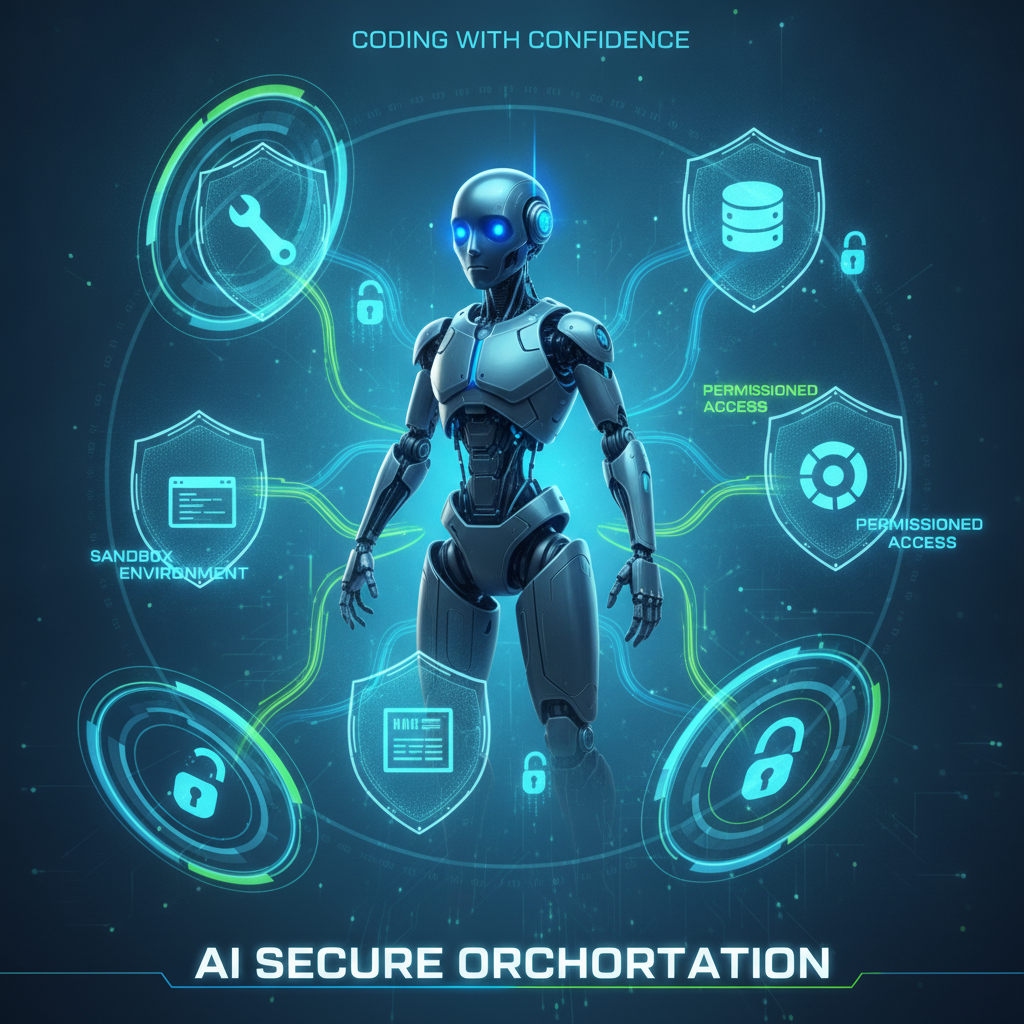
Within this paradigm, a harness constitutes the comprehensive execution environment encapsulating foundational components—sandboxed filesystems, memory and state management, fine-grained permissions, retry and error handling policies, and observability instrumentation—around the AI model interfaces. This added architecture acts as a mediation layer, translating stochastic, probabilistic AI outputs into predictable, deterministic workflow behaviors despite intrinsic model variability.
Pivoting to a harness-centric design acknowledges that deploying autonomous agents reliably involves end-to-end system control beyond model sophistication or prompt engineering. It requires treating the entire execution ecosystem as an integrated system governed by strict operational guardrails. This approach entails instrumenting for failure recovery, securing execution boundaries, and preserving full traceability, enabling complex autonomous workflows to proceed confidently without risking cascading failures or integrity violations.
The next sections analyze three critical operational challenges arising in the absence of a dedicated harness: output unpredictability, risks of state corruption coupled with security vulnerabilities, and operational blind spots obstructing observability and debugging.
Unpredictability of Model Outputs
Generative AI agents rely on models whose outputs emerge from probabilistic decoding processes, such as sampling with temperature, top-k/top-p filtering, or stochastic beam search. Each model invocation inherently produces a distribution-weighted, context-dependent response that can vary notably even under identical inputs. Moreover, the outputs depend heavily on mutable dynamic context—immediate prompts combined with evolving memory or environment states maintained during agent execution.
This fundamental variability creates fragile multi-step workflows. Divergent outputs in early steps can cascade, misaligning subsequent decisions, corrupting internal state representations, or inducing unintended side effects. For instance, an autonomous coding assistant might hallucinate invalid filenames or syntactically incorrect code snippets upon retries, leading to repository corruption or build failures. Without an interceding control layer, these errors compound, causing execution drift and destabilizing both internal agent memory and external system integration points.
Raw AI SDK invocations or standalone generative tools typically lack native mechanisms for guaranteeing output consistency, correctness, or policy compliance. They do not validate, filter, or conditionally retry based on output semantics, relying instead on brittle application-level error handling that often misses subtle model drift or hallucinations. This leads to silent failures that degrade reliability and user trust.
AI agent harness engineering introduces a vital mediation layer that absorbs inherent model non-determinism by orchestrating controlled execution flows:
- Rigorous output validation: Employing schema validation, regex enforcement, semantic parsing, or domain-specific constraints to ensure that generated outputs conform to expected formats before downstream consumption, thereby preventing propagation of invalid states.
- Strategic retry semantics: Re-invoking the model using exponential backoff, alternative prompt formulations, or fallback models upon validation failures or timeouts to recover from transient hallucinations or API errors without disrupting end-to-end workflow.
- Memory isolation and checkpointing: Capturing intermediate state snapshots enables precise rollback and isolation of inconsistent results, preventing state pollution and enabling safe progression or fallback.
- Sequential consistency controls: Enforcing logical gating mechanisms that verify state transitions between steps to prevent uncontrolled advancement on invalid or out-of-sequence outputs.
A representative example involved a customer support automation system using an open AI agent SDK, which without output validation and retry isolation repeatedly generated contradictory order status updates. These erroneous updates propagated to downstream CRM workflows, causing billing errors affecting thousands of customers. Introducing harness-enforced output schema validation coupled with controlled retry loops eliminated inconsistencies, elevating reconciliation success rates to 99.9%, reducing support escalations by 20%, and saving millions annually.
Ignoring harness principles here manifests as silent system fragility, opaque failures, and costly fallout. By contrast, harness engineering transforms probabilistic AI model calls into resilient execution units that tame variance into reliable autonomous decisions. For a deeper dive on output variability control, see the OpenAI Cookbook’s guidance on sampling techniques and output validation.
Risks of State Corruption and Security Vulnerabilities
Unregulated mutable state constitutes a severe risk vector in autonomous AI workflows not governed by engineered harness environments. AI agents routinely interact with filesystems, external APIs, shared memory stores, and process resources. Without explicit governance and sandboxing, AI-generated code or commands—potentially erroneous or adversarial—can corrupt critical state, cause race conditions, or cascade disruptive failures across multi-step workflows.
State corruption risks amplify in multithreaded or asynchronous executions, where concurrent mutations can cause nondeterministic outcomes or deadlocks. Consider an AI coding assistant that writes intermediate build artifacts or patches source repositories directly. Without atomic writes, sandbox protections, and transactional guarantees, partial or conflicting writes can leave codebases in broken states, undermining developer productivity, triggering failed continuous integration pipelines, or causing subtle bugs that evade detection.
Security vulnerabilities intersect this risk spectrum where harnesses lack explicit permission models and sandbox isolation. Autonomous agents executing AI-generated code snippets or system commands must be strictly confined to prevent:
- Injection attacks: Malicious payloads embedded in prompts or outputs can execute arbitrary code or escalate privileges.
- Sandbox escape exploits: Vulnerabilities allowing AI agents to break containment and access unauthorized host resources or sensitive data.
- Denial-of-service (DoS) scenarios: Infinite retry loops or uncontrolled resource consumption that exhaust infrastructure capacity.
Early deployments of cloud-based AI coding assistants exemplify these challenges. Agents granted excessive filesystem or shell execution permissions inadvertently enabled attackers to inject malicious input that bypassed restrictions, resulting in unauthorized data exfiltration and service interruption.
AI agent harness engineering confronts these threats by:
- Enforcing immutable memory regions and controlled mutation APIs: All state changes occur through harness-mediated channels that validate, sequence, and log mutations.
- Imposing strict permission boundaries: Fine-grained, principle-of-least-privilege controls on filesystem access, network communications, and process capabilities prevent unauthorized operations.
- Utilizing sandboxed execution environments: Containerization (e.g., Docker, gVisor), VM isolation, or language sandboxing (e.g., WASM runtimes) ensure that agent code cannot affect host or other agents beyond defined scopes.
- Applying retry policies with backoff and quotas: Preventing DoS by limiting excessive retries and resource consumption while allowing recovery from transient faults.
- Comprehensive audit logging: Tracking all state mutations, command executions, and permission checks supports forensic analysis and regulatory compliance.
A no-code AI automation platform designed for sensitive enterprise workflows exemplified these principles with strict sandboxing and permission enforcement, enabling safe orchestration of contract generation and financial data processing. This architecture ensured GDPR and HIPAA compliance, eliminated privilege escalation vulnerabilities, and reduced system downtime by over a third.
These examples underline that harnesses are far beyond convenience layers—they are foundational security primitives essential to preserving system integrity and trustworthiness in production AI agent deployments. For detailed practices on sandbox security and permission control, consult the CNCF Sandbox Security Best Practices.
Operational Blind Spots and Debugging Challenges
Absence of an AI agent harness severely limits observability, rendering autonomous workflows opaque to operational teams. AI agents combine multiple intricate layers: probabilistic model invocations, mutable state management, permission enforcement, retry policies, and external API calls. Without centralized, structured telemetry capturing these layers, root cause analysis of failures or unexpected behaviors becomes onerous or impossible.
Model-induced silent failures or transient errors during multi-step workflows often cause intermittent state inconsistencies that raw AI SDK logs fail to capture beyond coarse-grained request traces or unstructured debug dumps. This problem becomes pronounced in AI-powered coding assistants or AI agents generating dynamic source code, where the code itself is ephemeral, making failure reproduction difficult.
Operational blind spots impair both reactive incident response and proactive reliability efforts. Without metrics on retry frequencies, validation errors, or permission denials, prioritizing fixes or detecting early warning patterns is guesswork. This opacity also inflates maintenance overhead and constrains iterative product improvement as root cause clarity is paramount to resilient system evolution.
Harness engineering institutes observability as a first-class control and feedback plane, transforming uncontrolled execution into a monitored, debuggable system. Key observability features include:
- Comprehensive logging: Captures prompt inputs, model parameters, outputs, latencies, and resource usages per invocation, enabling retrospective behavioral analysis.
- Permission and sandbox audit trails: Tracks authorization decisions, sandbox violations, and anomalous access to support security incident identification.
- Retry and error state tracking: Records retry counts, error codes, fallback paths, and escalation decisions to understand resilience dynamics.
- State transition recording: Versioned snapshots and mutation logs enable determinism verification and fine-grained rollback diagnostics.
- Metrics and alerting pipelines: Real-time thresholds for error rates, latency spikes, and resource exhaustion trigger operator notifications for timely interventions.
A development scenario using an open AI agent SDK highlights this: implementing a harness equipped with structured telemetry allowed engineers to identify a subtle prompt-induced retry explosion causing memory exhaustion. This detection occurred within hours, enabling rapid staging and validation of a fix that averted an extended outage. After deployment, mean time to recovery (MTTR) dropped by 40% for harness-managed autonomous agent incidents.
In contrast, teams lacking harness observability confront tortuous manual log aggregation, speculative diagnosis, and lengthy incident resolution, driving up maintenance costs and reducing engineering velocity. For a contemporary overview of observability in complex distributed systems, see the CNCF observability conceptual overview.
By addressing model unpredictability, state and security risks, and closing observability gaps, AI agent harness engineering enables autonomous agents to operate reliably and securely at scale. The harness converts raw AI model outputs into controlled, auditable, maintainable workflows that meet enterprise operational criteria far beyond what model-centric approaches can offer.
Core Components of AI Agent Harness Engineering
Having established the critical operational challenges motivating harness engineering, it follows naturally to explore the core architectural components enabling these guarantees. The evolution of autonomous AI agents entails a shift from pure model optimization toward harness-centric execution environments that impose operational rigor.
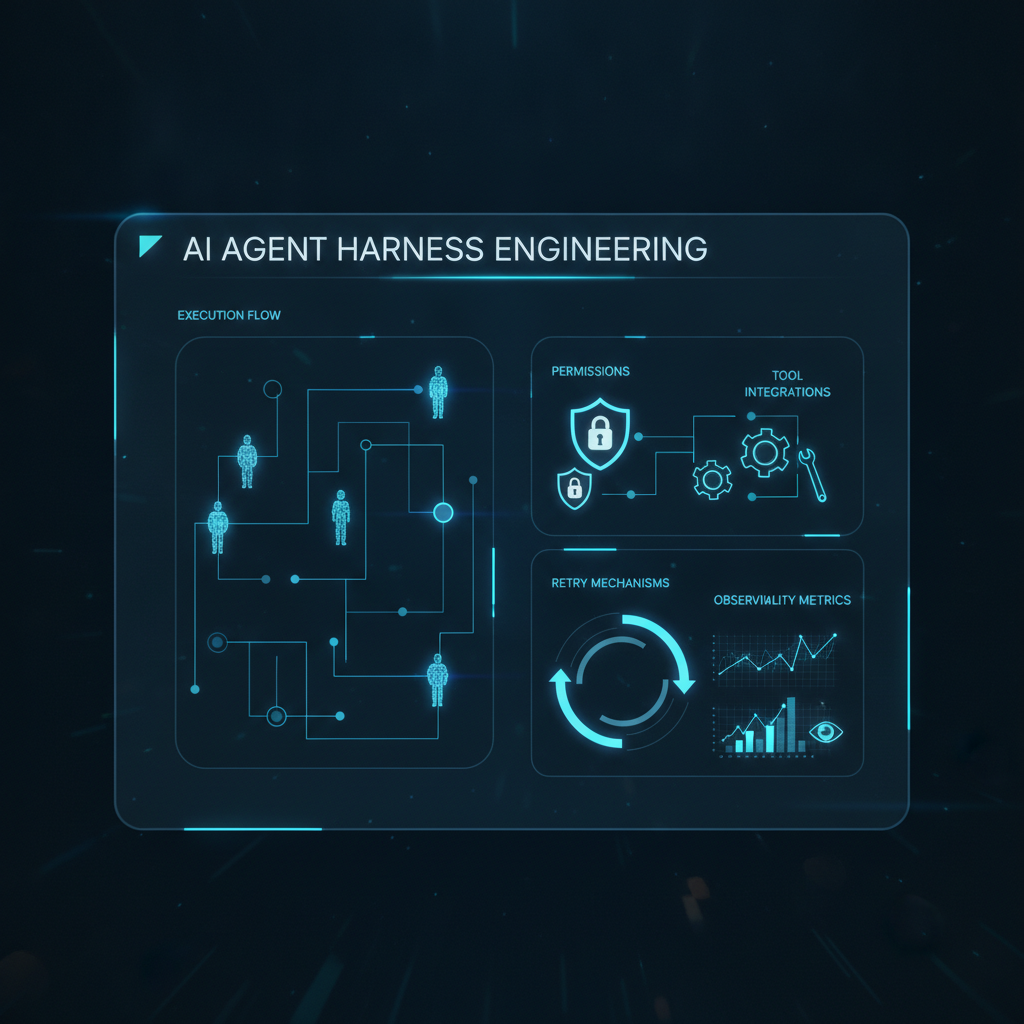
The harness acts as an orchestration and mediation framework managing granular execution contexts, strict permission enforcement, retry coordination, and integrated observability. Beyond raw inference calls, it encapsulates the entire agent lifecycle with deterministic state transitions, external interaction boundaries, and fault handling policies. This makes the autonomous agent’s runtime behavior predictable, secure, auditable, and maintainable.
Critical architectural considerations include:
- Runtime Context Encapsulation: The harness provides isolated execution contexts per agent invocation, establishing ephemeral state that prevents cross-invocation contamination and fosters deterministic agent effects.
- Permission and Security Layers: It enforces least privilege access controls spanning APIs, filesystems, network boundaries, and inter-agent communication channels to mitigate unauthorized or escalating operations.
- Resiliency Protocols: Integrated retry and error-handling schemes manage transient failures gracefully, balancing fault tolerance with consistency preservation to avoid side effects duplication or cascading failures.
- Monitoring and Telemetry Integration: Observability tools embedded deeply in the harness capture fine-grained logs, distributed traces, and real-time metrics that provide operators visibility into agent decisions and system health.
This harness-centric design aligns with best practices from distributed system engineering by decoupling AI operational semantics from underlying model internals. The resulting architecture treats AI systems as dependable, auditable components within complex AI stacks and development pipelines.
Transitioning to concrete implementation patterns, the next section details structured execution contexts leveraging filesystems, sandboxes, and memory isolation to enforce robustness and reproducibility.
Structured Execution Contexts: Filesystems, Sandboxes, and Memory
A cornerstone of harness engineering is establishing rigorous isolation boundaries that govern each agent’s runtime environment. These boundaries prevent unintended side effects and support reproducibility by ensuring transient runtime state does not leak beyond designated execution epochs.
Ephemeral filesystems form a primary isolation mechanism. Typically implemented via overlay or union filesystem techniques, ephemeral filesystems layer a pristine base image with writable, disposable overlays. Agents read base resources and confine all writes to scratch spaces discarded upon execution completion. This guarantees that agents start with a clean slate and that side effects from one execution do not persist into another, enabling safe retries and rollback.
Sandboxing augments filesystem isolation by constraining execution via container runtimes (e.g., Docker, gVisor) or language-specific sandboxes (e.g., WebAssembly). Sandboxes restrict permissible system calls, limit network connectivity, and enforce resource quotas on CPU and memory. These controls secure agents from influencing host systems or other agents, mitigating risk from buggy or malicious code. Refer to gVisor: Container Sandbox Runtime for an in-depth perspective on sandbox implementations.
Complementing these, memory management techniques ensure that agent state across execution steps remains tractable and reproducible. Harnesses capture dedicated memory snapshots or state checkpoints reflecting deterministic agent status after each discrete operation. Persisting these snapshots independently of ephemeral process memory enables precise rollback, replay-based debugging, and controlled stateful interactions resilient to partial failures. This approach parallels container snapshotting and virtual machine checkpointing adapted to AI agent execution semantics.
A common pitfall is state leakage—accidental preservation or sharing of files, environment variables, or memory across isolated agent runs. Such leakage compromises deterministic behavior, causes intermittent faults, and introduces security vulnerabilities. Harness engineering avoids this by robust overlay stacks for clean mount points, strict environment variable scoping, and isolated process heaps per invocation.
Leading AI stacks and no-code AI platforms routinely embed these patterns. For instance, many AI SDK implementations isolate agent logic in containerized sandboxes reset at each user interaction, assuring that prompt contexts remain distinct. AI tutorials similarly emphasize ephemeral workspaces and memory snapshots to promote repeatability and ease debugging.
These structured execution contexts establish the foundation for scalable permissioning and resilient retry mechanisms—the subject of the next section.
Control Mechanisms: Permissions and Retry Logic
Building on isolated execution contexts, AI agent harness reliability critically depends on carefully architected control mechanisms governing resource access and error resilience. Harness engineering embeds fine-grained permission models alongside sophisticated retry and failure handling to sustain operational integrity despite distributed complexity and failure modes.
Permission Models
Harnesses adopt strict least privilege permissioning to limit agent capabilities tightly to necessary actions. For example, OpenAI API integrations enforce scoped access tokens confined to specific endpoints, rate limits, and execution windows. Permissions further cover:
- Filesystem read/write access controls scoped to safe paths,
- Execution context restrictions limiting allowed system calls or code injection abilities,
- Network capabilities bounded to vetted domains or egress proxies.
Permission policies dynamically adjust per invocation or agent, factoring in roles, operation phases, or provenance metadata. Such granularity is essential in multi-agent settings sharing infrastructure without risking cross-contamination or privilege escalation. Harness engine runtime policy enforcement performs context-sensitive checks early, proactively denying unauthorized attempts.
For example, in multi-agent workflow orchestration platforms, harnesses centralize token management, quota enforcement, and audit logging to prevent misuse or policy violations. Attempts to circumvent controls via indirect code execution or file access trigger sandbox-level blocks combined with permission filters.
Retry Logic
Failure recovery necessitates robust retry protocols baked into the harness, considering that transient issues—network blips, API throttling, intermittent internal errors—are unavoidable. Yet naive retries risk exacerbating failures via resource exhaustion or inconsistent state.
Key retry strategies include:
- Idempotency checks: Verifying if prior attempts succeeded partially or fully to prevent duplicate side effects (e.g., repeated payment API calls or database writes).
- Exponential backoff: Gradually increasing delays between retries disperses load spikes on dependent services, reducing cascading error amplification and adhering to rate limits.
- Retry limits and escalation: Bounding retry attempts prevents infinite loops and directs persistent failures toward fallback mechanisms or human intervention.
These policies require balancing retry aggression for responsiveness or fault tolerance against risks of latency inflation and failure compounding. Harnesses dynamically adjust retry parameters based on real-time telemetry, error rates, and system load.
In AI SDKs powering coding assistants or enterprise AI workflows, integrated retry logic ensures developers experience seamless feedback loops while maintaining consistent error propagation and observability. Harness-enforced semantics relieve developers from boilerplate fault tolerance code, contributing to reliability and uniformity.
Together, precise permissioning and retry orchestration form the control core for AI agent reliability. They gate resource access and orchestrate error recovery flows feeding directly into comprehensive observability and feedback loops discussed next.
Observability and Monitoring Frameworks
Robust observability is indispensable for managing the complexity of autonomous AI agent harnesses where non-deterministic decisions intertwine with mutable state and distributed dependencies. Unlike traditional logging, observability frameworks embed multidimensional telemetry—including detailed traces, distributed context propagation, and real-time metric streams—to surface deep insights into system behavior and health.
Granular Execution Tracing
Harness instrumentation generates fine-grained execution traces capturing each discrete agent operation. Trace spans include metadata such as:
- Model invocation parameters, prompt inputs, and output latencies,
- Counts of API requests, success/failure responses, and error codes,
- Resource utilization metrics (CPU, memory),
- Versioned state snapshots loaded or persisted at each step.
Distributed tracing protocols like OpenTelemetry link these spans across components, reconstructing causal chains even through asynchronous and microservice boundaries. This level of visibility is critical to debugging both single-agent workflows and emergent anomalies in multi-agent or event-driven architectures. See OpenTelemetry documentation for practical guidance.
Real-Time Metrics and Alerting
Aggregated operational metrics on throughput, error frequencies, latencies, retry rates, and resource consumptions feed alerting pipelines that proactively detect degradation before user impact. Anomaly detection applied to these time series can identify subtle error growth or resource exhaustion trends.
Alerting systems within harness frameworks contextualize alerts by correlating with recent deployments, configuration changes, or environment state shifts to accelerate root cause identification. This contrasts with undifferentiated log floods that overwhelm responders with noise and unfocused diagnostics.
Operational Impact
Quality observability improves system robustness by enabling feedback-driven continuous improvement, including adaptive retry tuning, security incident detection, and resource optimization. Advanced AI-assisted coding tools and SDKs surface observability data directly within developer workflows, supporting iterative enhancement at development velocity.
Meticulously embedding observability into harness layers is a design imperative, avoiding after-the-fact instrumentation or bolt-ons. This observability foundation complements control mechanisms—permissions and retries—to provide comprehensive operational governance.
The following section transitions to architecture-level considerations that enforce clear separation between AI application logic and harness infrastructure, underpinning maintainability and security.
Separation of AI Logic and Infrastructure Layers
A fundamental architectural best practice in AI agent harness engineering is the strict separation of the autonomous agent’s core AI logic from the harness infrastructure managing execution and environment controls. This separation enforces modularity, decouples responsibilities, and enhances system robustness, security, and maintainability.
Frameworks and Patterns
Architectural paradigms such as microkernel or layered designs establish clean interfaces separating:
- AI logic layers handling domain-specific workflows, decision-making algorithms, and model invocations,
- Harness infrastructure layers orchestrating execution contexts, state management, permission enforcement, retry coordination, and observability integration.
Decoupling empowers independent evolution: AI models can be updated for accuracy or new capabilities without changes to harness control code, and harness components can be refactored or scaled without impacting AI reasoning.
Practically, this is implemented through well-defined SDK programming interfaces, plugin mechanisms, or domain-specific languages tuned for autonomous AI workflows and AI-assisted coding environments. This clear boundary also supports robust testing by allowing AI logic to be validated against simulated harness environments.
Operational Benefits
Layer separation yields significant advantages:
- Security: Infrastructure layers operate with elevated privileges while AI logic runs with constrained scopes, minimizing attack surfaces and limiting the blast radius of logic errors.
- Debugging: Isolation simplifies fault localization—facilitating rapid distinction between AI algorithm faults and harness infrastructure issues.
- Scaling and Deployment: Harness infrastructure components (sandbox pools, telemetry services) can scale horizontally or be replaced without disrupting AI logic, supporting smoother rollouts and runtime upgrades.
In contrast, monolithic integrations that tightly couple model internals and execution environment risk cascading faults, state leakage, inconsistent permission enforcement, and maintenance complexity.
Tooling Synergies
Separation enhances developer productivity by providing focused abstractions. Developers work within AI logic layers leveraging rich tooling for model training and application logic, abstracted from harness complexity. Features such as hot-swappable model plugins, interactive debug consoles, and integrated observability dashboards emerge naturally.
Furthermore, this facilitates AI-assisted coding paradigms, where generated code cleanly interfaces with a robust harness, reducing integration errors and accelerating iteration cycles.
In sum, modular separation of AI and infrastructure is foundational to scalable, secure, and maintainable autonomous AI agent systems within modern AI stacks.
With this architectural foundation in place, the next section outlines practical patterns and best practices in harness engineering that realize these principles in real-world deployments.
Patterns and Best Practices in AI Agent Harness Engineering
AI agent harness engineering shifts architectural focus from AI models alone to the comprehensive execution environments controlling autonomous agents. The harness envelops the agent operating context—environment abstractions, authorization and permissions, retry and error policies, observability tooling, and sandboxed execution layers—delivering reliability, security, and maintainability by design.
Rather than treating AI models as stateless oracles, harness designs govern full task lifecycles, providing deterministic workflows, permission enforcement, and durable state management crucial for production-grade agents.
Core harness engineering best practices include:
- Defining explicit interfaces transforming AI outputs into declarative commands interpreted, validated, and scheduled by the harness. This decreases brittleness from unpredictable or invalid AI outputs.
- Layered sandboxing segregating potentially unsafe side effects—file I/O, network calls, code execution—into controlled environments limiting damage from adversarial or erroneous inputs.
- Retries calibrated against failure categories, with rollback and telemetry integration enabling robust error handling beyond naive repeated invocation.
These patterns enable production systems that maintain consistency and reliability despite AI nondeterminism, fostering accelerated developer iteration, especially in domains such as AI-assisted coding and AI SDK development where deterministic automation is critical.
The following subsections examine foundational architectural patterns that operationalize these principles.
Deterministic Enforcement and Workflow Control Patterns
Deterministic execution underpins reliability for multi-step, long-running AI agent workflows susceptible to cascading errors and divergent states. Non-determinism from stochastic models, network variability, or external dependencies threatens consistency and operational correctness.
State machines provide explicit encoding of legal states and transitions. This enables strong validation of agent actions, ensuring only permitted transitions occur, and facilitates idempotent operations preventing repeated execution side effects. Idempotency supports safe retry semantics while avoiding duplicated work or resource leaks.
Event-driven architectures complement state machines by decomposing workflows into asynchronous discrete events queued and processed reliably. Event sourcing stores these events durably, enabling recovery, audit trails, and precise state reconstruction. This decoupling supports elasticity and fault isolation critical in distributed or cloud-native AI application environments. Martin Fowler’s Event Sourcing pattern offers detailed insights.
Checkpoint and rollback mechanisms capture stable snapshots of execution state—including AI outputs, environment metadata, permission info, and effect logs—allowing recovery from transient failures without restarting entire workflows. This granular fault containment preserves partial progress efficiently.
Integration with permission controls and sandboxing grounds deterministic patterns in secure execution. At checkpoints, permissions are re-validated; if conflicts arise, workflows pause or rollback before retry or escalation. Sandboxing enforces effect containment and cleanup to prevent persistent damage.
A concrete example in AI-assisted coding involves a multi-step refactoring agent. Each refactor operation corresponds to an event in a state machine verifying codebase consistency and running syntax preconditions. Permission denials mid-process trigger rollback to the last committed state, possibly awaiting user approval, ensuring reliable progression despite variable external states.
In distributed AI SDK tooling, harnesses blend event-driven orchestration and checkpointing to isolate and replay failed build sub-tasks without disrupting overarching workflows, underpinning stable AI-assisted CI/CD pipelines.
Avoiding naive retry loops without state management is critical; blind retries cause inconsistent states, duplicated API calls, or stale locks. Harnesses explicitly prevent these via deterministic sequencing and transactional semantics.
These deterministic patterns anchor harness reliability by shifting complexity from forgiving AI output errors to enforcing strict execution control.
Balancing Complexity, Performance, and Scalability
Harness layers introduce intrinsic trade-offs between comprehensive instrumentation for visibility and control versus runtime overhead impacting latency and throughput. Navigating these trade-offs is essential to meet system goals—whether maximizing user responsiveness or enabling rich observability for complex autonomous agents.
Extensive logging, permission verification, sandbox security enforcement, and telemetry collection add measurable latency. Container or VM-based sandboxing induces startup delays ranging from hundreds of milliseconds up to seconds per action. Telemetry I/O also burdens backend processing pipelines. In latency-sensitive AI-powered coding tools, this overhead degrades user experience, motivating adaptive instrumentation strategies.
Scalable harness architectures mitigate overhead by employing distributed, layered designs. Lightweight front-end microservices perform fast authorization checks while delegating heavier stateful workflows to dedicated execution engines. Distributed, highly available key-value stores (e.g., etcd, Cassandra) support scalable checkpoint persistence and state sharing without centralized bottlenecks. This decoupling maintains throughput while preserving determinism and reliability.
The Spring AI framework exemplifies scalable harness design, supporting incremental instrumentation plug-ins and flexible execution backends, enabling independent scaling of harness components according to operational load. AI stacks integrate the harness between model inferencing and auxiliary services like data versioning or action orchestration, partitioning responsibilities to optimize overall system performance.
Adaptive permission models apply trust policies escalating enforcement only when needed, reducing unnecessary latency. Similarly, telemetry sampling and log aggregation synthesize raw data into actionable metrics, preventing noise overwhelm.
This balancing act is vital across diverse AI applications—from latency-critical interactive tools to high-throughput batch AI pipelines—guiding harness complexity tuning to maintain reliability without sacrificing efficiency. For distributed state management implementations, etcd documentation offers practical guidance.
Common Failure Modes and Mitigation Techniques
Effective AI agent harnesses systematically address prevalent failure classes—permission conflicts, state desynchronization, and unhandled exceptions—that threaten reliability and availability.
Permission conflicts arise when sandbox policies or ACLs are inconsistent with external resource permissions or evolve uncoordinatedly. Such mismatches cause mid-execution authorization failures, workflow stalls, or repeated retries, degrading user experience and risking resource deadlocks. Mitigations include upfront permission validation against current policies, dynamic reconciliation of ACL caches, and controlled permission escalation workflows mediated by user consent. Sandboxing defaults to least privilege minimize risks.
State desynchronization occurs when harness execution contexts diverge from AI outputs or external system states. Causes include stale checkpoints, race conditions on shared resources, or conflicting AI-generated plan changes. This leads to inconsistent workflows violating invariants and risking data corruption. Countermeasures involve continuous state validation, invariant assertions, and use of versioned immutable snapshots enabling rollback and reconciliation diagnostics. Event-driven serialized updates also reduce desynchronization risk by enforcing single-writer semantics on critical state.
Unhandled exceptions—ranging from AI model adapter runtime errors to infrastructure outages—cause workflow crashes and cascading failures. These reduce system availability and undermine trust. Mitigations include input validation guards, scoped try-catch boundaries isolating failures, transactional rollback protocols restoring consistent states, retry orchestration distinguishing transient versus permanent errors, and alerting operators on persistent failures for intervention.
In tooling domains like AI-assisted coding or no-code AI platform development, these mitigations underpin continuous uptime despite intrinsic AI output variability. Harness-integrated observability combining structured logs, metrics, and distributed tracing is crucial for early fault detection and forensic root cause analysis. Automation layered atop observability enables seamless recovery workflows—triggering retries, rollbacks, fallback code, or resource reclamation without user disruption.
Failure to address these modes yields brittle and opaque systems prone to silent failures or catastrophic crashes, undermining the promise of reliable AI-powered automation and SDK platforms. These mitigations embody the harness’s core role in isolating execution control and error semantics from AI model logic, elevating raw models into stable, production-grade autonomous agents.
Operational Considerations for Production AI Agent Harnesses
Operationalizing AI agent harnesses extends far beyond AI model development, entering a complex engineering domain critical to delivering secure, resilient, and maintainable autonomous agents at scale. The harness constitutes the essential runtime environment mediating AI models, encompassing virtualized filesystems, sandboxed execution contexts, memory and resource governance, permission policies, retry orchestration, and integrated observability subsystems. Decoupling these infrastructure concerns from AI model logic enables modularity and robustness, facilitating rapid iteration of agent capabilities without jeopardizing system integrity.
As autonomous agents transition from prototypes to production microservices, operational demands escalate drastically. Unlike traditional monoliths, AI agents feature inherent non-determinism and stateful interactions with external environments. Harness-centric architectures tightly govern execution consistency amidst transient failures, adversarial inputs, and infrastructure mutations. Resilience mechanisms—automatic failover, adaptive retries—must handle failures without manual intervention. Security hardening addresses complex threat vectors exposed by AI API interactions and sandbox escape attempts. Runtime instrumentation tracking fine-grained permission usage, command execution, and resource utilization supports compliance auditing and anomaly detection.
Such scaling demands mandate harnesses as first-class custodians of execution environment control flows, interaction protocols, and runtime policies. The harness delivers dependable runtime contracts abstracting away underlying model variability and infrastructure volatility. This separation prevents fault cascades and expedites incident resolution, a necessity documented in numerous large-scale AI deployments.
Real-world adoption underscores these principles. A fintech AI trading platform reduced downtime by 30% after adopting harness-enforced sandboxing and refined retry policies. A healthcare AI provider achieved HIPAA compliance by embedding privacy controls at the harness level instead of relying on application code downstream. Such examples confirm harness engineering’s status as a reliability, security, and regulatory enabler rather than mere operational convenience.
The discussion now turns to implementing observability practices aimed at sustaining reliable maintenance of these harness environments.
Implementing Observability for Reliable Maintenance
Achieving maintainability and operational reliability in AI agent harnesses relies upon transforming opaque, autonomous execution flows into transparent, observable workflows. Observability must span multiple abstraction layers—from sandbox lifecycle events to detailed AI model interactions—to yield actionable insights that promote health monitoring, fault diagnosis, and iterative improvement.
Instrumentation begins at the harness layer, where fine-grained telemetry captures sandbox instantiation, filesystem state changes, permission violations, and retry attempts. Harnesses manage ephemeral, fragmented asynchronous contexts requiring centralized log aggregation correlated by unique execution identifiers persisting across components. Distributed tracing further reconstructs end-to-end lifecycles, identifying systemic bottlenecks such as AI inference latency spikes or memory contention within sandboxes. Standards like OpenTelemetry distributed tracing guide effective instrumentation.
Meaningful observability additionally demands crafting tailored KPIs reflecting autonomous agent operational health. Metrics like execution success ratios versus incident retries indicate reliability trends. Counts of sandbox breaches or repeated permission denials highlight potential security or logic anomalies. Resource consumption profiling at sandbox granularity informs capacity planning and cost optimization. Real-time dashboards tailored for operators enable rapid anomaly detection and targeted troubleshooting, reducing mean time to resolution (MTTR).
Unique challenges stem from asynchronous, event-driven architectures fragmenting visibility, non-deterministic AI outputs complicating failure attribution, and stateful workflows crossing sandbox boundaries requiring lineage audits. Observability, thus, integrates tightly with harness internals, transcending conventional application monitoring.
Advanced tools, including popular AI SDKs and open AI API integrations, increasingly embed observability hooks via middleware interceptors capturing trace correlation IDs and propagating context seamlessly across systems. This comprehensive instrumentalization is vital to establishing operational trust and continuous delivery in production AI agent services.
Observability underpins the next foundational pillar—security—in production harness design.
Security Best Practices in AI Agent Harnesses
Engineering secure AI agent harnesses necessitates multi-layered defense architectures governing every interaction from API ingress through runtime execution. Given sensitive API access (e.g., OpenAI API keys), data confidentiality, and autonomous execution capabilities, lax security rapidly leads to data leakage, unauthorized mutations, or exploitation of AI APIs for malicious computations.
At the core lies granular access token management incorporating narrowly scoped capabilities, temporal constraints, and automatic rotation and revocation. Tokens embedded within harness components or AI agents enforce principle-of-least-privilege, limiting API calls to minimal required methods and resources. Overscoping tokens expand attack surfaces and risk privilege escalation. Lifecycle management protocols minimize token exposure windows.
Least privilege applies internally as well. Sandboxed runtimes confine AI agent code to whitelisted filesystem paths, enforce network egress proxies, and cap memory allocations to deter denial-of-service or corruption attacks. Network ingress restrictions prevent unsolicited communications while egress policies guard against data exfiltration.
Continuous auditing of harness permission states and runtime environment integrity detects anomalous privilege escalation or policy drifts. Event logs and permission matrices analyzed via automated tooling flag suspicious activities. Environment compartmentalization—distinct containerized sandboxes per agent instance—limits lateral attacker movement.
Typical threat vectors include sandbox escape exploiting kernel flaws, token theft abuse, and injection attacks targeting AI input pipelines. Countermeasures encompass hardened container runtimes, secure cryptographic storage of secrets, and rigorous input validation. Automated penetration testing validating these defenses under production loads fortifies resilience. The CNCF Security SIG recommendations provide practical best practices aligning with cloud-native harness architectures.
Security policies must balance strictness with operational flexibility. Dynamic workloads may require time-bound permission escalations or policy exceptions enforced via auditable, policy-driven workflows to accommodate legitimate needs without compromising core guarantees.
As harness deployments grow in scale and complexity, embedding these layered security measures becomes prerequisites that uphold operational integrity and maintain stakeholder trust in sensitive AI-powered applications.
Evolving and Scaling Harness Architectures
Scaling AI agent harnesses to meet increasing workload demands and evolving AI capabilities requires an architectural strategy grounded in modularity, extensibility, and elasticity. Harnesses must adapt fluidly as agent complexity, concurrency, and integration surface area expand.
Modularity decomposes harnesses into loosely coupled components—sandboxing engines, memory managers, retry orchestrators, telemetry collectors, and security enforcers—each managed as services or libraries with well-defined interfaces. This separation enables seamless component replacement, upgrades, and independent lifecycle management essential for continuous integration and deployment pipelines. Large AI platform operators report substantial reductions in version conflicts and operational friction after adopting modular harness architectures.
Integration with evolving AI models relies on stable interface contracts—standardized APIs and middleware layers abstracting communication between harness components and model runtimes. This decoupling sidesteps tight coupling, facilitating plug-and-play upgrades while preserving runtime consistency critical for production SLAs.
Elastic execution environments often leverage container orchestration platforms such as Kubernetes, or serverless frameworks, enabling on-demand scaling, fault isolation, and operational transparency. Containerization enforces process-level isolation, resource capping, and predictable lifecycle management. Kubernetes orchestrates thousands of parallel sandboxed agent instances, scaling horizontally with request volumes and providing robust infrastructure for multi-tenant workloads. Serverless alternatives offer event-driven activation with pay-per-use cost models, though latency and environmental control granularity differ. Kubernetes’ best practices for machine learning workflows provide relevant guidance.
Trade-offs appear: container startup overheads add latency that may impair near-real-time responsiveness; orchestration complexity demands dedicated operational expertise and tooling investments. Yet such costs are offset by gains in availability, fault tolerance, and capacity elasticity indispensable for demanding AI workloads.
Viewing the harness as a composable layer within a broader AI stack—including models, API gateways, developer tools, and CI/CD pipelines—fosters developer velocity and operational agility. Centralized policy enforcement, monitoring, and security governance delivered by the harness simplify multi-model and multi-agent deployments.
Emerging AI coding assistants increasingly incorporate adaptive retry strategies and dynamic permission adjustments responding to real-time operational signals, further enhancing harness robustness and efficiency.
Evolving high-scale, production AI agent harness architectures therefore require foresight balancing modular expansion, elastic infrastructure, and automated operational control—cornerstones of sustainable autonomous agent platforms.
Key Takeaways
AI agent harness engineering establishes the structural and operational framework transforming raw AI models into reliable, production-grade autonomous agents. By orchestrating execution boundaries, contextual isolation, permission semantics, and observability, harnesses tame AI nondeterminism, enforce security, and enable ongoing maintainability—foundational for enterprise-grade deployments.
- Layered execution contexts: Employ isolated filesystems, sandboxes, and memory scopes to contain state, minimize side effects, and enable reproducible agent actions—critical for debugging and recovery in complex workflows.
- Fine-grained permission controls with retry strategies: Implement scoped, explicit permission models for resources alongside calibrated retry policies balancing fault tolerance and security, preventing policy violations during runtime.
- Comprehensive observability: Embed structured logging, metrics, and distributed tracing capturing AI decisions and harness interactions, enabling diagnosis, performance tuning, and compliance auditing.
- Separation of AI logic and harness infrastructure: Decouple core AI reasoning from environment management to facilitate modular updates, independent scaling, and easier integrations with diverse AI SDKs or providers.
- Pattern-based harness architecture: Leverage declarative execution models, sandboxing layers, idempotent workflows, and error-handling abstractions to simplify automation and improve reliability.
- Deterministic enforcement against AI variability: Apply consistency validations, fallback mechanisms, and checkpointing post-model execution to prevent error propagation and workflow divergence.
- Balance harness complexity and overhead: Avoid unnecessary instrumentation or isolation in low-risk paths while strengthening safeguards on critical operations to preserve system responsiveness.
- Scalable state and resource management: Design memory and filesystem abstractions as horizontally scalable external services to eliminate bottlenecks and support elastic provisioning.
- Observability as an active control surface: Utilize monitoring feedback for automated failover, rollback, and adaptation, integrating diagnostics with autonomous operational management.
These key dimensions form the blueprint for engineers architecting the next generation of scalable, secure, and maintainable AI-driven autonomous systems embedded deeply within modern software ecosystems.
Conclusion
The shift to harness-centric architectures redefines autonomous AI agent deployment by embedding operational rigor around models characterized by intrinsic probabilistic outputs. Through meticulous engineering of isolation boundaries, permission enforcement, retry coordination, and comprehensive observability, AI agent harnesses reconcile model non-determinism with the stringent demands of production reliability, security, and maintainability.
This multi-layered approach mitigates critical risks such as silent state corruption, cascading failures, and security breaches while enabling scalable, auditable workflows essential for enterprise integration and regulatory adherence. As autonomous agents proliferate across diverse technical contexts—from AI-assisted coding environments to distributed orchestration frameworks—harnesses form the indispensable foundation elevating raw model capabilities into trustworthy, operationally resilient solutions.
Looking ahead, AI agent harness architectures will confront increasing complexity from scaling concurrency, richer multi-agent interactions, and evolving adversarial threat landscapes. The imperative question now shifts from whether harness principles matter, to how well they expose controllable abstractions that remain testable, observable, and correct under relentless operational pressure. Designing harness frameworks with clarity, modularity, and adaptive control will become paramount to sustaining production confidence as autonomous AI systems evolve from experimental novelties to core infrastructure pillars.