Introduction
AI agent orchestration in complex systems reveals a fundamental tension: while separating planning, execution, and validation into distinct modules enhances modularity, it simultaneously exposes intricate challenges around maintaining state consistency, orchestrating asynchronous coordination, and enabling robust error recovery. Without a centralized harness architecture governing control flow, the proliferation of point-to-point inter-agent communications quickly becomes fragile, prone to cascading failures, message loss, and inefficient retries.
Designing orchestration frameworks that reliably manage dynamic task dependencies requires more than naive modularization—it demands nuanced approaches to fault tolerance, concurrency control, and operational observability. Modern AI agent orchestration frameworks integrate planners, executors, and validators within harness architectures that enable scalable, resilient workflows particularly suited for real-world stochastic environments. This article explores these foundational trade-offs and architectural considerations, illuminating critical facets often overlooked by conventional automation tools and low-code platforms such as Zapier.
By examining how harness architectures shape control flow and fault recovery—a linchpin for adaptive multi-agent systems—we establish a framework for engineering robust AI orchestration platforms capable of seamless adaptation and failure containment in production environments.
Core Concepts and Definitions
AI agent orchestration transcends simple task sequencing or pipeline automation by embodying a layered control mechanism that harmonizes heterogeneous AI agents toward overarching objectives. Rooted in multi-agent systems theory and complex workflow management, the discipline requires reconciling diverse agent modalities, operational constraints, and stochastic environmental factors into adaptable, fault-tolerant workflows. Unlike rigid schedulers or linear pipelines, AI orchestration frameworks coordinate autonomous agents that can vary widely in capabilities and response characteristics across distributed infrastructures, introducing unique system design challenges.
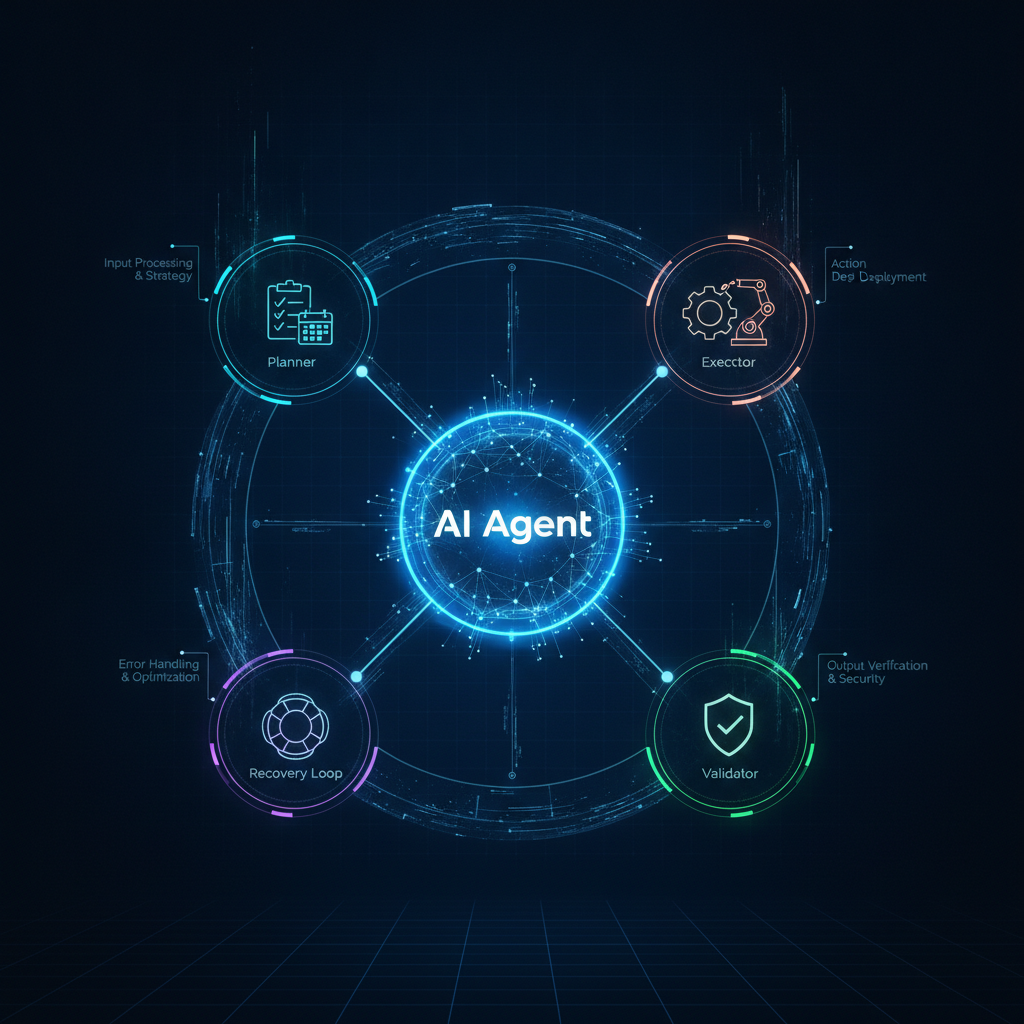
At its architectural heart, AI orchestration frameworks modularize functional roles—planners, executors, validators, and recovery loops—to achieve cohesion and extensibility through harness engineering. This approach “harnesses” otherwise independent agents within a coordinated control flow, promoting clarity, robustness, and maintainability.
Planners
Planners embody the strategic core of AI agent orchestration, tasked with decomposing high-level goals into executable tasks, scheduling them efficiently across distributed agents, and dynamically adapting plans in response to environmental shifts, agent failures, or new data. Their operation intertwines symbolic reasoning, heuristic search, and learned decision policies to produce flexible, context-aware execution strategies.
State-of-the-art planners blend deterministic rule-based logic—such as task dependency graphs enforcing execution order—with reinforcement-learned policies that optimize task allocations for latency, cost, or resource utilization. This hybrid approach supports domain-general reasoning while preserving crucial domain-specific invariants. Planners maintain a global, asynchronous view of tasks, continuously assimilating execution feedback and environmental observations to adjust or recompose plans dynamically. This closed perception-action loop is fundamental for reliable AI workflows facing non-deterministic execution outcomes. For further details, see an overview of symbolic planners and their integration with learning.
Executors
Executors operationalize plans into actual task dispatches, interfacing with AI modules, external services, or infrastructure components. Beyond simple invocation, executors manage intermediate state transitions, coordinate lifecycle metadata (timestamps, retries, resource consumption), and synchronize with planners by reporting progress or anomalies.
Architectural decisions around executors involve a trade-off between centralized and decentralized models. Centralized executors simplify global state aggregation and monitoring but risk single points of failure and potential latency bottlenecks under load. Decentralized executors, often implemented atop distributed event buses or messaging systems like Apache Kafka, enhance scalability and fault isolation yet complicate global coordination and consistent state aggregation.
Key executor responsibilities include checkpointing transient outputs to enable rollback or retries, managing session contexts, and facilitating precise fault diagnosis. Effective executor designs account for network unreliability, API rate limits, and heterogeneous service SLAs, ensuring robust task execution aligned with planner directives.
Validators
Validators integrate runtime monitoring logic that verifies task outputs against correctness criteria or statistical confidence thresholds, acting as gatekeepers preventing propagation of erroneous data. They adjudicate whether outputs are acceptable or necessitate remediation, possibly triggering replanning or alternative execution workflows.
Balancing strict validation with noise tolerance is delicate. Overly conservative validators cause pipeline thrashing and false alarms, especially in domains with inherently noisy AI data such as natural language processing or computer vision. Excessive permissiveness risks downstream contamination by flawed results. Validators often implement adaptive thresholds, confidence measures, or anomaly detection models that recalibrate dynamically based on historical performance metrics or environmental variability. This adaptive validation enhances workflow resiliency without compromising reliability.
Recovery Loops
Recovery loops embody the self-healing layer of AI orchestration frameworks, overseeing error detection, localization, and corrective strategies. Upon validator-flagged failures, recovery protocols engage rollback sequences, retries, fallback agents, or alternative execution paths to uphold workflow continuity.
Architectural patterns for recovery include compensating transactions—rolling back to known good states—exponential backoff retry schemes preventing resource exhaustion, and circuit breakers isolating malfunctioning agents. Advanced frameworks may incorporate learned failure predictors that proactively reroute tasks to mitigate cascading failures, optimizing operational resilience.
For example, an orchestrator handling autonomous tooling might detect degraded performance in a vision recognition service, seamlessly switching to a more stable but less complex fallback model, maintaining throughput with graceful degradation.
Together, planners, executors, validators, and recovery loops interlock within harness-based AI orchestration frameworks, producing adaptable, extensible workflows suited for high-stakes, distributed AI applications.
Challenges in Modular Agent Coordination
While modularizing AI agent orchestration enhances conceptual clarity and code maintainability, real-world distributed execution surfaces formidable challenges. These arise chiefly from agents operating semi-autonomously, communicating asynchronously, and exhibiting diverse fault modes in complex AI workflows.
State Consistency
Ensuring a coherent global state across loosely coupled, asynchronously operating agents is foundational yet difficult. Messages and event triggers between agents lack synchronous locking or atomic transaction semantics. This approach prioritizes scalability and availability but risks state divergence during partial failures or network partitions.
Planners and executors contend with fragmented, delayed or out-of-order status messages that must be reconciled into a consistent global execution context. Techniques such as vector clocks, versioned state stores, and distributed consensus protocols (e.g., Raft, Paxos) mitigate inconsistencies but incur latency and throughput trade-offs. In distributed simulations or multi-service orchestration, failure to reconcile state leads to task duplication, deadlocks, and degraded throughput.
Error Propagation and Recovery
Detecting, containing, and recovering from failures without centralized locking or global transactions is challenging. Spreading errors may cascade via inter-agent communication chains, amplifying inconsistencies or causing bottlenecks. Aggressive retry policies risk resource thrashing, while overly cautious fallbacks degrade system responsiveness and throughput.
Effective recovery loops must balance sensitivity and robustness, identifying safe restore points amidst partial task completions and consumed outputs. Fallback strategies require contextual insights to selectively degrade noncritical services while preserving core functionality. Common automation and low code platforms often abstract workflow simplicity at the expense of fault containment sophistication, rendering them unsuitable for mission-critical AI orchestrations demanding large-scale resiliency.
Coordination Complexity
Agent heterogeneity—varying capabilities, latencies, and failure profiles—inflates coordination complexity. Policies must dynamically reconcile throughput, latency, and fault tolerance objectives amid fluctuating system conditions.
Hierarchical coordination architectures mitigate this by segregating agents into control tiers, whereby local controllers handle immediate decisions feeding into higher-level planners. This confines error domains and shortens control loops, improving modular fault isolation. Alternatively, token-based or lease mechanisms serialize access to shared resources without full synchronization overhead.
Eventual consistency models tolerate transient state inconsistencies, relying on reconciliation protocols to achieve convergence. Applying these paradigms requires idempotent task semantics and robust conflict resolution strategies tailored for AI workflows—particularly challenging when task outputs entail side effects or external state changes.
Despite the widespread availability of low code and general automation tools, the complexity of robust AI agent orchestration continues to drive research and engineering innovation. Mature platforms invest in advanced state management, recovery loops, and observability to meet production demands.
Understanding these coordination challenges primes engineers to design or select frameworks that scale reliably under real-world, failure-prone conditions. The following section unpacks the precise functional roles—planners, executors, and validators—that form the layered foundation of modern AI agent orchestration.
Planners, Executors, and Validators: Functional Roles
Breaking down AI agent orchestration systems into planners, executors, and validators clarifies responsibility boundaries, enhancing modularity, maintainability, and fault isolation. This separation supports complexity management in large-scale autonomous workflows by allocating specialized concerns to distinct layers.
Planners formulate strategy: synthesizing high-level goals, environmental context, and policy constraints into explicit task sequences, conditional branches, or fallback strategies. Their output emphasizes declarative task definitions—the “what” of orchestration—abstracting from operational detail. Conversely, executors translate these plans into concrete operations, invoking APIs, AI models, or database transactions to implement objectives. They address imperative concerns—“how” tasks execute—handling retries, timeouts, logging, and session management focused on reliable delivery. Validators close the loop, assessing outputs for correctness, completeness, and consistency. Using heuristic rules, statistical tests, or secondary model inferences, validators detect errors early, triggering corrective actions such as replanning or error recovery where necessary.Architectural Rationale and Modularization Benefits
Modularizing these roles reduces cognitive load per component, enabling focused interface definitions and independent testing. Planners can evolve sophisticated reasoning techniques without altering executors; executors optimize for execution efficiency transparently to other layers; validators enhance error detection independently.
This layering aligns with classical control theory abstractions: planning as high-level control, execution as actuation, and validation as feedback sensing—a structure conducive to formal correctness guarantees and improved robustness.
Trade-offs and Inter-component Communication Challenges
Decomposition introduces synchronization overhead, latency, and potential error propagation. Planners rely on timely executor feedback to assess plan viability; executors require deterministic, unambiguous instructions to avoid conflicts; validators must report anomalies promptly to prevent wasted computation downstream.
Asynchronous operation frequently results in distributed, eventually consistent state snapshots. For example, slow executor responses may cause planners to prematurely resend commands, conflicting with validator flags, fostering race conditions. Managing these synchronization boundaries demands explicit protocols, serialization strategies, and sometimes consensus mechanisms—injecting complexity and performance costs.
Error propagation complicates root cause analysis. Validator-detected failures could reflect planning inaccuracies, execution faults, or external system disturbances. Cross-layer observability and sophisticated diagnostics, such as sidecar monitoring or instrumentation injection, become indispensable.
Misconceptions Around Coupling and Monolithic Designs
A common fallacy posits that monolithic, tightly coupled orchestration designs reduce complexity by collapsing layers and minimizing inter-component communication. In practice, however, this leads to brittle systems where localized changes trigger cascading regressions, complicating testing and maintenance.
Layered architectures instead isolate faults and enable selective component restarts or hot-swapping. For instance, a bug in execution code within a monolithic agent can corrupt planner state or validator checks, triggering systemic outage; separation confines failure domains and supports graceful degradation.
Practical Examples in AI Agent Orchestration Tools
Leading frameworks exemplify these modular roles. LangChain uses chain-of-thought prompt templates as planners, toolkits or API wrappers as executors, and output parsers or QA filters as validators. IBM Watson Orchestrate partitions workflow configuration (planner), step execution modules (executor), and validation steps linked to event dashboards, reflecting these architectural patterns.
Interfacing commonly involves event-driven architectures or RPC, accommodating real-world constraints like API throttling and network unreliability with messaging queues and persistent logs to guarantee continuity.
Validators as Fault Tolerance Gatekeepers
Beyond correctness enforcement, validators serve as critical fault tolerance bottlenecks by detecting semantic drift, SLA violations, or policy breaches early, enabling dynamic rollback or replanning before costly error propagation. Checkpointing provides deterministic rollback targets, reduces error amplification, and supports automated recovery workflows crucial for resilient long-running tasks.
Impact on System Resilience and Adaptation
The planner-executor-validator feedback loop accelerates system adaptation. Validation feedback informs planner heuristic tuning; executor instrumentation improves observability; validators’ anomaly signals refine detection thresholds dynamically. These layered interactions form closed-loop, self-tuning systems able to withstand environmental uncertainty, workload shifts, and evolving user requirements—a hallmark of mature AI agent orchestration frameworks.
Transitioning from role separation, the following section focuses on how overarching harness architectures unify these components, managing control flow to optimize reliability and scalability.
Harness Architecture for Control Flow Management
The centralized harness architecture emerges to mitigate the complexity and fragility of direct inter-agent communication. It mediates and orchestrates interactions among heterogeneous AI agents fulfilling planner, executor, and validator roles through a unified control layer. This harness abstracts coordination, state management, and fault containment away from individual agents, enabling robust, maintainable orchestration systems.
Mitigating Brittle Point-to-Point Communication
Without a harness, agents form ad hoc meshes of point-to-point connections, leading to O(n²) communication channels with exponential failure dependencies. Increased agent counts escalate fragility and cloud failure domains.
Harnesses decouple execution logic from coordination by centrally managing message brokering, event routing, and persistent state stores. Agents focus solely on domain-specific tasks, emitting and consuming harness-mediated events rather than directly addressing peers. This abstraction reduces coupling, improves debugging clarity, and facilitates incremental system evolution.
Architectural Patterns for Harness Engineering
- Centralized Event Buses: Facilitating publish-subscribe patterns allowing agents to emit domain events (e.g., task started or completed) and subscribe to relevant streams. This promotes reactive, asynchronous workflows with loose coupling.
- State Tracking Stores: Durable stores record workflow progress, task metadata, and global execution state. These may utilize key-value databases, relational stores, or distributed consensus-backed state machines, enabling consistency and facilitating recovery.
- Asynchronous Message Queues: Queues buffer communication, smoothing transient failures and enabling backpressure management, retries, and priority scheduling without message loss.
Combined, these patterns ensure ordered, observable, and reproducible workflow execution across distributed agents.
Asynchronous Task Management Strategies
- Dependency Graphs and DAGs: To enforce correct task precedence and prevent cyclic dependencies.
- Concurrency Pools and Rate Limiters: To throttle parallel executions in accordance with resource availability, API quotas, or external system load.
- Failure Detection and Timeout Policies: To catch hung or failed tasks, enabling timely intervention.
- Recovery Orchestration: To selectively roll back or restart downstream tasks depending on failure impact and system policies.
These mechanisms ensure control over unpredictable latency, partial failures, and dynamic workloads common in distributed AI pipelines.
Fault Tolerance and Recovery Mechanisms
By centralizing failure detection and containment within the harness, fault propagation is confined. The harness monitors event streams, validation signals, and timeout triggers to identify anomalies and orchestrate recovery policies including rollbacks, retries with backoff, or graceful degradation scenarios.
Autonomous recovery decisions minimize manual intervention and maintain service continuity essential for enterprise-grade deployments.
Comparison with Conventional Automation Frameworks
While harness architectures share conceptual foundations with tools such as Zapier or low-code platforms—namely, event-driven orchestration—they differ fundamentally in scope and complexity. Zapier orchestrates mostly synchronous, stateless pipelines linking stable APIs with deterministic outcomes.
AI orchestration harnesses operate over highly concurrent, asynchronous, dynamic workflows driven by adaptive planning, runtime validation, and complex recovery strategies. They handle stateful processes with uncertain task durations, ranging from minutes to hours, and require deep integration with complex ML models and business logic.
Thus, harnesses emphasize responsiveness, state consistency, extensibility, and fault recovery beyond the capabilities of conventional automation frameworks.
Challenges in Distributed Stateful Orchestration
- Consistency Models: Balancing strong consistency that simplifies reasoning but adds latency with eventual consistency that improves availability but shifts complexity downstream.
- Race Conditions: Ensuring ordered and atomic updates amid concurrent state mutations by multiple agents.
- Deadlocks and Livelocks: Designing coordination protocols to prevent circular waits or redundant retries that degrade throughput and responsiveness.
Robust harness design requires formal modeling, failure simulations, and runtime monitoring capable of capturing subtle issues in complex workflows.
Robustness via Decoupling and Maintainability
Centralizing orchestration logic permits agents to remain domain-focused, simplifying codebases and fault isolation. This paradigm supports:
- Easier bug isolation and fix deployment without end-to-end rollout.
- Incremental harness enhancements independent from agent implementations.
- Extensible registration of new agent types or validation schemes through standardized interfaces.
Production orchestration tools such as Microsoft’s Semantic Kernel exemplify harness design principles managing control flow, state persistence, and fault tolerance effectively.
Practical Considerations for Platform Design
- Integration with UI automation and robotic process automation (RPA) tools for full-stack workflow control.
- Extensibility of integration points for planners, executors, validators, and recovery agents.
- Built-in telemetry, tracing, and alerting to enable operational observability.
- Scalability under bursty or high-concurrency workloads, with support for horizontal event bus and queue scaling.
- Security frameworks supporting multi-tenant isolation and access controls.
Harness architectures lay the foundation for sustainable, scalable, and resilient AI agent orchestration required in production environments.
Designing for Failure: Recovery Mechanisms
AI agent orchestration systems operate amid distributed, dynamic, and inherently failure-prone settings, coordinating heterogeneous agents interacting with external services and mutable data sources. Fault tolerance must be intrinsic to the orchestration harness, enabling graceful degradation and automated recovery without manual intervention. Layered recovery mechanisms tightly coupled with planners, executors, and validators sustain workflow integrity and resilience.
Retries: Controlled Policies and Idempotency
Retries are a foundational recovery strategy but demand disciplined control. Unregulated retries risk duplicated work, infrastructure overload, or downstream cascading failures. Controlled policies employ exponential backoff combined with jitter, preventing retry storms and improving system stability. For instance, agents invoking unstable third-party APIs back off progressively on transient errors, balancing responsiveness with resource conservation.
Idempotency underpins safe retries, requiring repeated execution to have identical effects or abort safely without side effects. Achieving idempotency may involve assigning unique request identifiers or separating command issuance from state mutation steps. Multi-agent workflows must consider causal dependencies to avoid inconsistent partial outputs or state divergence due to retries.
Rollbacks: Transaction-Like Compensation and Cleanup
Rollback mechanisms revert orchestrated systems to prior consistent states following failures, akin to database transactions. Yet, AI workflows often operate on external systems or with irreversible side effects, complicating strict rollback semantics.
Where feasible, compensating transactions undo prior impacts through domain-specific reversal logic. For example, a failed customer onboarding sequence may trigger compensatory cancellations for resource allocations performed earlier, preventing dangling states. Such compensation requires explicit orchestration of reverse operations embedded within agent behaviors or workflow definitions.
Distributed orchestrations involving heterogeneous failure modes and partial commits raise further complexity around rollback scope and coordination. Strategies must define rollback granularity and inter-agent compensation protocols, often implemented via saga patterns or workflow-driven compensations tightly integrated into orchestration logic.
Compensating Actions: Logical Undo in Distributed Contexts
When atomic rollback is untenable, compensating actions logically neutralize prior operations’ intentions. This includes corrective commands, triggering re-processing flags, or alternate workflows offsetting failures’ effects.
Distributed multi-agent systems especially rely on compensation to resolve autonomy and partial state visibility issues. For example, compute resource schedulers deploying AI agents may compensate for failed jobs by releasing allocations and rerouting tasks while state partially persists inconsistently across nodes.
Designing compensations involves thorough modeling of side effects, dependencies, and failure modes, supported by explanatory logging, event sourcing, and audit trails that facilitate deterministic replay and debugging.
Challenges in Engineering Fault Tolerance
Fault tolerance introduces performance and complexity trade-offs. Synchronous validations, repeated retries, and intricate rollback coordination inflate latency and resource demands, challenging low-latency or high-throughput requisites. For example, tightly integrated UI automation with synchronous checkpoints reduces degree of parallelism but raises correctness certainty.
Recovery logic complexity demands extensive testing, including chaos engineering techniques simulating multi-agent partial failures and network disruptions. Ensuring correctness under such conditions requires comprehensive test coverage and robust automation.
Balancing consistency and availability remains a tension mirroring the CAP theorem: systems prioritizing strong, synchronous validations incur blocking, while those favoring eventual consistency relax correctness guarantees temporarily for availability. Different use cases mandate tailored prioritization of these axes.
Real-World Use Cases and Tool Support
Mature AI orchestration tools demonstrate integrated recovery features. AWS Step Functions support configurable retry strategies with exponential backoff, catch/fallback handlers, and chained activity compensations (AWS Step Functions error handling). Temporal framework provides durable workflow histories, automatic retries, and external compensation signaling supporting complex stateful recoveries.
Automation platforms like Robot Framework and UIPath extend recovery to interactive workflows, offering plug-in compensating actions and retry orchestration aligned with human-in-the-loop processes and GUI operations. These tools facilitate embedding domain-specific recovery strategies within multi-agent AI pipelines.
Prioritizing recovery as a primary orchestration concern ensures long-running workflows maintain correctness and resilience, laying the groundwork to address concurrency complexities intrinsic to concurrent multi-agent processing.
Concurrency Control and Consistency Issues
AI agent orchestration frequently entails parallel execution of autonomous agents with intertwined dependencies. Effective concurrency control is vital to prevent race conditions, inconsistent state, and failure cascades that threaten system correctness and operational stability.
Common Concurrency Pitfalls
Race conditions occur when agents simultaneously access or mutate shared resources without synchronization, causing corrupted state or lost updates. For example, concurrent writes to a shared knowledge base without version control may cause over-writes or conflicting task triggers.
State inconsistency arises from network delays, message reordering, or failure-induced state divergence. Executors may act on stale instructions while validators verify outdated outputs, spawning cascading errors. Such asynchronous inconsistencies are particularly challenging in highly distributed workflows with eventual consistency semantics.
Control Patterns for Concurrency Management
- Locking Strategies: Including pessimistic locking, which blocks concurrent access at the cost of throughput, and optimistic locking using version checks to detect conflicts post-factum. Choice depends on contention levels and workflow characteristics.
- Event-Driven Synchronization: Agents coordinate via ordered event streams ensuring causal consistency—downstream actions only proceed following predecessor completion. This approach reduces need for rigid lock-based schemes.
- Versioning and Conflict Resolution: Employing vector clocks or operational transformation to reconcile divergent states across distributed agents, crucial in geo-distributed or intermittently connected contexts (Microsoft AI Agent Orchestration Patterns).
Synchronization Models within the Harness
Harness architectures may centralize or decentralize synchronization. Centralized orchestrators simplify concurrency controls and strong consistency but risk bottlenecks and single points of failure, limiting scalability. Decentralized coordination distributes control, enhancing resilience and scale but demands complex consensus and state reconciliation protocols to ensure determinism and avoid race conditions.
Hybrid models balance these trade-offs—centralizing critical control paths while decentralizing task execution—coupled with fine-grained synchronization scopes reducing global lock contention.
Interaction with Automation Frameworks
Complexity compounds when integrating external automation systems such as UI automation. These systems’ asynchronous, non-atomic operations necessitate serialization or mutual exclusion within the orchestration pipeline to prevent conflicting UI state or action sequences. Orchestrators implement concurrency-aware adapters and synchronization barriers to bridge these external eventual consistency semantics with internal agent workflows.
Practical Implications and Architectural Best Practices
Concurrency errors often manifest as subtle, intermittent bugs difficult to reproduce, such as deadlocks or data races. Diagnosing requires comprehensive distributed tracing, deterministic workflow replay, and enriched telemetry capturing causality.
Architectural best practices comprise bounding concurrency scopes, designing idempotent agent actions, applying explicit versioning with conflict detection and retries, and aligning synchronization models with operational scale and failure modes to optimize throughput without sacrificing correctness.
Robust concurrency control embedded in orchestration frameworks enables highly scalable, resilient multi-agent AI systems capable of dynamic adaptation and stable operation under complex workloads.
Operational Considerations and Practical Frameworks
Observability and Monitoring in AI Agent Workflows
Observability is vital in AI orchestration harnesses where planners, executors, validators, and recovery components operate across distributed agents. Accurate, real-time insights into system health, reliability, and performance enable fault diagnosis and proactive management.
Critical Operational Metrics
Key metrics include task execution latency—from plan generation to executor completion—highlighting bottlenecks in decision logic or resource contention. Success and failure rates segmented by orchestration layer reveal stability patterns. Validation error frequencies indicate semantic or quality degradation. Recovery loop triggers quantify system adaptability under failure conditions.
Tracing Strategies for Multi-Agent Orchestration
Distributed tracing maps execution flows, capturing asynchronous, multi-threaded task progress through the orchestration stack. Frameworks like OpenTelemetry or Jaeger instrument RPC calls and event emissions, providing end-to-end visibility. Complementary event logging chronicles control-layer state transitions, capturing contextual metadata such as agent identities, inputs/outputs, and error codes, empowering granular diagnostics.
Combined, these tools expedite failure root cause analysis, enabling dynamic adaptation strategies such as backoff re-ranking or recovery path selection without human intervention, minimizing operational downtime.
Challenges and Mitigation Strategies
Extensive tracing and logging impose overhead, risking runtime performance degradation. Adaptive monitoring—probabilistic sampling, event batching, and dynamic thresholding—informed by anomaly detection balances insight depth with system responsiveness.
Observable feedback fosters closed-loop adaptation, feeding runtime metrics into planner heuristics tuning and recovery trigger modulation, reinforcing system robustness and efficiency.
Practical Platform Integration
Leading AI orchestration platforms embed observability natively. Systems like Ray Serve or LangChain provide telemetry dashboards exposing agent health, latency percentiles, and state transitions. Cloud-native orchestrators, e.g., AWS Step Functions and Azure Durable Functions, offer built-in tracing tailored for AI workflows, streamlining production readiness and reliability engineering.
Such multi-layered observability is foundational for managing sophisticated nested planner-executor architectures with validation checkpoints and recovery protocols.
Evaluation of Practical Platforms and Tooling
Selecting AI orchestration platforms versus general-purpose automation tools is critical. While tools like Zapier or low-code platforms accelerate prototyping with simple branching and prebuilt connectors, they often lack the nuanced controls needed for layered AI workflows including planner-executor separation, integrated validation, and sophisticated recovery loops.
AI-specific platforms—e.g., Prefect, Temporal, or actor frameworks like Ray—offer native constructs managing task dependencies, state checkpoints, and conditional executions aligned with layered orchestration. They support extensibility for custom planning, validation heuristics, and adaptive recovery strategies embedded seamlessly within workflows.
Traditional automation tools must often be bolstered with external middleware to approximate these patterns, increasing complexity and maintenance overhead. Their integration with AI inference and runtime context is typically minimal, limiting sophistication.
Fault tolerance is native in AI orchestration platforms, featuring durable state persistence, retry policies with backoff, continuous validation, and automatic recovery critical for complex or long-running workflows. By contrast, general automation platforms provide limited retry features and sparse checkpointing, constraining scalability and resilience.
Scalability differs markedly: AI orchestration operates within horizontally scaled clusters managing diverse agent pools, whereas SaaS-based automation platforms often impose throughput ceilings tied to licensing models.
Task coordination granularity and stateful process management in AI orchestration exploit constructs like DAGs and state machines, enabling audit logging and selective rollback. Low-code tools offer visual workflow design but struggle with stateful iterative validation and multi-agent recovery.
Other practical considerations include vendor lock-in risks inherent in proprietary platforms, cost implications of transaction- or execution-based pricing models in SaaS offerings, and critical integration with existing AI infrastructure components such as model serving endpoints, feature stores, and data pipelines.
Real-world examples highlight differential outcomes: a fintech firm employing Temporal reduced recovery time by 70% and increased throughput by 20% via integrated validation and recovery, while early Zapier prototypes hit scale and reliability limits. Transitioning to custom orchestration yielded substantial operational gains in adaptive workflows such as fraud detection and customer service automation.
Though evolving, low-code tools remain immature for fully robust AI agent orchestration without extensive customization.
In sum, observability and tooling choices profoundly impact orchestration resilience, operational insight, and scalability. Tightly coupling these with layered control workflows and recovery mechanisms distinguishes production-grade platforms from prototyping tools.
Key Takeaways
- Explicit separation of concerns enhances modularity and independent component evolution but requires well-defined interfaces and consistent state management to prevent synchronization bottlenecks.
- Harness architectures centralize control flow and inter-agent communication, enabling asynchronous task management and adaptive recovery while imposing consistency and coordination complexities.
- Recovery mechanisms balancing rollback, retries, and compensations must mitigate performance impact and coordinate failure containment across agents with diverse failure semantics.
- Platform selection entails trade-offs: low-code tools offer ease at the expense of fine-grained control and robustness; specialized AI orchestration frameworks provide extensibility and resilience but incur greater development effort.
- Concurrency and idempotency considerations are essential to prevent task duplication or race conditions across asynchronous, distributed agents and external automation tools with variable latencies.
- Integrated validators serve as fault tolerance gatekeepers, enabling early error detection and preventing costly error propagation.
- Open-source and free automation tools serve as starting points but require significant engineering to meet industrial-grade fault tolerance and scalability requisite in AI workflows.
Grounding system design in these principles facilitates constructing resilient, scalable AI agent orchestration frameworks capable of meeting complex operational demands.
Conclusion
AI agent orchestration sits at the intersection of distributed systems, multi-agent coordination, and fault-tolerant control, addressing the challenge of integrating heterogeneous, autonomous AI agents into coherent workflows. Modularizing into planners, executors, validators, and recovery loops under a harness architecture provides a structural foundation for reliability, scalability, and adaptability essential in production environments.
Resolving challenges around state consistency, concurrency, failure containment, and observability through layered control and centralized coordination prepares systems to operate robustly amid real-world uncertainty and operational complexity.
As AI workflows grow increasingly pervasive, diverse, and mission-critical, future orchestration designs must prioritize transparency and diagnosability under failure, enabling rapid iteration, composability, and resilience at scale. The architectural question facing engineers is not whether coordination and fault tolerance complexities will surface, but how to architect systems that expose, isolate, and verify these properties effectively under evolving demands and operational pressures—ensuring AI systems remain responsive, trustworthy, and maintainable as scale and heterogeneity expand.