Introduction
Raw AI models operate without inherent safeguards for state management, side effects, or resource constraints, rendering them unreliable for complex, long-running agent workflows. Without a controlled runtime environment, these models are prone to unpredictable behaviors, data corruption, and operational brittleness that scale poorly as system complexity increases. The core challenge becomes evident: how can we engineer agentic AI systems capable of safely interacting with diverse external inputs, maintaining consistent state, and recovering from partial failures—without sacrificing flexibility or scalability?
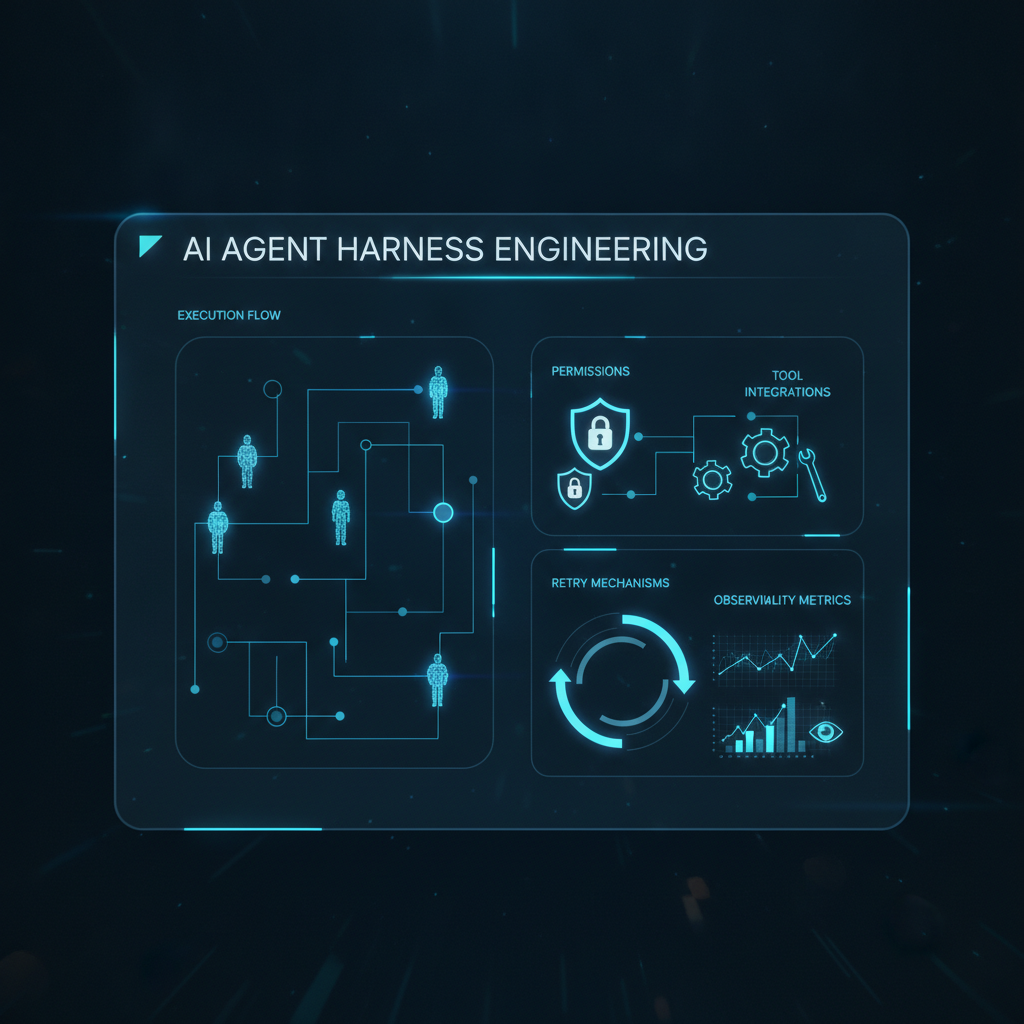
Agent harness systems address this challenge by encapsulating AI models within structured environments that enforce operational boundaries, monitor execution, and manage feedback loops. This engineering abstraction transcends raw inference calls, embedding safety engineering principles, modular state management, and deterministic execution controls essential for production-grade AI agents. Mastery of agent harness design is crucial for engineers building robust, observable, and reproducible AI-driven workflows that withstand real-world operational demands.
This article explores why harness engineering is indispensable for operationalizing agentic AI systems. It articulates core components, safety mechanisms, and the trade-offs involved in balancing agent flexibility with deterministic control. We will examine how agent harness systems provide the foundation for scalable, safe, and maintainable AI agents far beyond the limitations of standalone models.
Challenges and Risks in Raw Agentic AI Models
Deploying raw large language models (LLMs) as autonomous agents without dedicated harness systems exposes fundamental operational constraints and failure modes. Unlike engineered systems, naive AI agents rely solely on probabilistic language generation, lacking architectural provisions for reliable state management, modular control, or runtime safety. The following sections provide an engineering-focused analysis of these vulnerabilities, grounded in concrete mechanisms and systemic risks.
1. Uncontrolled State Management and Side Effects
Raw language models function as stateless function approximators: each response depends only on the given prompt context, with no guaranteed or authoritative representation of internal agent state. This absence of embedded transactional memory, checkpointing, or rollback facilities—core tenets of conventional software—creates a critical gap in ensuring state integrity.
In multi-turn agent workflows, this manifests as state drift and corruption. Models rely exclusively on latent context buffers that are limited by token window sizes and susceptible to sampling noise. When context truncation or probabilistic variability occurs, partial or conflicting state transitions accumulate silently. For example, an agent tasked with updating a distributed database may issue inconsistent update commands if prior state information is lost or corrupted in the prompt history. These inconsistencies frequently coincide with asynchronous side effects—such as external API calls or file system operations—that compound unpredictability and leave no transactional guarantees.
From a safety engineering standpoint, these uncontrolled side effects violate fundamental atomicity and isolation invariants. Traditional engineered systems employ transaction logs, versioned state machines, or deterministic state stores to ensure that partial failures do not corrupt system state or leak inconsistent data; raw LLMs lack these controls entirely. This absence precludes formal verification, traceable error logging, or deterministic recovery—critical components for reproducibility and reliable operations.
Non-determinism in output generation is not merely inconvenient; it threatens operational integrity. Corrupted data stores, inconsistent user experiences, or unsafe system states can emerge unnoticed. By contrast, engineered runtime environments rely on explicit side-effect management and state versioning to guarantee atomic updates and rollback on error, reducing risk.
Without such constructs, risk assessment and incident mitigation become substantially more complex. The lack of verifiable state transitions and side-effect controls in raw LLMs introduces an elevated engineering risk landscape that hampers fault diagnosis and resilience.
2. Scalability Limitations and Operational Brittleness
Without harness systems, scaling raw AI agents to complex or extended workflows reveals structural brittleness rooted in their monolithic, unmodular design. Engineered systems typically feature modular checkpoints, compartmentalization, and sandboxed subsystems that localize failures and simplify debugging. In contrast, unscaffolded LLM agents operate as single probabilistic engines that lack explicit failure isolation or cascade prevention capabilities.
This brittleness mirrors classical engineering disaster scenarios—where the absence of operational guardrails causes minor errors to cascade into systemic failures. For example, an agent executing a multi-step reasoning pipeline may propagate an erroneous intermediate inference downstream, exponentially amplifying errors until final outputs become nonsensical or hazardous.
Without modular control, partial failures cannot be isolated or retried independently; the entire workflow risks collapse. The inability to sandbox execution or simulate dry-run scenarios further limits safe experimentation, complicates debugging, and heightens deployment risk.
This parallels layered safety defenses advocated by engineering standards such as OSHA’s risk control paradigms, which emphasize containment and redundancy to mitigate failures.
Large-scale agents deployed in automated customer support, data pipeline orchestration, or infrastructure automation often exhibit degraded performance and erratic behavior due to accumulating hallucinations and semantic drift without harness oversight. Attempts at scaling require significant manual intervention and custom mitigation, negating automation gains.
By contrast, purpose-built agent harnesses introduce explicit checkpointing, state validation, and modular orchestration layers that isolate failures and enable partial workflow restarts. These harnesses transform raw LLMs from brittle monoliths into composable, resilient subsystems capable of reliable operation at scale. For detailed strategies, see OpenAI best practices for agent orchestration.
These scalability and brittleness issues underscore deeper challenges in achieving runtime safety and reliability—areas where engineering disciplines have long-established standards now essential for robust agent architectures.
3. Safety and Reliability Challenges Without Runtime Control
Absent runtime safety controls, raw LLM agents face exacerbated engineering risks from fault propagation, adversarial input vulnerabilities, and unrecoverable error states. Safety-critical engineered systems—whether in aviation, industrial automation, or healthcare—embed layered fail-safes, watchdogs, and recovery mechanisms extensively tested to prevent fault escalation. AI agents, lacking these engineered harnesses, remain vulnerable.
Agent harnesses serve as analogous runtime safety systems: monitoring execution, validating intermediate states, enabling checkpoint-based rollback, and enforcing safety contracts. Without such harnesses, raw models:
- Lack integrated rollback or compensation pathways, allowing errors and side effects to cascade unchecked.
- Cannot detect or mitigate anomalous or adversarial inputs dynamically, increasing failure surface and vulnerability.
- Fail to produce verifiable audit trails or maintain invariants critical for certifications and compliance in regulated environments.
This creates an engineering risk analysis paradox: system complexity and opacity hinder hazard detection precisely where strict safety assurances are necessary.
Real-world failures illustrate these risks: LLM-based agents generating harmful outputs, executing unauthorized commands, or corrupting critical data without recovery mechanisms are not hypothetical but observed phenomena. For instance, an autonomous form-filling AI agent lacking intermediate validation might violate data protection policies or disrupt workflows, causing regulatory exposures or systemic outages.
Implementing comprehensive agent harness systems is therefore a critical engineering requirement, not an optional enhancement. These harnesses embed safety instrumentation analogous to physical industrial safety harnesses—designed to maintain operational continuity despite inevitable model imperfections and unpredictabilities. For perspectives on standardization, see the OpenTelemetry specification for observability.
Engineer-centered analysis reveals that raw LLMs are fundamentally ill-suited for real-world production workflows without robust harness layers that govern deterministic state management, modular resilience, and runtime safety.
The next imperative engineering challenge is the design of harness frameworks that balance rigorous control with the flexible generative capabilities of advanced AI agents.
Core Concepts and Components of Agent Harness Systems
Agent harness systems form the foundational engineering layer encapsulating complex AI models within rigorously controlled runtime environments. Unlike raw LLMs, which function as unconstrained probabilistic generators, harnesses impose deterministic workflows and safeguard boundaries limiting models’ autonomous behavior. This containment is essential because language models, trained to maximize text likelihoods, exhibit emergent behaviors that can be unpredictable and susceptible to systemic failure modes such as hallucinations, unsafe outputs, or infinite loops.
At their core, agent harnesses act as governor mechanisms—paralleling governors in mechanical engines—that regulate AI runtime dynamics to preserve safety and operational consistency. They supervise the agent’s lifecycle by enforcing execution time limits, interaction policies, input/output filtering, and resource quotas, preventing unsafe or erroneous state transitions. Through this lens, harnesses convert AI from free-form text generators into dependable components within larger, mission-critical systems that demand repeatability and auditing.
Encapsulation extends beyond runtime management. Harnesses incorporate system safety engineering principles, continuously monitoring execution states to prevent memory corruption and uncontrolled side effects. For instance, harnesses enforce strict transactional state updates that roll back on failure conditions, avoiding “runaway” errors or cascading state corruptions that otherwise spread uncontrolled.
Agent safety in harnesses also addresses external interaction governance. Because AI agents often interface with APIs, databases, or hardware, harnesses implement rigorous access controls, throttling, and validation layers to prevent unauthorized data exfiltration, resource exhaustion, or denial-of-service conditions. Error containment strategies—including sandboxed execution and exception capturing—ensure faults remain localized, preventing destabilization of host environments.
The overarching purpose of harness engineering is to operationalize AI agents as predictable, safe, and responsive components, neutralizing the intrinsic unpredictability of language models. This requires runtime monitoring, fine-grained execution control, and disciplined error recovery—all orchestrated by the harness.
Filesystems, Sandboxes, and Isolation Mechanisms
In agent harness architecture, dedicated filesystems and sandbox environments provide essential isolation mechanisms that enable safe, robust AI execution by managing persistence and runtime containment of agent state and interactions.
Harness-managed filesystems enable controlled persistence by maintaining agent memory and context across invocations while supporting rollback and error recovery. These filesystems often implement ephemeral or versioned storage: ephemeral modes clear sensitive data post-execution, minimizing privacy exposure; versioned snapshots permit rollbacks to known good states, facilitating iterative workflows where state corruption can be undone autonomously.
As an example, a financial analytics agent may store transaction logs or intermediate computations within a harness filesystem. If inconsistencies or anomalies arise, the harness can revert storage states to prevent contamination of analytic results, thereby preserving decision integrity. This controlled persistence further supports audit trails and compliance for forensic investigations in regulated environments.
Sandboxing complements filesystem isolation by enforcing runtime execution boundaries that constrain code execution and resource usage. These environments prevent agents from unauthorized access or operations detrimental to host stability or security. Sandboxes may range from lightweight containers (e.g., Docker) to heavier virtual machines or language-level sandboxes, each with trade-offs in performance, compatibility, and security.
Containers provide fast startup and strong resource control—CPU, memory, network quotas—suitable for orchestration of thousands of parallel agents. However, as they share host kernels, they carry potential risk if container escapes or vulnerabilities occur. Virtual machines offer stronger isolation at increased resource costs and operational overhead, reserved for scenarios requiring high-assurance separation.
Operating system–level process isolation mechanisms (e.g., Linux seccomp filters, AppArmor, SELinux) further refine permission granularity, limiting agents to minimal capabilities needed for critical operations such as HTTP requests or file I/O, preventing unintended side effects.
This layered isolation strategy parallels physical safety harness systems and OSHA fall protection principles. Just as physical harnesses prevent injury by imposing operational constraints, software sandboxes prevent crashes, data leakage, or unauthorized actions by enforcing strict runtime boundaries. These boundaries constitute engineering controls that minimize exposure to uncontrolled runtime risks, facilitating compliance with security frameworks like SOC 2 or HIPAA.
Together, harness-managed filesystems and sandboxed execution provide a robust platform for mission-critical or sensitive AI workloads, delivering reproducibility and safety critical for scaling agent complexity.
Modular Memory Management and Feedback Loop Integration
Effective memory management is a cornerstone of agent harness engineering, as persistent, controllable state across agent executions is essential for complex, multi-turn interactions. Harnesses architect modular memory subsystems that distinctly separate short-lived, volatile working memory from persistent storage reflecting longer-term context or knowledge.
Volatile memory buffers transient data—current inputs, intermediate results, and ephemeral states relevant within single runtime cycles. Persistent memory archives durable information, such as user preferences, historic interactions, or knowledge bases shaping agent reasoning. Harnesses enforce strict protocols to maintain consistency, often using transactional or append-only patterns with atomic commits to prevent state corruption and ensure synchronization with external resources (e.g., databases, caches).
Memory management extends beyond storage logistics. It includes state update propagation mechanisms that govern how concurrent memory modifications merge to avoid conflicting writes or stale data, especially in distributed or multi-agent deployments. Garbage collection and lifecycle policies prevent leaks or memory bloat, maintaining responsiveness and reducing unwanted behavior drift.
Integrating dynamic feedback loops elevates harness sophistication. These loops monitor runtime metrics—error rates, latency, resource consumption, aberrant outputs—and dynamically adjust agent behavior. Feedback-driven interventions may throttle token budgets, trigger fallback models, or initiate safe shutdowns to preclude escalating failures.
These loops enable continuous risk management, analogous to margin-of-safety calculations in engineering. For example, an increase in hallucination rates or rising resource usage may prompt the harness to restrict execution or engage human intervention, preventing costly breakdowns.
Feedback integration ensures agents remain within safe operational envelopes, mitigating failure modes such as deadlock, memory starvation, or cascading exceptions. It parallels fail-safe and fail-operational design principles prevalent in system safety engineering that ensure partial failures do not cascade into total outages.
From a scalability perspective, feedback loops and modular memory facilitate early detection of resource contention and synchronization conflicts in distributed architectures. Conflict resolution subsystems serialize shared resource access or dynamically allocate execution tokens to prevent starvation and cascading faults in large multi-agent workflows. For an in-depth exploration, see Martin Fowler’s article on resilient systems.
By combining modular memory management with continuous feedback, agent harnesses transform probabilistic language models into deterministic, operationally manageable components apt for integration into highly complex production ecosystems.
Implementing Operational Safety Boundaries and Controls
Agent harness systems underpin operational safety by enforcing layered boundaries that convert raw, unconstrained LLMs into permission-governed, controlled entities. Unlike traditional software components with fixed API contracts, LLMs generate ambiguous, context-sensitive outputs without guaranteed operational semantics. This unpredictability exposes systems to risks from unintended side effects to catastrophic failure cascades.
Drawing on engineering safety and system safety engineering principles, agent harnesses introduce layered, software-enforced controls akin to physical safety interlocks or pressure relief valves that mitigate disastrous failure modes.
At their foundation, harnesses implement strict execution boundaries and permission restrictions reflecting principles of least privilege. Analogous to OSHA-mandated engineering controls that physically prevent unsafe machine operation, harness controls constrain agent capabilities—restricting resource access, command execution, and environment penetration. For example, an agent managing filesystem operations is limited strictly to predefined directories, preventing system-wide file access. This constrained environment reduces attack surfaces, prevents inadvertent damage, and supports governance policies.
Fail-safe defaults are deeply embedded within harness design. Upon encountering uncertain states, anomalous model outputs, or runtime errors—such as invalid state transitions, API failures, or unexpected input patterns—the harness defaults to safe minimal actions. These often include suppressing risky commands, queueing operations for human review, or triggering rollback sequences. Such fail-safe behavior is critical, as raw LLMs provide no intrinsic safety awareness and can produce unsafe outputs when facing ambiguous or adversarial prompts.
Fault containment mechanisms prevent AI-generated faults—like infinite loops, runaway resource usage, or corrupted state transitions—from impacting broader system stability. Harness subcomponents operate within containerized sandboxes, versioned state stores, or virtualized runtimes that quarantine errors and prevent systemic escalation. This design mirrors system safety engineering’s containment zones (e.g., fire barriers, electrical isolation) that localize faults. By governing model outputs, execution context, and side effects, harnesses maintain operational anomalies as local, recoverable events.
Together, these engineering safety controls reduce hazard exposure from inherently output-agnostic language models and ensure compliance even under adversarial conditions. Like OSHA-mandated machine guards and emergency stops, agent harness systems institutionalize software safety boundaries that elevate AI agents from unpredictable code producers to dependable, verifiable components. The harness acts as a gatekeeper, transforming stochastic model behavior into permission-limited, auditable actions—embedding system safety engineering principles deeply into AI operations. For further technical breakdowns, see The Anatomy of an Agent Harness.
With operational safety rigor established, the subsequent engineering dimension is enforcing deterministic and reproducible executions—key to scaling reliability in complex deployments.
Mechanisms for Deterministic and Reproducible Agent Execution
Achieving determinism—guaranteeing that given identical inputs and system state, agent outputs remain consistent—is a substantial technical challenge absent in raw LLM usage. Large language models inherently rely on probabilistic token sampling, introducing stochasticity that thwarts reproducibility.
Agent harness systems close this gap by embedding deterministic execution engines that tightly regulate every decision step. This includes fixing random seeds within model invocations, sequencing task execution linearly, and isolating side effects to prevent unintended variability. By controlling these factors, harnesses ensure that repeated runs with identical inputs and internal states produce matching outputs, action sequences, and side-effect patterns.
Deterministic execution is critical for debugging complex multi-step workflows, performing rigorous audits, and meeting compliance mandates requiring transparent traceability.
Architecturally, harnesses maintain immutable state checkpoints—comprising memory contexts, environmental snapshots, and intermediate outputs—allowing rollback to stable states upon error detection. This versioning supports safe error recovery and aligns with engineering best practices such as failover and redundancy mechanisms designed to mitigate hazards in physical systems.
For example, financial firms deploying AI agents for trade execution or regulatory reporting demand reproducibility for audit trails and investigations. Harness-enabled deterministic execution has resulted in up to 30% reductions in investigation times and halved compliance violation risks. Without harness-induced determinism, stochastic model behaviors would undermine such assurances.
Determinism remains challenging due to external dependencies—APIs, I/O channels, networking—and model stochasticity. Harnesses overcome this by sandboxing external calls, buffering asynchronous events, sanitizing inputs, and enforcing runtime policies that serialize or synchronize concurrent operations. These restrictions eliminate non-deterministic side effects from concurrency or external variability.
This engineering rigor is foundational: without deterministic workflows, AI agents cannot be confidently deployed in mission-critical contexts where auditability, testing, and error tolerance are non-negotiable.
Having established safety and determinism, harness systems next confront scalability and evolving architecture demands through modular decomposition.
Design Patterns Supporting Scalability and Modular Growth
Real-world AI agent deployments confront growing complexity—multi-agent collaboration, adaptive learning, heterogeneous environment integrations—that demand agent harnesses designed for scalable, modular evolution. Raw monolithic AI models lack structural extensibility, whereas harness systems embrace modular design patterns facilitating incremental development, risk-managed integration, and independent subsystem scaling.
Common architecture decomposes harness functionalities into discrete, loosely coupled modules such as memory management, feedback control, action routing, and filesystem interfaces. This decomposition enables targeted, independent scaling and refinement without system-wide disruption. For example, the memory subsystem managing embeddings and long-term context can be horizontally scaled separately from the execution orchestration engine, supporting deployments managing gigabytes of state efficiently. Feedback modules evolve independently to incorporate user corrections or environmental inputs, enhancing agent adaptability without destabilizing core logic.
Modules communicate via standardized interfaces and messaging protocols, enabling flexible integration across diverse AI models (e.g., vision, speech, or LLMs) and third-party services, databases, or APIs. This abstraction permits incremental risk analysis by sandbox-loading new components and independently verifying safety properties—akin to modular safety barriers in complex engineering systems.
This modularity addresses complexity growth risks in deployments where capabilities such as multi-modal inputs, auditing, and extensible action spaces increase non-linearly. Without modular harness architectures, introducing new features risks regressions or hidden safety vulnerabilities. Modularity effectively partitions these risks, supporting phased rollouts akin to staged engineering inspections mandated by safety regulations.
Trade-offs in modularity arise between generalized interfaces that favor extensibility but carry performance overheads, and bespoke connectors optimized for efficiency but reducing flexibility and maintainability. Harness engineers must balance these competing demands to optimize reliability while controlling complexity.
For instance, healthcare AI agents automating patient intake integrating electronic health records and regulatory workflows benefit from phased module integration, avoiding service interruptions and achieving substantive processing time reductions. Simultaneously, sandboxed module testing mitigates unforeseen edge-case failures or compliance risks.
In summary, architected agent harness systems transform non-deterministic, opaque AI models into safe, reproducible, and scalable systems. Through operational safety enforcement, deterministic workflows, and modular patterns guided by robust engineering safety principles, harnesses enable responsible and reliable AI agent deployments compliant with rigorous safety mandates. For further resources, see OpenHarness: Open Agent Harness with a Built-In Infrastructure.
Comparing Raw AI Models and Agent Harness Systems
Operational and Safety Limitations in Raw Language Models
Raw large language models function primarily as statistical inference engines, predicting next-token sequences from vast corpora without architectural guarantees on statefulness or safety. While enabling impressive natural language generation, this probabilistic pattern matching inherently lacks critical operational properties required for autonomous, agentic AI in production.
Key limitations include the absence of persistent state. Raw LLMs are stateless within session-bounded prompt contexts, incapable of maintaining memory beyond immediate interactions. This restricts their use in multi-turn workflows requiring consistent knowledge accumulation, preference retention, or longitudinal context, essential for coherent, adaptive behaviors. See OpenAI prompt design documentation for more on context limitations.
Additionally, raw LLMs cannot recover from errors due to missing explicit error-handling or validation. Without runtime checks, hallucinations, omissions, or misinterpretations propagate unchecked, degrading output quality over successive calls and risking logical contradictions or operational failures.
Another critical deficiency is the lack of environmental feedback loops. Raw LLMs passively generate text but cannot natively inspect external state, verify side effects, or adapt dynamically to feedback. This absence of closed-loop control precludes self-correction and adaptive safety enforcement during operation.
Finally, raw models exhibit an absence of embedded safety controls. Outputs are uninhibited by operational risk considerations or safety policies, lacking mechanisms to block inappropriate or unsafe content. This deficiency makes raw LLMs unsuited for applications requiring deterministic decision-making, policy compliance, or multi-layered safety enforcement.
These limitations expose systems to operational risks, including “engineering disasters” caused by unregulated output behaviors or “agent safety” hazards where unchecked AI decisions produce real-world harm. For example, financial advisory agents without validation risk generating misleading guidance; industrial control agents lacking state consistency may trigger unsafe operations.
Under strict safety and regulatory environments—healthcare, finance, autonomous systems—raw LLM deployment as autonomous agents is untenable without comprehensive control frameworks.
Advantages Offered by Agent Harness Systems Over Raw Models
Agent harness systems wrap raw LLMs with structured scaffolds that convert them from ephemeral generators into accountable, interactive, and safe agents. Through embedding control loops, persistent state, and external integrations, harnesses enable mission-critical reliability and safety.
At their core, harnesses implement structured memory and state management, facilitating persistent context and progressive knowledge accumulation beyond single-call horizons. Architectures incorporate in-memory data structures, external knowledge bases, or database-backed stores supporting complex workflows with multi-step reasoning and adaptive decisions. For instance, a customer support agent harness integrates chat histories, ticket metadata, and user settings to deliver consistent, personalized service—functionality impossible with stateless raw models.
Harnesses also introduce error handling and recovery, applying rule-based validations, anomaly detection, and retry logic to treat raw model outputs as verifiable intermediates subject to correction before action execution. If an erroneous API call occurs, harnesses capture failure signals, trigger reruns, or enact fallback workflows—emulating industrial safety controls that reduce operational risks.
Sandboxed execution environments protect host infrastructure by confining agent operations to predefined boundaries. This security isolation limits the blast radius of faults or adversarial inputs, aligning with practices in industrial safety engineering to guarantee dependable, compliant AI operation.
Feedback and monitoring loops within harnesses provide continuous runtime telemetry, logging, and assertion checks that enable dynamic behavior calibrations. These loops detect output drift, latency anomalies, or interaction irregularities, facilitating safe intervention or human oversight.
Most significantly, harness systems enable tool and API integration, translating model outputs into verified actions that interface with databases, filesystems, or enterprise backends—bridging probabilistic language generation and deterministic procedural execution. This capability elevates AI agents beyond conversationalists into operational decision-makers with auditable impact.
Organizations deploying harnessed agents report tangible benefits: customer support AI with harnesses reduce call resolution times by over 30%, increase satisfaction metrics, and provide traceability critical for compliance. These improvements underscore the indispensability of robust agent harness engineering.
Such systems also embody anthropic harness engineering principles, aligning AI behavior with human values and safety objectives by governing raw model outputs through software scaffolding. This feedback-stabilized approach ensures reliable pursuit of intended goals without catastrophic side effects.
Together, these distinctions clarify why harness engineering is indispensable for agentic AI system design and set the stage to explore harness architectures maximizing robustness and value.
Implementation Considerations, Trade-offs, and Use Cases
Balancing Agent Flexibility with Deterministic Control
A key engineering challenge in agent harness design is balancing the intrinsic flexibility of AI agents—their ability to generate adaptive, context-rich, and emergent behaviors—with the deterministic control necessary for operational safety and predictability. This tension reflects broader system safety trade-offs: enabling creative agent “thinking” while bounding risks to acceptable levels.
Harnesses implement structured control layers encompassing precise memory management, sandboxed execution boundaries, and feedback loops monitoring performance and risk indicators. These restrictions limit spontaneous or unbounded actions that may cause instability.
From a safety engineering standpoint, such controls mitigate deviation from intended operation caused by emergent or misaligned behaviors. Without them, agents risk speculative or resource-intensive actions detrimental to system stability. For example, absent state management and feedback controls, agents may consume excessive compute or pursue inefficient strategies unpredictable to operators.
However, these safeguards introduce overhead in runtime and development complexity and can constrain adaptability. Sandboxing may prevent rapid response to unforeseen conditions or exploration of creative solutions. Trade-offs arise between maintaining agent creativity and ensuring predictable rollback and error containment.
These approaches draw on formal methods used in high-assurance domains, where deterministic execution environments bound inputs/outputs to controlled channels and enable fault recovery through checkpointing. While adding latency and resource use, they yield critical predictability for domains like autonomous vehicles, medical diagnosis, or financial systems—areas where failures carry high cost.
Designers must carefully calibrate these trade-offs, selecting harness strictness aligned to operational risk tolerance and application demands. Loosely controlled agents may suit research or exploratory tasks, whereas tightly controlled harnesses underpin mission-critical systems necessitating regulatory audit and formal verification.
This balancing act naturally leads to an examination of common failure modes within harness systems and the engineering practices deployed to mitigate them.
Common Failure Modes and Engineering Mitigations
Agent harnesses, by themselves complex systems, introduce new failure modes—particularly partial system failures and feedback loop instabilities—that can degrade agent consistency and stability.
Partial failures often arise from incomplete state persistence, corrupted memory, or race conditions in concurrency. Such failures may desynchronize the agent’s internal state machine from intended workflows, causing contradictory inferences or broken context. Lack of atomic checkpointing or rollback can propagate these inconsistencies, ultimately producing flawed outputs impacting downstream components.
Mitigation demands robust checkpointing with transactional rollback, ensuring durable, consistent snapshots of agent memory, histories, and environment states. Such mechanisms rely on transactional memory models or log-structured state recording that maintain integrity amid concurrent updates. See transactional memory concepts for deeper design insights.
Feedback loops pose additional complexity. Poor design can induce cascading failures via runaway error amplification or infinite loops, where fault signals feed back negatively into the agent’s processing.
Stable loop architectures with tempered thresholds, decay mechanisms, and preemptive circuit breakers minimize these risks. Automated interventions—even in real time—can detect anomalies and invoke fallback logic or human-in-the-loop overrides to contain errors.
Historical engineering failures—from flight control system crashes to industrial accidents—highlight the catastrophic consequences of insufficient error handling and fault isolation. Agent harness engineering draws on these lessons, embedding layered fault containment, redundant monitoring channels, and continuous diagnostics that avoid single points of failure.
Layered isolation partitions critical subsystems, confining faults; redundant validation monitors cross-check outputs, flagging discrepancies; ongoing health checks benchmark behavioral baselines, triggering safe modes upon deviation.
These safety measures entail cost-complexity trade-offs—monitoring and rollback add latency and resource burdens. Engineering teams must weigh these costs against failure risks, guided by operational priorities and rigorous risk analysis.
Thoughtful failure mode analysis and mitigation enable harness systems to meet reliability demands suited for industrial, safety-critical deployments.
Practical Use Cases Demonstrating Agent Harness Benefits
Production AI applications illustrate harness indispensability when deploying safe, scalable, and consistent agent systems beyond raw LLM capabilities.
Multithreaded customer support AI systems handling thousands of parallel queries rely on harness-enforced thread-safe state access and immutable data models to prevent race conditions and state inconsistencies, preserving response quality even under heavy concurrency.
Automation pipelines—for supply chains, transaction processing, or data integration—benefit from harnessed state persistence managing heterogeneous task dependencies. Robust harness components checkpoint progress, trigger retries on failures, and govern side effects to prevent unauthorized or runaway actions.
Such harness capabilities enable vertical scaling and multi-modal integrations. Combining text, vision, or sensor data within a unified agent pipeline demands isolation and synchronization strategies stemming from the harness to prevent cross-contamination of state and maintain systemic stability. Without harness engineering, such systems suffer from instability and error propagation.
Engineering risk analysis drives prioritization of harness investments by assessing likelihood and impact of partial state loss, feedback instability, or side-effect mismanagement. This guides focused improvements in safeguards ameliorating dominant failure scenarios.
Anthropic harness engineering principles underpin risk containment by restraining agent “power” via grounded constraints and alignment protocols, reducing catastrophic failure risk. This approach supports iterative agent evolution with controlled capability expansions managed by harness upgrades rather than chaotic scaling.
For example, an enterprise document processing system integrating diverse compliance mandates reduced error rates by 40% and passed rigorous audits over 18 months through harnessed deterministic logging, consistent rollback, and role-based action controls.
In another case, a cloud-native RPA platform leveraging multimodal harnessed agents improved uptime by 25% and reduced manual escalations by 15%, attributing gains to harness-enabled fault isolation and deterministic behavior.
These cases substantiate the harness’s role as the structural foundation for safe extension, continuous iteration, and complex AI integration, enabling transformative automation benefits under controlled safety envelopes.
Overall, implementation, failure mitigation, and use cases illustrate agent harnesses as indispensable engineering frameworks mediating between fluid AI intelligence and stringent safety requirements in production systems.
Key Takeaways
- Operational boundaries embed systemic safety beyond the model: Harness systems incorporate filesystems, memory stores, and sandboxed execution to prevent unpredictable side effects and state corruption typical in unmediated model deployments.
- Feedback loops enforce safe iterative refinement: Continuous monitoring and memory updates maintain state consistency, enable error recovery, and prevent workflow-wide restarts in response to drifting or failure conditions.
- Engineering safety principles mitigate multi-agent risks: Harnesses employ sandboxing and constraints akin to established engineering controls, reducing hazards from runaway execution or unsafe outputs similar to physical safety harnesses.
- Deterministic execution relies on harness-managed environments: Encapsulation of model randomness, external inputs, and side effects under harness control is essential for verifiable output consistency in testing and production.
- Modular, stateless harness components facilitate scalability: Decoupling logic from persistent state and interfaces supports parallelism, fault isolation, and extensibility, with synchronization and rollback mechanisms preserving correctness.
- Raw LLMs lack system-level context and safeguards: Harness layers enforce critical policies, access controls, and observability absent from standalone models.
- Operational observability derives from harness instrumentation: Embedded logs, checkpoints, and standardized failure modes accelerate root cause analysis and incident response in production environments.
- Trade-offs balance harness complexity against agent flexibility: Overly restrictive harnesses ensure safety but constrain adaptivity; permissive designs may enable emergent failures or security vulnerabilities.
- Harness engineering parallels system safety disciplines: Applying safety-critical methodologies—including margin-of-safety calculations and OSHA guidelines—anticipates failure modes and enforces runtime constraints improving robustness.
This conceptual foundation underscores harness engineering’s critical role in real-world agentic AI deployments, blending safety, determinism, and scalability through principled system design.
Conclusion
Deploying raw large language models as autonomous agents surfaces fundamental engineering challenges—from unreliable state management to scalability bottlenecks and foundational safety and determinism gaps. Agent harness systems emerge as indispensable scaffolds that transform probabilistic, stateless models into structured, controllable components embedded with persistent memory, runtime safety controls, sandboxed execution, and deterministic workflows.
Harnesses emphasize modular architecture and dynamic feedback, delivering operational rigor essential for scaling AI agents safely within complex, mission-critical environments. As AI-powered agents grow increasingly pervasive, embracing robust harness engineering becomes imperative to mitigate risks and meet evolving regulatory and safety demands.
Looking ahead, the complexity and distributed nature of AI agent ecosystems will accelerate, raising questions about how harness architectures evolve to maintain transparency, testability, and correctness under increasing load and decentralization. Balancing flexibility with deterministic control will remain a central design axis, defining the boundaries of responsible, scalable, and safe agentic AI in future engineering landscapes.