Introduction
Domain ownership is far more than merely representing the registrar holding a domain today. It is a historical timeline—a layered sequence of ownership changes, registrar transfers, DNS configuration updates, and privacy proxy toggles—that collectively influence a domain’s trustworthiness, security posture, and operational stability. Capturing and interpreting WHOIS history, however, is nontrivial. The underlying data arrives as discrete snapshots, registrar logs, and public records fraught with gaps, format heterogeneity, and privacy-imposed obfuscations. For engineers tasked with building domain management, validation, or risk assessment systems, reconstructing a reliable ownership lineage from fragmented data presents a fundamental challenge: how to piece together a coherent temporal narrative that reveals hidden risks and informs sound architectural decisions.
This challenge naturally prompts a critical design question: how to balance competing demands for data freshness, archival completeness, and privacy safeguards to extract actionable insights from WHOIS history? The tension between frequent updates and comprehensive archival depth directly impacts the accuracy of domain legitimacy assessments, security incident investigations, SEO reputation forecasts, and portfolio governance. This article explores the technical realities governing WHOIS history construction, surveys available tools and APIs for accessing these records, and offers detailed guidance on integrating domain history data into robust verification and risk analysis workflows.
Understanding WHOIS History and Its Importance
What WHOIS History Represents
WHOIS history represents a granular, time-indexed dataset capturing the evolutionary trajectory of a domain’s registration and ownership attributes, alongside associated DNS configuration metadata. Fundamentally, it is constructed by aggregating periodic snapshots of registrar-maintained WHOIS records—structured documents reflecting key lifecycle elements such as registrar identity, registrant contact details, administrative and technical contacts, authoritative name servers, registration and expiration timestamps, and status flags. Each snapshot corresponds to a distinct observation point, collectively forming a longitudinal profile of a domain’s registration state.
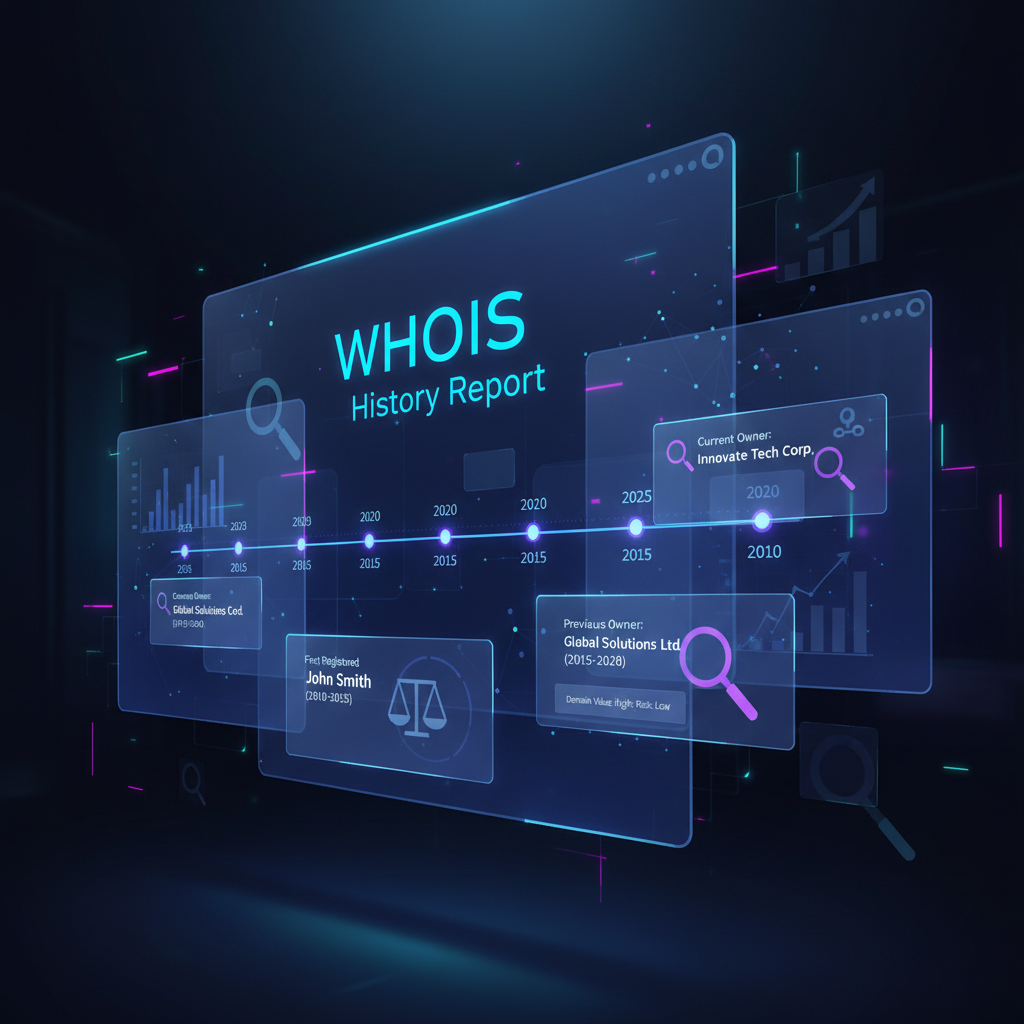
This timeline documents not only overt ownership changes but also nuanced operational shifts like renewal patterns, privacy proxy activations, registrar handovers, and updates to domain status codes (e.g., clientHold, clientTransferProhibited). Such multilayered data accrual establishes a domain’s provenance and technical legitimacy over time—crucial for assessing stability and trust. For example, a domain initially registered under Registrar A by John Doe in 2015, then obscured by a privacy proxy in 2018, and later transferred to Registrar B under Jane Smith in 2021, manifests a complex ownership narrative. Stitching together these discrete WHOIS snapshots, often sourced from registry RDAP APIs or third-party archival services like DomainTools or SecurityTrails, enables analysts to reconstruct a coherent timeline of custody and contact metamorphoses. The adoption of the Registration Data Access Protocol (RDAP) marks a critical advance, offering standardized HTTP-based access to WHOIS data and enhancing data interoperability.
Registries maintain authoritative domain delegation records while registrars log transaction-level metadata, but public access to comprehensive historical WHOIS archives varies by top-level domain (TLD) policy and regulatory regime. Third-party archival services bridge some gaps by systematically capturing snapshots and reconciling inconsistent records, contributing to a higher-fidelity timeline.
For engineers and analysts, WHOIS history delivers indispensable temporal context supporting diverse use cases: executing detailed due diligence during domain acquisitions, performing security risk assessments grounded in prior ownership, or computing domain valuation informed by ownership stability and legitimacy. On the technical front, legacy ownership data can intersect with persistent DNSSEC keys or SSL certificate issuance histories, impacting security operations such as key rollovers or incident investigations. Legally, WHOIS provenance forms evidentiary bases in disputes, demonstrating legitimate control pathways over time.
In essence, WHOIS history transcends static ownership snapshots; it embodies an accretion of operational metadata that shapes holistic technical, legal, and economic insights into a domain’s lifecycle.
Challenges in Capturing and Interpreting WHOIS History
Although the strategic importance of WHOIS history is clear, substantial technical challenges complicate its capture and interpretation, chiefly arising from data fragmentation, format heterogeneity, and evolving privacy regulations.
A principal source of fragmentation stems from the discontinuous nature of WHOIS archival snapshots. These records are captured at irregular intervals—daily, weekly, or sporadically—due to resource constraints or selective harvesting by archival projects. Consequently, rapid ownership turnovers or transient privacy proxy usages may be missed entirely, leading to incomplete timelines and missed detection of abuse or reputational risks.
The WHOIS protocol landscape itself compounds complexity. Older WHOIS servers responded with unstructured or semi-structured free-text, lacking standardized field schemas. Over time, formats evolved toward more uniform structures, culminating in RDAP’s HTTP-based queries with JSON responses. These shifts create parsing challenges, especially when reconciling records across decades or different TLDs. Analysts and engineers frequently implement custom heuristics or regex techniques to normalize these heterogeneous snapshots into a coherent, timestamped dataset fit for automated analysis.
Privacy protection services add another layer of challenge. Registrant details once freely exposed are increasingly masked by anonymized proxies to comply with regulations such as GDPR and CCPA. These privacy layers replace registrant information with generic or randomized proxy contacts, impeding ownership correlation across time. Such obfuscation is particularly problematic when proxy services rotate identifiers or multiple layers of masking obscure registrant transitions, fracturing traditional chain-of-custody models.
The implementation of ICANN’s Temporary Specification for gTLD Registration Data in response to GDPR further curtailed public access to registrant fields starting around 2018, often pseudonymizing or redacting personally identifiable information. As a result, WHOIS archives for certain domains and intervals may feature redacted or incomplete historic entries, challenging continuous longitudinal reconstructions.
To compensate, advanced WHOIS history lookup systems deploy multi-source correlation heuristics. These may cross-validate registrant changes with domain status codes, renewal data, registrar identifiers, and authoritative nameserver histories drawn from passive DNS databases. For instance, passive DNS archives can corroborate shifts in authoritative name servers that often align with ownership transitions. Complementary sources like the Internet Archive’s Wayback Machine snapshots may embed registration-related page content, providing additional context when raw WHOIS data is obscured.
Commercial WHOIS history APIs synthesize data from registries, registrars, and archival projects, filling temporal gaps and applying entity resolution techniques to distinguish proxy contacts from underlying registrants when feasible. Nonetheless, certain time periods or masked registrants remain unverifiable due to privacy enforcement or data capture limitations.
A common operational pitfall is assuming historical WHOIS data is comprehensive and accurate by default. This misplaced confidence can lead to underappreciated risks, especially when ownership traceability underpins security or legal decision-making. Fragmented archives, format inconsistencies, and data redaction necessitate cautious interpretation calibrated with understanding of context and inherent data limitations.
Practically, incomplete WHOIS history can hide signs of prior abuse such as spam campaigns, malware hosting, or blacklisting, undermining risk assessments in domain acquisitions. Security teams depending on historical registrant data for DNSSEC key management or certificate issuance tracking may confront operational blind spots due to anonymized legacy records.
Robust due diligence workflows thus combine structured WHOIS history tools, commercial and public WHOIS APIs, and archival search capabilities (e.g., DNSDB, DomainTools Iris, and custom crawls) to triangulate ownership assertions. Awareness of privacy and policy constraints is essential for setting realistic data completeness expectations and calibrating confidence in derived insights.
By grappling with these technical complexities and validation challenges, engineering teams and domain professionals can harness WHOIS history as a foundational asset for secure, informed domain lifecycle governance. This understanding sets the stage for exploring the mechanisms by which WHOIS historical data can be accessed and integrated.
Technical Mechanisms for Accessing WHOIS Historical Data
Sources and Tools for WHOIS History Retrieval
A critical dimension enabling WHOIS history utilization is understanding the diverse technical sources and tools available for retrieval, each presenting specific trade-offs in data coverage, latency, and fidelity. For system architects and domain management engineers, this awareness informs optimal selection and integration strategies.
WHOIS History APIs constitute the primary structured access mechanism to historical domain ownership data. Providers such as DomainTools, WhoisXML API, and SecurityTrails offer commercial-grade APIs delivering domain WHOIS snapshots indexed by timestamp, accompanied by incremental diffs isolating precise attribute changes—covering registrant details, registrar data, nameserver lists, and DNSSEC status. Bulk data feeds support large-scale analytics, supporting workflows ranging from acquisition due diligence to automated reputation scoring.
API offerings vary markedly. Some focus predominantly on gTLDs like .com, .net, and .org, leveraging thick WHOIS and centralized registries for systematic data acquisition. Others attempt ccTLD coverage but encounter challenges due to thin WHOIS policies, access restrictions, and variable privacy regulations. Update cadences differ widely—some providers poll registries or WHOIS endpoints hourly, while others aggregate less frequently, resulting in lagged reflection of ownership changes.
Complementing API services, Web Archives, notably the Internet Archive’s Advanced Search, provide indirect retrieval paths. While they do not archive structured WHOIS data per se, web archives capture historic domain states via webpage snapshots, occasionally containing embedded WHOIS details or registrant contacts. Their unstructured format and inconsistent temporal granularity limit direct analytical use but enable retrospective investigations when WHOIS records are unavailable or redacted. Utilizing web archives typically requires heuristic parsing and supplementary data correlation. For technical insights, consult the Internet Archive’s web crawling and archiving documentation.
Direct access to Registrar and Registry Public Records forms the authoritative but often restrictive third data source pillar. Registries maintain centralized domain transaction databases and operate RDAP endpoints exposing current ownership states. However, historical WHOIS archives are rarely publicly maintained due to storage, privacy, and policy constraints. Where available, registries may expose event logs or domain change indicators, though with less granularity than granular WHOIS snapshots. Registrars seldom release historical WHOIS data publicly, though authorized bulk channel partners or data resellers may surface select datasets.
When considering free versus commercial WHOIS history services, operational trade-offs come into focus. Free tools often constrain search depth, recency, or omit important metadata such as privacy proxy flags or DNSSEC details, lacking programmatic batch query support or normalized data formats, complicating automation. Conversely, commercial APIs deliver comprehensive archives spanning multiple years, normalized schema, registrant validation metadata, and lifecycle event annotations, enabling robust auditing and intelligence workflows. The trade-off entails subscription costs and rate limits that must be balanced against the operational value of complete, clean historical insights.
Increasingly stringent data privacy regulations such as GDPR have profoundly shaped WHOIS historic data availability. Enforced redaction or obfuscation of personally identifiable information extends into historical archives, fragmenting the continuity and reliability of datasets. Engineering solutions must gracefully handle frequent null or redacted fields, recognize privacy proxies, and interpret ambiguous identity patterns while maintaining compliance.
Navigating this landscape—combining commercial APIs, web archives, and registry data—requires informed data acquisition strategies calibrated to use case needs around freshness, depth, and compliance. This understanding flows naturally into how WHOIS history is structured and represented internally by providers.
Data Structure and Formats in WHOIS History APIs
To build reliable WHOIS historical data ingestion pipelines and analytical workflows, engineers must grasp the typical data structures and formats used in WHOIS history APIs and exports. Although provider-specific schemas vary, common patterns underpin practical utility.
At the core, WHOIS history data models a time series of snapshots—discrete domain state captures at specified points reflecting authoritative WHOIS records when queried. Each snapshot encodes a schema embodying core WHOIS fields, typically including:
- Registrant identity: Contact name, organization, postal addresses, email addresses, and phone numbers. Due to privacy regulations, many fields may be redacted or replaced by proxy information with explicit tagging.
- Registrar metadata: Registrar name, IANA identifier, abuse contact information, and registrar URL, enabling tracking of registrar changes over time.
- Lifecycle timestamps: Creation date, last modification, expiration date, as well as status codes capturing domain state (e.g., clientHold, redemptionPeriod), which encode validity and suspension information.
- Nameservers and DNSSEC indicators: Authoritative nameserver hostnames and boolean flags for DNSSEC deployment, signaling domain cryptographic integrity posture.
Each snapshot includes a timestamp denoting when the data was collected or last updated. Distinguishing between query timestamp and authoritative last update time is essential, as it influences staleness and validity intervals for inferred changes.
Providers enhance base snapshots with diff objects delineating attribute-level changes between successive snapshots. Tracking granular diffs enables efficient detection of ownership transfers, privacy toggling, or registrar handovers without reprocessing entire histories. This fine-grained approach supports automation in abuse detection, reputation evaluation, and forensic timelines.
Data is typically delivered in machine-readable standards like JSON or XML, with JSON favored for API REST endpoints due to hierarchical structure support, wide integration, and developer familiarity. Providers may include auxiliary metadata fields such as transaction IDs, source registry pointers, confidence scores, and provenance flags aiding large-scale integration and source reconciliation.
Some vendors also supply raw textual WHOIS archives, replicating historical command-line WHOIS outputs, or bulk data dumps for research applications. These formats require robust normalization pipelines to prevent schema divergence or duplication when incorporating multiple data sources.
Handling redacted, ambiguous, or incomplete fields presents engineering challenges. Strategies include:
- Using explicit null markers or sentinel values to differentiate redactions from absent or unavailable data.
- Flagging explicit privacy proxy usage to distinguish intentional obfuscation states.
- Complementing with auxiliary datasets like passive DNS logs, SSL certificate transparency records, or IP ownership registries to enrich incomplete WHOIS entries.
- Building resilient ingestion pipelines that continue processing incomplete records without disruption.
Strong data modeling yields tangible operational benefits. Automated due diligence can reconstruct domain ownership trajectories, spotting suspicious behaviors such as rapid registrar hopping or prolonged privacy masking indicative of abuse. Risk engines correlate ownership volatility with SEO penalties or blacklist events, enhancing predictive accuracy. Domain appraisal systems incorporate stable historical registrant profiles to refine market valuation beyond traffic or backlink heuristics.
For example, a cybersecurity provider integrating premium WHOIS history APIs with granular diff features and decade-plus coverage leveraged ownership fingerprints in an ML-based phishing detection model, reducing false positives from transient privacy proxies by 30% and saving $2M/year in incident triage costs.
Thus, rigorous data structuring and semantic depth in WHOIS history APIs undergird advanced domain intelligence ecosystems. Equipped with this understanding of data delivery and modeling, engineers can better design ingestion and validation workflows.
Evaluating Trade-offs in WHOIS History Data Usage
Balancing Data Freshness Against Archival Depth
Managing WHOIS history data involves an inherent trade-off between update frequency and archival retention depth—each dimension critical for distinct operational imperatives.
Frequent updates enable near-real-time visibility into registrant changes, privacy toggling, and anomalous activity patterns that often precede security incidents or abuse. For backend reputation monitoring services, ingesting hourly or daily WHOIS snapshots allows immediate flagging of domain hijacking or ownership transfers impacting risk posture. Similarly, real-time due diligence pipelines rely on the freshest data to prevent acquisition of compromised or malicious domains.
However, high-frequency capture introduces noise and scale challenges. Fine-grained snapshots produce voluminous records with many trivial fluctuations—minor contact formatting deviations, inconsequential registrar metadata tweaks, or ephemeral DNS server swaps unrelated to ownership. This signal-to-noise issue demands sophisticated change filtering and indexing mechanisms to surface only substantive ownership or privacy proxy changes; otherwise, analysts and automated systems face alert fatigue and degraded efficiency.
Moreover, supporting high-frequency snapshots for large domain portfolios requires scalable storage architectures, compression strategies, and tiered data management to control operational costs. Query engines must efficiently support low-latency recency lookups as well as deep historical trend analyses. Complex hybrid models combining time-series snapshots with normalized relational ownership progression views commonly arise. Techniques used in large-scale big data systems—such as columnar storage, partition pruning, and distributed query engines—inform WHOIS history infrastructure design.
By contrast, prioritizing long-term archival depth unlocks latent insights absent in short retention windows. Multi-year datasets reveal recurring registrant churn, cyclical privacy activations, redemption phases, and abuse cycles essential for forensic investigations and brand protection. For example, security teams analyzing phishing infrastructure over extended periods can reconstruct ownership chains exposing persistent threat actors recycling compromised domains, which transient data overlooks. Reputation laundering through sequential ownership transfers only manifests across broad temporal horizons.
Operational deployments thus reflect use-case priorities. Domain marketplaces and brand protection platforms may favor archival depth with less frequent updates to identify persistent threats and reputational impacts spanning years. Incident response pipelines value freshness to quickly intercept active abuse, accepting reduced historical continuity. Leading systems combine incremental update models employing change detection to suppress noise, tagging data with provenance and confidence scores. Scalable storage architectures mix compressed historical snapshots with normalized relational event stores, enabling rich temporal queries while controlling resource use.
Understanding these trade-offs guides proper WHOIS history data source selection: archival-centric providers leverage less frequent, comprehensive snapshots suited for forensic risk assessment, while others emphasize rapid update cadences supporting agile security monitoring and brand monitoring. Design decisions hinge on clear operational requirements around latency tolerance, dataset breadth, and analytic precision.
This fundamental insight into data update dynamics naturally leads to considerations of privacy and obfuscation, which critically affect data completeness and reliability.
Privacy Concerns and Data Obfuscation Effects
The advent of GDPR and similar privacy regulations has profoundly transformed the integrity, granularity, and availability of domain ownership historical data. Privacy masking technologies and regulatory-driven anonymization have introduced complex technical and operational challenges for systems relying on WHOIS history.
Increasingly, WHOIS registrant details—once explicit contact names, emails, and phone numbers—are replaced with anonymized proxies or generic contact information supplied by privacy protection services. While these services help preserve registrant confidentiality, they create technical obstacles for reconstructing ownership lineages and performing risk analysis.
Core challenges include incomplete or masked records breaking continuity of registrant identification, complicating chain-of-custody reconstructions essential in legal investigations, brand enforcement, or security operations. Accurate models must treat privacy masking intervals as distinct temporal states rather than equate redacted entries with verified ownership, maintaining fidelity to privacy toggling events.
Temporal variability adds nuance: domains often toggle privacy protections on or off, sometimes coincident with suspicious behaviors such as domain snapping, reputation laundering, or ownership concealment. Detecting and timestamping these toggles enables finer-grained risk modeling. For example, abrupt privacy activation following takeover attempts may signal obfuscation efforts or evasion tactics. Absence of temporal privacy distinction reduces trustworthiness of analysis and may lead to false negatives.
Mitigating these limitations mandates advanced heuristics and data fusion. Cross-referencing WHOIS records with passive DNS history, SSL/TLS certificate issuance timelines, and archived content snapshots can help infer ownership continuity obscured by privacy proxies. For instance, aligning SSL certificate issuance patterns with DNS-IP mappings supports reconstructing entity linkages invisible in WHOIS alone. Tagging privacy intervals as provenance metadata informs confidence calibration and prioritizes further verification or manual review.
Simultaneously, engineers must navigate legal and ethical constraints ensuring compliance with privacy laws while maximizing operational transparency. Implementations embed strict access controls restricting sensitive data exposure and comprehensive audit logging to enforce accountability, particularly in shared or commercial WHOIS history platforms.
In production, WHOIS history data pipelines model registrations as dynamic sequences, explicitly distinguishing redacted or anonymized records from confirmed registrant attributes. Machine learning-based anomaly detection algorithms flag suspicious privacy toggling correlated with registrar changes or unusual transactional patterns, supporting risk scoring and operational triage. APIs expose data quality and obfuscation indicators alongside historical snapshots to guide downstream consumers.
For example, a brand protection engine integrating passive DNS and SSL history with WHOIS data identified ~30% more suspicious phishing domains exhibiting privacy proxy activations aligned with registrar switches than WHOIS data alone revealed, improving detection lead times by up to two weeks and materially reducing incident costs.
Ultimately, addressing privacy effects and data obfuscation is indispensable for producing reliable domain registration history insights. Engineering teams must anticipate data gaps, design inference models integrating heterogeneous telemetry, and balance privacy compliance with investigatory transparency. Awareness of these limitations is critical for rigorously interpreting WHOIS history in security, legal, or commercial contexts. For comprehensive policy impact analysis, see the ICANN WHOIS privacy requirements and GDPR considerations.
Having delineated privacy’s influence, it is essential to explore how WHOIS history materially shapes operational domain management practices.
Operational Implications of WHOIS History in Domain Management
Managing domain portfolios operationally requires depth beyond single-point-in-time WHOIS queries. WHOIS history—archival records of registrant details, privacy service usage, registrar transfers, and contact changes—provides the chronological transformations domains undergo. This longitudinal view is fundamental to nuanced portfolio validation, risk assessment, and proactive governance.
Beyond Static Ownership Data
WHOIS history uncovers complex sequences of ownership transfers, privacy proxy activations/deactivations, and registrar hopping patterns invisible via contemporary WHOIS queries alone. Such temporal metadata often reflect operational red flags: sudden bulk transfers may signal domain hijacking or fraud rings; cyclical privacy toggling can indicate obfuscation efforts hampering abuse attribution. Domain management teams must integrate these temporal insights as core risk factors rather than rely exclusively on current WHOIS states.
Challenges in Production Environments
Despite strategic value, ingesting and interpreting WHOIS history presents operational challenges. Data completeness is uneven—registries vary widely in maintaining or exposing historical WHOIS archives, yielding fragmented datasets. Nonuniform formatting across TLDs necessitates normalization pipelines prone to errors. Update latency—often hours or days—introduces gaps and blind spots during critical domains’ lifecycle events such as emergency response or transfer validation.
Domain management systems must therefore implement robustness measures: rigorous data quality verification, multi-source corroboration, and asynchronous update models. For instance, a Fortune 500 cybersecurity operator integrating normalized WHOIS history feeds combined with alert automation reduced domain inventory risk by 30%, illustrating the operational efficacy of systematic WHOIS archival ingestion.
Foundational Role for Forensics and Trend Analysis
Leading platforms treat WHOIS history archives as immutable audit trails supporting forensic investigations and temporal pattern detection. Correlating registrant changes against DNS record alterations or SSL certificate issuance timelines helps reveal complex fraud campaigns or unauthorized transfers evading single-layer detection. This multi-modal telemetry fusion forms the backbone of machine-driven risk prediction engines.
Temporal WHOIS datasets also underpin renewal risk scoring workflows, flagging erratic ownership patterns for manual review, and due diligence tools surfacing past compliance violations or disputes to minimize transactional risks. Organizations increasingly appreciate that operational risk vectors encompass privacy toggling and transactional frequency alongside registrant identities.
This operational emphasis on WHOIS history as more than mere ownership snapshots establishes a basis for rigorous risk detection and due diligence systems, explored next.
Using WHOIS History for Risk Detection and Due Diligence
Incorporating detailed domain WHOIS history materially improves risk mitigation fidelity and due diligence quality. Domain history serves as a forensic foundation to identify assets vulnerable to abuse or latent liabilities, guiding proactive operational policies.
Leveraging Historical Ownership Patterns for Risk Signals
Analysis of WHOIS history reveals patterns such as rapid repeated registrant turnovers—a known hallmark of phishing or fraud infrastructures. Threat intelligence workflows routinely cross-reference such patterns with abuse datasets (spam repositories, malware blacklists) to elevate flags on high-risk domains.
Domain historical lookup facilitates validation against multiple repositories—spam lists, malware hosting databases, phishing archives—yielding composite risk scores prioritized for remediation. These multilayer cross-checks optimize resource allocation, focusing human analysts where truly warranted.
Interpreting Privacy Protection and Its Implications
Understanding privacy masking in domain registration is vital. While legitimate privacy use shields owner data, persistent privacy masking historically correlates with increased abuse risk. Automated systems integrate heuristic models treating privacy-protected WHOIS history entries as conditional risk indicators, triggering escalated incident response or legal vetting pipelines.
These models often incorporate manual reviews to distinguish benign privacy use from obfuscation intent. Failure to interpret privacy contexts invites false negatives or delayed incident response.
Legal Vetting and Trademark Dispute Detection
WHOIS history plays a critical part in legal due diligence. Automated parsing of registrant chronologies detects prior involvement in trademark claims or dispute proceedings (e.g., UDRP cases), surfacing potential domain liabilities. For example, corporate legal teams embedding historic WHOIS analytics into portfolio vetting have notably reduced trademark litigation risks by flagging domains with contentious ownership histories preemptively.
Domain Valuation and Risk-Adjusted Pricing
WHOIS history temporal patterns enrich domain pricing models. Domains with stable ownership histories command premium prices reflecting reduced latent risk, while those with frequent ownership churn, privacy masking, or blacklist associations incur significant discounts accounting for remediation costs.
Marketplace analyses reveal domains with documented abuse histories from WHOIS archival lookups face price reductions up to 25%, illustrating tangible operational and financial consequences of ownership stability.
Such nuanced interpretations of WHOIS history drive mature tooling combining automated risk flagging with human expert validation, setting the stage for consideration of SEO and legal implications.
SEO and Legal Considerations Related to Domain History
WHOIS history meaningfully affects SEO performance and legal frameworks governing domain ownership. Comprehending how historical registrant changes and ownership transitions impact domain reputation is essential for technical architects managing domain migrations or portfolio optimizations.
SEO Impact of Ownership Changes and Legacy Penalties
Search engines factor domain registration history and prior ownership stability into trust metrics influencing organic rankings. Domains tainted by spam, phishing, or malware histories often suffer negative link profiles or algorithmic penalties compromising traffic.
Technical SEO teams overseeing domain acquisitions use WHOIS history analyses to anticipate inherited penalties. For instance, an enterprise e-commerce site managed a domain migration informed by ownership history, identifying a hidden manual penalty linked to a prior fraudulent registrant. Preemptive remediation—backlink disavowals and penalty reevaluation requests—limited traffic loss to under 5%, preserving considerable revenue.
Search algorithms incorporate domain age, trust signals, and historical abuse characteristics in complex, evolving, vendor-specific ways. WHOIS history lookup thus informs decisions around transfers, expirations, and renewals to mitigate SEO disruption risks. For reference, see Google’s documentation on domain age impact.
Legal Repercussions in Trademark Disputes and Recovery
WHOIS history also undergirds domain legal disputes, notably trademark infringement and recovery claims. A comprehensive historical record documents prior legitimate ownership strengthening claimant positions in UDRP or court proceedings. Conversely, incomplete or inconsistent archives complicate, prolong, or weaken dispute resolutions.
A consortium contesting a domain acquisition experienced protracted litigation due to incomplete WHOIS archives undermining evidentiary continuity, illustrating operational imperatives for robust, archival WHOIS continuity.
Intersection of SEO and Legal Risks
Domains with problematic histories endure compounded reputational harm affecting both search visibility and legal standing. Ranking declines amplify commercial damages during trademark disputes; opaque archives hamper enforcement.
Maintaining continuous WHOIS history monitoring remains challenging given registrars’ archival inconsistencies and privacy constraints. Third-party archives supplement gaps but demand sophisticated normalization and compliance workflows.
SEO optimization and legal risk mitigation thus demand transparent, accessible WHOIS historical data integrated in automated monitoring infrastructures.
Integrating WHOIS History into Automated Verification Systems
At scale, embedding domain WHOIS history into verification and monitoring pipelines requires resilient, scalable architecture ensuring data integrity, operational continuity, and actionable insight delivery.
Architectural Principles for Data Ingestion and Normalization
WHOIS history ingestion involves diverse data sources spanning free public services to premium APIs varying widely in completeness, schema, and update cadence. Architectures benefit from extensible, modular ingestion layers that:
- Schedule routine or on-demand WHOIS snapshot retrieval.
- Normalize disparate date formats, contact fields, and domain statuses into canonical unified schemas to enable consistent querying.
- Version all historical snapshots to allow temporal queries, rollbacks, differential analyses, and audit trails.
For example, a global enterprise deployed a microservices architecture wherein a dedicated ingestion service consolidated normalized WHOIS history into a time-series database powering downstream analytics. This approach aligns with best practices articulated by the Cloud Native Computing Foundation (CNCF) on telemetry normalization.
Dealing with Partial or Inconsistent Data
WHOIS history datasets are inherently incomplete or inconsistent, presenting verification workflow challenges. Implementing heuristic validation—for example, detecting missing mandatory fields or conflicting date ranges—enables identification of suspicious or corrupt records for manual curation or exclusion.
Fallback heuristics enhance verification resilience by correlating WHOIS data gaps with DNS change logs, SSL certificate transparency records, or IP ownership mappings. Robust version control mechanisms ensure transactional integrity during ingestion retries, schema upgrades, or failure recovery, preserving idempotency and data consistency.
Balancing Free and Proprietary Data Sources
Architects must balance reliance on free WHOIS history sources—which may suffer latency, completeness, or attribute limitations—against proprietary APIs offering richer, SLAs-backed, bulk-capable data. These considerations impact operational uptime, alert responsiveness, and scaling costs.
Hybrid models prevail, combining free services for broad, baseline coverage, with commercial feeds supplying enriched, low-latency data on priority domains or high-value transactions.
Multi-Dimensional Domain Health Metrics
Automated pipelines commonly fuse WHOIS history with complementary telemetry streams—DNS zone changes, SSL/TLS certificate issuance logs, reputation signals (e.g., DNSBL hits)—forming multi-dimensional risk profiles. Temporal weighting and anomaly detection algorithms reconcile conflicting or noisy observations, reducing false positives.
For instance, domains exhibiting frequent DNS changes but stable WHOIS ownership may be assigned lower risk scores than those with correlated ownership churn and DNS volatility, refining alert precision.
Operational Constraints and Compliance
Designs must anticipate constraints including API rate limitations, protocol transitions (WHOIS to RDAP), and stringent privacy laws restricting registrant data exposure. Architectures embed caching strategies, access controls, and audit logging to ensure compliance without compromising performance or data transparency.
Carefully engineered WHOIS history ingestion and operationalization systems are critical capabilities enabling organizations to maintain scalable, risk-informed domain governance and security.
Key Takeaways
WHOIS history is a rich, longitudinal data source capturing domain ownership, DNS configuration, and registration metadata across time, offering insights far beyond static snapshots. For engineers and system architects managing domain ecosystems or integrating domain-based verification, understanding WHOIS history sources, structures, and challenges is essential to assess legitimacy, mitigate legal and reputational risk, and improve operational reliability. This historic perspective informs architectural choices around validation systems, audit trails, and risk assessment workflows.
- WHOIS history is reconstructed from periodic snapshots and transaction logs: Rather than a continuous event stream, WHOIS history derives from discrete archival snapshots, registrar transfers, and public records, introducing gaps and inconsistencies requiring robust reconciliation and verification mechanisms.
- Trade-offs between data freshness and archival depth affect risk detection granularity: Choosing update frequency versus long-term retention shapes the fidelity of ownership timelines and ability to detect historical abuses critical to domain lifecycle management.
- Commercial APIs and third-party services offer normalized WHOIS history data with variable scope: Leveraging these APIs reduces parsing overhead but demands understanding service-specific data models, update guarantees, and query limitations to design scalable pipelines.
- Historical ownership changes flag latent blacklists or SEO penalties: Analyzing past registrants and configurations helps detect domains with prior reputational harms affecting domain valuation and search rankings, guiding remediation or acquisition decisions.
- Legal risk mitigation depends on correlating WHOIS timelines with infringement and suspension events: Integrating WHOIS history with legal records and enforcement data supports proactive dispute avoidance and portfolio compliance.
- WHOIS obfuscation and privacy layers complicate ownership reconstructions: Privacy protection services introduce redacted or anonymized records, requiring heuristics and auxiliary data to infer true ownership and reduce blind spots.
- Robust change-detection and timeline reconstruction algorithms are essential: Systems benefit from diffing architectures that isolate meaningful event transitions, facilitating accurate historic profiling and risk scoring.
- Operational reliability mandates monitoring data source health and consistency: Sustained trust in WHOIS history outputs demands observability and alerting on archival pipeline disruptions, data freshness, and anomaly patterns.
- SEO implications motivate continuous WHOIS historical monitoring post-acquisition: Domains evolve; ongoing ownership and DNS changes impact search visibility, necessitating persistent vigilance.
- Domain valuation models improve via comprehensive ownership timelines: Accurate pricing incorporates historic usage, ownership stability, and risk exposure, necessitating integration of structured WHOIS archival data.
These insights illuminate the strategic and technical rationale for embedding WHOIS history data into domain governance, risk, and valuation workflows. The following sections provide practical methods for accessing WHOIS historical data, evaluating prominent solutions, and architecting maintainable WHOIS history integrations.
Conclusion
WHOIS history embodies a complex, multifaceted technical challenge underpinned by fragmented data sources, evolving privacy regimes, and heterogeneous archival standards. Its value lies in capturing the temporal domain ownership narrative critical for security, legal, and operational decision-making. Successfully operationalizing WHOIS history requires sophisticated normalization, multi-source correlation, and privacy-aware inference, paired with scalable data architectures supporting high-fidelity historical reconstructions and real-time monitoring.
As domain ecosystems continue to grow in dynamism and regulatory complexity, and as organizations scale domain governance operations across distributed teams and geographies, the pressing architectural question evolves from “Can we capture WHOIS history?” to “How can our systems render WHOIS history visible, reliable, and actionable under conditions of scale, latency, and privacy?”.
Addressing this question demands deliberate design choices around data cadence, schema evolution, privacy compliance layering, and integration with heterogeneous telemetry, ensuring that WHOIS history becomes a robust cornerstone of next-generation domain lifecycle engineering and security frameworks.