Introduction
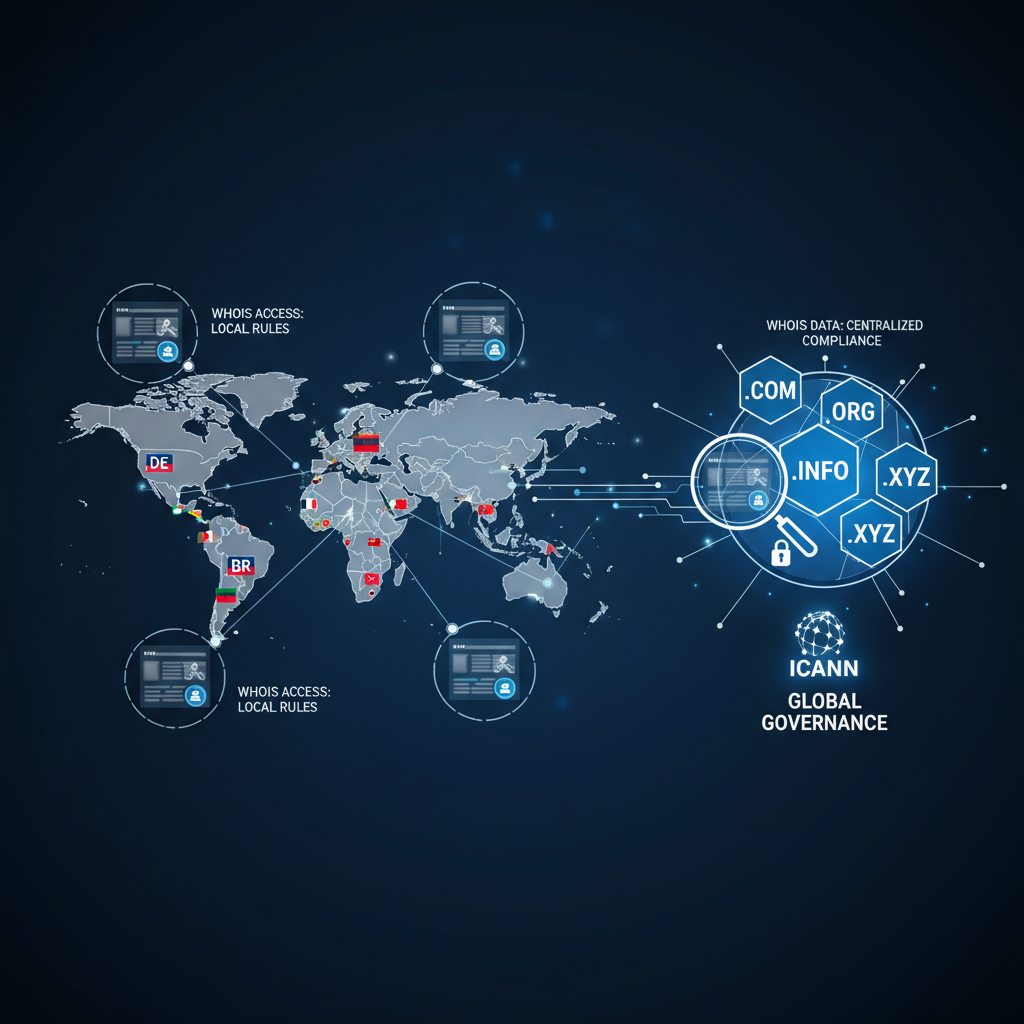
WHOIS data access and privacy controls exhibit significant variation across the domain landscape. While ICANN enforces a standardized WHOIS framework for generic top-level domains (gTLDs), country code top-level domains (ccTLDs) operate under a fragmented set of local regulations and registry policies that profoundly affect data visibility, accuracy, and update dynamics. For engineers developing domain management systems, compliance tooling, or security automation, these differences manifest as concrete challenges in data normalization, API integration, and jurisdiction-aware privacy handling.
This article explores how ccTLD WHOIS rules diverge from their ICANN-governed gTLD counterparts, emphasizing the operational impact of decentralized governance on WHOIS query results, privacy implementations, and transfer workflows. Understanding these distinctions is critical for designing resilient WHOIS clients, enforcing correct compliance logic, and handling the complexities inherent in multi-TLD domain portfolios within production environments. We will dissect how local laws and autonomous registry policies shape WHOIS realities beyond the globally uniform ICANN model.
Fundamentals of WHOIS Policies for ccTLDs and ICANN gTLDs
The Domain Name System (DNS) underpins internet navigation, and WHOIS—the protocol furnishing domain ownership and registration metadata—plays a vital role in transparency, security, and operational workflows. For engineers architecting domain tooling or automation pipelines, grasping the divergence between ccTLD and ICANN-gTLD WHOIS policies is indispensable. These differences impose significant technical and operational constraints, particularly when consistency, privacy compliance, and cross-registry interoperability are prerequisites.
WHOIS policies influence how systems conduct ownership validation, abuse monitoring, transfer management, and audit logging. Given that WHOIS data serves as a foundational source of truth for registrant identity and domain lifecycle state, engineering around its variability requires a granular understanding of policy-driven constraints and how they translate into API availability, data formats, and access mechanisms.
Overview of ICANN gTLD WHOIS Framework
ICANN’s governance of gTLD WHOIS policies epitomizes centralized oversight designed to ensure global uniformity and interoperable domain data exposure. This centralized framework mandates a robust, standardized WHOIS data model encompassing registrant, administrative, and technical contact details, authoritative name servers, domain status codes, and registration timestamps. The structured, consistent format enables automated WHOIS parsers, compliance validation systems, and security tooling to rely on predictable data schemas.
Operationally, ICANN enforces stringent requirements on data currency and accuracy, obligating registries to reflect registrar-submitted changes within hours. These timeliness guarantees enhance the reliability of incident investigations, domain dispute resolutions, and regulatory audits. Moreover, evolving privacy laws like GDPR have propelled ICANN to augment WHOIS access controls, leading to the adoption of the Registration Data Access Protocol (RDAP). RDAP supersedes the legacy WHOIS protocol by enabling authenticated, secure, and tiered query access with granular permissions, benefiting engineers through richer and more reliable data sources. The ICANN RDAP implementation guidance provides comprehensive technical details on these advancements.
From an engineering perspective, this uniformity simplifies implementation of domain transfer workflows—whether shifting domains between registrars like GoDaddy, Cloudflare, or AWS Route 53—or managing domain verification processes in registration platforms. Standardized WHOIS fields and predictable status flags such as “clientTransferProhibited” underpin automated pipelines that coordinate domain state, authorization, and DNS provisioning across distributed systems.
In aggregate, ICANN’s gTLD WHOIS policies deliver a dependable, interoperable foundation indispensable for large-scale tooling in portfolio management, security monitoring, and registrar integrations. This predictability reduces engineering complexity and operational risk in multi-gTLD environments.
Variability and Local Control in ccTLD WHOIS Policies
By contrast, ccTLD WHOIS policies are fundamentally decentralized, governed by national or regional authorities reflecting localized legal frameworks and operational priorities. This decentralized governance produces a broad spectrum of WHOIS rules with disparate data accessibility, privacy protections, and update rigor. For engineers, this means adapting domain management and automation systems on a per-jurisdiction basis.
Unlike ICANN-gTLDs, ccTLD registries operate under countries’ specific privacy laws and registry-specific transparency policies. European ccTLDs such as .fr and .de comply rigorously with GDPR, often anonymizing or redacting registrant data by default in WHOIS responses. Conversely, ccTLDs in jurisdictions with less stringent privacy regimes may openly publish full registrant details. This creates a patchwork landscape where data visibility and completeness fluctuate drastically.
Registry governance models also vary widely. Some ccTLDs are run by governmental agencies imposing strict eligibility and validation checks, while others are managed by commercial or nonprofit bodies enforcing looser requirements. Variations exist in periodic validation policies, ranging from mandatory registration data reconfirmation at renewal to minimal verification with no enforcement. These differences impact WHOIS data accuracy, freshness, and trustworthiness, complicating automation and cross-border security workflows.
To illustrate, the .io ccTLD applies specific privacy and data retention policies that restrict WHOIS data exposure more than typical gTLD registries, enforcing unique access controls diverging from the ICANN framework. Engineering automated WHOIS crawlers or validation tools that target multi-ccTLD portfolios must handle such discrepancies, often requiring custom parsers and adaptive authentication schemes aligned with each registry’s protocols.
On privacy, registrants must carefully evaluate ccTLD policies before assuming the availability of privacy shields or proxy services commonplace in gTLDs. Several ccTLDs prohibit privacy protection or mandate explicit registrant disclosure, driven by legal or national-security considerations. This necessitates embedding nuanced legal and technical validations into registration and management platforms.
Operationally, domain management systems handling ccTLDs—such as Hostinger’s multi-ccTLD offerings or transfer features in Cloudflare—must accommodate heterogeneous WHOIS access modes. Unlike centralized ICANN gTLD APIs, ccTLD WHOIS may be accessible via varied interfaces including legacy port 43 WHOIS servers, web portals, RDAP variants, or manual systems. Robust service implementations require adaptable registry-specific adapters and fallback strategies to ensure reliability across jurisdictions.
Implementing domain-specific features like Cloudflare’s domain redirect under ccTLD zones demands careful WHOIS data mapping considerations. Failure to align with registry-specific visibility and update constraints risks operational delays, DNS misconfigurations, or regulatory non-compliance. The CIRA study on ccTLD WHOIS data variability offers deeper technical insight into these operational challenges.
In sum, ccTLD WHOIS policies prioritize sovereign control, legal compliance, and local policy enforcement, embedding complexity that engineers must address through context-aware design, error handling, and compliance layering. Integrations with global domain infrastructures thus require deliberate accommodation of ccTLD idiosyncrasies, a sharp contrast to the relative predictability of ICANN’s gTLD framework.
This distinction leads naturally into a detailed comparison of the key operational and policy differences impacting WHOIS data handling.
Key Differences in ccTLD WHOIS Rules Versus ICANN gTLDs
The operational and regulatory frameworks governing WHOIS data management differ markedly between ccTLDs and generic ICANN gTLDs. ICANN enforces global, harmonized policies via contractual mechanisms for registries and registrars, producing predictable data formats, privacy rules, and transfer procedures. In contrast, ccTLDs derive policies from sovereign authorities who may or may not align with ICANN standards, resulting in profound heterogeneity.
ICANN gTLD WHOIS data disclosure protocols stem from community consensus, establishing uniform requirements on registrant data publication, accuracy enforcement, privacy safeguards, and transfer authorization. These are codified in agreements that apply consistently across all accredited entities, fostering standardized operational workflows. For example, ICANN mandates baseline WHOIS publication requirements, complemented by protocols like RDAP to support secure, tiered data access. The ICANN RDAP Implementation Guidelines provide detailed compliance standards.
Conversely, ccTLD registries independently craft WHOIS policies reflecting national statutes and internal priorities. This sovereignty leads to heterogeneity in everything from mandatory data elements, permissible data sharing, privacy enforcement, to technical query interfaces. Some ccTLDs derive governance from telecommunications regulation or data protection laws, while others follow registry-specific administrative rules, administered by government or private operators alike.
From an engineering vantage, this divergence complicates reliability, automation, and tooling. ICANN contracts standardize WHOIS protocols and transfer policies, enabling software systems to perform domain lookups, compliance validations, and abuse mitigation on a stable foundation. In contrast, ccTLD registries expose diverse query mechanisms, from classic WHOIS queries and RDAP variants to proprietary APIs or manual lookups, with differing data availability rules. This necessitates bespoke integrations and enduring adaptation to registry-specific behaviors.
At the system architecture level, managing a mix of gTLDs and ccTLDs requires handling asynchronous updates, non-uniform data models, and specialized error scenarios. Lack of standardization in ccTLD WHOIS complicates the synthesis of consistent domain views, impeding automated contact aggregation, status reconciliation, and enforcement logic. These distinctions must be thoroughly understood before delving into deeper operational facets of WHOIS data access, privacy, and transfer workflows.
WHOIS Data Access Control and Privacy Variations
Diverse Regulatory Environments and Access Paradigms
While ICANN gTLD WHOIS data access is governed by consistent, contractually mandated policies, ccTLD WHOIS data access is highly variable, shaped by the specific regulatory landscape of each administering jurisdiction. This results in a complex and fragmented WHOIS data visibility ecosystem.
ICANN requires baseline WHOIS data to remain publicly accessible, though this has been modulated by GDPR considerations through temporary specifications, RDAP adoption, and community policy processes. The overarching goal balances transparency for cybersecurity, intellectual property enforcement, and transfer validation with user privacy protection.
However, in ccTLD contexts, privacy laws such as the EU’s GDPR apply unevenly, and national regulators may interpret or enforce data protection statutes differently. For example, .de (Germany) and .nl (Netherlands) enforce rigorous GDPR-aligned redaction of personal data in WHOIS output, whereas other ccTLDs—often outside stringent regulatory regimes—may publish largely unredacted registrant details.
- Some ccTLDs openly publish full registrant contact information, supporting broad compliance but raising privacy risks.
- Others limit public WHOIS responses to minimal domain status details or channel requestors to registry or registrar processes, often requiring strong vetting.
- Some registries implement tiered or authenticated data access, restricting sensitive data to vetted parties or legitimate use cases.
Consequently, WHOIS consumer applications must incorporate registry-specific logic to adapt to varying visibility and authentication regimes. Understanding these differences is critical, as summarized by the RIPE NCC’s overview of WHOIS and RDAP access.
Consequences for Engineering Systems and Compliance Workflows
The inconsistent WHOIS access policies among ccTLDs create several engineering challenges in building reliable domain lookup, data aggregation, and abuse detection systems:
- Custom Query Implementations: Varying WHOIS clients, RDAP endpoint semantics, and web-based interfaces produce heterogeneous response formats complicating parsing and normalization.
- Dynamic Privacy Redaction: Privacy policies evolve and differ across jurisdictions, requiring adaptive parsing logic and alert thresholds to avoid misinterpretation or compliance errors.
- Limited Automation: Access restrictions and manual vetting routinely introduce human-in-the-loop dependencies, reducing automation in abuse monitoring or incident response pipelines.
- Inconsistent Data Completeness: Partial or masked registrant information diminishes confidence in ownership verification and affects the precision of security investigations.
Moreover, many ccTLDs now support optional proxy or privacy services either natively or via registrars, such as .ca and .uk, allowing registrants to opt for anonymization in WHOIS. These services complicate data accuracy, as proxy contacts obfuscate true ownership, introducing challenges for abuse attribution and transfer authorization.
By comparison, ICANN gTLD registrars provide WHOIS privacy services as value-added offerings distinct from registry policies and maintain accountability mechanisms under contract. The mix of registry- and registrar-provided privacy across ccTLDs further fragments data integrity and complicates operational workflows.
To address these realities, domain administrators and system developers must embed registry- and jurisdiction-specific logic, maintain flexible architectures to accommodate privacy variations, and implement rigorous error handling. This heterogeneity increases the operational costs and latency of real-time domain monitoring and compliance enforcement across multi-registry portfolios.
Data Accuracy and Update Mechanisms Across Domains
Contrasting Data Accuracy Enforcement Regimes
ICANN gTLD policies impose rigorous obligations on registrars to ensure registrant data accuracy and rapid update propagation. Registrars validate contact data at registration or transfer and provide timely correction mechanisms. Noncompliance triggers contractual penalties, reinforcing data integrity. Updates propagate via standardized protocols such as Extensible Provisioning Protocol (EPP), with well-defined event semantics and timestamps ensuring registry WHOIS reflects current domain ownership promptly.
In contrast, ccTLD registries demonstrate wide variance in accuracy enforcement:
- Some ccTLDs rely on self-reported data without mandatory validation.
- Verification may be manual, infrequent, or event-triggered without defined SLAs.
- Updates can require offline manual review, introducing delays ranging from hours to weeks.
For example, government-operated ccTLDs or small registries might conduct manual verification of registrant credentials, extending update latency and potentially causing stale or inconsistent WHOIS records.
Operational Implications for System Integrity
This variability leads to reliability challenges in WHOIS data across domain spaces:
- Update Latency: Registrant or ownership changes might not be reflected promptly, impairing incident attribution, audit accuracy, and enforcement timeliness.
- Synchronization Gaps: Disparate update mechanisms complicate synchronization across registries, especially when integrating ccTLD and gTLD WHOIS snapshots.
- Data Completeness and Integrity: Variable validation rigor results in incomplete or inaccurate WHOIS datasets, complicating integration with automated lifecycle management systems.
For instance, Hostinger manages a diverse portfolio spanning gTLDs and ccTLDs that differ in validation timelines. While ICANN gTLDs receive near-instant updates, some ccTLDs require manual data reviews, necessitating bespoke synchronization checkpoints to maintain integrity. This overhead translates into increased engineering complexity and operational brittleness.
Similarly, compliance verification and security automation pipelines must accommodate data staleness and partial records from ccTLD WHOIS responses, often requiring fallback cross-referencing against registrar portals or registry APIs. These challenges highlight the critical impact of update mechanism diversity on domain administration fidelity.
Impact of Transfer Rules on WHOIS Information Management
Divergent Transfer Policies and Protocols
Domain transfers under ICANN gTLDs adhere to uniform policies requiring authorization codes, inter-registrar coordination, and enforcement of status flags to prevent unauthorized moves. Transfers trigger immediate WHOIS record updates reflecting new ownership, facilitating domain lifecycle orchestration within automated systems.
By contrast, ccTLD transfer processes vary considerably, driven by local laws and registry policy rather than ICANN mandates. Notable distinctions include:
- Local Presence Requirements: Some ccTLDs (e.g., .ca, .au) mandate registrant or administrative presence within the country, complicating foreign ownership and transfers.
- Manual Approvals: Transfers often require registry staff approval or manual processing absent automated protocols.
- Absence of Formal Transfers: Certain ccTLDs lack inter-registrar transfer mechanisms altogether; registrant moves require surrender and re-registration, disrupting WHOIS continuity.
- Extended Timelines: Transfers may take days to weeks with no standardized SLAs.
Transfer Effects on WHOIS Data Consistency and Domain Management
From a system engineering perspective, these factors impact WHOIS data and domain control processes profoundly:
- Propagation Delays: Registries and registrars such as Route 53, Cloudflare, GoDaddy, Namecheap, or Hostinger may experience transfer-induced WHOIS data lags, delaying ownership status reflection.
- Residual Ownership Mismatches: Workflows involving Cloudflare domain transfers between accounts can encounter inconsistencies where WHOIS has not caught up with DNS delegation, complicating audit and compliance controls.
- Cross-Registry Complexity: Transferring domains between disparate registries—especially when ccTLDs lack standardized EPP transfers—requires tailored re-registration approaches and manual WHOIS updates.
- Automation Challenges: Orchestration systems must include registry-specific logic for transfer state polling, error handling, and WHOIS data reconciliation post-transfer.
A large enterprise managing a multi-ccTLD portfolio encountered extended delays—up to ten days—in WHOIS record updates post-transfer, causing uncertainty over domain control and raising security concerns about DNS hijacking or redemption lock enforcement. Adaptive polling and manual reconciliation were necessary to ensure inventory correctness.
These realities demand that system architects acquire deep registry-specific knowledge and design flexible workflows that accommodate asynchronous and opaque transfer processing, preserving domain hygiene and compliance assurance.
Challenges and Engineering Considerations for Handling ccTLD WHOIS Variations
Data Normalization and API Integration Difficulties
The heterogeneity of ccTLD WHOIS rules fundamentally challenges the construction of scalable domain management platforms. Unlike ICANN-governed gTLDs adhering to globally standardized protocols (RFC 3912 WHOIS and RDAP RFC 7480 series), ccTLDs present a fractured ecosystem with diverse technical interfaces and data models.
At the query layer, many ccTLDs support WHOIS over legacy port 43 but implement bespoke command syntaxes or restrict query scopes. Others have adopted RESTful RDAP APIs but vary dramatically in endpoint design, schema structure, authentication requirements, and rate limiting—diverging well from the stable gTLD baseline.
Data representation variability compounds this challenge: field names differ (e.g., PersonName vs. RegistrantName), date formats and timezones lack standardization, and status codes are registry-specific or undocumented. Encoding issues—such as mixed UTF-8 and localized legacy character sets—further complicate parsing, often requiring complex normalization logic.
Additionally, pervasive legal and policy-driven masking causes deliberate omission of registrant contacts in some ccTLD WHOIS outputs, rendering partial or structurally incomplete datasets. API access itself may be gated behind authentication layers, throttling, or licensing terms that vary per registry.
Architecting unified data ingestion pipelines therefore demands modular, adaptable adapters per registry that abstract protocol nuances, error conditions, and authentication schemes. Generic parsers fail due to subtle semantic mismatches; engineering teams must build extensive rule sets and validation layers.
Post-ingestion normalization into a canonical internal schema involves trade-offs. Schemas balancing completeness and extensibility risk complexity or bloat, while minimal common denominators compromise advanced compliance or intelligence use-cases. Pragmatic models combine core registrant, status, and timestamp fields with registry-specific extensions preserving fidelity.
Automated update workflows face challenges as ccTLD refresh cadences range from near-real-time RDAP notifications to sporadic manual WHOIS data reloads. Robust caching, retry logic, and error tolerance strategies become indispensable to maintain data freshness and system resilience.
High-quality domain management platforms weave middleware normalization layers encapsulating protocol handling, parsing, and canonicalization into modular service components. Hybrid query architectures leveraging both port 43 WHOIS and RDAP endpoints maximize coverage and robustness. Extensibility through plug-in registry-specific modules enables rapid adaptation as policies and implementations evolve.
These integration challenges underscore the necessity for engineering architectures designed with adaptability and resilience to thrive across fragmented ccTLD WHOIS landscapes. With ingestion complexities addressed, the focus shifts to privacy compliance considerations critical for lawful operation.
Jurisdiction-Aware Privacy Compliance in WHOIS Clients
A fundamental difference between ccTLD and ICANN-gTLD WHOIS management lies in the diverse privacy regimes imposed by sovereign jurisdictions. While ICANN has advanced standardized privacy policies post-GDPR via Temporary Specifications and Standardized Access Requirements, ccTLD operators remain subject to localized data protection frameworks ranging from stringent (EU GDPR) to permissive or undeveloped.
These divergent legal regimes define what personal data—registrant name, address, email, phone—may be publicly disclosed or must be masked. For example, the .eu ccTLD strictly enforces GDPR masking, suppressing personally identifiable information unless explicitly authorized. Conversely, ccTLDs like .fm or .io may permit broad WHOIS visibility.
This variability in ccTLD WHOIS rules includes:
- Mandated automatic redactions of registrant and administrative contact details.
- Complete WHOIS data suppression or service denial to comply with privacy.
- Tiered access controls requiring authentication and justification for bulk or detailed queries.
- Lack of standardized WHOIS flags to indicate active redaction or privacy status.
- Optional privacy services or proxy registrations without standard signaling mechanisms, leaving client software to infer privacy heuristically.
WHOIS client implementations must therefore embed sophisticated jurisdiction-aware logic that dynamically applies the correct privacy policies per domain’s ccTLD. This involves associating domains with curated policy engines encoding permissible data exposure, access rights, and query rate limits. Clients adapt their behavior accordingly, such as routing to registry-authorized API endpoints when WHOIS data is restricted.
Architecturally, modular, policy-driven privacy engines are essential. These must be updatable in near-real-time to incorporate evolving legislation or registry policy changes without requiring software redeployment. They often implement rule-sets, decision trees, or rule-based systems integrated with data normalization chains to apply live redactions, flags, or anonymizations. Continuous monitoring of registry notices and policy bulletins is critical for timely updates.
Fallback mechanisms are operationally critical—for instance, WHOIS clients might integrate with registrar APIs or trusted third-party aggregators possessing authorized data access, improving data completeness and resilience. Such multi-source approaches introduce data reconciliation complexities, requiring harmonization of conflicting or overlapping records while maintaining strict privacy compliance.
Ignoring these jurisdiction-specific ccTLD WHOIS rules risks serious legal non-compliance, including GDPR fines and reputational harm. Automated systems for cybersecurity, IP enforcement, or transfer validations must bake these privacy constraints deeply into workflows to prevent data leaks and systemic failures.
Privacy auditing tools and compliance testers are needed to verify that WHOIS clients fully honor jurisdictional restrictions and do not disclose protected data unintentionally. This remains a dynamic, ongoing operational challenge given frequent regulatory and policy changes.
Understanding and architecting around these privacy regimes shape the operational realities for domain portfolio management and multi-TLD WHOIS integration.
Operational Impacts on Multi-TLD Domain Portfolios
The stark contrast between heterogeneous ccTLD WHOIS policies and standardized gTLD frameworks imposes pronounced operational challenges for enterprises, registrars, and service providers managing global domain portfolios. Variability in access methods, data availability, and privacy rules demands agile tooling and governance capable of reconciling conflicting and fragmented datasets.
Multi-TLD management platforms must embed dynamic compliance logic customized for each ccTLD jurisdiction to effectively handle WHOIS queries, renewals, privacy toggling, and transfer workflows. Assumptions valid for ICANN gTLDs break down in ccTLD contexts where registrant contact data may be withheld or domain status flags absent. For example, compliance checks predicated on standardized ICANN WHOIS Framework Policies are ineffective where registrant disclosure is legally prohibited.
This necessitates operational workflows that automatically detect appropriate WHOIS query methods, apply jurisdictional privacy enforcement, and handle data interpretation differences. Failure risks incomplete data ingestion, ineffective ownership verification, and regulatory penalties.
Particularly acute are domain transfer automations. WHOIS status codes signaling transfer locks or eligibility lack consistency across ccTLDs, compelling integration with registry-specific APIs or registrar portals for authoritative state. This complicates fulfillment pipelines in leading platforms such as AWS Route 53 or Cloudflare, where transfer workflows depend on consistent and accurate status interpretation.
To manage these complexities, engineers adopt layered WHOIS interaction abstractions. Registry-specific pluggable adapters encapsulate protocol implementation, data normalization, and privacy compliance logic, enabling core domain management engines to remain decoupled from TLD-specific idiosyncrasies. This fosters agility in responding to policy changes without disruptive platform overhauls.
Supplementary to tooling, maintaining comprehensive, accurate registry policy matrices containing access rules, privacy restrictions, and transfer procedures is essential. Integration of these matrices into operational workflows supports automated validation, anomaly detection, and alerting.
Beyond software, organizational processes and user education are critical, especially for ccTLDs with tight or evolving privacy and data access rules. Domain administrators require awareness of regional privacy implications, data retrieval limits, and alternative verification mechanisms to avoid operational blind spots.
For example, a global registrar implementing jurisdiction-aware WHOIS logic reduced transfer disputes by 20% and improved renewal automation by an equivalent margin, saving millions in operational costs annually. This success depended on extensible WHOIS client architectures and real-time policy monitoring dashboards embedded in the platform.
Collectively, these considerations compel a holistic approach coupling adaptable engineering frameworks, vigilant governance, and domain operations expertise to manage multi-TLD portfolios reliably and compliantly.
Key Takeaways
The term “ccTLD WHOIS rules” encapsulates the distinct regulatory, operational, and technical approaches to domain registration data visibility and control between country code top-level domains (ccTLDs) and ICANN-governed generic top-level domains (gTLDs). For engineers creating domain management systems, compliance frameworks, or privacy controls, understanding these distinctions is fundamental to precisely interpreting WHOIS data availability, enforcing jurisdictional policies, and integrating across diverse registry APIs.
- WHOIS governance diverges due to sovereign jurisdictional authority: ccTLD policies reflect local legal and governmental priorities, leading to inconsistent data access, formatting, and privacy enforcement contrasting sharply with ICANN’s globally standardized gTLD WHOIS framework. This complicates integration efforts requiring homogeneity.
- ICANN’s reach is limited over ccTLDs, affecting compliance modeling: Unlike uniform ICANN contractual requirements for gTLDs, ccTLD registries operate autonomously, often exempt from ICANN’s WHOIS Accuracy Program or Privacy Specification, yielding complex multi-TLD compliance landscapes.
- WHOIS privacy protections vary widely among ccTLDs: Some mandate full public disclosure, others enforce stringent masking or proxy use, compelling engineering solutions with detailed domain-specific privacy logic and data handling workflows.
- Data consistency and availability challenges affect tooling reliability: ccTLD WHOIS query responses differ in data models, protocols, and access policies, necessitating flexible, modular WHOIS client designs to handle edge cases.
- Registry data access may require jurisdiction-specific authentication and APIs: Many ccTLDs impose query authentication, rate limiting, or require API keys per local policy, demanding advanced credential management and robust error handling.
- Transfer workflows and WHOIS updates are often asynchronous and non-uniform: ccTLD transfer processes diverge in timing and protocol versus gTLDs, impacting WHOIS ownership data propagation and necessitating tailored synchronization solutions.
- Local data protection laws necessitate dynamic privacy compliance measures: Privacy regulations like GDPR impact ccTLD WHOIS differently by jurisdiction, requiring adaptive, policy-driven compliance enforcement in domain management systems.
- Cross-registry WHOIS normalization is vital for unified domain intelligence: Scalable domain monitoring, security, and management platforms must abstract disparate WHOIS schemas and access protocols into uniform internal representations.
These points frame the architectural and operational imperatives for engineers working with WHOIS data in cross-jurisdictional, multi-TLD environments. The following sections provide deeper dives into the governance models, privacy paradigms, and integration patterns essential for navigating this fragmented landscape.
Conclusion
Navigating WHOIS policy complexities demands a sophisticated understanding of the deep contrasts between ICANN-governed gTLD frameworks and the diverse, sovereign-driven ccTLD landscape. Centralized ICANN oversight delivers standardized data models, prompt update mechanisms, and coherent privacy controls that enable scalable automation and global interoperability. Contrarily, ccTLDs present a fragmented environment shaped by disparate data access policies, evolving privacy mandates, variable accuracy enforcement, and heterogeneous transfer procedures—requiring flexible, registry-aware engineering strategies.
For domain architects and engineers, mastering these distinct operational paradigms is critical to building resilient, compliant platforms capable of harmonizing heterogeneous data sources, adapting dynamically to regulatory evolution, and maintaining operational integrity across multi-TLD portfolios. As domain ecosystems globalize further and privacy regulations continue to evolve, the defining architectural challenge will be to design solutions that make these complexities explicit, testable, and manageable under real-world scale and operational pressure. How these systems expose domain state to downstream consumers while respecting diverse legal boundaries shapes the future of domain data reliability and digital trust.