Introduction
Traditional API designs break down when interfacing with large language models (LLMs) because fixed endpoints cannot flexibly manage the dynamic, multi-source context these models require for accurate inference. Engineers building LLM applications face a fundamental challenge: how to ingest, filter, transform, and deliver diverse data inputs in a way that preserves relevance and freshness within strict prompt length limits—all while controlling latency and maintainability.
This necessity drives a paradigmatic shift from rigid APIs to context pipelines—multi-layer architectures that treat context as a programmable, adaptive interface rather than a static contract. Designing these pipelines involves engineering retrieval accuracy, transformation consistency, governance for data quality, and operational readiness at scale. In this article, we will dissect these core layers and trade-offs, offering practical strategies that underpin real-world LLM inference workflows and enable resilient, scalable AI engineering beyond traditional API constraints.
Challenges in Traditional API Design for LLM Applications
Traditional API paradigms were originally engineered to deliver predictable, static payloads through well-defined endpoints. These APIs typically expose fixed schemas aligned with explicit data models—whether for CRUD operations on relational databases, RESTful resources, or RPC-style services—allowing clients to anticipate request and response shapes reliably. However, this architectural approach fundamentally conflicts with the demands of modern LLM applications, where context is not a fixed, discrete payload but an evolving, multi-modal, and often fuzzy input fabric driving the model’s behavior and inference quality.
Unlike conventional APIs serving deterministic queries bound by stable contracts, LLM systems require input contexts that are frequently aggregated from heterogeneous sources, dynamically filtered, and semantically structured to maximize inference relevance within stringent token limits. The brittle nature of fixed schemas in this setting manifests as an inability to flexibly absorb real-world variations: shifts in user intent, background knowledge, domain expansions, or auxiliary signals cannot be encapsulated in static request formats without disproportionate engineering overhead or frequent endpoint versioning.
This mismatch highlights an essential insight: context pipelines for LLM are not mere data ingestion conduits; they constitute foundational architectural layers that shape model behavior, govern input quality, and orchestrate information flows extending well beyond simple retrieval. They must incorporate mechanisms for contextual governance, semantic structuring, and continuous refinement as integral parts of their design. This distinguishes them fundamentally from traditional API endpoints, positioning context pipelines as dynamic operational systems tightly coupled to LLM inference quality rather than passive data fetchers.
Limitations of Fixed Endpoints with Dynamic LLM Contexts
The ill fit of fixed APIs is particularly evident when engineers attempt to scale context inputs with the dynamic breadth LLMs demand. These models thrive on layered, multi-source context that includes documents, metadata, user history, and live signals—a combination that rarely conforms to rigid, pre-defined API schemas.
A critical engineering challenge arises in handling variable-length, multi-source data streams under constrained token budgets. LLMs often impose strict limits—such as 4,096 or 8,192 tokens per prompt—requiring upstream systems to determine which context to include, restructure, or summarize. Rigid API endpoints built around fixed fields cannot dynamically prioritize or truncate various context elements intelligently. This results in either excessive data loss or inefficient use of token budgets, directly degrading LLM inference quality.
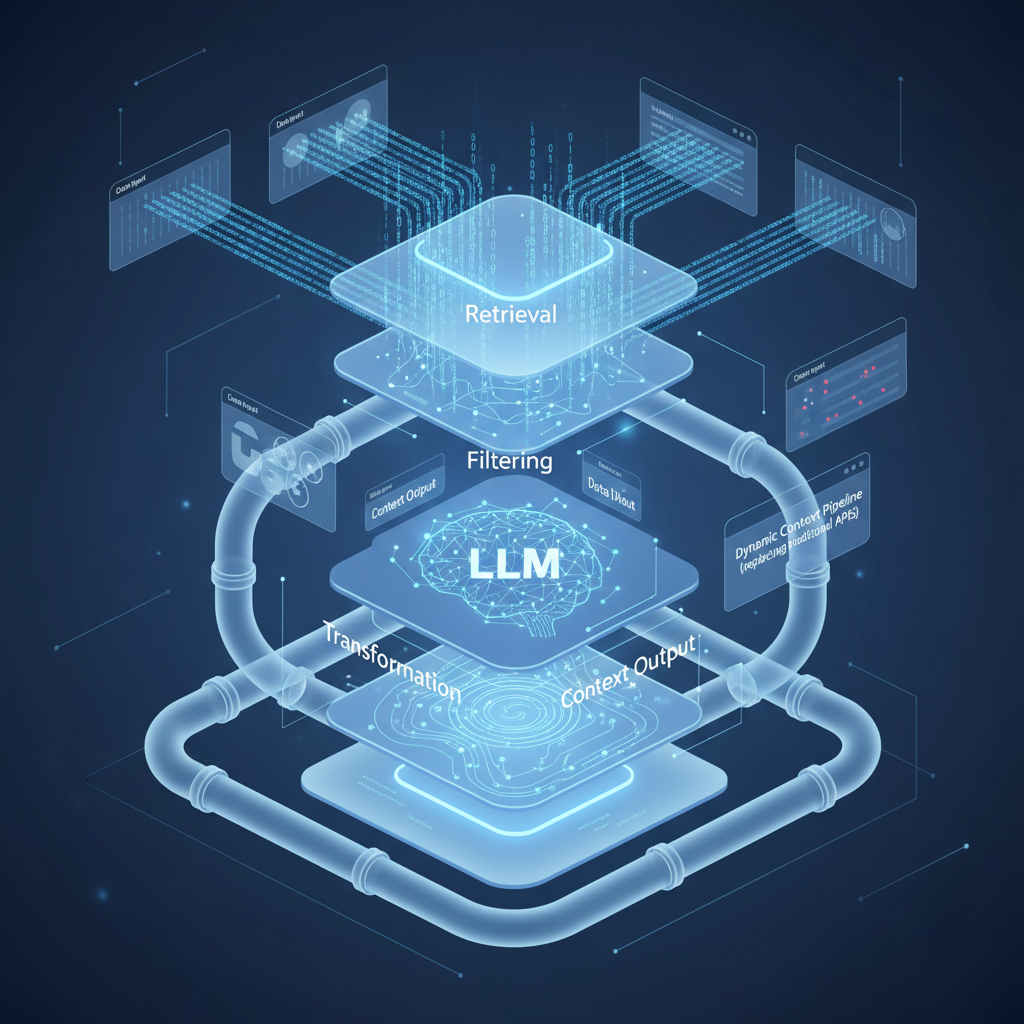
Moreover, misconceptions about context pipelines focus solely on data ingestion. Effective context pipelines span several key architectural layers:
- Source Layer: Integration with diverse data sources (databases, knowledge bases, event streams, user inputs) feeding the pipeline.
- Governance Layer: Policies and mechanisms to validate, filter, and sanitize context, ensuring freshness and relevance.
- Structure Layer: Semantic transformations that organize disparate context pieces into hierarchies, embeddings, or summaries optimized for the LLM interface.
- Delivery Layer: Mechanisms to package, cache, or stream contextual payloads dynamically into the model input format.
- Maintenance Layer: Continuous monitoring, versioning, and adaptive tuning of pipeline components to prevent drift or obsolescence.
A canonical failure mode is seen in enterprise knowledge management platforms exposing APIs that return static document lists with limited metadata. When these are directly fed into an LLM, critical contextual nuances—such as document recency, user preferences, or relevance rankings—are lost or underutilized. This diminishes the quality of systems AI outputs, with the LLM missing key context signals or becoming brittle to domain changes.
Open-source LLM applications also suffer fixed endpoint limitations. Simplistic retrieval APIs cannot support evolving use cases like multi-turn conversational context, augmented reality inputs, or multi-modal data fusion without major re-engineering, compelling architects to reinvent pipelines at scale.
Thus, designing effective context pipelines for LLM requires fundamentally rethinking API design away from fixed, schema-bound contracts toward layered, adaptive information flows that maintain semantic richness and operational flexibility.
Engineering Impacts: Latency, Maintainability, and Relevance
From an engineering perspective, implementing context pipelines that satisfy real-time relevance and operational efficiency entails difficult trade-offs across latency, maintainability, and contextual relevance.
Latency constraints are paramount: LLM inference is computationally expensive, and adding layers of context processing can introduce bottlenecks threatening user experience, especially in interactive or production-critical environments. Sacrificing freshness for speed—such as through caching stale context or simplifying multi-source merges—risks polluting inputs with irrelevant or obsolete data, degrading model outputs over time.
This trade-off drives the need for sophisticated ML pipeline orchestration tools and patterns that balance context pipeline freshness with throughput. Techniques include asynchronous indexing of external data sources, incremental context updates, and prioritized fetching of high-impact context subsets before inference calls. Dynamic filtering stages employ heuristics or learned models to discard noisy or redundant fragments, improving signal-to-noise ratio without excessive latency. For deeper insights, see best practices in machine learning pipeline orchestration.
Maintainability suffers due to multi-source integration complexity and evolving input formats. Engineering teams must design modular, reusable components with clear separation between ingestion, governance, and transformation layers. Versioning context schemas and transformation logic is essential, enabling rollbacks and controlled evolution without disrupting dependent pipelines.
Comprehensive monitoring frameworks provide observability into pipeline health, detecting data distribution drift, alerting on out-of-bound context volumes, and flagging anomalies in inferred outputs traceable to input changes. Such governance mechanisms are hallmarks of mature AI engineering practices that ensure context pipelines operate as reliable, long-lived operational systems instead of ad hoc scripting layers.
Real-world examples illustrate naive pipeline design impacts. For instance, a retail AI assistant tied to a slow, batch-updated price feed and static catalog context pipeline suffered repeated inference errors due to outdated pricing data injected into prompts. Lack of observability into context freshness hampered debugging, prolonging incident resolution and degrading customer experience. Introducing incremental context refresh triggers, adaptive filtering based on popularity signals, and an audit trail correlating context versions to inference results yielded a 30% error rate reduction and substantial improvements in response relevancy.
In sum, effective context pipelines for LLM must be engineered holistically, blending latency-sensitive orchestration, modular maintainability, and real-time relevance governance. Approaching context as a layered, adaptive system rather than a static payload enables software engineers and AI architects to unlock the full potential of LLM applications beyond traditional API limits.
Having outlined how traditional API paradigms fail and revealed operational constraints in latency, maintainability, and relevance, we next explore designing adaptive context pipelines that reconcile these challenges for robust, scalable LLM inference.
Core Components and Architecture of Context Pipelines for LLM
Source Layer: Aggregating Diverse Contextual Inputs
The source layer forms the foundation of context pipelines, tasked with ingesting and consolidating heterogeneous data streams essential for constructing coherent, relevant input context for downstream inference. Unlike traditional ingestion scenarios, this layer must accommodate varied data modalities—structured relational databases, semi-structured logs, unstructured documents, external APIs, and high-velocity real-time event streams—that collectively shape the model’s contextual understanding.
Data heterogeneity introduces substantial engineering complexity. Structured sources may provide clean, schema-bound signals, but their interpretations require alignment with unstructured text or noisy streaming telemetry. Without harmonization, context inputs risk incompleteness or semantic fragmentation, severely degrading output fidelity.
Key challenges include context synchronization and freshness. Staleness is a frequent cause of hallucinations or outdated LLM responses, especially in dynamic environments such as customer support or financial trading. To mitigate this, modern pipelines leverage incremental ingestion powered by change-data-capture (CDC) mechanisms, enabling fine-grained updates without full dataset reprocessing. Event-driven architectures trigger reactive updates based on domain data mutability and update frequency.
AI-assisted labeling tools enhance semantic input quality, automatically annotating data to improve downstream filtration and relevance scoring. This is especially valuable for unstructured sources like text logs, where domain entities or intents must be extracted and linked to ontologies or knowledge graphs.
Open-source LLMs typically operate under stricter data input constraints compared to proprietary models, which may benefit from curated knowledge graphs or specialized indexes. The relative paucity of dedicated training data for open models necessitates a robust source layer design that exploits all signals while minimizing noise. This mandates preprocessing beyond raw retrieval to normalize, unify, and semantically align heterogeneous inputs.
Preprocessing methods include:
- Retrieval: Leveraging vector similarity search, keyword querying, or database lookups to source candidate context fragments.
- Filtering: Removing irrelevant or redundant data via heuristic or learned classifiers tuned to domain-specific importance.
- Initial Transformation: Normalizing diverse data types (e.g., converting CSV rows into JSON snippets or embedding textual metadata) to establish uniform payloads for downstream governance.
By enabling dynamic, multi-format ingestion and normalization, the source layer sets the stage for contextual precision critical to reliable LLM outputs. For best practices, see the Apache Kafka documentation on CDC.
Govern Layer: Ensuring Data Quality and Compliance
Once raw data enters the pipeline, the govern layer implements stringent quality assurance, privacy enforcement, and regulatory compliance protocols to safeguard contextual input integrity and appropriateness. This layer discerns relevant, trustworthy context from noisy or unauthorized data, underpinning output accuracy and ethical reliability.
Governance begins with data validation, performing schema integrity checks, range validations, and content veracity assessments to filter malformed or corrupted inputs. Advanced implementations incorporate contextual relevance scoring, leveraging domain-specific knowledge graphs or AI classifiers to quantify semantic alignment between candidate fragments and inference intents. This scoring enables dynamic prioritization and deduplication, preventing overload with repetitive or extraneous information that may trigger hallucinations.
Privacy and regulatory compliance are non-negotiable pillars. Subject to frameworks like GDPR, HIPAA, or enterprise Responsible AI principles, pipelines enforce strict access controls, encryption at rest and in transit, and data minimization. For example, differential privacy mechanisms or selective redaction excise or anonymize personally identifiable information (PII) before model consumption. Automated audit trails document transformations for compliance verification.
Governance introduces subtle trade-offs. Excessively strict policies risk removing valuable context, compromising output quality or increasing hallucination reliance. Lenient governance allows biased or erroneous fragments, propagating ethical risks and eroding user trust. Best practices iterate policies based on metrics like precision-recall of relevance filters and fairness audits to balance application risk appetites.
Common pitfalls include governance silos disconnected from source realities, causing excessive false positives or compliance rules that lag schema changes. Establishing feedback loops between source and govern layers enables adaptive policies that sustain both context quality and compliance.
Governance effectiveness reduces hallucination and bias amplification, foundational challenges in AI systems built on open source LLMs. With governance, pipelines proceed into the structure layer equipped with context provenance validated for reliability, legality, and ethics.
Structure Layer: Transforming and Optimizing Context for LLM Input
Following governance, the structure layer reconceptualizes validated inputs into formats optimized for specific LLM architectures and inference constraints. Engineering this transformation balances competing priorities: maximizing semantic richness and diversity while respecting token limits, prompt formats, and compute budgets.
Central are techniques such as hierarchical summarization, which distills multi-granular context—from sentence-level detail to document abstracts—into layered representations. This enables the model to attend to broad situational overviews or granular facts, enhancing interpretability. Neural summarizers reduce noise by filtering irrelevant detail while preserving critical signals.
The use of vector embeddings provides additional context compression and semantic augmentation. By embedding segments into dense, continuous vector spaces, applications perform similarity clustering or prioritize segments via learned ranking, including only top-K salient vectors in prompts. Inspired by open source LLM advances (e.g., FAISS, Pinecone), this reduces input dimensionality while maintaining relevance.
Prompt templating frameworks enforce schema conformity, constraining context insertion by predefined roles (system instructions, user context, auxiliary knowledge). Explicit tagging and delimiters preserve compositional clarity, respecting tokenization and attention window constraints.
Compression strategies blend semantic pruning and syntactic rewriting—e.g., rephrasing verbose passages into compact equivalents or utilizing domain-specific shorthand. Priority ranking algorithms, typically learned rankers or heuristics, ensure retention of essential data within tight token budgets, crucial for large open source models with more rigid context windows than proprietary solutions.
Handling long-context inputs benefits from emerging test-time training that fine-tunes embeddings or summaries at inference, enabling the model to “memorize” salient context within computation graphs. This reduces truncation-induced relevance degradation and aligns outputs with desired behaviors.
Structure layer transformations profoundly influence inference quality by converting disparate fragments into cohesive, model-native prompts that guide semantic focus and reduce hallucination risk. Designing these pipelines requires integration of domain expertise, neural architecture understanding, and token-efficient engineering—not mere text concatenation.
A smooth transition from structure to delivery ensures contextual signals remain intact and immediately accessible for scalable model invocation.
Deliver Layer: Efficiently Injecting Context into LLM Inference
The deliver layer operationalizes structured context, injecting it into the LLM inference pipeline with system-level optimization to minimize latency and maximize throughput—critical for production-grade, interactive AI services.
A common pattern is batching context inputs. Grouping multiple requests sharing context fragments amortizes compute across overlapping embeddings or prompt preparations, reducing redundant transformations and improving GPU/TPU utilization during inference. However, batching must preserve individual freshness and precision to avoid stale or imprecise outputs.
To address latency, intelligent caching stores frequently accessed fragments as raw embeddings or pre-structured prompts. Approximate nearest neighbor (ANN) retrieval enables rapid reassembly of relevant context for recurrent queries, cutting recomputation overhead. Caches exploit temporal locality in interactive applications like chatbots or knowledge assistants.
Streaming mechanisms add architectural sophistication, permitting incremental injection of context segments mid-inference aligned with event-driven source updates. This allows delivering updated knowledge without restarting inference, enhancing responsiveness.
At a higher level, ML pipeline orchestration frameworks (e.g., Kubeflow, MLflow, Airflow) coordinate dependencies and resource allocation, balancing inference demands against context delivery. They schedule data pulls, transformations, governance checks, and inference invocations in a fault-tolerant manner, enforcing SLAs for throughput and latency. Orchestration tightly integrates with delivery to synchronize stateful pipeline components efficiently.
Scaling delivery across multiple context scenarios—where diverse knowledge bases or user profiles coexist—introduces complexity around resource contention, caching policies, and failure handling. Service mesh architectures, circuit breakers, and graceful degradation strategies ensure availability even if some context sources or governance services degrade.
For example, a large-scale customer support system integrating real-time event stream ingestion with intelligent prompt batching and caching reduced average inference latency by 35% while maintaining 99.9% SLA uptime. It used Airflow for orchestration and FAISS for vector similarity caching, balancing retriever and transformer workloads.
Thus, the deliver layer is the critical runtime interface ensuring context reaches LLM inference optimally, harmonizing backend architectures with application responsiveness.
Maintain Layer: Operational Readiness and Pipeline Monitoring
The maintain layer underpins the entire pipeline by embedding observability, continuous validation, and operational readiness practices that ensure sustained efficacy and compliance in production.
Robust instrumentation provides metrics, tracing, and alerting tailored to context pipelines’ complexity. Metrics track ingestion latency, data freshness, filter rejection rates, token budget usage, and governance rule hits. Distributed tracing links these across layers—from source ingestion to inference injection—revealing bottlenecks and cascading failures.
Alerts trigger on violations such as data drift, governance non-compliance (e.g., unauthorized PII leaks), or degradation of embedding relevance. Automated validation frameworks simulate multimodal inputs, verifying governance policies and structural transformations maintain integrity across code changes. This proactive approach reduces incidents and mitigates garbage-in, garbage-out failure modes.
Informed by professional machine learning engineering frameworks (e.g., TensorFlow Developer certificates), best practices incorporate CI/CD pipelines that include pipeline testing as first-class artifacts. Domain-specific semantic validation further protects production integrity.
Systematic data drift detection monitors distributional changes in contextual inputs, alerting when domains shift (e.g., log format changes or API schema updates). Automated retraining or policy tuning pipelines can then trigger, which is vital for pipelines integrating open source LLM models continuously evolving to new input distributions.
These operational controls safeguard data quality, compliance, and reliability, mitigating hallucination or bias amplification risks over time. Continuous feedback loops between maintain and upstream layers enable adaptive pipeline evolution.
In high-stakes domains, pipeline monitoring has prevented costly compliance breaches. For example, early detection of schema drift in patient record ingestion averted potential HIPAA violations and erroneous model outputs, preserving compliance and trust.
Ultimately, maintainability equips context pipelines to evolve alongside data landscapes and regulations, ensuring AI systems employing LLM inference remain robust, compliant, and performant across their lifecycle.
Trade-offs and Failure Modes in Context Pipeline Design
Balancing Freshness, Latency, and Context Size Constraints
Designing robust context pipelines for LLM demands negotiating freshness, latency tolerances, and token budget constraints—core to feeding relevant, timely data without degrading inference performance.
Sophisticated pipelines integrate multi-layer retrieval, filtering, and transformation to curate context precisely. Each intermediate step improves relevance but cumulatively adds latency—external API calls, database queries, and normalization routines contribute to tail latency. Network variability compounds this, challenging real-time responsiveness critical in interactive LLM apps like conversational agents or question-answering.
Exceeding an LLM model’s context length limit is a persistent failure mode. Token limits are rigid and truncate excess input. Naively concatenating inputs from multiple sources risks losing critical segments at sequence start or end, degrading output quality severely—manifesting as hallucinations, factual errors, or irrelevant generations. For example, long-context summarization loses background factoids; multi-document Q&A pipelines lose context overlaps. See the OpenAI token limits documentation for practical implications.
Traditional LLM APIs optimize for discrete transactional inputs, not continuous or variable-length context streams. Static payloads cannot meet flexible, dynamic context assembly needs, necessitating orchestration frameworks that chunk, reorder, and weight inputs pre-inference. Techniques like end-to-end test-time training for long context adaptively fine-tune models on varying context windows during inference, pushing boundaries without unacceptable latency.
Mitigation strategies include prioritizing fresh but filtered data, hierarchical retrieval, and embedding or summary-based compression. But these increase pipeline complexity, influencing maintainability and stability discussed next.
Complexity and Maintainability Challenges with Multi-Layer Pipelines
Enterprise systems AI pipelines rarely follow simple linear paths; they orchestrate retrieval, enrichment, filtering, governance, and delivery stages—each with distinct operational and maintenance demands. Coherent interplay among layers at scale introduces formidable complexity.
Debugging is a key challenge. Upstream errors—stale indices, transient API failures, malformed normalization—can subtly corrupt downstream inputs, degrading model outputs. Failures become difficult to pinpoint due to opaque error propagation. Observability tools with fine-grained tracing and metrics illuminate pipeline health but introduce operational overhead requiring dedicated teams to maintain telemetry and logs alongside core model infrastructure. The CNCF Observability Landscape catalogs tools and best practices.
Enforcing governance policies (security, privacy, data lineage) while maintaining agility surfaces trade-offs. Embedding compliance checks into context assembly prevents unsafe inputs but adds validation latency and bottlenecks. Engineers experienced via machine learning & AI professional certificates understand that embedding such controls demands domain expertise and tooling—data provenance, differential privacy, bias mitigators.
Evolving data schemas and source reliability shifts compound maintenance burdens. Changes in upstream document formats or metadata require pipeline updates to avoid parsing errors or index breaks. Modular design with interface contracts improves component isolation, facilitating targeted upgrades, yet cannot eliminate complexity or integration risks as pipelines grow.
A real-world example: a global bank deploying multi-source LLM pipelines observed a 30% bug resolution time drop after adopting modular orchestration and automated schema validation, demonstrating gains offsetting increased system complexity and training costs.
Beyond complexity, pipelines must gracefully handle ambiguous or conflicting context inputs to preserve reliability.
Edge Cases: Handling Ambiguous or Conflicting Context Inputs
Ambiguity and conflict among context inputs represent critical edge cases. Aggregated context originates from diverse sources—databases, documents, user interactions—with varying reliability and freshness. Pipelines must reconcile contradictory facts, outdated information, or fragmentary signals.
Resolution strategies rely on provenance tracking, confidence-weighted fusion, and contextual hierarchies. Frameworks like Synaptic AI tag context fragments with source metadata and confidence scores, enabling downstream components to prioritize or exclude conflicting inputs. The Smart Pigs pipeline exemplifies layered fusion combining rule-based filters and learned rankers to arbitrate among divergent streams.
A common misconception holds that more context uniformly improves LLM performance. Empirical evidence counters this: indiscriminate inclusion of contradictory or ambiguous context degrades output consistency and reliability. For instance, question-answering systems exposed to conflicting policies without filtering may generate incorrect or non-compliant recommendations, risking operational and reputational damage.
Sophisticated filtering and governance guard against these risks, including stale context detection, weighted fusion heuristics refined by feedback, and human-in-the-loop review in high-stakes domains.
Ambiguity especially impacts compliance-sensitive tasks. Contradictory context biasing compliance checks can cause unsafe approvals and regulatory violations. Consequently, ongoing research in engineering AI pursues ambiguity detection and mitigation patterns such as uncertainty quantification layers and dynamic pruning informed by downstream monitoring.
Navigating these trade-offs, complexity layers, and edge scenarios is essential to building robust, scalable context pipelines for LLM that replace traditional fixed-input APIs. Effective design balances freshness and latency, controls context size, orchestrates maintainable governance layers, and addresses ambiguity through principled fusion—forming the backbone of next-generation LLM applications at scale.
Real-World Applications and Best Practices for Context Pipelines
Enterprise Use Cases: Multi-Source Integration and Compliance
In enterprise-grade LLM applications, context pipelines are pivotal for integrating and harmonizing data from heterogeneous sources. Enterprises manage large, distributed data ecosystems encompassing internal relational databases, legacy SOAP or REST APIs, external knowledge graphs, and regulatory datasets. Architecturally, such pipelines often comprise layered ingestion, transformation, and governance stages before LLM inference.
At the foundation, dynamic retrieval mechanisms selectively query repositories to source relevant fragments. Domain-specific filtering and transformations reconcile differing formats—from structured SQL tables to semi-structured JSON and unstructured documents—into unified context embeddings or tokenized prompts. Approaches like vector similarity search coupled with metadata-driven filters maintain precision without exceeding model input size limits.
Governance layers enforce enterprise compliance mandates including GDPR, HIPAA, or industry-specific security regimes. Data masking anonymizes personal identifiers dynamically, while access audits log retrieval and usage for traceability. Retention policies programmatically expire or archive data per legal requirements. Metadata tagging and provenance tracking create immutable audit trails supporting transparency and rollback during faults or corruption. For governance guidance, see the OWASP Data Security Project.
Balancing retrieval latency, data freshness, and operational reliability remains challenging. Legacy enterprise systems can introduce delays and staleness risks. Hybrid architectures mitigate this via asynchronous retrieval, TTL caching, and fallback data sources ensuring continuity. Monitoring frameworks detect anomalous quality patterns—e.g., bias from stale context—triggering failover or corrective actions to preserve inference stability across verticals like finance or healthcare.
These pipelines go beyond data transport. Leveraging systems AI principles, they actively shape statistical and semantic context quality, enhancing downstream LLM accuracy and reducing hallucinations. Architecturally, these pipelines instantiate hybrid retrieval-generation paradigms, blending symbolic reasoning with neural comprehension to meet stringent operational and regulatory demands in mission-critical environments.
Open-Source and Community Pipelines: Flexibility and Extensibility
The open-source LLM landscape favors modular, extensible pipelines prioritizing adaptability and collaborative evolution over rigid enterprise constraints. Drawing on diverse datasets—from academic corpora to community-curated graphs—these pipelines employ plug-and-play architectures integrating multiple data connectors, custom parsers, and retrieval algorithms.
Supporting varied open source models, pipeline components are often discrete, interchangeable modules. This enables rapid swapping or extension—e.g., integrating new JSON APIs or novel document chunking—without full pipeline rewrites. Modularity facilitates experimenting with emerging retrieval methods, including hybrid dense-sparse vector searches or embedding augmentation using auxiliary transformers.
Community pipelines manage data heterogeneity and noise due to irregular data quality and provenance. Built-in filtering and transformation normalize text encodings, correct formatting inconsistencies, suppress duplicates, and apply lightweight semantic clustering pre-generation. This upstream cleaning is vital for feeding coherent, relevant context to inference stages. See the Microsoft Azure AI documentation on data preprocessing for broad guidance.
An illustrative example is the Synaptic AI pipeline framework, embodying best practices in collaborative version-controlled configuration and shared tooling. By leveraging standardized schemas and interoperable component APIs, practitioners refine robustness and maintainability collectively, accelerating adoption across ecosystems.
Tension arises between pipeline complexity and maintainability. Lightweight pipelines support rapid prototyping but may lack fault tolerance or scalability. Comprehensive setups add operational overhead and learning curves. Extensibility layers—plugin registries, declarative pipelines—enable incremental enhancement, allowing pipelines to mature with growing model capabilities and diversity.
Best Practices for Maintaining Robust and Scalable Pipelines
Robustness and scalability demand disciplined engineering and operational strategies. Pipelines ingesting real-time or multi-context data streams require consistent low-latency inference and high fidelity.
Continuous monitoring anchors pipeline health management. Instrumentation across stages collects telemetry on throughput, latency, error rates, and context quality metrics like embedding coherence or semantic drift. Dashboards and alerts detect anomalies early, facilitating prompt troubleshooting before output degradation.
Automated validation frameworks enforce data integrity and adherence to syntactic and semantic constraints (e.g., domain-specific ontologies) before inference. These guardrails prevent catastrophic failure modes and maintain application trust.
Modular orchestration via ML frameworks (Kubeflow, Airflow, ZenML) enables decoupled development, testing, and deployment of pipeline components. This maintainable architecture facilitates upgrades or A/B testing of retrieval, filtering, or embedding generators without service downtime, preserving continuous availability. For orchestration best practices, consult the Kubeflow official documentation.
Design patterns emphasize component isolation and version-controlled deployments. Feature toggling supports incremental rollouts, reducing operational risk while enabling rapid iteration. Engineering teams are encouraged to pursue professional machine learning and AI certificates, codifying pipeline reproducibility, auditability, and compliance—aligning technical and organizational governance.
Real-time and multi-context use cases pose additional challenges: synchronizing disparate input streams, avoiding processing bottlenecks from contention, and managing memory footprints inherent to large embeddings. Practical mitigations include bounded queues, prioritized scheduling, and adaptive batching refined via quantitative profiling during routine operation.
Ultimately, context pipelines are not passive ETL, but critical engineering constructs influencing prompt precision, inference stability, and trustworthiness of LLM applications at scale. Rigorous engineering and operational discipline ensures pipelines scale gracefully with evolving production demands.
By understanding nuanced enterprise, open-source, and operational needs, software engineers and AI practitioners can architect context pipelines for LLM that are technically sound, resilient, compliant, and extensible to enable advanced LLM applications.
Key Takeaways
Context pipelines supplant traditional API-centric designs by structuring and processing diverse data inputs to optimize large language model (LLM) inference. For engineers building LLM applications, mastering the architecture of these pipelines—from ingestion through filtering, transformation, and delivery—is essential to ensuring data relevance, latency control, and maintainability. The shift toward context as a programmable interface demands rigorous design around data governance, dynamic context management, and multi-source integration to meet real-time, scalable AI engineering needs.
- Define context pipelines as multi-layer architectures: Comprising source ingestion, governance, structuring, delivery, and maintenance layers that collectively prepare and manage LLM inputs to maximize model utility and relevance.
- Balance retrieval accuracy with context length constraints: Engineering retrieval methods to ensure high relevance within fixed prompt sizes via intelligent filtering and ranking, avoiding information overload and preserving inference quality.
- Implement normalization and transformation for consistency: Complex transformations—tokenization, embedding, format standardization—align heterogeneous sources with LLM expectations and pipeline components.
- Embed governance for data quality and compliance: Pipelines enforce validation, access control, and lineage tracking to prevent stale, sensitive, or corrupt inputs, critical in enterprise and regulated settings.
- Optimize for real-time and multi-context trade-offs: Low-latency inference with concurrent contexts requires careful orchestration of caching, update propagation, and asynchronous data flows to maintain freshness without excessive compute.
- Anticipate operational complexity in maintenance and evolution: Modular, observable pipelines facilitate incremental improvements, error diagnosis, and adaptation to evolving schemas or models.
- Leverage open source frameworks and tooling: Integration with ML orchestration platforms and AI data labeling reduces engineering burden and increases reproducibility.
- Recognize context pipelines as dynamic interfaces replacing rigid APIs: Serving as programmable, adaptive input translators embedding domain knowledge to flexibly tailor prompts and minimize backend coupling.
This article continues by exploring architectural patterns, engineering strategies for retrieval and transformation, and practical deployment considerations guiding readers to build robust, scalable context pipelines essential for next-generation LLM applications.
Conclusion
Context pipelines for LLM applications fundamentally redefine traditional API design by shifting from static, schema-bound inputs to dynamic, multi-layered architectures managing heterogeneous data sources with semantic rigor. Engineering these pipelines requires balancing freshness, latency, and token constraints while embedding governance and operational monitoring to ensure data quality, compliance, and robustness. Modular ingestion, intelligent filtering, targeted transformation, and optimized delivery collectively enable scalable, maintainable, and reliable LLM inference in enterprise and open source environments alike.
As LLM use cases increase in complexity and stakes, evolving context pipelines must not only meet technical constraints but also mitigate ambiguity and uphold ethical standards. The architectural challenge lies in making pipeline behavior transparent, testable, and resilient under operational pressures. How organizations design, instrument, and maintain these pipelines will decisively shape the next generation of intelligent, contextually aware, and trustworthy AI systems—transforming the very fabric of LLM-powered software infrastructure.